Wonders & Monuments · Great monuments
St Peter’s Basilica
The great Renaissance and Baroque church over the tomb of the Apostle, with Bernini’s piazza before it.
Still standing. The basilica and the piazza still stand and are in use. They replaced the ancient Constantinian church of St Peter. The present work is Renaissance and Baroque, the work of many architects, including Bramante, Michelangelo, Maderno and Bernini.
Michelangelo, in Great Art · Bernini, in Great Art · The Sistine Chapel · St Peter's Basilica, in Great Churches & Monasteries
What it is
St Peter’s Basilica stands over the traditional tomb of the Apostle Peter, on the Vatican hill. Constantine raised the first great church here in the fourth century. That church was taken down in the sixteenth century and replaced by the present basilica, begun in 1506. Many architects worked on it. Michelangelo designed the great dome; Carlo Maderno lengthened the nave and built the façade; Gian Lorenzo Bernini shaped the oval piazza with its colonnades in the seventeenth century. The result is a church and a forecourt on a scale meant to gather Christendom.
The pictures on this page are historic photographs of the façade, the dome and the piazza. They show the completed work, not the Constantinian church. For Michelangelo’s sculpture and painting, and for Bernini’s, this library has Great Art pages. Vasari’s Lives, as hosted here, is an early volume and does not give a full account of this later basilica, so it is not quoted on this page.
Why it matters
This is costly work offered to the glory of God, and to the honour of an apostle, at the centre of the Roman Church. The virtue to notice is magnificence joined to perseverance: a century and more of building, and a dome that still governs the skyline. Beauty here is the curve of the colonnades and the rise of the cupola.
Look closely
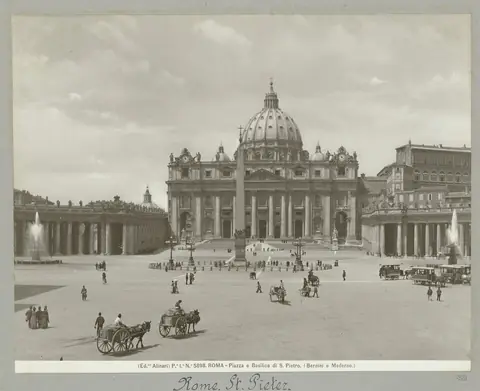
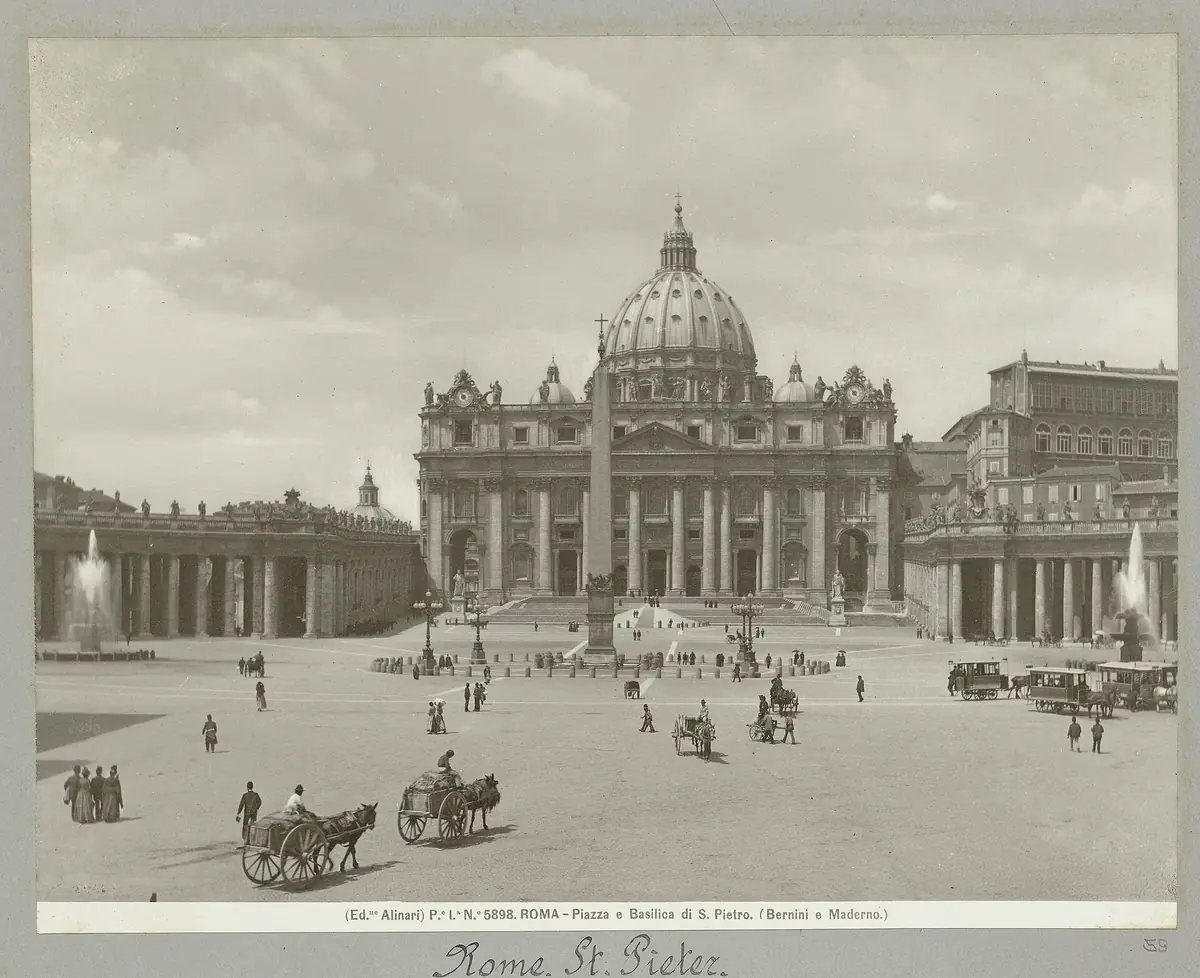
Image: Wikimedia Commons · CC0 (public domain) St Peter’s Square and the basilica
Look closely. A historic photograph of the piazza, with Bernini’s colonnades opening toward the façade and the dome rising behind. Carriages and figures give the square a human scale. This is the completed design as a single scene: court, front and cupola.
In the library: Bernini, in Great Art · Michelangelo, in Great Art
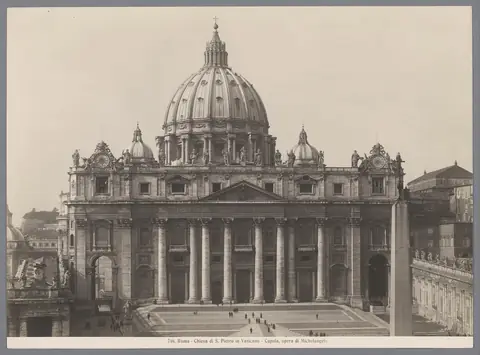
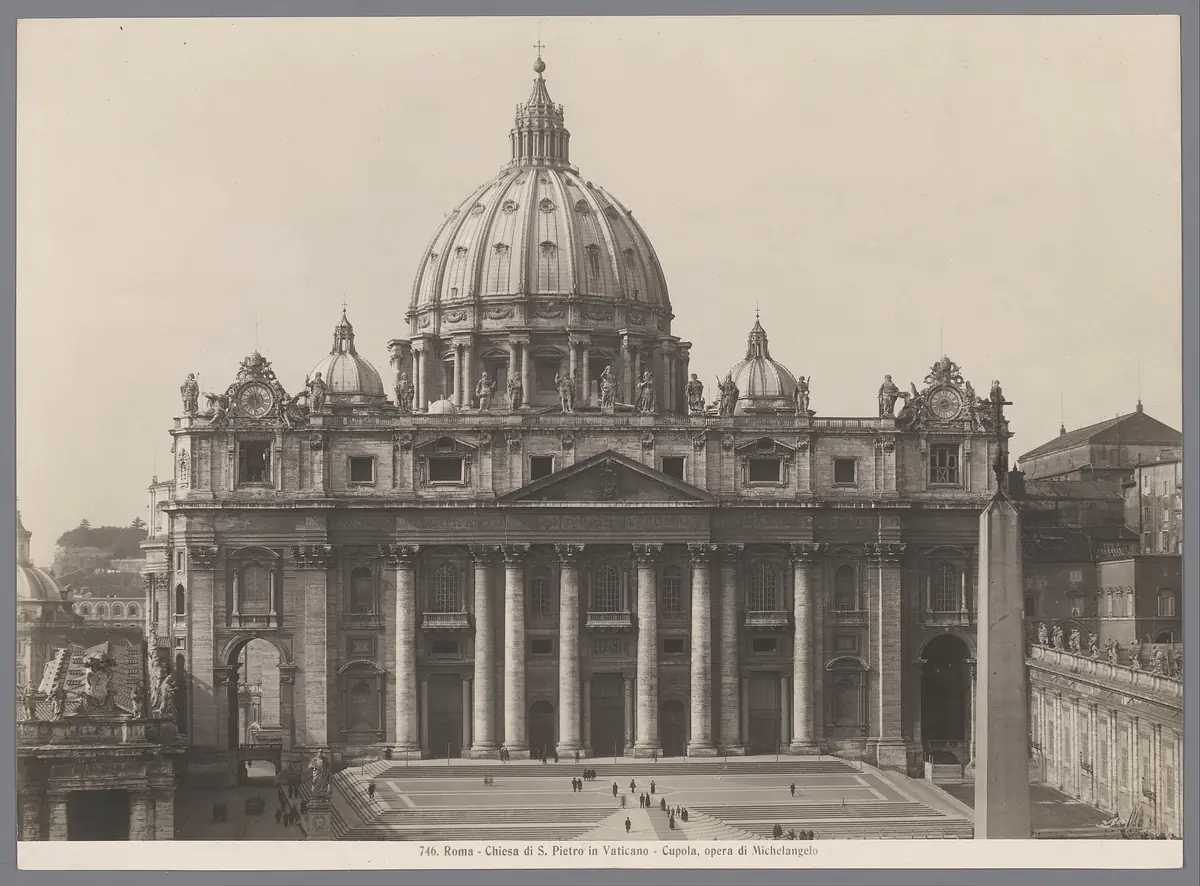
Image: Wikimedia Commons · CC0 (public domain) The façade from the square
Look closely. A closer view of Maderno’s façade from the piazza, with the dome above. Notice the width of the front, the attic statues, and how much of the cupola is hidden or revealed depending on where the photographer stood.
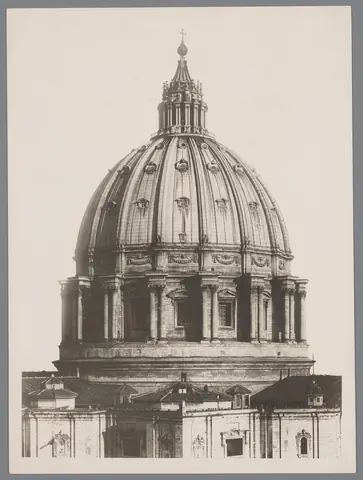
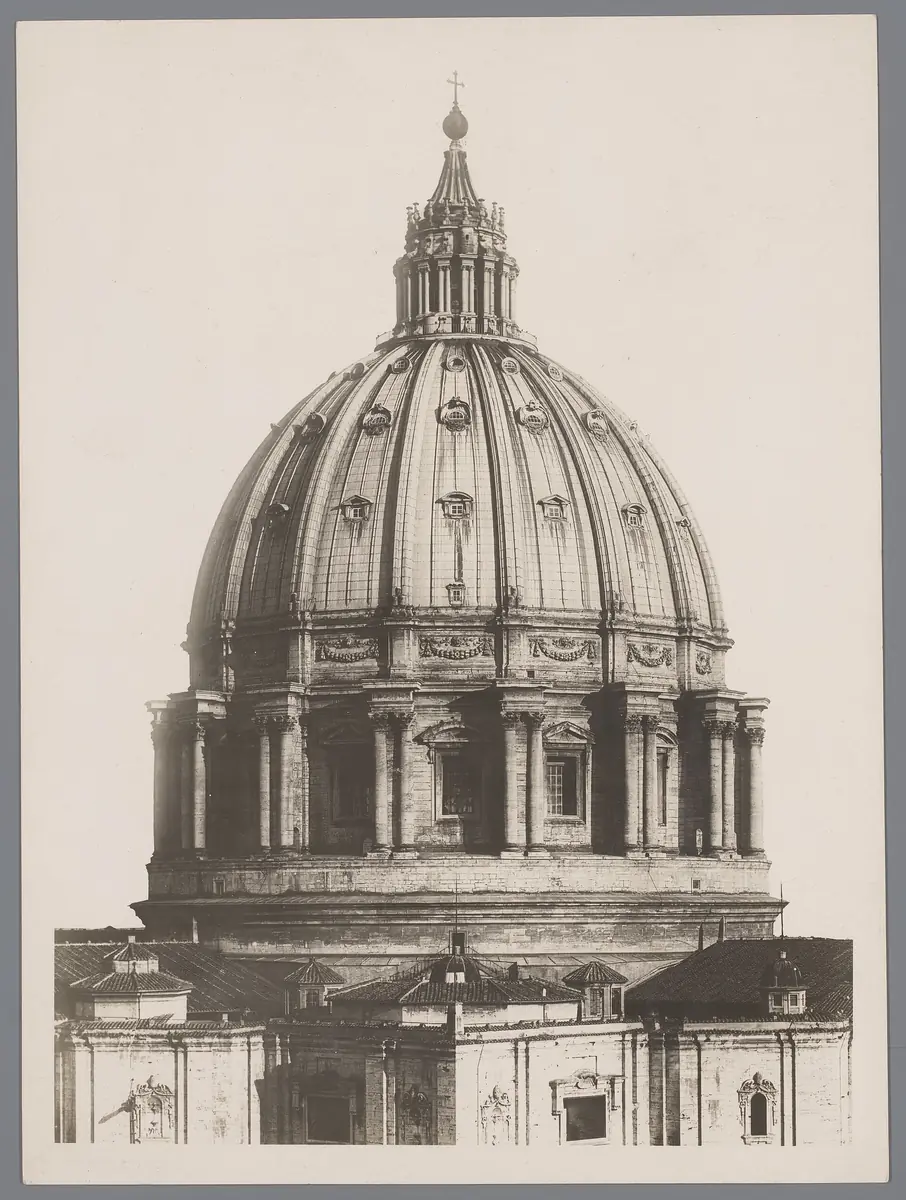
Image: Wikimedia Commons · CC0 (public domain) Michelangelo’s dome
Look closely. A photograph that isolates the dome, so that the drum, the ribs, the lantern and the curve of the cupola can be read without the full width of the façade. This is the part of the church most closely tied to Michelangelo’s design.
In the library: Michelangelo, in Great Art


What to watch for
Look slowly- Façade and dome. Maderno’s façade partly hides Michelangelo’s dome from the piazza. Views that isolate the cupola are useful for that reason.
- Bernini’s colonnades. The piazza is an oval of columns, like arms opened toward the city. Look for that plan, not only for the façade.
- A new church on an old site. The present basilica replaced Constantine’s. These photographs are of the later building.
- Many hands. Bramante, Michelangelo, Maderno and Bernini are only the most famous names. The work took generations.
Sources
Dates follow standard historical references and, where we quote a book, the wording of the edition hosted in this library. Photographs are used only when the photograph itself is Public domain, CC0, or CC BY with a named credit. Lost wonders are shown in later engravings and reconstructions, which are imaginings, not photographs of the original work. Each picture links to its source page with full licence details.