Work record
A Tramp Abroad
Mark TwainA Tramp Abroad by Mark Twain (1880)A Tramp Abroad is Mark Twain's comic account of his travels in Germany, Switzerland, and northern Italy in 1878, published in 1880.1880 · 19th Century · Travel · English
Abstract
Background. After a long stay in Heidelberg, Clemens toured the Black Forest and the Swiss Alps with his Hartford pastor friend, then turned the trip into a subscription book padded with yarns, legends, and borrowed mountaineering narratives.
Content. A self-important American vows to cross the Continent by foot and almost never does. He watches fraternity sword fights, sits through Wagner, drifts on a log raft while spinning river legends, overpays at spas, and mounts a ludicrous caravan to a hotel above Zermatt. Interpolated tales include a miner's story of jays stuffing acorns into a cabin. Between the farce come real disasters on the Matterhorn and Mont Blanc, and a grave meditation on the carved lion at Lucerne.
Form. Loose episodic chapters, frequent digressions, inserted anecdotes, mock scholarship, and a closing set of essays, including the satire on German grammar.
Themes. The vanity of the tourist and the guidebook, the honest eye versus borrowed taste, the comedy of language, and, at the serious center, loyalty unto death and faith facing a cold end.
Significance. It fixed the image of the innocent American abroad for a later generation, supplied several of Twain's most anthologized pieces, and offers students a vivid literary account of the monument to the Swiss Guards.
Key figures
- Mark Twain: Narrator posing as a bold pedestrian and art student
- Harris: Companion and so-called agent, based on the Hartford pastor Joseph Twichell
- Jim Baker: Western miner whose blue-jay yarn is told in Chapters 2-3
- Edward Whymper: English mountaineer whose Matterhorn narrative is reprinted
- Louis XVI: French king blamed for the massacre of his Swiss Guards in 1792
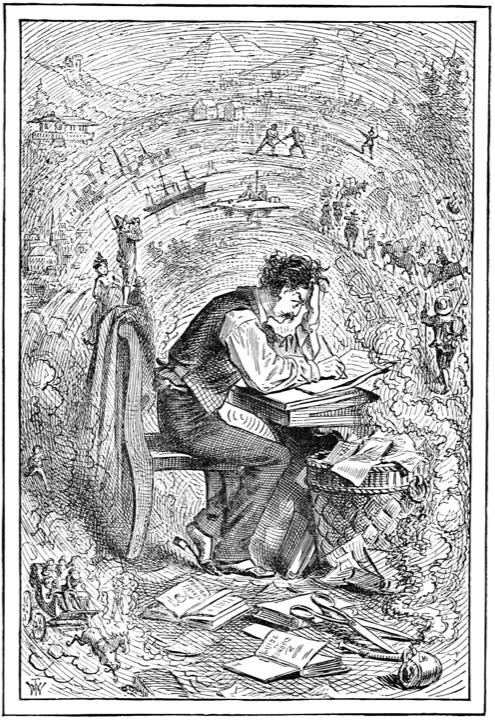

Summary
A Tramp Abroad is Mark Twain's comic account of his travels in Germany, Switzerland, and northern Italy in 1878, published in 1880. The narrator announces that he will astonish mankind by crossing Europe on foot, hires an agent named Harris, and sets out to study art and the German language; in practice the pair ride trains, carriages, rafts, mules, and once a glacier, and the joke of the walking tour that never walks runs through the whole book. The first half is set in south-western Germany. At Heidelberg Twain describes the student corps and their dueling ground, where young men slash each other's faces with swords while a surgeon stands by, and he follows it with a mock account of a bloodless French duel in which he seconds Gambetta. He records Wagner opera, his own disastrous painting of Heidelberg Castle, a night spent crawling around a dark hotel room hunting a mouse, and a raft voyage down the Neckar that he decorates with invented Rhine legends, among them the Lorelei and the knight who conquers a dragon with a fire extinguisher. Tall tales interrupt the travel: Jim Baker's yarn of the blue jays who try to fill a house with acorns through a knot-hole, Nicodemus Dodge and the skeleton, and the Tennessean who waits years for an answer at Gadsby's hotel. The second half moves to Switzerland. At Lucerne Twain mocks the souvenir trade and then stops before the Lion of Lucerne, the dying lion cut into a cliff to honor the Swiss Guards killed defending the Tuileries on 10 August 1792. He calls it the most mournful and moving piece of stone in the world, and he condemns Louis XVI for letting those heroes be massacred in his cause. From there the book climbs: sunrise missed on the Rigi, a burlesque expedition of guides, mules, and barkeepers up the Riffelberg, and a plan to ride a glacier down to Zermatt. Between the jokes Twain sets serious Alpine history: Whymper's account of the 1865 Matterhorn disaster, the three guides lost on Mont Blanc in 1820 whose remains the glacier gave up decades later, and the eleven climbers who died near the summit in 1870, one of whom left a notebook farewell to his wife. After Chamonix, Geneva, Milan, Venice, Rome, and Florence, the book ends with Titian's Moses, and six appendices follow, including the famous comic essay The Awful German Language. The American Publishing Company of Hartford issued the book by subscription in 1880, illustrated with more than three hundred drawings.
Virtues in this work
- Friendship: Twain honors the Swiss Guards' loyalty at the Lion of Lucerne: they kept their oath to the king even when he abandoned them.
- Fortitude: The guards died at their post on 10 August 1792, and the Mont Blanc climbers of 1870 faced a slow death in a snow cave with steady courage.
- Faith: The dying climber Mr. Bean writes to his wife that he dies with faith in God and will meet her again in heaven.
- Humility: Twain makes himself the butt of the book's best jokes, from the walking tour that never walks to the barometer he boils.
Plot or Argument
- Chapters 1-7: Frankfurt and Heidelberg
Twain announces his walking tour, hires Harris as his agent, and settles in Heidelberg. He retells a Frankfurt legend, hears Jim Baker's blue-jay yarn, describes student life and the beer-drinking corps, and spends three chapters at the dueling ground, where students fight with swords for scars while a surgeon sews them up.
- Chapters 8-13: Duels, opera, art, and a dark room
A burlesque French duel between Gambetta and Fourtou ends with no one hurt but the second. Twain sits through Wagner, paints a picture of Heidelberg Castle that is mistaken for a Turner, begins the tramp to Heilbronn by train, and spends a night crawling around a hotel room in the dark, covering forty-seven miles without leaving it.
- Chapters 14-19: Rafting down the Neckar
Twain and Harris charter a log raft back to Heidelberg. Twain fills the voyage with legends, some borrowed and some invented: the Cave of the Spectre, the Lorelei, the knight who defeats a dragon with a fire extinguisher, and the deadly jest of Dilsberg. A storm and a mishap end the voyage.
- Chapters 20-24: Baden-Baden and the Black Forest
Twain mocks his own collecting of bric-a-brac, meets a talkative young American, complains of insolent shopkeepers at Baden-Baden, studies the ant in the Black Forest, recalls Nicodemus Dodge and the skeleton, and considers how Germans keep Sunday.
- Chapters 25-30: Lucerne and the Rigi
At Lucerne Twain mocks the chamois and the souvenir trade, then describes the Lion of Lucerne with real feeling and blames Louis XVI for abandoning his Swiss Guards; the same chapter tells of the man who put up at Gadsby's. He climbs the Rigi for the famous sunrise, oversleeps, and mistakes the sunset for it, and sends Harris on a walking trip by proxy.
- Chapters 31-39: The Alps by buggy, mule, and glacier
The travellers reach Interlaken and the Jungfrau, cross the Gemmi to Leuk, and come to Zermatt and the Matterhorn. Twain stages a mock-heroic expedition of guides, porters, mules, and barkeepers to the Riffelberg Hotel, boils his thermometer, and tries to ride a glacier down the valley, only to learn that it moves less than an inch a day.
- Chapters 40-46: Death in the mountains
Twain turns serious with glaciers and Alpine tragedy: the guides lost in 1820 whose remains came out of the glacier decades later, Whymper's account of the 1865 Matterhorn disaster, and the eleven men who died near the summit of Mont Blanc in 1870. At Chamonix he climbs Mont Blanc by telescope and claims a diploma.
- Chapters 47-50 and appendices: Geneva and Italy
Twain describes Geneva's shops and European manners, the cathedral of Milan, the treasures of St. Mark's in Venice, and the galleries of Rome and Florence, ending with Titian's Moses. Six appendices follow, among them The Portier, The College Prison, and The Awful German Language.
Characters
- Mark Twain, narrator
Comic persona of the author: a vain, timid, and self-deceived tourist who claims to tramp Europe on foot and to understand art.
- Harris, companion
Twain's hired 'agent' and travelling companion, modeled on his friend the Rev. Joseph Twichell of Hartford.
- Jim Baker, storyteller
Lonely California miner who claims to understand animal talk and tells the yarn of the blue jays and the knot-hole.
- Nicodemus Dodge, storyteller's subject
Green country boy in a Missouri printing office who is the butt of practical jokes and turns the tables.
- Edward Whymper, climber
English mountaineer whose account of the first ascent of the Matterhorn and the deaths on the descent Twain reprints.
- Mr. Bean, climber
American in the 1870 Mont Blanc party whose notebook farewell to his wife Twain quotes.
Lessons
Loyalty that costs something
In Chapter 26 Twain stops joking before the Lion of Lucerne, the memorial to the Swiss Guards who kept their oath at the Tuileries in 1792 and died for it. He finds no souvenir able to copy its sorrow and calls the guards heroes betrayed by a king who would not let them defend themselves. Loyalty is honored most where it was most costly.
- Why does Twain think the souvenir copies of the Lion fail?
- Whom does Twain blame for the guards' deaths, and is his judgment fair?
- Why do people raise monuments to soldiers who lost?
Faith at the edge of death
Twain sets the comic Alps beside real tragedies: the Matterhorn disaster of 1865 and the eleven climbers who died on Mont Blanc in 1870. One of them wrote to his wife that he died with faith in God and would meet her in heaven. The book lets students see how a dying man's last words can show what he truly trusted.
- What did Mr. Bean provide for before he died, and what does that show about him?
- Why does Twain call this the bitterest death in the history of the Alps?
- How does the hope of heaven change the way Bean faces death?
Laughing at ourselves, and at others
Twain's best jokes are at his own expense: he never walks, misreads every guidebook, and boils his thermometer. But some jokes punch at whole peoples, from German manners and language to Italian shopkeepers, in the stereotypes of 1880. Readers should enjoy the self-mockery and weigh the national caricatures honestly, asking whether a joke humbles the teller or only belittles others.
- Find a joke in which Twain is the fool. What does it teach?
- Find a joke at the expense of a whole nation. Is it fair, and what would a German or Italian reader think?
- What is the difference between humility and contempt in humor?
Seeing versus pretending to see
Twain mocks tourists who repeat guidebook praise of paintings and sunsets they barely look at, and in his last chapter he admits that a great work of art, Titian's Moses, must be seen for oneself. Honest attention is a discipline: it requires looking long and refusing to fake an admiration one does not feel.
- How does Twain miss the sunrise on the Rigi, and what does he see instead?
- Why does he mock guidebooks?
- When have you praised something because you were told to rather than because you saw it?
Context
In the 1870s steamships and railways opened Europe to American tourists, and guidebooks such as Baedeker's told them what to admire. Germany had just been unified (1871) and Heidelberg's student corps kept their dueling customs; the Third Republic in France was still unsettled, with Léon Gambetta a leading republican. Switzerland was becoming the playground of English and American climbers after the golden age of Alpine mountaineering, whose most famous tragedy was the death of four men on the descent from the first ascent of the Matterhorn in July 1865. The Lion of Lucerne, dedicated in 1821, had long been one of the sights every visitor to Lucerne was expected to see.
Composition
Twain sailed for Hamburg on the Holsatia in April 1878 with his wife, daughters, and household, studied German in Heidelberg, and in August and September 1878 walked and rode through the Black Forest and Switzerland with his friend Joseph Twichell, pastor of Asylum Hill Congregational Church in Hartford, who became Harris. The family wintered in Munich and Paris and returned to America in 1879. Twain struggled to finish the book, inserting tall tales, legends, borrowed Alpine narratives, and appendices. The American Publishing Company of Hartford published it by subscription in 1880, with more than three hundred illustrations.
Reception
The book sold well, as Twain's subscription books usually did, and several of its set pieces took on a life of their own: Jim Baker's blue-jay yarn, the Riffelberg expedition, and above all The Awful German Language, which is still reprinted and quoted by language students. Critics have generally ranked it below The Innocents Abroad and Life on the Mississippi as a whole, but its comic persona of the bumbling American tourist shaped later travel humor.
Comparisons
- Life on the Mississippi
Twain wrote both books within a few years; the cub pilot who learns to read the river and the tourist who never learns to read a guidebook are two sides of his comic self-portrait.
- A Tale of Two Cities
Dickens shows the mob and the Terror of the French Revolution; Twain's chapter on the Lion of Lucerne remembers the Swiss Guards massacred at the Tuileries in August 1792.
- The Prisoner of Chillon
Twain visits Bonnivard's dungeon at Chillon in Chapter 42 after reading Byron's poem, and finds it roomier and better lit than he expected.
- Travels in Alaska
Muir watches glaciers with a naturalist's reverence, while Twain describes glaciers and moraines in Chapter 40 and jokes about riding one.
- The French Revolution: A History
Carlyle narrates the attack on the Tuileries of 10 August 1792 at length; Twain's few sentences on the same day judge Louis XVI for abandoning his guards.
Quotes
Frequently cited
“the most mournful and moving piece of stone in the world”
Frequently cited
“Yes, sir, a jay is everything that a man is”
Frequently cited
“a gifted person ought to learn English (barring spelling and pronouncing) in thirty hours, French in thirty days, and German in thirty years”
“The Lion of Lucerne would be impressive anywhere, but nowhere so impressive as where he is”
“his sentimental treachery to his Swiss guard on that memorable 10th of August, when he allowed those heroes to be massacred in his cause”
“One day it occurred to me that it had been many years since the world had been afforded the spectacle of a man adventurous enough to undertake a journey through Europe on foot”
“This is what the Matterhorn is--a monument”
“I die with faith in God, and with loving thoughts of you. Farewell to all. We shall meet again, in Heaven”
For Students
A reading companion for classical Christian high school students. See the student guide.
Reading Guide
Watch for
- How often the 'walking tour' turns into a ride, and what the running joke says about the narrator.
- The change of tone at the Lion of Lucerne in Chapter 26, where Twain stops mocking and praises loyal men who died at their post.
- The Alpine tragedies of Chapters 40-45, set beside the comic Riffelberg expedition.
- Period jokes about Germans, Italians, French people, and other groups; ask whether each one humbles the narrator or belittles others.
- Mature content: bloody student duels (Chapters 5-7), drinking customs, and a frank complaint about a nude painting by Titian (Chapter 50).
Key terms and names
- Swiss Guards
- Swiss soldiers in the service of the French king; hundreds were killed defending the Tuileries Palace in Paris on 10 August 1792.
- Corps
- A German student fraternity with its own colors and customs, including formal sword duels that left honored scars.
- Alpenstock
- A long iron-tipped staff carried by Alpine walkers; tourists had place names burned into them as souvenirs.
- Glacier
- A slow-moving river of ice; Twain learns that the Gorner Glacier travels less than an inch a day.
- Moraine
- A ridge of rocks and earth pushed along and left behind by a glacier.
- Courier
- A paid travelling servant who arranges trains, hotels, and baggage for tourists.
- Subscription book
- A book sold door to door by agents before publication, the way most of Twain's travel books reached readers.
Seminar Questions
- Comprehension What does Twain say he set out to do in Chapter 1, and how much of the journey does he actually walk?
- Comprehension What does the Lion of Lucerne commemorate, and how does Twain describe it?
- Interpretation Why does Twain drop his joking voice at the Lion of Lucerne and again in the Alpine disaster chapters?
- Interpretation Is Twain's judgment of Louis XVI in Chapter 26 fair? What would the king's defenders say?
- Interpretation Which jokes in the book are at Twain's own expense, and which are at the expense of other nations? How do they differ in effect?
- Big Question Why do people honor those who die keeping an oath, even in a lost cause?
- Big Question Can comedy and reverence live in the same book, and what does each need from the other?
Faith Connections
- John 15:13 (Scripture)
Greater love hath no man than this, that a man lay down his life for his friends. The Lion of Lucerne honors guards who kept their post and died for a king who would not let them fight.
- Revelation 2:10 (Scripture)
Be thou faithful unto death, and I will give thee a crown of life. The Latin on the Lion, to the loyalty and bravery of the Swiss, names the same faithfulness.
- 1 Thessalonians 4:13-14 (Scripture)
Paul tells believers not to sorrow as others which have no hope. The dying climber on Mont Blanc writes to his wife that they will meet again in heaven.
- Psalm 121:1-2 (Scripture)
I will lift up mine eyes unto the hills. Twain's Alps are both beautiful and deadly; the psalm looks past the mountains to the Lord who made them.
Logic and Rhetoric
Central argument: Travel is less heroic and tourists less wise than they pretend; guidebooks, legends, and fashionable admiration are full of humbug, and an honest traveller should laugh at himself. Yet some things deserve reverence without irony, such as the loyalty of the Swiss Guards and the faith and courage of those who died in the mountains.
Rhetorical device: mock-heroic. In Chapters 37-39 Twain describes a short walk from Zermatt to the Riffelberg Hotel as a polar expedition, with guides, porters, mules, a chaplain, barkeepers, and the boiling of thermometers to find the altitude.
Debate: Resolved: that the Swiss Guards were right to keep their post on 10 August 1792.
Memory Work
the most mournful and moving piece of stone in the world
I die with faith in God, and with loving thoughts of you. Farewell to all. We shall meet again, in Heaven
Writing Prompts
Essay: Using Chapter 26, explain why Twain treats the Lion of Lucerne seriously in a comic book, and what he believes the Swiss Guards did that deserves to be remembered.
Comparison with A Tale of Two Cities: Compare Twain's few sentences on 10 August 1792 with Dickens's picture of the Revolution. What does each writer think about loyalty, the mob, and sacrifice?
Medical Lens
A Tramp Abroad is not a medical book, but it has a few passages of interest for the history of medicine. Chapters 5 to 7 describe the Heidelberg student duels of the 1870s, in which a surgeon attends the fights, stops bouts when wounds are dangerous, and sews up faces and scalps on the spot; Twain notes that deaths sometimes followed and that the scars were worn with pride. Chapters 40 and 45 record death in the mountains: the three guides lost in a crevasse on Mont Blanc in 1820, whose remains the glacier delivered decades later, and the 1870 party of eleven who died of cold, exhaustion, and hunger near the summit, with a notebook that records frozen feet and failing strength.
- Chapters 5-6
The student dueling room at Heidelberg, where a surgeon stands by to judge, stop, and dress the sword wounds to faces and heads.
- Chapter 40
Remains of the guides lost on Mont Blanc in 1820 emerge from the Glacier des Bossons decades later and are identified by an old survivor of the climb.
- Chapter 45
The 1870 Mont Blanc party dies of cold, hunger, and exhaustion in a snow cave; one climber's notebook records frozen feet and failing strength.
Creative Prompts
- Essay
Write about a monument you have seen, in the way Twain writes about the Lion of Lucerne: describe it closely, explain why copies or photographs fall short, and say what virtue it honors.
- Fiction
Tell the story of 10 August 1792 from the point of view of one of the Swiss Guards at the Tuileries, ending with what he would want carved in stone.
- Classroom
Map Twain's route from Hamburg and Heidelberg down the Neckar, through Lucerne, Zermatt, and Chamonix to Milan and Venice, marking where he walked and where he rode.
- Dialogue
Stage a conversation between Twain and a German student who has just read The Awful German Language and wants to defend his mother tongue.
Further Reading
- The Innocents Abroad, Mark Twain
Twain's first and most famous travel book, about an 1867 voyage to Europe and the Holy Land.
- Scrambles amongst the Alps, Edward Whymper
Whymper's own account of the Matterhorn ascent and disaster, which Twain quotes.
- Mark Twain: A Life, Ron Powers
- Life on the Mississippi, Mark Twain
Verification notes
Publication by the American Publishing Company in 1880, the roughly 328 illustrations, and Harris as a character based on Joseph Twichell were checked at https://en.wikipedia.org/wiki/A_Tramp_Abroad. Twain's departure in April 1878 on the Holsatia, Twichell's weeks with him in August-September 1878, and the family's return in 1879 are standard in Twain biography; the book itself says the journey began in March 1878. The text is Project Gutenberg #119 (A Tramp Abroad, produced by David Widger from an 1880 first edition), stored in content/texts/a-tramp-abroad.txt with Gutenberg's license header and footer removed; Gutenberg's seven-part divisions, each with its own list of illustrations and contents, are kept. One heading was corrected: Gutenberg prints the chapter between XLIII and XLV as CHAPTER XLIX, which the hosted text gives as CHAPTER XLIV. All quotations were checked by exact search against the stored text, which prints dashes as double hyphens; the Lion of Lucerne sentence matches the wording on the Virtue in Stone page.
- Exact month of the American first edition (usually given as March 1880).
- Full name of the 1870 Mont Blanc climber Twain calls Mr. Bean (often given as John Bean); the book gives only the surname.