Work record
Childe Roland to the Dark Tower Came
Robert BrowningChilde Roland to the Dark Tower Came by Robert Browning (1855)Childe Roland to the Dark Tower Came is a poem of thirty-four six-line stanzas by Robert Browning, first published in 1855 in Men and Women.1855 · 19th Century · Poetry · English
Read this when a quest has dragged on, hope is thin, and courage must persist without comfort.
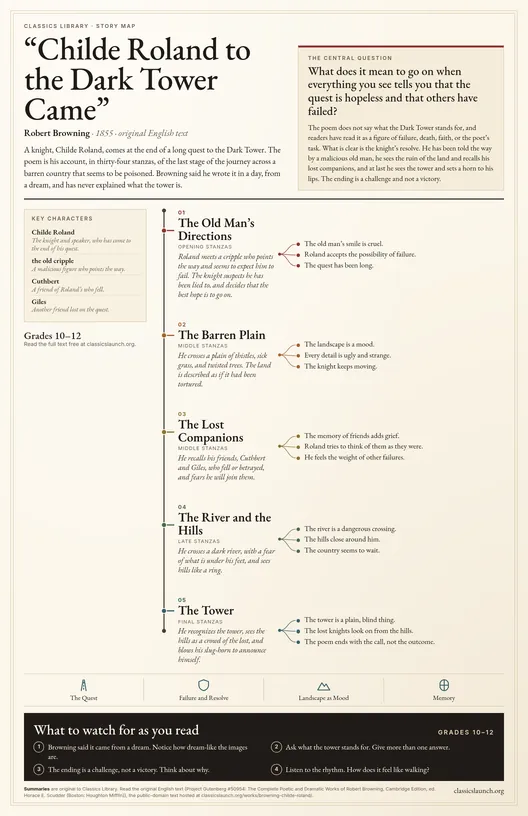 Story mapSee the story mapThe whole book on one page: the story in movements, the characters, and what to watch for. Free to print.
Abstract
Background. Browning published the poem in 1855 in Men and Women. Its title and epigraph are taken from a line that Edgar sings in Shakespeare's King Lear, and the poem builds a dark tale on that one line.
Content. Childe Roland, a knight on a long quest, takes the road that a cripple points out to the Dark Tower. He crosses a barren plain, a spiteful river and a place of ruin, and remembers two friends who betrayed him. At last he sees the squat and blind Tower in the midst of the hills, where the names of fallen knights seem to toll, and he sets his horn to his lips and blows.
Form. Thirty-four six-line stanzas rhymed abbaab, in iambic pentameter. The rhyme gives a driving, claustrophobic feel, and the poem is told in the past tense by Roland.
Themes. Endurance without hope, despair, betrayal and memory, the landscape as an image of the mind, the long failure of the earlier knights, and the knight's ambiguous courage.
Significance. It is one of the strangest and most influential poems of the Victorian age and a challenging test for older students of how a poem makes meaning from symbol, with an ending that leaves its hero's courage open to many readings.
Summary
Childe Roland to the Dark Tower Came is a poem of thirty-four six-line stanzas by Robert Browning, first published in 1855 in Men and Women. Its title is a line from a song of Edgar in Shakespeare's King Lear, and the poem makes a dark story of a single line. The speaker is Childe Roland, a knight on a long quest for the Dark Tower, who tells the story in the past tense. It opens with his first thought that the hoary cripple at the roadside lied in every word when he pointed out the way. Roland nevertheless turns as he pointed, with neither pride nor hope but a sort of gladness that some end might be. He has searched for years, his hope has dwindled into a ghost, and he has heard failure prophesied so often that he thinks only of whether he will be fit to fail as the Band of knights before him did. The way leads across a gray plain of starved, ignoble nature, with thistles chopped, grass thin as hair in leprosy and a stiff blind horse he hates for its misery. Roland turns his mind to his friends Cuthbert and Giles, but memory only brings betrayal and disgrace. He fords a spiteful little river, comes on a trampled place where some unknown struggle was fought and sees an engine like a harrow, ground that is blasted and a palsied oak. A black bird sails past. When the plain gives place to mountains, he hears a click like a trap, and at last he recognizes the place: the Tower itself, round and squat and blind, stands in the midst of the hills. The hills lie like giants at a hunting, and the names of the lost adventurers toll like a bell. Roland sees them all ranged on the hillsides to watch him, and yet he sets the slug-horn to his lips and blows. The poem is a study in dogged fortitude without reward or consolation, and in the way memory and fear work on a lonely mind. Browning is reported to have said that the poem came to him as a dream and was not an allegory, and readers have found in it every kind of meaning.
Virtues in this work
Plot or Argument
- Stanzas 1-3: the cripple
Roland suspects the old cripple of lying and turns down the road he points out, glad that some end might come.
- Stanzas 4-7: the long quest
After years of failure and the memory of the Band of knights, Roland thinks only of whether he will be fit to fail.
- Stanzas 8-14: the gray plain
Roland enters a barren plain of thistles and mud, where a stiff blind horse stands and the road behind him disappears.
- Stanzas 15-17: Cuthbert and Giles
Roland calls to mind two companions and finds only betrayal and disgrace.
- Stanzas 18-26: river and ruin
He crosses a spiteful river, finds a trampled place of struggle, an engine like a harrow and ground gone dead.
- Stanzas 27-29: the bird and the trap
A black bird passes, the plain gives way to mountains and he hears a click like a trap shutting.
- Stanzas 30-31: the Tower
He recognizes the place and sees the round, squat, blind Tower in the midst of the hills.
- Stanzas 32-34: the horn
The hills seem to watch, the names of the lost adventurers toll, and Roland blows the slug-horn.
Characters
- Childe Roland, The knight
A knight on a long quest who walks to the Dark Tower in despair and persists.
- The cripple, The guide
A hoary old man at the roadside, whom Roland takes for a liar, who points to the way.
- Cuthbert, A lost friend
A companion whom Roland remembers with warmth until the memory turns to disgrace.
- Giles, A lost friend
A companion called the soul of honor, remembered as a traitor.
- The Band, The earlier knights
The knights who sought the Dark Tower before Roland and failed.
Lessons
Courage without comfort
Roland receives no sign, no friend and no prize, yet he goes on to the end. The poem tests whether fortitude needs hope as its companion.
- What keeps Roland going?
- Does the poem call him brave or fated?
Landscape can mirror the mind
The blasted plain, the dead trees and the spiteful river mirror Roland's despair and fear. The poem shows how a place may become a state of mind.
- Which details of the plain stand out?
- How does the landscape change as Roland nears the Tower?
Memory can wound as well as help
Roland turns to his friends for comfort and finds only betrayal and disgrace. The poem asks how remembering can strengthen or break a person.
- Why does Roland think of Cuthbert and Giles?
- How does the memory change his mood?
Context
The title and the quest come from a song of Edgar, disguised as a madman, in Shakespeare's King Lear, which begins Child Rowland to the dark tower came. The song itself echoes a much older ballad and fairy tale.
Composition
Browning is said to have dated the poem January 1852 and to have written it in a single day; this and the story that it came to him as a dream rest on later report.
Reception
The poem was published in Men and Women (1855). It became a favorite of modernist readers, and it has influenced many later writers, among them Stephen King, whose novels of the Dark Tower take their name and idea from it.
Comparisons
- The Divine Comedy
Dante's journey through a hostile landscape under the weight of fear gives a model for Roland's, though Dante has a guide and a destination in grace.
- Ulysses
Ulysses and Roland both press forward past the point of comfort, though Ulysses wills it with confidence and Roland with despair.
- The Faerie Queene, Book I
Spenser's knights on a quest are the tradition from which Roland, an English knight, comes; Browning reverses the romance of success.
- Prospice
Another Browning poem that faces the worst with a fighter's courage, though Prospice ends in hope.
Quotes
Frequently cited
“Dauntless the slug-horn to my lips I set, And blew.”
“My first thought was, he lied in every word,”
“So, quiet as despair, I turned from him,”
“I shut my eyes and turned them on my heart.”
“Better this present than a past like that;”
“Burningly it came on me all at once, This was the place!”
“What in the midst lay but the Tower itself?”
For Students
A reading companion for classical Christian high school students. See the student guide.
Reading Guide
Watch for
- How the landscape grows more and more unnatural.
- The memories of Cuthbert and Giles, and how they fail to help.
- The last stanza, and the contrast between the Band watching and Roland's horn.
Key terms and names
- Childe
- An old title for a young man of noble birth who is training to be a knight.
- Slug-horn
- A kind of small horn or trumpet, here Roland's war-signal.
- Dark Tower
- The goal of the quest, in which earlier knights have failed.
- Spurge and cockle
- Weeds that grow on poor ground.
Seminar Questions
- Comprehension What does Roland think of the cripple, and what does he do?
- Comprehension What does Roland see when he reaches the end of his journey?
- Interpretation How does the landscape reflect his state of mind?
- Interpretation What does the final line tell us about Roland?
- Big Question What is courage when there is no hope?
- Big Question Is Roland's journey a picture of despair or of faith?
Faith Connections
- Ephesians 6:13 (Scripture)
Put on the whole armor of God that you may be able to stand in the evil day; Roland stands without armor of faith but with the soldier's will.
- Psalm 23:4 (Scripture)
The valley of the shadow of death is the nearest biblical image to Roland's plain, but the psalm adds the presence of the shepherd that is absent here.
- Augustine, Confessions 1.1 (Church Fathers)
Augustine's restless heart seeks its rest in God, while Roland's seems to have no rest to look for.
Logic and Rhetoric
Central argument: The poem argues by narrative and image that endurance can continue after hope has failed, and leaves the reader to judge whether that is courage or fate.
Rhetorical device: Symbolic landscape. The poem builds its meaning from a landscape that stands for despair and fear, and leaves the reader to read the symbols.
Debate: Resolved: Courage may endure after hope has failed.
Memory Work
Dauntless the slug-horn to my lips I set, And blew.
My first thought was, he lied in every word,
Writing Prompts
Essay: Write an essay on how Browning uses landscape and memory in Childe Roland to dramatize despair and endurance.
Comparison with Ulysses: Compare how Roland and Ulysses face the end of a long road and what each takes from it.
Medical Lens
The poem's mood of despair, nightmare landscapes and exhausted persistence can open a conversation about depression, though it is a work of imagination and not a clinical text.
Creative Prompts
- Essay
Write an essay on whether the poem is about despair or courage.
- Poetry
Write a six-line stanza in the same rhyme scheme describing an imagined landscape that mirrors a feeling.
- Adaptation
Draw the Tower, the hills and the plain as they appear in the last stanzas.
- Classroom
Discuss how the poem's ending changes what we think of Roland.
Further Reading
- King Lear, William Shakespeare
Edgar's song, from which the title is taken.
- Men and Women, Robert Browning
The 1855 volume in which the poem first appeared.
- The Complete Poetic and Dramatic Works of Robert Browning, Robert Browning
The Cambridge Edition used for this text.
Verification notes
The text follows the Cambridge Edition, ed. Horace E. Scudder, Project Gutenberg #50954, with the editor's headnote omitted; the epigraph is not repeated in the body text. Stanza and line locations count the thirty-four six-line stanzas of the hosted text. The 1855 publication follows the source metadata. The date of composition (January 1852), the dream story and the Stephen King influence are standard reports that have not been matched to a page here. Quotes were checked against the hosted text.
No verification flags recorded.