Work record
Michael Strogoff: The Courier of the Czar
Jules VerneMichael Strogoff; Michel Strogoff; The Courier of the Czar; Michael Strogoff: The Courier of the Czar; StrogoffMichael Strogoff: The Courier of the Czar by Jules Verne (1876)Michael Strogoff is the story of a courier of the Czar who crosses Siberia during a Tartar invasion.Also known as: Michael Strogoff · Michel Strogoff · The Courier of the Czar · Michael Strogoff: The Courier of the Czar · Strogoff
1876 · 19th Century · Novel · French
Read this when you want a great journey where duty outweighs love, fear and pain.
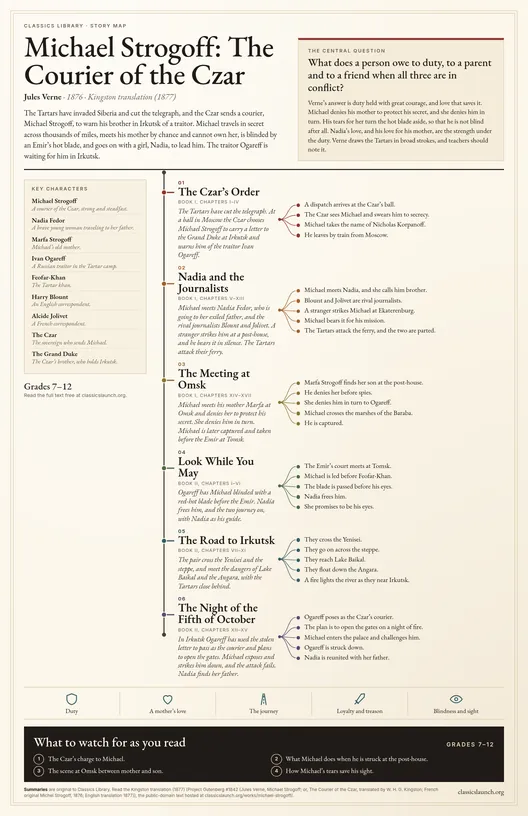 Story mapSee the story mapThe whole book on one page: the story in movements, the characters, and what to watch for. Free to print.
Abstract
The mission. The Tartars have invaded Siberia and cut the telegraph, and the Czar chooses Michael Strogoff, a Siberian of great strength, to carry a letter to his brother, the Grand Duke, at Irkutsk. Michael travels in secret as the merchant Nicholas Korpanoff and warns of the traitor Ivan Ogareff. On the way he befriends Nadia Fedor and two journalists, and bears a blow in silence.
The trial. Tartars part Michael and Nadia at the Irtysh. At Omsk Michael meets his mother and denies her to protect his secret, and she denies him in turn. Captured by the Tartars, he is blinded with a red-hot blade by the order of Ogareff before the Emir at Tomsk. Nadia frees him and guides him on a long and dangerous road across Siberia, with the Tartars close behind.
Irkutsk. In Irkutsk, Ogareff poses as the Czar’s courier and plans to open the city to the Tartars. Michael, whose sight has been saved by his tears, exposes him and strikes him down in the Grand Duke’s palace, and saves the city. He marries Nadia and rises high in the service of the Czar.
Main characters
- Michael Strogoff: courier of the Czar
- Nadia Fedor: traveling companion
- Ivan Ogareff: Russian traitor
- Marfa Strogoff: Michael’s mother
Summary
Michael Strogoff is the story of a courier of the Czar who crosses Siberia during a Tartar invasion. In the 1870s the Emir of Bukhara and the Khan Feofar have invaded Russian Asia and cut the telegraph lines, and the Czar’s brother, the Grand Duke, is cut off in Irkutsk. The Czar sees that a traitor, a former Russian colonel, Ivan Ogareff, who has joined the Tartars, plans to deliver Irkutsk. He chooses Michael Strogoff, a man of strength and steady heart, a Siberian from Omsk, to carry a letter to the Grand Duke, and swears him to secrecy. Under the false name of Nicholas Korpanoff, a merchant, Michael travels from Moscow by rail, steamer and tarantass. On the way he befriends a young girl, Nadia Fedor, who is going to join her exiled father at Irkutsk, and two rival journalists, the Englishman Harry Blount and the Frenchman Alcide Jolivet. At a post-house a stranger strikes Michael, who bears the blow in silence for the sake of his mission. Michael and Nadia cross the Urals, but the Tartars attack their ferry on the Irtysh, Michael is swept away, and Nadia is taken prisoner. At Omsk he meets his old mother, Marfa, by chance, and denies her before spies, to keep his secret. She in turn denies him to Ogareff and is carried off a prisoner. After a dash across the marshes of the Baraba, Michael is captured and brought before the Emir at Tomsk. Ogareff, who has discovered who he is, sentences him to be blinded with a red-hot blade, and he is left in the dark, after Ogareff has robbed him of the Czar’s letter. Nadia, who is also a prisoner at Tomsk, frees him, and the two travel on, she leading him as a blind man. They cross the Yenisei, the Baikal and the Angara, a long and dangerous road. In Irkutsk, Ogareff has already arrived and is in the Grand Duke’s favor, posing as the Czar’s courier, with a plan to open the gates to the Tartars on a night of fire. Michael, whose sight has been saved by the tears he shed for his mother, enters the city. In the Grand Duke’s palace he exposes and strikes down Ogareff, who has used the stolen letter to pass himself off as the courier, and the Tartars’ attack fails. Nadia finds her father, and Michael is welcomed by the Czar. The book ends with Michael’s marriage to Nadia, and a high place for him in the Empire. Teachers will find a tale of loyalty and courage in which the hero’s test is to put duty before his own anger, his love and his fear.
Virtues in this work
- Fortitude: Michael endures cold, hunger, wounds and blindness without giving up his mission.
- Faith: He keeps his oath to the Czar and trusts in providence on the road.
- Piety: He is faithful to his mother and honors her even at the cost of silence.
- Friendship: Nadia and the journalists stand by him at risk to themselves.
Plot or Argument
- The Czar’s order
The Tartars have cut the telegraph, and the Grand Duke is cut off in Irkutsk. The Czar chooses Michael Strogoff, a Siberian of great strength, to carry a letter to him, and warns him of the traitor Ivan Ogareff.
- Nadia and the journalists
Under the name of Nicholas Korpanoff, Michael travels east, and meets Nadia Fedor, who is going to her exiled father, and the rival journalists Blount and Jolivet. A stranger strikes him at a post-house, and he bears it in silence. The Tartars attack their ferry on the Irtysh, and the two are parted.
- The meeting at Omsk
Michael meets his mother Marfa by chance at Omsk, and denies her to protect his secret. She denies him in turn when Ogareff questions her. Michael is later captured and taken before the Emir’s court at Tomsk.
- Look while you may
Ogareff has Michael blinded with a red-hot blade before the Emir. Nadia frees him, and the two journey on, with Nadia as his guide.
- The road to Irkutsk
The pair cross the Yenisei and the steppe, and meet the dangers of Lake Baikal and the Angara, with the Tartars close behind.
- The night of the fifth of October
In Irkutsk Ogareff, who has stolen the Czar’s letter and poses as the courier, plans to open the gates. Michael, whose sight is saved, confronts him in the palace, exposes him and strikes him down, and saves the city.
Characters
- Michael Strogoff, courier of the Czar
A courier of the Czar, a Siberian of great strength and strong will.
- Nadia Fedor, brave young woman traveling to her exiled father
A brave young woman traveling to her exiled father.
- Marfa Strogoff, Michael’s old mother
Michael’s old mother, a woman of the Siberian steppe.
- Ivan Ogareff, russian traitor
A Russian traitor who has gone over to the Tartars.
- Feofar-Khan, tartar Khan and ally of the Emir of Bukhara
The Tartar Khan and ally of the Emir of Bukhara.
- Harry Blount, english war correspondent
An English war correspondent.
- Alcide Jolivet, french correspondent and Blount’s friendly rival
A French correspondent and Blount’s friendly rival.
- The Czar, sovereign
The sovereign who gives Michael his errand.
- The Grand Duke, czar’s brother
The Czar’s brother, who holds Irkutsk.
Lessons
Duty before everything
Michael bears insult, denies his own mother and gives up all comfort for his task. The book makes duty the whole law of his life, and then tests it with the claims of love and pain. Students can ask whether Michael’s duty is a virtue, and whether he is ever right to give it up.
- What does Michael give up for his mission?
- Why must he deny his mother at Omsk?
- Is there a point where duty should yield to love?
Treachery and loyalty
Ivan Ogareff is a Russian who has gone over to the enemy for revenge, and Michael is a man who holds to his oath at any cost. The two men stand for opposite ways of answering a hurt, and the book puts them face to face in the last chapters.
- What drives Ogareff to treason?
- How does Michael answer insult differently?
- What does the book say of a man who betrays his country?
The love of a mother and a friend
Marfa’s love and Nadia’s love save Michael: the tears he sheds for his mother protect his sight, and Nadia lends him her eyes. The book gives teachers a story in which love is stronger than cruelty.
- How does Marfa help her son even in her suffering?
- What does Nadia do for Michael?
- Why does the book make tears the instrument of his rescue?
The far reaches of Russia
The journey across Siberia gives Verne a chance to describe rivers, steppes, mountains and peoples. Teachers should note the broad strokes in which Verne draws the Tartars, and discuss what the book shows and what it passes over.
- What places does Michael pass on his road?
- How does Verne describe the Tartar armies?
- Which descriptions would a modern writer handle differently?
Context
Michel Strogoff was published in French in 1876 as one of Verne’s Voyages extraordinaires, and Kingston’s English translation followed in 1877. The tale is set in the Russian Empire of the 1870s, with an invasion of Siberia by the Tartar khanates of Central Asia, an imagined event that draws on the real wars of the Russian conquest of Turkestan.
Composition
Verne never visited Siberia and drew his picture from geographies and travelers’ accounts, in the manner of his other novels. The book was adapted by Verne and Adolphe d’Ennery as a stage play in 1880, which was a great popular success in Paris.
Reception
Kingston’s English version is a Victorian rendering that is fuller than some abridgments, but it is not a modern translation and in places differs from the French. The novel has been many times filmed and remains one of Verne’s best-known adventures.
Comparisons
- Around the World in Eighty Days
Verne’s other great race against time, with a more comic hero and a lighter tone.
- Twenty Thousand Leagues Under the Sea
Verne’s submarine romance, with a darker and more solitary hero.
- The Count of Monte Cristo
A French tale of a man who endures great trials and returns to justice.
- The Three Musketeers
Dumas’s tale of a courier’s mission, and of loyalty to a sovereign.
- The Thirty-Nine Steps
Buchan’s tale of a man on the run to deliver a vital message.
- The Scarlet Pimpernel
Orczy’s tale of a disguised hero who rescues and outwits his enemies.
- Kim
Kipling’s tale of a boy of Asia on a long journey of secret errands.
Quotes
Frequently cited
“SIRE, a fresh dispatch.”
Frequently cited
“Then look while you may.”
Frequently cited
“use my eyes whilst yours sleep”
Frequently cited
“That man, your Highness, is not a courier of the Czar!”
Frequently cited
“MICHAEL STROGOFF was not, had never been, blind.”
For Students
A reading companion for classical Christian high school students. See the student guide.
Reading Guide
Watch for
- How the Czar and his courier meet, and what the Czar asks of him.
- How Michael bears the blow at the post-house and why.
- The scene at Omsk with his mother and what he does.
- How Verne describes the places on the road through Siberia.
Key terms and names
- Courier
- A messenger who carries important letters over a long distance.
- Tartar
- The name Verne uses for the Central Asian invaders of Siberia.
- Tarantass
- A heavy Russian carriage on long poles, used for post travel.
- Podorojna
- A permit to take post-horses on Russian roads.
- Irkutsk
- The capital of Eastern Siberia, where the Grand Duke holds out.
- Steppe
- A wide, grassy plain.
Seminar Questions
- Comprehension What is the Czar’s order to Michael Strogoff, and why must it be secret?
- Comprehension How is Michael blinded, and how is his sight saved?
- Interpretation Why does Verne make Ivan Ogareff a Russian and not a Tartar?
- Interpretation What does Michael’s silence at the post-house show about him?
- Big Question When does duty to a country outweigh duty to a parent?
- Big Question What does it mean to be strong, and how does Michael show it?
Faith Connections
- Luke 9:62 (Scripture)
No one who puts a hand to the plow and looks back is fit for the kingdom of God. Michael’s single-minded purpose, even when he must deny his own mother, may be set beside this saying with care for the difference between an earthly and a heavenly call.
- Exodus 20:12 (Scripture)
Honor your father and your mother. Michael’s denial of his mother at Omsk puts the commandment under strain, and the book answers it with her own blessing on his purpose.
- Cicero, On Duties I.7 (Great Conversation)
Cicero speaks of duties that conflict and the need to choose the higher. It gives a way of discussing Michael’s choice between his mother and his mission.
Logic and Rhetoric
Central argument: Duty may require a person to give up the claims of love and comfort, but love is not therefore defeated, and may in the end be what saves him.
Rhetorical device: irony. Michael’s tears, shed for his mother, protect his eyes from the blade of the Emir.
Debate: Resolved: That Michael was right to deny his mother at Omsk.
Memory Work
use my eyes whilst yours sleep
MICHAEL STROGOFF was not, had never been, blind.
Writing Prompts
Essay: How does Verne use the journey across Siberia to test Michael’s character? Answer with three scenes.
Comparison with Around the World in Eighty Days: Compare Michael Strogoff and Phileas Fogg as Verne’s two travelers who must keep to a schedule, and say what each journey teaches.
Medical Lens
The blinding of Michael with a heated blade is the center of the book, and the Conclusion explains that his tears saved his sight by turning to vapor on the iron, a cause that Verne calls a human phenomenon. The explanation is a piece of literary invention, not a medical account. There are also wounds, a blow at a post-house, cold and fatigue.
- Book II, Chapter V: “Look While You May!”
The blinding by the heated sword, which is told briefly and without detail.
- Book II, Chapter XV: Conclusion
The explanation that Michael’s tears protected his eyes.
Creative Prompts
- Essay
Write an essay on why Verne makes the hero’s sight depend on his love for his mother.
- Dialogue
Write the conversation between Michael and Nadia on the night after the blinding, in which she says how she will lead him.
- Fiction
Retell the meeting at the post-house from the point of view of Harry Blount or Alcide Jolivet.
- Classroom
Draw a map of Michael’s route from Moscow to Irkutsk, with the main events in each place.
Further Reading
- Around the World in Eighty Days, Jules Verne
Verne’s race around the world, in this library.
- The Count of Monte Cristo, Alexandre Dumas
A French novel of endurance and return, in this library.
- Kim, Rudyard Kipling
A novel of a secret journey across Asia, in this library.
Verification notes
The text is W. H. G. Kingston’s 1877 translation as given in Project Gutenberg eBook #1842, complete in two books and thirty-two chapters. Project Gutenberg’s file does not itself name the translator, and the attribution was confirmed from bibliographic references. Kingston’s version may differ from the French in places, and the quotations are given in his English.
- The identification of the Project Gutenberg text as W. H. G. Kingston’s 1877 translation rests on bibliographic references (such as the Online Books Page and the ISFDB) and not on the file itself.
- The date and success of the 1880 stage play by Verne and d’Ennery should be checked in a Verne biography before they are given in class.
- Kingston’s translation was not compared with the French original, and some passages may differ from Verne’s text.