Work record
Rupert of Hentzau
Anthony HopeRupert of Hentzau; Rupert of Hentzau (1898); Sequel to The Prisoner of Zenda; Ruritanian sequelRupert of Hentzau by Anthony Hope (1898)Rupert of Hentzau is the sequel to The Prisoner of Zenda, and it is told by Fritz von Tarlenheim, the young officer of the first book, who is now married to Helga.Also known as: Rupert of Hentzau · Rupert of Hentzau (1898) · Sequel to The Prisoner of Zenda · Ruritanian sequel
1898 · 19th Century · Novel · English
Read this when you want to see what a good deed costs a story’s hero.
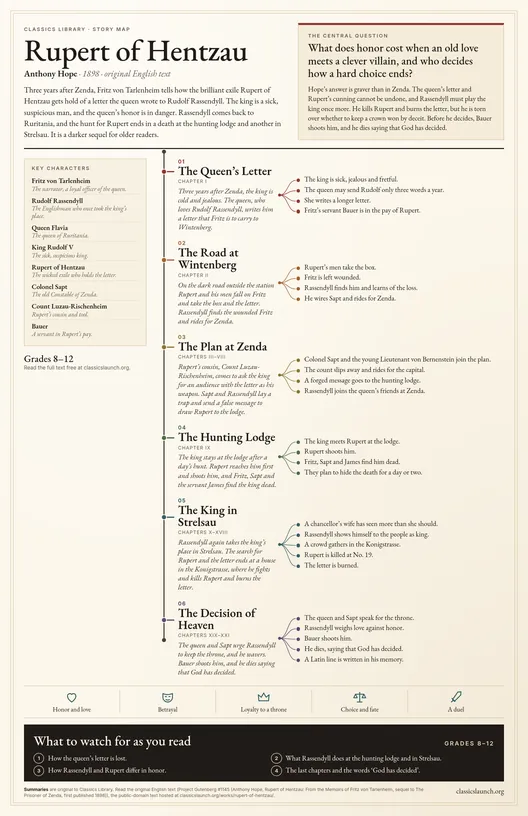 Story mapSee the story mapThe whole book on one page: the story in movements, the characters, and what to watch for. Free to print.
Abstract
The letter. Queen Flavia, who loves Rudolf Rassendyll, writes him a letter, which Fritz von Tarlenheim is to carry. Fritz’s servant Bauer is a spy of Rupert of Hentzau, and Rupert takes the letter and means to use it against the Queen and the King.
The hunt and the killing. On the road outside Wintenberg, Rupert and his men take the letter from Fritz. Rassendyll, Sapt and Bernenstein try to stop Rupert’s cousin, who carries it to the King, and they draw Rupert to the hunting lodge. There Rupert shoots the King, and the Queen’s friends hide the death while they hunt for the villain and the letter. Rassendyll takes the King’s place in Strelsau.
The end. In a house in the Konigstrasse, Rassendyll fights Rupert, kills him and burns the letter, and then he appears as the King. Sapt and the Queen urge him to keep the throne, and while he hesitates he is shot by Bauer and dies, saying that God has decided. The Queen mourns him, and the book ends with the Latin line on his memory and her child’s voice. It is a tale of the cost of loyalty, told by a faithful friend who survives to remember.
Main characters
- Fritz von Tarlenheim: narrator and officer
- Rudolf Rassendyll: Englishman who returns
- Queen Flavia: Queen of Ruritania
- Rupert of Hentzau: exile and villain
Summary
Rupert of Hentzau is the sequel to The Prisoner of Zenda, and it is told by Fritz von Tarlenheim, the young officer of the first book, who is now married to Helga. Three years have passed since King Rudolf the Fifth was freed from Zenda and wed the Princess Flavia. The King is a sick, suspicious and fretful man. The Queen, who loves the Englishman Rudolf Rassendyll, may send him only three words a year and receive three in return. One year she cannot bear it, and she writes him a letter, which Fritz is to carry to a meeting at Wintenberg. But the servant Fritz takes with him, Bauer, is in the pay of Rupert of Hentzau, the brilliant exile who escaped at the end of the first book. On the dark road outside the station at Wintenberg, Rupert and his men fall on Fritz and take the letter. Rassendyll finds him wounded, learns of the loss and sets out for Zenda, where he and old Colonel Sapt, the young Lieutenant von Bernenstein and the Queen make their plans. Rupert’s cousin, the Count of Luzau-Rischenheim, arrives to ask the King for an audience, and the letter is his weapon. The Queen’s friends catch him, but he slips away and rides for the capital. Rassendyll and Sapt draw Rupert to the hunting lodge with a forged message, but the King, who has stayed there after a day’s hunting, meets him first, and Rupert shoots him. Fritz, Sapt and the servant James find the King dead. The Queen’s friends must hide the death for a day or two while they search for Rupert and the letter, and Rassendyll goes to Strelsau, where he must once more play the King. The hunt leads to a house in the Konigstrasse. There Rassendyll fights and kills Rupert and burns the letter, and he shows himself to the people as King. Sapt and the Queen urge him to remain on the throne for her honor and for the kingdom. He hesitates, torn between his love and the thought that a crown won by deceit is not his to keep. Before he decides, Bauer shoots him, and he dies, saying that God has decided. The book ends with the Queen, her people and a Latin line in his memory. Parents and teachers will find a gripping tale and a serious moral about the cost of loyalty.
Virtues in this work
- Friendship: Fritz, Sapt and Bernenstein hold together around the Queen and Rassendyll through every danger and grief.
- Honor: Rassendyll tries to do right to the end and will not take what is not his by deceit without hesitation.
- Fortitude: The Queen’s friends bear a dangerous secret and a loss, and the Queen herself bears her grief with courage.
Plot or Argument
- The queen’s letter
Three years after the events of Zenda, the sick and jealous King Rudolf grows ever colder, and Queen Flavia, who loves Rudolf Rassendyll, writes him a letter that Fritz is to carry to Wintenberg. Fritz’s servant Bauer is Rupert’s spy.
- The dark road at Wintenberg
On the road from the station Rupert and his men fall on Fritz and take the box and the letter. Rassendyll finds him wounded, wires Sapt, and rides for Zenda to protect the Queen.
- The plan at Zenda
Rupert’s cousin, Count Luzau-Rischenheim, arrives with the letter to ask the King for an audience. Sapt and Rassendyll lay a trap for him, and he escapes and rides for the capital. They send a false message to draw Rupert to the hunting lodge.
- The hunting lodge
The King has stayed at the lodge after a day’s hunting. Rupert reaches him first and shoots him. Fritz, Sapt and the servant James find the King dead and plan to hide the death for a day or two while they hunt for Rupert and the letter.
- The king in Strelsau
Rassendyll again takes the King’s place in Strelsau, and Bauer’s gang, the crowd in the Konigstrasse and Rupert’s plots make the search dangerous. At No. 19 Konigstrasse he fights and kills Rupert and burns the letter.
- The decision of heaven
The Queen and Sapt urge Rassendyll to keep the throne, and he wavers. Bauer shoots him, and he dies saying that God has decided. The book ends with the Queen, her child and the Latin lines in his memory.
Characters
- Fritz von Tarlenheim, narrator
The narrator, a loyal officer of the Queen and her friend.
- Rudolf Rassendyll, englishman
The Englishman who once took the King’s place and returns to help the Queen.
- Queen Flavia, queen of Ruritania
The Queen of Ruritania, who loves Rassendyll and is wed to the King.
- King Rudolf V, sick
The sick, suspicious King who is killed at the hunting lodge.
- Rupert of Hentzau, brilliant and wicked exile
The brilliant and wicked exile who holds the Queen’s letter.
- Colonel Sapt, old soldier and Constable of Zenda
The old soldier and Constable of Zenda, hard and shrewd.
- Count Luzau-Rischenheim, Rupert’s cousin
Rupert’s cousin, a young count who becomes his tool and later his enemy.
- Bauer, servant
A servant who is Rupert’s spy and later an assassin.
Lessons
The long reach of a past deed
Hope begins with the remark that an act may spread its consequences for years. The first book ended in triumph, and this book shows that Rupert’s escape, the Queen’s feelings and the secret of the double all had later results. Students can follow how a small thing, a letter, comes to unsettle a kingdom.
- What seeds of the sequel were sown at the end of The Prisoner of Zenda?
- How does a single letter drive the whole plot?
- Which choices in the first book have returned in this one?
Loyalty with a divided heart
Fritz, Sapt and Rassendyll all serve the Queen, but they do not agree on what service requires. Fritz is tender, Sapt ruthless, and Rassendyll torn. The book draws out how loyalty can become a trap and what a person owes to truth in the course of serving another.
- How do Fritz, Sapt and Rassendyll differ in their ideas of service?
- Where is Rassendyll tempted to keep the throne, and why does he hesitate?
- What does the Queen ask of her friends, and is it right?
A tragic ending
Rassendyll dies, and the book does not turn the end into a triumph. He had tried to do right by his friends and by the truth and could not find a clean way. The book is a lesson in how good people can be caught in a situation that no good choice entirely resolves, and it invites a Christian reader to ask where hope lies.
- Why does Hope let Rassendyll die?
- What does the dying man mean by saying that God has decided?
- Is the tragic ending more satisfying than a happy one would have been?
Context
Rupert of Hentzau came out in 1898, four years after The Prisoner of Zenda. It belongs to the tradition of Ruritanian romance, in which readers enjoyed imagined kingdoms in Central Europe with castles, swordsmen and royal intrigue, a world that was soon to be swept away by the First World War.
Composition
Anthony Hope wrote the sequel in response to the popularity of the first book, and chose a first-person narrator, Fritz von Tarlenheim, who tells the tale with a greater sense of loss than the sprightly Rudolf of Zenda.
Reception
The book was a success, though less loved than its predecessor, and later readers have often praised it for its darker color and the characterization of Rupert, who is among the most memorable villains of Victorian popular fiction. It has been staged and filmed with the earlier book several times.
Comparisons
- The Prisoner of Zenda
This is the book to which Rupert of Hentzau is the sequel; read it first for the story of Rudolf, the King, Flavia and the first Rupert.
- The Man in the Iron Mask
Dumas’s late musketeer romance is another story in which the original heroes age and meet a darker end.
- The Three Musketeers
The first book of Dumas’s series, with the same bonds of friendship, honor and swordplay that Hope draws on.
- A Tale of Two Cities
Dickens’s novel of two look-alike men, in which one goes to his death for the sake of others, is a good companion piece on sacrifice.
- The Scarlet Pimpernel
Orczy’s Pimpernel is a lighter hero of disguise and rescue, with a happier end than Hope allows his hero.
Quotes
Frequently cited
“A man who has lived in the world, marking how every act, although in itself perhaps light and insignificant, may become the source of consequences that spread far and wide, and flow for years or centuries”
Frequently cited
“I’ve tried to do the right thing through it all.”
Frequently cited
“Qui in hac civitate nuper regnavit In corde ipsius in aeternum regnat”
“Among the sins of Rupert of Hentzau I do not assign the first and greatest place to his killing of the king.”
“I know I’m wrong, but I’m starved, starved, starved!”
“In life and in death, my sweet queen”
For Students
A reading companion for classical Christian high school students. See the student guide.
Reading Guide
Watch for
- How a single letter turns a quiet court into a place of danger.
- What each member of the Queen’s party is willing to do to keep the secret.
- How Rassendyll’s choice at the end is different from the choice of the first book.
- What Fritz, as narrator, admits that he does not know.
Key terms and names
- Sequel
- A book that carries on the story of an earlier one.
- Constable of Zenda
- The old soldier Sapt’s office, which gives him command of the castle.
- Exile
- A person sent away from his country, as Rupert is at the start.
- Assassin
- A person who kills by surprise for a political end.
- Epitaph
- A short inscription in memory of one who has died.
Seminar Questions
- Comprehension How does Rupert of Hentzau get hold of the Queen’s letter?
- Comprehension What happens to the King at the hunting lodge?
- Interpretation Why does Fritz, and not Rassendyll, tell the story?
- Interpretation What is Hope saying about Rupert in comparing his sins?
- Big Question Is it right to hide a king’s death to protect a queen’s honor?
- Big Question What should a man do when love, honor and the good of a country all seem to point in different ways?
Faith Connections
- Proverbs 14:12 (Scripture)
There is a way that seems right to a man, but its end is the way of death. The plan to hide the King’s death and put a stand-in on the throne seems right to the Queen’s servants, and the book shows its cost.
- Ecclesiastes 9:11 (Scripture)
The race is not always to the swift, nor the battle to the strong. The careful plans of the Queen’s party are undone at the end by a servant with a pistol.
- Sophocles, Antigone (Great Conversation)
Another story of duty, love and a king’s law in which a person must choose between loyalties, and where the choice brings tragedy.
Logic and Rhetoric
Central argument: A deed done for love or duty may be the right deed in its aim and still be bound up in deceit, and the cost of that deceit falls on the doer.
Rhetorical device: retrospective first-person narration. Fritz tells the tale after the event, and his hindsight and his sorrow shape what the reader sees of each scene.
Debate: Resolved: That Rassendyll should have taken the throne when it was offered to him.
Memory Work
I’ve tried to do the right thing through it all.
A man who has lived in the world, marking how every act, although in itself perhaps light and insignificant, may become the source of consequences that spread far and wide, and flow for years or centuries
Writing Prompts
Essay: Explain how Rupert of Hentzau is both like and unlike the Rupert of The Prisoner of Zenda, using two scenes, and say what the author wants us to think of him at the end.
Comparison with The Prisoner of Zenda: Compare the endings of Zenda and Rupert of Hentzau, and say what each tells us about love and duty.
Medical Lens
The King is sick and suspicious and is killed, a man is shot and dies of his wound, and the Queen is long in grief. The book offers a literary picture of a ruler’s illness and of a mourner, with no medical detail.
- Chapter I: The Queen’s Good-By
The King’s sickness and jealousy are shown to wear down his wife and his friends.
Creative Prompts
- Fiction
Write the letter that Queen Flavia might have written to Rudolf Rassendyll, in her own voice, without naming the places.
- Dialogue
Write a conversation in which Fritz and Sapt argue over whether to tell the truth about the King’s death.
- Essay
Explain why Hope chose to have Fritz von Tarlenheim narrate, and what he sees that Rassendyll could not.
- Classroom
Make a timeline of the two days in which the King is killed and Rupert is found, and mark where each character is.
Further Reading
- The Prisoner of Zenda, Anthony Hope
The first book of the pair, in this library.
- The Man in the Iron Mask, Alexandre Dumas
A late chapter of the musketeers, in this library.
- A Tale of Two Cities, Charles Dickens
A man gives his life for the one a woman loves, in this library.
Verification notes
The text is as given in Project Gutenberg eBook #1145, the 1898 sequel to The Prisoner of Zenda, complete in twenty-one chapters; it has not been checked line by line against a printed first edition. Hope’s knighthood follows standard reference works.
- The text follows Project Gutenberg eBook #1145 and has not been compared with a scan of the 1898 first edition.
- Hope’s knighthood in 1918 and the publication year follow standard reference works.
- The English rendering of the Latin lines is a translation made for this guide, not Hope’s own.