Work record
The Prisoner of Zenda
Anthony HopePrisoner of Zenda; The Prisoner of Zenda (1894); Ruritanian romance; Rudolf RassendyllThe Prisoner of Zenda by Anthony Hope (1894)The Prisoner of Zenda is the story of Rudolf Rassendyll, a cheerful English gentleman of twenty-nine, with money enough, no profession, and a long, sharp nose and dark-red hair that run in his family.Also known as: Prisoner of Zenda · The Prisoner of Zenda (1894) · Ruritanian romance · Rudolf Rassendyll
1894 · 19th Century · Novel · English
Read this when you want a swift story of honor tested by a borrowed crown.
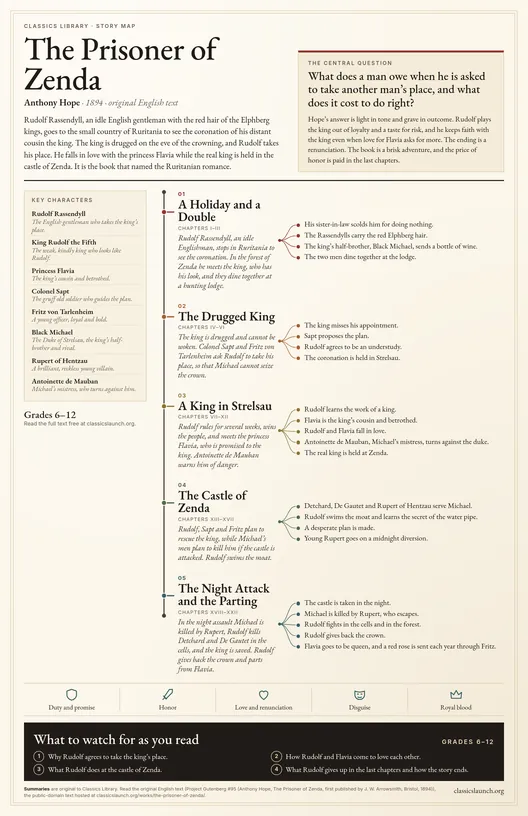 Story mapSee the story mapThe whole book on one page: the story in movements, the characters, and what to watch for. Free to print.
Abstract
The double. Rudolf Rassendyll, an idle Englishman, goes to see the coronation of the King of Ruritania, who is his red-haired distant cousin. The King is drugged by his half-brother, Black Michael, and two loyal officers, Sapt and Fritz, beg Rudolf to stand in for him at the crowning, so that the usurper cannot take the crown.
The king and the castle. Rudolf rules in Strelsau for some weeks, wins the people, and falls in love with Princess Flavia, who is promised to the King. The real King is held in the castle of Zenda by Michael and his hired swordsmen, Detchard, De Gautet and Rupert of Hentzau, and Rudolf, Sapt and Fritz plan to free him, with the help of Antoinette de Mauban.
The rescue and the parting. In a night attack, Michael is killed by Rupert, Rudolf kills Detchard and De Gautet, and the King is saved, though Rupert escapes. Rudolf gives back the crown and parts from Flavia, who keeps her duty. Each year she and Rudolf exchange a red rose through Fritz, and Rudolf resolves to live as the woman he loves would wish, and to keep faith with her as long as he lives.
Main characters
- Rudolf Rassendyll: English gentleman, double of the King
- Colonel Sapt: loyal soldier of the King
- Princess Flavia: the King’s cousin and betrothed
- Rupert of Hentzau: young adventurer in the Duke’s service
Summary
The Prisoner of Zenda is the story of Rudolf Rassendyll, a cheerful English gentleman of twenty-nine, with money enough, no profession, and a long, sharp nose and dark-red hair that run in his family. His sister-in-law scolds him for idleness, and he sets out for the Tyrol, but first stops to see the coronation of Rudolf the Fifth, King of Ruritania. The King, his distant cousin, has the same red hair and the same face. They meet in a hunting lodge, share a bottle of wine sent by the King’s half-brother, Black Michael, Duke of Strelsau, and the King is drugged. The next day he cannot be woken, and the King’s two loyal officers, Colonel Sapt and Fritz von Tarlenheim, ask Rudolf to take his place at the coronation, so that Michael cannot seize the crown. The English visitor is crowned in Strelsau in the King’s stead, learns the work of a king, and meets the King’s cousin and betrothed, Princess Flavia, with whom he falls deeply in love. Meanwhile the real King has been kidnapped by Michael and held in the castle of Zenda, and Rudolf, Sapt and Fritz plot to rescue him against Michael’s hired swordsmen, Detchard, De Gautet and the dashing and wicked young Rupert of Hentzau. Antoinette de Mauban, Michael’s mistress, turns against him and helps Rudolf. The story reaches its climax in a night assault on the castle, a swim across the moat, a fight in the cells and a duel in the forest, in which Michael is killed by Rupert, Rudolf kills two of Michael’s men, and the King is saved. Rudolf must now give back the crown and part from Flavia, who keeps her duty to her country and to the King. The book ends with the two exchanging a red rose each year through Fritz, and with Rudolf’s resolve to live as the woman he loves would wish. Parents and teachers will find a lively adventure with a serious question beneath it: what a man owes to the truth and to a promise, and what it costs him to do right.
Virtues in this work
- Honor: Rudolf gives back the crown and keeps faith with the King, and he refuses to profit from a deception that was meant for another’s good.
- Fortitude: He swims a moat, fights in a cell and keeps his head under a danger that would shake most men.
- Friendship: Sapt and Fritz stay with Rudolf through every danger, and the bond between Rudolf and Fritz lasts after the story is over.
Plot or Argument
- A holiday and a coincidence
Rudolf Rassendyll, an idle and amiable Englishman, travels toward the Tyrol but stops to see the coronation of King Rudolf the Fifth of Ruritania. In the forest of Zenda he meets the King, who is his double, and the two dine together at a hunting lodge.
- The drugged king and the coronation
The King is drugged with wine from his half-brother, Black Michael. Colonel Sapt and Fritz von Tarlenheim persuade Rudolf to take the King’s place in Strelsau, so that the coronation may proceed and Michael may not seize the crown.
- A king in Strelsau
Rudolf rules for several weeks, wins the people, meets the Princess Flavia, and finds himself in love with a woman who is promised to another. Antoinette de Mauban, Michael’s mistress, warns him of danger and later turns against the Duke.
- The castle of Zenda
Rudolf, Sapt and Fritz plan to rescue the King from his cell in Zenda, while Michael’s men, Detchard, De Gautet and Rupert of Hentzau, plan to kill the King if the castle is attacked. Rudolf swims the moat and learns the secret of the castle’s water pipe.
- The night attack and the parting
In the climax, Michael is killed by Rupert, and Rudolf kills Detchard and De Gautet in the cells. The King is saved, and Rupert escapes. Rudolf gives back the crown and parts from Flavia, who goes to be Queen. Each year a red rose is exchanged between them through Fritz.
Characters
- Rudolf Rassendyll, english gentleman
The English gentleman who takes the place of the King.
- Colonel Sapt, gruff old soldier
The gruff old soldier who guides the plan and guards the King’s cause.
- Fritz von Tarlenheim, young officer
A young officer, loyal and bold, who becomes Rudolf’s close friend.
- Princess Flavia, king’s cousin and betrothed
The King’s cousin and betrothed, who falls in love with Rudolf.
- Black Michael, duke of Strelsau
The Duke of Strelsau, the King’s half-brother and rival.
- Rupert of Hentzau, brilliant
A brilliant, reckless young villain in Michael’s service.
- Antoinette de Mauban, Michael’s mistress
Michael’s mistress, who turns against him and warns Rudolf.
- King Rudolf the Fifth, weak
The weak, kindly King, drugged and kidnapped, who looks like Rudolf.
Lessons
Honor under a borrowed name
Rudolf takes the King’s place in a good cause, but he also takes on the King’s promises. He refuses to profit from the lie, and he gives back the crown without keeping a single thing that is not his. The book invites a Christian reader to weigh the difference between a stratagem for a just end and the deceit that corrupts a man, and to see why Rudolf is more careful of the truth than of his own safety.
- What does Rudolf refuse to do when Rupert and others tempt him to keep the crown?
- Where does Sapt argue that the end justifies the means, and where does Rudolf draw a line?
- Is it right to tell a lie to prevent a worse wrong?
Love and duty
Rudolf and Flavia love one another, and neither will take what belongs to the King. Their choice to part is not shown as weakness but as a kind of strength, and the ending is both sad and noble. A reader may set this beside the Christian account of love as a gift of self, not a claim.
- Why does Flavia choose to stay with her duty?
- What does Rudolf mean by living as the woman he loves would have him live?
- How does the book set love and duty side by side without making either seem small?
A foil in Rupert
Rupert of Hentzau is brave, witty and handsome, and he is a villain. Hope makes him charming so that the reader sees that courage without conscience is not virtue. Compare Rupert’s daring with Rudolf’s, and notice what each man is willing to risk.
- What makes Rupert attractive, and what makes him dangerous?
- How does Rudolf’s courage differ from Rupert’s?
- Why does Rudolf spare Rupert on the bridge?
Context
The Prisoner of Zenda appeared in 1894, in the long peace of Victorian Europe, when readers enjoyed tales of far-off kingdoms and the old world of princes and swordsmen. Ruritania is an imaginary kingdom, set somewhere in Central Europe near Germany, and the book belongs to a family of romances of the 1890s that includes Stevenson’s Kidnapped and Doyle’s historical tales.
Composition
Anthony Hope Hawkins was a young barrister when he wrote the book in a few weeks, in the evenings. It was published by J. W. Arrowsmith in Bristol in 1894 and was an immediate success, and a stage version followed in 1896. The sequel, Rupert of Hentzau, appeared in 1898 and is also hosted in this library.
Reception
The book sold widely, was staged and filmed many times, and gave the language the word Ruritanian for any romantic setting of intrigue and royal costume. It also started a long line of stories in which a double takes the place of a ruler, among them later tales of an identical stranger standing in for a king.
Comparisons
- Rupert of Hentzau
Hope’s sequel returns to Ruritania six years later and follows the same band into a darker story of a lost letter, a queen’s honor, and a villain who is not dead.
- The Man in the Iron Mask
Dumas’s twins, one a king and one a prisoner, set another version of the stolen throne beside Hope’s double who takes a king’s place for a time.
- The Prince and the Pauper
Twain’s Tudor tale also turns on two look-alike boys who change places, and it asks what a king learns from living as a commoner.
- Kidnapped
Stevenson’s Highland adventure shares the flavor of flight, loyalty, and swordplay, with a young man schooled by danger.
- The Scarlet Pimpernel
Orczy’s Pimpernel is another hero of disguise and daring who hides a bold purpose behind a mask, in a story that is closer to melodrama.
- The Three Musketeers
Dumas’s musketeers are the model for the swordplay, friendship and court intrigue that Hope borrows and compresses.
Quotes
Frequently cited
“Thus he vanished—reckless and wary, graceful and graceless, handsome, debonair, vile, and unconquered.”
Frequently cited
““Heaven doesn’t always make the right men kings!””
Frequently cited
“But if it be never—if I can never hold sweet converse again with her, or look upon her face, or know from her her love; why, then, this side the grave, I will live as becomes the man whom she loves; and, for the other side, I must pray a dreamless sleep.”
““I wonder when in the world you’re going to do anything, Rudolf?” said my brother’s wife.”
““Good families are generally worse than any others,” she said.”
“The red rose for the Elphbergs, Marshal”
For Students
A reading companion for classical Christian high school students. See the student guide.
Reading Guide
Watch for
- How Rudolf decides, chapter by chapter, what he will and will not do while he wears the King’s name.
- What Sapt, Fritz and Rupert each want from Rudolf, and how each tries to persuade him.
- The difference between the stratagem of the night attack and the lies that Rudolf refuses to tell.
- What Flavia and Rudolf say to each other at the end and what they do not say.
Key terms and names
- Ruritania
- Hope’s imaginary kingdom in Central Europe, ruled by the house of Elphberg.
- Elphberg
- The royal family of Ruritania, marked by red hair and a distinctive nose.
- Coronation
- The ceremony in which the King is crowned and takes his oath of office.
- Impersonation
- The act of taking the place of another person by pretending to be him.
- Stratagem
- A clever plan used in war or conflict to deceive an enemy.
Seminar Questions
- Comprehension How does Rudolf come to be in the place of the King, and who persuades him?
- Comprehension What happens to the real King, and where is he held?
- Interpretation What does Rudolf learn about being a king while he wears the crown?
- Interpretation Why does Hope make Rupert of Hentzau so attractive, and what does that teach?
- Big Question Can a good end justify a deception that keeps a throne from a wicked man?
- Big Question Is love ever right to give up for the sake of duty, and when does it become wrong?
Faith Connections
- Genesis 39:9 (Scripture)
Joseph refuses the wife of Potiphar because it would be great wickedness against God, and not only against his master. Rudolf’s refusal to take what belongs to the King, though he loves Flavia, has the same shape of loyalty.
- Luke 16:10 (Scripture)
Faithfulness in a little matter is the sign of faithfulness in a greater one, and Rudolf’s care of a crown that is not his own is a test of this saying.
- Shakespeare, Henry V, the night before Agincourt (Great Conversation)
Shakespeare’s king goes in disguise among his soldiers and learns what a ruler owes to the men who follow him, a useful parallel to Rudolf’s weeks in a king’s place.
Logic and Rhetoric
Central argument: A man who takes a place that is not his, for a good cause, must hold to the truth in everything else and give back what he has borrowed.
Rhetorical device: plain first-person narrative with comic and romantic touches. Rudolf tells his own story with ironic modesty, and the effect is to make his seriousness at the end more telling.
Debate: Resolved: That Rudolf was right to take the King’s place at the coronation.
Memory Work
But if it be never—if I can never hold sweet converse again with her, or look upon her face, or know from her her love; why, then, this side the grave, I will live as becomes the man whom she loves; and, for the other side, I must pray a dreamless sleep.
“Heaven doesn’t always make the right men kings!”
Writing Prompts
Essay: Explain what Rudolf Rassendyll gains and gives up, using three scenes, and say whether Hope intends the end of the book to be a defeat or a victory.
Comparison with The Man in the Iron Mask: Compare the two doubles, the twin in the Bastille and Rudolf in Strelsau, and say what each book teaches about the right to a throne.
Medical Lens
The King is drugged with drink at the hunting lodge, and several characters are wounded in swordplay. The book offers only passing material on drugging and sword wounds, told in a light adventure style.
- Chapter III: A Merry Evening with a Distant Relative
The King is drugged by wine sent from his half-brother and sleeps through the day of his coronation.
Creative Prompts
- Fiction
Write a short scene in which Rudolf, back in England, receives the red rose from Fritz and writes his answer.
- Dialogue
Write a conversation between Sapt and Rudolf on whether it is right to deceive a people for their good.
- Essay
Explain how Rudolf’s choice at the end shows a different idea of success from the one Rupert would have chosen.
- Classroom
Draw a plan of the castle of Zenda from the text, with the moat, the drawbridge, the cells and the old pipe, and mark where each part of the plot takes place.
Further Reading
- Rupert of Hentzau, Anthony Hope
The sequel to this book, in this library.
- The Man in the Iron Mask, Alexandre Dumas
A royal twin and a stolen throne, in this library.
- The Prince and the Pauper, Mark Twain
Two look-alike boys change places, in this library.
- Kidnapped, Robert Louis Stevenson
A young man’s flight and loyalty in the Highlands, in this library.
Verification notes
The text is as given in Project Gutenberg eBook #95, which reproduces the 1894 first edition by J. W. Arrowsmith of Bristol; the print edition has not been checked line by line. The book is complete in twenty-two chapters. The hero’s age, the dates of the sequel and stage version and the details of the author’s life follow standard reference works.
- The text follows Project Gutenberg eBook #95 and has not been compared line by line with a scan of the 1894 Arrowsmith first edition.
- The date of the stage version (1896) and Hope’s later knighthood for war service follow standard reference works.
- The statement that the book was written in a few weeks is traditional and rests on the author’s own later account.