Work record
The Robbers
Friedrich SchillerDie RäuberThe Robbers by Friedrich Schiller (1781)The Robbers is the play with which Friedrich Schiller, then a young military surgeon in Stuttgart, made himself famous at twenty-two.Also known as: Die Räuber
1781 · 18th Century · Drama · German
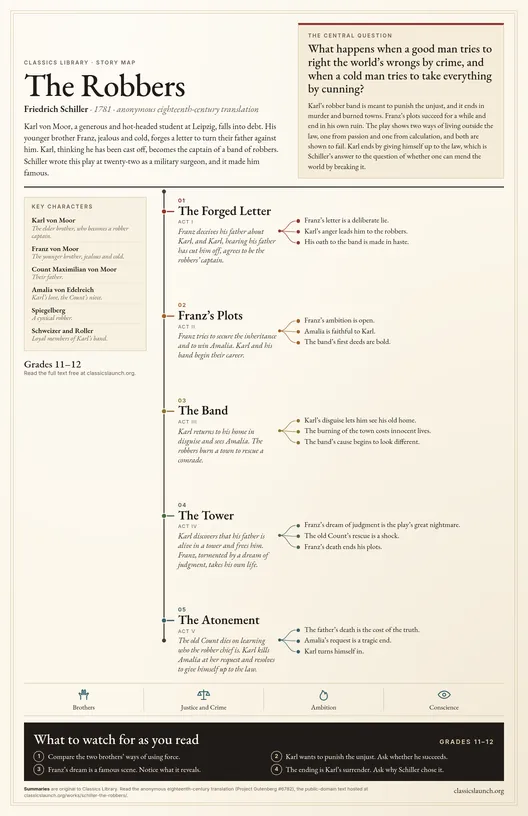 Story mapSee the story mapThe whole book on one page: the story in movements, the characters, and what to watch for. Free to print.
Abstract
Background. Schiller wrote this play as a student at the military academy of Duke Karl Eugen in Stuttgart and published it in 1781. Its staging in Mannheim the next year made him famous.
Plot. One brother deceives his father and drives the other from home. The wronged brother turns outlaw and becomes the leader of a band. The schemer destroys himself, the father dies, and the outlaw, realising that crime cannot mend the world, gives himself up.
Ideas. The play examines the claims of revolt and the limits of the self-appointed avenger, setting God's justice against private vengeance. It also considers how disbelief in conscience breeds cruelty.
Text. The text is an anonymous eighteenth-century English prose translation. It keeps the Latin epigraph from Hippocrates, and the language is high-flown and violent. Stage directions appear in brackets, and the speeches of Karl and Franz are very long. The hosted text is complete as printed here, with its section headings kept as a guide to the reader, and every quotation on this page is drawn directly from that text. Teachers can pair this work with the library's study guide, seminar questions and memory-work selection to prepare a discussion, a short essay or a recitation. The full text is hosted on this site, and each quotation in the guide has been checked against the hosted translation.
Main characters
- Karl von Moor: The elder brother, later a robber chief
- Franz von Moor: His scheming younger brother
- Count Moor: Their deceived father
- Amalia: Karl's beloved
- Spiegelberg: A cynical robber
- Schweizer: A loyal robber
Summary
The Robbers is the play with which Friedrich Schiller, then a young military surgeon in Stuttgart, made himself famous at twenty-two. It is a drama of two brothers. Karl von Moor, the elder, is a generous, hot-headed student at Leipzig who has fallen into debt. Franz, the younger, is jealous, clever and cold, and he has decided that he, and not Karl, will have the title, the lands and the beautiful Amalia, whom their father's family has raised. Franz persuades the old Count by a series of lies, and by a forged letter, that Karl has become a wastrel and a criminal, so that the father disowns him. Karl, who has in fact written to ask his father's forgiveness, receives from Franz a letter of rejection. In rage he lets his student friends make him the captain of a band of robbers, in the Bohemian forests. For a time he thinks of himself as an avenger of the poor who punishes unjust nobles, corrupt judges and cheating priests. But his band burns a town, murders the innocent, and commits crimes that horrify him. Meanwhile at home, Franz imprisons his father in a tower and gives out that he is dead, and he tries to force Amalia to marry him. Karl, returning in disguise, discovers the truth. The ending is terrible. Franz, haunted by a dream of the Last Judgment, tries to escape his conscience and then strangles himself. The robbers free the old Count, who learns that the leader of the band is his own son, and dies of the shock. Amalia, who recognises Karl, begs him to kill her; he does so, and then, realising that he has tried to repair the world's moral order by crime, he decides to deliver himself to the law, and so to be a free-will offering to justice. He leaves to give himself up to a poor labourer, who will thereby win the reward. The play is a fierce study of rebellion, its idealism and its corruption. It was a sensation, and a warning: the revolutionary's good intentions do not keep him from becoming what he opposes. Teachers should be aware that it includes murder, a suicide, and a cruel imprisonment, and that the language is passionate.
Virtues in this work
- Justice: Karl, who has taken justice into his own hands, learns to submit himself to it.
- Humility: His last speech asks Providence to pardon the boy who tried to forestall it.
- Charity: The old Count's love for Karl survives even the lies against him.
- Fortitude: Amalia refuses to marry Franz under any threat.
Plot or Argument
- Act I: The forged letter
Franz deceives his father about Karl, and Karl, hearing his father has cut him off, agrees to be the robbers' captain.
- Act II: Franz's plots
Franz tries to secure the inheritance and to win Amalia. Karl and his band begin their career.
- Act III: The band
Karl returns to his home in disguise and sees Amalia. The robbers burn a town to rescue a comrade.
- Act IV: The tower
Karl discovers that his father is alive in a tower and frees him. Franz, tormented by a dream of judgment, takes his own life.
- Act V: The atonement
The old Count dies on learning who the robber chief is. Karl kills Amalia at her request and resolves to give himself up to the law.
Characters
- Karl von Moor, robber captain
A generous but headstrong young man, deceived by his brother, who becomes an outlaw.
- Franz von Moor, younger brother
A cold schemer who denies conscience and tries to take all his father has.
- Count Maximilian von Moor, father
An old man who loves Karl and is deceived by Franz.
- Amalia von Edelreich, niece
The count's niece, who loves Karl and will not yield to Franz.
- Spiegelberg, robber
A cynical comrade who wants plunder and wickedness.
- Schweizer and Roller, robbers
Loyal followers of Karl who pay with their lives.
Lessons
Injustice does not justify crime
Karl claims that he is amending the world, but his band murders the innocent. His final speech admits that the attempt to keep law by lawlessness ruined the very order he wished to restore.
- How does Karl justify his robbers' crimes at first?
- What does he recognise in the last scene?
Unbelief breeds cruelty
Franz denies all moral law and nature's claims, and treats father and brother as obstacles. His Last Judgment dream shows his conscience asserting itself against his reason.
- What philosophy does Franz profess?
- What does his dream reveal?
Good intentions are not enough
Schiller makes Karl a better man than Franz but shows that his love of justice is distorted by pride. The play warns revolutionary idealists that evil means corrupt good ends.
- Where does Karl's idealism turn to pride?
- How does the play treat the robbers who follow him?
Context
The play belongs to the German 'Storm and Stress', a movement of the 1770s and 1780s that rejected the rationalism of the Enlightenment in favour of passion, genius and rebellion. It is set in the Germany of the poet's own day.
Composition
Schiller wrote the play while a student at the Duke of Württemberg's military academy, and published it at his own expense in 1781. It was staged in Mannheim in January 1782, and Schiller left Stuttgart without permission to see it, for which the duke forbade him to write.
Reception
The play was a sensation across Europe, and revolutionary France made Schiller an honorary citizen in 1792. It inspired Verdi's opera I masnadieri.
Comparisons
- Crime and Punishment
Both works show a rebel who commits crimes to prove that he is above the law and finds his conscience too strong.
- Faust, Part One
Both are major German works of the age of Storm and Stress that deal with striving and guilt.
- The Life of Friedrich Schiller
Carlyle's life of Schiller describes the origin and reception of The Robbers.
- The Brothers Karamazov
Dostoevsky's novel was influenced by Schiller, and also deals with brothers, a father and the question of moral order.
- King Lear
Franz's treatment of his father is like Edmund's, and the play shares Lear's theme of filial betrayal.
Quotes
Frequently cited
“Oh! fool that I was, to fancy that I could amend the world by misdeeds and maintain law by lawlessness! I called it vengeance and equity.”
Frequently cited
“Pardon--pardon the boy who thought to forestall Thee; to Thee alone belongeth vengeance; Thou needest not the hand of man!”
“here I stand on the brink of a fearful life, and learn, with wailing and gnashing of teeth, that two men like myself could ruin the whole edifice of the moral world.”
For Students
A reading companion for classical Christian high school students. See the student guide.
Reading Guide
Watch for
- How Franz speaks about conscience and the soul.
- The moments when Karl's ideals conflict with the actions of his band.
- Each mention of Providence, vengeance and law.
Key terms and names
- Storm and Stress
- The German literary movement of the 1770s and 80s that celebrated passion, genius and rebellion.
- Banditti
- Robbers; the band of criminals led by Karl.
- Providence
- God's ordering of events; Karl comes to believe that vengeance belongs to it alone.
- Atonement
- An act that repairs a wrong; Karl's final deed is meant to be one.
Seminar Questions
- Comprehension How does Franz deceive his father?
- Comprehension What does Karl decide at the end of the play?
- Interpretation Why does Schiller make Karl a sympathetic outlaw?
- Interpretation What does Franz's dream tell us about his philosophy?
- Interpretation What does Amalia's death add to the ending?
- Big Question Can crime ever serve justice?
- Big Question What does the play say about the limits of reason in morals?
Faith Connections
- Romans 12:19 (Scripture)
'Vengeance is mine, I will repay, says the Lord.' Karl's last speech reaches this conclusion.
- Genesis 4 (Scripture)
The story of Cain and Abel is an ancient pattern of brothers divided by envy.
- Augustine, City of God, Book XIX (Great Conversation)
Augustine's account of a just order sets the peace of God against the order of robber bands.
Logic and Rhetoric
Central argument: Evil means cannot repair injustice, since they corrupt both the doer and the order they wish to heal.
Rhetorical device: monologue of self-recognition. In the last scene Karl, alone, reviews his career and reverses his judgment of it.
Debate: Resolved: That unjust treatment justifies a man in taking the law into his own hands.
Memory Work
Oh! fool that I was, to fancy that I could amend the world by misdeeds and maintain law by lawlessness! I called it vengeance and equity.
Pardon--pardon the boy who thought to forestall Thee; to Thee alone belongeth vengeance; Thou needest not the hand of man!
Writing Prompts
Essay: Karl calls himself an avenger, yet at the end he surrenders. Explain how Schiller prepares this change.
Comparison with Crime and Punishment: Compare Karl's surrender with Raskolnikov's confession.
Medical Lens
Franz's despair in Act V ends in suicide after a dream of the Last Judgment; teachers should handle the scene with care.
- Act V
Franz, haunted by a dream of judgment, strangles himself.
Creative Prompts
- Essay
Compare Franz's philosophy with Karl's. Which brother is the greater moral failure, and why?
- Dialogue
Write the conversation between Karl and the old Count in the tower, if Karl had been able to say who he was.
- Classroom
Debate whether Karl's decision to deliver himself to the law is an act of justice or of pride.
Further Reading
- The Life of Friedrich Schiller, Thomas Carlyle
Carlyle's biography, hosted in this library.
- Wallenstein, Friedrich Schiller
Schiller's later and more mature treatment of loyalty and ambition.
- The Sorrows of Young Werther, Johann Wolfgang von Goethe
Another landmark of Storm and Stress, hosted in this library.
- The Brothers Karamazov, Fyodor Dostoevsky
A later novel on brothers, a father and moral rebellion, influenced by Schiller.
Verification notes
Full text from Project Gutenberg, an anonymous English translation of the eighteenth century, in public domain; the translator is not named in the hosted edition. Quotes were checked against the hosted text.
- Identity of the anonymous translator and the exact year of translation.
- The hosted text's division into acts.