Work record
The Comedy of Errors
c. 1594 (First Folio 1623) · Renaissance Early Modern · Drama · English (Early Modern)
Abstract
Background. Shakespeare joined two Roman comedies by Plautus, the Menaechmi and the Amphitruo, and framed them with a romance of shipwreck and recovery. A Gray's Inn revels account records a performance in December 1594.
Plot. Arriving in hostile Ephesus, a young Syracusan and his slave are taken for their identical brothers, who live there. A wife claims the visitor at her table while her real husband rages outside the bolted door. A goldsmith's chain, a purse of ducats and a ring travel to the wrong hands, producing an arrest, mutual beatings, a quack exorcism and confinement for the citizen twin. Fleeing what they take for sorcery, the travelers hide in a priory, and by the time the Duke brings Egeon to the block both pairs are face to face.
Structure. The classical unities of time and place are observed with unusual strictness: one city, one day, and a sunset deadline that drives the farce toward its single recognition scene.
Themes. Selfhood lost and recovered through kin, the strains of marriage, rash diagnoses of madness, and law softened by mercy.
Significance. Shakespeare's briefest play shows his early mastery of comic plotting and anticipates the shipwrecked twins of Twelfth Night and the reunions of his late romances.
Main characters
- Egeon: Syracusan merchant condemned to die by nightfall
- Antipholus of Syracuse: Wandering son mistaken for his married twin
- Antipholus of Ephesus: Settled citizen shut out, arrested and pronounced possessed
- Dromio of Syracuse: Punning servant pursued by a kitchen maid
- Dromio of Ephesus: His twin, thrashed for messages he never got
- Adriana: Ardent, suspicious wife of the Ephesian brother
- Luciana: Her unmarried sister, wooed by the stranger
- Emilia: Abbess revealed as Egeon's long-lost wife
- Doctor Pinch: Schoolmaster-exorcist who binds the supposed madman
- Solinus: Duke of Ephesus, pardoner at the close

Summary
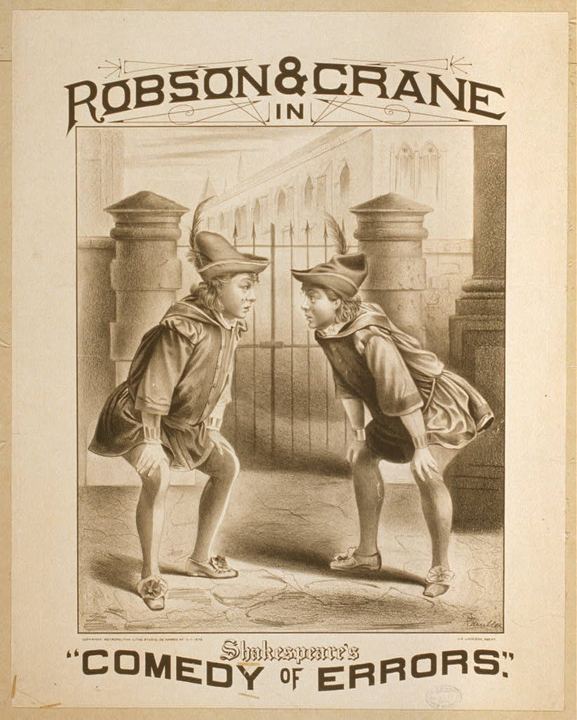
The Comedy of Errors takes place in a single day in the Greek city of Ephesus, where two sets of identical twins, separated as babies, are mistaken for each other until the whole town seems bewitched. Egeon, an old merchant of Syracuse, has been arrested because the two cities are at war and any Syracusan found in Ephesus must pay a thousand marks or die. Asked by Duke Solinus why he came, Egeon tells his story: years ago in Epidamnum his wife Emilia bore twin sons, and on the same day a poor woman bore twin boys whom Egeon bought to serve them. A shipwreck split the family, Egeon keeping one son and one servant, Emilia the others. When his son turned eighteen he went in search of his brother, and Egeon has been searching for both for five years. Moved, the Duke gives him until sunset to find the money. That son, Antipholus of Syracuse, has just landed in Ephesus with his servant Dromio of Syracuse. Unknown to him, his twin, Antipholus of Ephesus, is a respected citizen married to Adriana, with a servant who is the twin Dromio of Ephesus. The Ephesian Dromio summons the wrong master home to dinner and is beaten for talking nonsense about a wife; Adriana and her sister Luciana then claim the bewildered traveler, who goes along with them, wondering whether he is dreaming or mad. While he dines upstairs, the real husband is locked out of his own house by his own servant's twin and goes off angrily to dine with a Courtesan, promising her a gold chain meant for his wife. Antipholus of Syracuse falls in love with Luciana, and his Dromio flees the attentions of the kitchen maid, Nell. Angelo the goldsmith hands the chain to the wrong brother and has the right one arrested for not paying. Money, a rope's end and a ring go astray, and each master beats the other's servant. Adriana fetches Doctor Pinch, a schoolmaster and conjurer, who pronounces her husband possessed; Antipholus of Ephesus and his Dromio are bound and shut in a dark room. The Syracusan pair, terrified of the town's witchcraft, take sanctuary in a priory, whose Abbess rebukes Adriana for driving her husband mad with jealousy. At sunset the Duke leads Egeon to execution past the priory; the escaped Ephesian Antipholus demands justice, and the Abbess brings out the other twins. The two Antipholuses and two Dromios stand together, the Abbess reveals that she is Emilia, Egeon's lost wife, the Duke pardons Egeon, Antipholus of Syracuse renews his suit to Luciana, and the Dromios go in hand in hand. The play, based on Plautus's Menaechmi, was performed at Gray's Inn on 28 December 1594 and first printed in the First Folio of 1623.
Virtues in this work
- Hope: Egeon keeps searching for his wife and sons for years and travels to hostile Ephesus in the attempt.
- Justice: Duke Solinus upholds the law but gives Egeon a day's grace and pardons him once the truth is known.
- Temperance: Luciana urges her sister to govern her jealousy and speak gently to her husband.
- Humility: The two Dromios refuse to claim precedence and leave the stage hand in hand.
- Charity: The Abbess gives sanctuary to the frightened travelers and offers to nurse the supposed madman herself.
Plot or Argument
- Act 1: A father condemned, a son arrived
Egeon tells the Duke how his family was shipwrecked and divided and is given until sunset to raise a ransom; Antipholus of Syracuse arrives and is scolded by the wrong Dromio for being late to dinner.
- Act 2: The wrong husband
Adriana complains of her husband's absence and Luciana counsels patience; Adriana and Luciana carry the astonished Antipholus of Syracuse home to dinner.
- Act 3: Locked out and in love
Antipholus of Ephesus is shut out of his own house and leaves for the Courtesan's; Antipholus of Syracuse woos Luciana, Dromio of Syracuse escapes the kitchen maid, and Angelo hands over the chain.
- Act 4: Arrest, sorcery and Doctor Pinch
The Ephesian Antipholus is arrested over the chain; the Syracusans, offered gold and claimed by a Courtesan, believe Ephesus is full of witches; Pinch declares the husband possessed and has him bound.
- Act 5: The priory and the reunion
The Abbess shelters the Syracusan twins and blames Adriana's jealousy; at sunset the twins meet before the Duke, the Abbess is revealed as Emilia, Egeon is freed, and all go in to a feast.
Characters
- Egeon, merchant of Syracuse
An old father under sentence of death who has spent years seeking his lost wife and sons.
- Emilia, Abbess at Ephesus
Egeon's lost wife, now head of a priory, who shelters the hunted twins and brings about the reunion.
- Antipholus of Syracuse, Egeon's son, a traveler
A melancholy young man searching for his family who is treated by strangers as a husband and debtor.
- Antipholus of Ephesus, his twin brother, a citizen
A hot-tempered, prosperous husband locked out, arrested and declared mad on one bad day.
- Dromio of Syracuse, servant to Antipholus of Syracuse
A quick-witted clown full of puns who is chased by a kitchen maid who claims him.
- Dromio of Ephesus, servant to Antipholus of Ephesus
The other twin servant, beaten by both masters for errands he never received.
- Adriana, wife of Antipholus of Ephesus
A passionate, jealous wife who loves her husband and fears losing him.
- Luciana, Adriana's sister
An unmarried young woman who preaches patience to her sister and is courted by the wrong brother.
- Solinus, Duke of Ephesus
A ruler bound by harsh law but moved to mercy by Egeon's story.
- Angelo, goldsmith
The craftsman whose gold chain passes to the wrong brother and sets off an arrest.
- Doctor Pinch, schoolmaster and conjurer
A lean, self-important exorcist who feels a pulse, commands Satan to depart, and has the sane husband bound.
- The Courtesan, acquaintance of Antipholus of Ephesus
Wants her ring back or the promised chain and concludes the man is mad.
Lessons
Who am I when no one knows me?
Antipholus of Syracuse compares himself to a drop of water seeking another drop in the ocean: he feels he has lost himself in searching for his family. When everyone in Ephesus calls him by another man's life, he begins to doubt his own mind. The comedy shows how much our sense of self depends on being known by the people who love us.
- Why does Antipholus of Syracuse feel lost even before the mix-ups begin?
- What does he decide to do when Adriana insists he is her husband?
- How does finding his brother answer the feeling he describes in Act 1, Scene 2?
Jealousy and patience in marriage
Adriana and Luciana argue in Act 2 about whether a wife should bear her husband's absences patiently, and in Act 5 the Abbess draws out of Adriana how often she scolded him. Shakespeare treats Adriana's love sympathetically while showing that constant reproach can wound the person it is meant to hold.
- What advice does Luciana give Adriana, and why does Adriana reject it?
- How does the Abbess lead Adriana to blame herself in Act 5?
- Is the Abbess fair to Adriana?
Everyone is sure and everyone is wrong
Each character judges by what he sees, and each judgment is reasonable and mistaken. The goldsmith, the wife, the Courtesan and Pinch all conclude that someone else is lying or mad. The play is a lesson in humility about appearances and in patience before passing judgment.
- Pick one character and list the evidence that convinces him or her. Was it reasonable?
- Why do the characters explain the confusion by madness or witchcraft instead of guessing the truth?
Mercy at sunset
The day begins with a law that condemns Egeon for being born in the wrong city and ends with a reunited family and a pardon. The Duke cannot break the law at first, but the discovery of the truth opens the way for mercy without payment.
- Why does the Duke refuse to pardon Egeon in Act 1?
- What changes at the end so that Egeon goes free?
Context
Shakespeare's comedy belongs to the generation of Elizabethan writers trained in Latin at grammar school, where Plautus and Terence were standard texts. Setting the play in Ephesus links it to the city's ancient reputation for magic, which appears in Acts 19, and to Saint Paul's Letter to the Ephesians on marriage, which Luciana's speech on husbands and wives echoes. The frame story of the shipwrecked merchant comes from the romance tradition, especially the tale of Apollonius of Tyre.
Composition
The main plot comes from Plautus's Menaechmi, about twin brothers mistaken for each other; Shakespeare doubled the confusion by adding twin servants, an idea he took from Plautus's Amphitruo, where a master and servant are both impersonated and a husband is shut out of his house. A record of the Christmas revels at Gray's Inn, published later as Gesta Grayorum, notes a Comedy of Errors like to Plautus his Menechmus performed on the night of 28 December 1594. Its date of composition is uncertain, with estimates running from about 1589 to 1594. The play was first printed in the First Folio of 1623.
Reception
Long regarded as an apprentice farce, the play has proved one of Shakespeare's most reliable comedies on stage because its plot runs with clockwork precision. It was adapted as the Rodgers and Hart musical The Boys from Syracuse (1938) and is often a first Shakespeare play for young readers and actors.
Comparisons
- twelfth-night
Shakespeare returned to twins separated by shipwreck in Twelfth Night, where Viola and Sebastian are mistaken for each other in Illyria; the later play adds disguise, melancholy and deeper love.
- a-midsummer-nights-dream
Both comedies send characters into a night of confusion in which identity and love are scrambled, explained in one play by fairy magic and feared as witchcraft in the other.
- the-taming-of-the-shrew
Another early comedy about marriage and wifely obedience; Luciana's speech on husbands and Katherine's final speech can be read side by side.
- the-odyssey
Egeon's long wanderings after shipwreck and the final recognition of a lost wife and son recall the shape of Odysseus's homecoming.
- the-anatomy-of-melancholy
The Abbess's list of how lost sleep, unquiet meals and barred recreation breed melancholy and madness anticipates the non-naturals that Burton catalogues as causes of melancholy.
Quotes
Frequently cited
“I to the world am like a drop of water That in the ocean seeks another drop, Who, failing there to find his fellow forth, Unseen, inquisitive, confounds himself.”
Frequently cited
“Am I in earth, in heaven, or in hell? Sleeping or waking, mad, or well-advis’d?”
Frequently cited
“The venom clamours of a jealous woman Poisons more deadly than a mad dog’s tooth.”
Frequently cited
“We came into the world like brother and brother, And now let’s go hand in hand, not one before another.”
“Yet this my comfort; when your words are done, My woes end likewise with the evening sun.”
“Give me your hand, and let me feel your pulse.”
“Peace, doting wizard, peace; I am not mad.”
“Unquiet meals make ill digestions; Thereof the raging fire of fever bred, And what’s a fever but a fit of madness?”
For Students
A reading companion for classical Christian high school students. See the student guide.
Reading Guide
Watch for
- Egeon's long story in Act 1, Scene 1: it gives you everything you need to solve the mystery before any character can.
- Every time a gold chain, a bag of money, a ring or a rope changes hands, and who ends up holding it.
- The moment in Act 3, Scene 1 when one brother is locked out of the house while the other dines inside.
- How often characters decide someone is mad or bewitched instead of guessing the truth.
- Who speaks the very last lines of the play, and how they settle the question of who is older.
Key terms and names
- Ephesus
- A Greek city on the coast of Asia Minor, the play's setting, famous in the Bible for its magicians and for Paul's letter to its church.
- Syracuse
- A city in Sicily at war with Ephesus in the play, so that any Syracusan caught in Ephesus must pay or die.
- Mark
- A unit of money; Egeon needs a thousand marks to save his life.
- Farce
- A comedy built on fast action, mistaken identity and physical jokes such as beatings and lock-outs.
- Conjurer
- Someone who claims to command spirits; Doctor Pinch tries to drive a devil out of a man who is simply confused.
- Priory
- A religious house headed by a prior or prioress; the Abbess's priory is where the Syracusans take sanctuary in Act 5.
Seminar Questions
- Comprehension Why has Egeon been sentenced to death, and how long does he have to find the money?
- Comprehension How did the two sets of twins come to be separated?
- Comprehension Why is Antipholus of Ephesus arrested in Act 4?
- Interpretation Antipholus of Syracuse decides to go along with Adriana even though he knows he has never met her. Why does he do it?
- Interpretation Why do so many characters decide that someone is mad or bewitched? What would they have needed to know to see the truth?
- Interpretation The servants are beaten again and again for things they did not do. Is this funny, sad, or both?
- Big Question How much of who we are depends on other people knowing us?
- Big Question When should we be slow to judge what we think we have seen?
Faith Connections
- Acts 19:11-20 (Scripture)
Ephesus was known for exorcists and books of magic, and the sons of Sceva fail when they try to cast out a spirit; Pinch's bungled exorcism plays on the same reputation.
- Ephesians 5:21-33 (Scripture)
Paul's teaching to the Ephesians on husbands and wives lies behind Luciana's argument to Adriana in Act 2, Scene 1, though the play shows both spouses failing in love.
- Luke 15:11-32 (Scripture)
Like the father of the prodigal son, Egeon and Emilia receive lost sons back with a feast; the Abbess invites everyone to a gossips' feast after thirty-three years of travail.
Logic and Rhetoric
Central argument: Every character draws a sensible conclusion from what he sees. But what they see is incomplete, because identical twins are present at once. Therefore their confident judgments of madness, theft and witchcraft are all false, and only the full truth, brought into the open at the priory, can restore order and allow mercy.
Rhetorical device: simile. In Act 1, Scene 2 Antipholus of Syracuse compares himself to a drop of water seeking another drop in the ocean, an image that sets up both his loneliness and the final reunion.
Debate: Resolved: that Adriana, not her husband, is chiefly to blame for the trouble in their marriage.
Memory Work
We came into the world like brother and brother, And now let’s go hand in hand, not one before another.
Am I in earth, in heaven, or in hell? Sleeping or waking, mad, or well-advis’d?
Writing Prompts
Essay: Choose the moment when the play's confusion is at its worst and explain, step by step, how each misunderstanding led to it.
Comparison with Twelfth Night: Compare the separated twins in The Comedy of Errors with Viola and Sebastian in Twelfth Night. Which play treats the reunion more seriously, and how can you tell?
Medical Lens
For a farce, the play contains an unusually full Elizabethan picture of how madness was recognized and treated. Characters read ordinary confusion as madness or demonic possession, and Adriana calls in Pinch, a schoolmaster and conjurer who takes the pulse like a physician, then exorcises in the name of the saints and orders the patient bound and laid in a dark room, the standard period handling of the mad. Antipholus later describes Pinch as a mountebank and a living anatomy, a satirical sketch of the hungry quack. The Abbess offers a rival account in Act 5: disturbed sleep, unquiet meals and lack of recreation breed fever, melancholy and madness, a list that matches the humoral doctrine of the six non-naturals (diet, sleep, exercise, passions and the rest), and she proposes to cure him with wholesome syrups, drugs and holy prayers. The play thus sets folk exorcism, humoral medicine and religious care side by side. Its madness is mistaken, which makes the treatments the satire's target rather than any real illness.
- Act 2, Scene 2 and Act 4, Scene 3
Antipholus of Syracuse wonders whether he is mad or dreaming and concludes that Ephesus is full of sorcerers; the Courtesan decides the Ephesian brother is mad.
- Act 4, Scene 4
Pinch feels the patient's pulse, attempts an exorcism, and has the husband and his servant bound and confined in a dark room.
- Act 5, Scene 1
The Abbess traces the husband's supposed madness to broken sleep, disturbed meals and barred recreation leading to fever and melancholy, and offers syrups, drugs and prayers.
- Act 5, Scene 1
Antipholus of Ephesus describes Pinch as a hollow-eyed mountebank and fortune-teller and tells how he gnawed through his bonds in the dark vault.
Listen to the book
Public-domain audiobook from LibriVox, read by Various volunteers. Recording: Comedy of Errors (version 3) on LibriVox (Internet Archive).
LibriVox recordings are volunteer readings released into the public domain. The reading may follow a different edition from the text in this library.
Creative Prompts
- Classroom
Make a timeline of the single day in Ephesus with two colored lines, one for each Antipholus, and mark every moment where one is mistaken for the other.
- Dialogue
Write the conversation between the two Dromios the morning after the reunion as they compare the beatings each received for the other.
- Fiction
Retell Act 3, Scene 1, the lock-out, as a short story from the point of view of Luce at the door.
- Essay
Is Adriana a jealous wife or a wronged one? Use her speeches in Act 2 and her answers to the Abbess in Act 5.
Further Reading
- Menaechmi, Plautus
The Roman comedy of twin brothers that Shakespeare adapted.
- Amphitryon (Amphitruo), Plautus
Source of the doubled servants and the husband shut out of his house.
- Twelfth Night, William Shakespeare
- The Anatomy of Melancholy, Robert Burton
The fullest English account of the causes of melancholy, including the non-naturals the Abbess invokes.
Verification notes
Plot, characters and sources are standard; the Gray's Inn performance of 28 December 1594 is documented in Gesta Grayorum (printed 1688). Composition date is uncertain and is given as c. 1594 following the manifest. Act and scene locators follow the attached Gutenberg text, which spells the kitchen maid both Luce and Nell. The identification of the Abbess's list with the six non-naturals is an interpretive gloss. Quotes were checked by exact search against the attached text.
No verification flags recorded.