Socrates
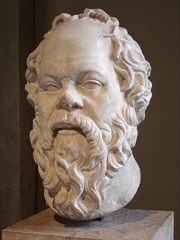
c. 470–399 BC · Athenian philosopher who taught by questioning and was put to death by his city.
Socrates was an Athenian, the son of a stonemason and a midwife. He served bravely as a foot soldier in the Peloponnesian War, but he spent most of his life in the streets and marketplace of Athens, talking with anyone who would talk with him. He wrote nothing himself; what we know comes mostly from his students Plato and Xenophon and from the comic playwright Aristophanes, who mocked him. Socrates questioned people who claimed to know what courage, justice or piety were, and showed through a series of questions that their answers did not hold together. He said that his only wisdom was knowing that he did not know, and that the unexamined life is not worth living for a human being. Many young men admired him; many powerful citizens resented him. In 399 BC he was tried for not honoring the city's gods and for corrupting the youth, and was condemned to death. He refused to escape and died by drinking hemlock, talking calmly with his friends to the end.
Faith: Practiced Athenian religion but was tried for impiety; his critique reshaped religious thought. Source: Wikipedia
Further reading
- Socrates: A Very Short Introduction by C. C. W. Taylor (Oxford University Press, 2019), ISBN 9780198835981
Key dates
- c. 470 BC Born in Athens
- 432–424 BC Serves as a soldier in the Peloponnesian War
- 423 BC Mocked in Aristophanes' Clouds
- 399 BC Tried, condemned and executed
Watch

Videos load from YouTube in privacy-enhanced mode only when you press play.
In their words
“the unexamined life is not worth living”
Read about them
Grades 9–12
- The Last Days of Socrates · In the library
- Meno · In the library
- The Symposium · In the library
More lives
Aristotle · Cicero · Confucius · Epictetus · Epicurus · Heraclitus