Work record
A Princess of Mars
Edgar Rice BurroughsPrincess of Mars; Under the Moons of Mars; Barsoom; John Carter of MarsA Princess of Mars by Edgar Rice Burroughs (1917)A Princess of Mars is the first of Edgar Rice Burroughs’s Barsoom stories.Also known as: Princess of Mars · Under the Moons of Mars · Barsoom · John Carter of Mars
1917 · Early 20th Century · Novel · English
Read this when you want a swift tale of courage, loyalty and a gentleman lost on Mars.
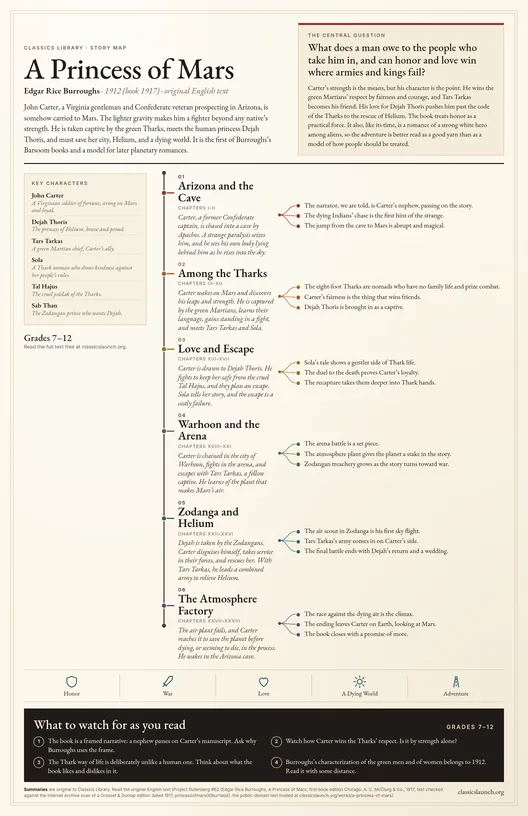 Story mapSee the story mapThe whole book on one page: the story in movements, the characters, and what to watch for. Free to print.
Abstract
The crossing. John Carter, a Virginia cavalry officer who does not seem to age, is trapped in an Arizona cave after the Civil War and wakes on Mars, which its people call Barsoom. There he is taken by the green Tharks, discovers a new strength in the lighter gravity, and begins to learn a harsh life of war, captivity and strange custom, while still keeping the manners of a gentleman.
The princess. Among the Tharks he first sees Dejah Thoris, the princess of Helium, held captive by the green men, and comes to love her. He also gains the friendship of the kind woman Sola, the faithful beast Woola, and the jed Tars Tarkas. Captivity, escape and war follow, and Carter’s honor is tested in the arena, in the air, and in the promises he makes to the princess.
The return. Carter has a part in the overthrow of Zodanga and in the rescue of Helium, is joined to Dejah Thoris, and is then suddenly drawn back to the Arizona cave. The book closes with his hope that he may yet return to the wife and the son whom he believes await him beneath the nearer moon, and with the sense that courage and faithfulness have not been spent in vain.
Main characters
- John Carter: Virginia gentleman on Mars
- Dejah Thoris: Princess of Helium
- Tars Tarkas: green Thark jed and friend
Summary
A Princess of Mars is the first of Edgar Rice Burroughs’s Barsoom stories. It is framed by a foreword in which the writer recalls a mysterious kinsman, John Carter of Virginia, a Confederate cavalry officer who has the look of a man who does not age. Carter’s own narrative then begins in Arizona, after the Civil War, when he is trapped in a cave and, as he tells it, is drawn from his body and wakes on Mars, which the inhabitants call Barsoom. He finds himself stronger in the lighter gravity, is taken by the green Tharks, and learns their speech and their harsh life. Among them he wins a place by courage and by kindness to the huge watch-beast Woola and to the banished Tars Tarkas’s daughter Sola. He also meets Dejah Thoris, Princess of Helium, a red Martian captive, and loves her. The middle of the book is a chain of escapes, recapture, and war: Carter is chained among the Warhoon, fights in the arena, serves as an air scout, and at last takes a hand in the fall of Zodanga and the rescue of Helium. The story ends with a sudden return to the Arizona cave, and with Carter’s hope that he may yet go back to the wife and child who wait for him under the nearer moon. The book is a romance of honor as much as of invention. Carter is a gentleman who keeps faith, tells the truth, and will die for the woman he has promised to protect. Teachers will want to say plainly that the fighting is frequent and that Martian dress is described as almost none, so that a family can judge the book for a given reader. Read in that light, it is a swift tale of loyalty, courage and perseverance, and a useful companion to later scientific romances of travel and war among the worlds.
Virtues in this work
- Fortitude: Carter meets capture, the arena and war without giving up the people he has promised to protect.
- Honor: He will not lie or abandon a friend, and he treats even a strange world as a place where a gentleman’s word must stand.
- Friendship: His kindness to Sola, Woola and Tars Tarkas is repaid in loyalty that helps to save him and the princess.
Plot or Argument
- From Arizona to Barsoom
After a foreword about the strange John Carter, the narrative moves to Arizona, where Carter is trapped in a cave and wakes on Mars. He meets the green Tharks, discovers his new strength, and is made a prisoner among a warlike people.
- Dejah Thoris and the making of a friend
Carter learns the language, wins respect in fight, and meets Dejah Thoris, Princess of Helium, a captive of the Tharks. He also gains the friendship of Sola and of Tars Tarkas, and he loves the princess.
- War, escape, and the Arizona cave
Carter is recaptured, fights in the arena, serves in the air, and helps to break the power of Zodanga and to save Helium. At the moment of joy he is drawn back to the Arizona cave, and the book closes with his hope of return.
Characters
- John Carter, virginia gentleman and former Confederate officer
A Virginia gentleman and former Confederate officer who wakes on Mars and becomes a warlord and husband of Dejah Thoris.
- Dejah Thoris, Princess of Helium
Princess of Helium, a red Martian captive whose courage and loyalty match Carter’s love.
- Tars Tarkas, green Thark jed
A green Thark jed who becomes Carter’s friend and later jeddak.
- Sola, Daughter of Tars Tarkas
Daughter of Tars Tarkas, kind to Carter and to Dejah Thoris when others are cruel.
- Woola, huge Martian watch-beast
A huge Martian watch-beast whose faithfulness to Carter is one of the book’s plain virtues.
- Sarkoja, older Thark woman
An older Thark woman, jealous and cruel, who works against the captives.
Lessons
Honor travels with the man
Carter keeps the manners of a Virginia gentleman on Mars: he will not lie, he will not abandon a friend, and he will risk his life for a promise. The setting changes; the duty does not.
- What does Carter refuse to do even when it would be easy or useful?
- How does his treatment of Woola and Sola differ from the Thark custom?
- Is honor here a feeling, or a set of acts?
Courage and gentleness together
The book’s hero is a fighter, but the people who help him are often those to whom he has been kind. Strength without kindness would not have won Tars Tarkas or the princess.
- Where does kindness do what force cannot?
- What does Dejah Thoris risk, and why?
- How should a reader judge a story that mixes love with frequent killing?
Loyalty under strange skies
Carter is far from home, yet he binds himself to friends and to a city not his own. The Christian reader may ask what it means to keep faith when the old supports of home and church are not in view.
- To whom does Carter owe loyalty by the end of the book?
- What does the return to Arizona cost him?
- How is homesickness related to hope in the last chapter?
Context
The book belongs to the early scientific romance, written when canals on Mars were still widely discussed and when magazine adventure was a mass entertainment in America. It also draws on the memory of the Civil War and on the Arizona frontier, so that a cavalry officer of the old South becomes a wanderer among invented nations.
Composition
The story first appeared in All-Story magazine in 1912 as Under the Moons of Mars, under the name Norman Bean, and was published as a book by A. C. McClurg & Co. in 1917. It opens the long Barsoom series. The hosted text is the public-domain 1917 book, checked against a Grosset & Dunlap copy dated 1917.
Reception
The book has remained in print as the first of the John Carter stories and has had a long afterlife in illustration, comics and film. It is still read as a founding tale of planetary adventure and as a romance of honor in a strange world.
Comparisons
- From the Earth to the Moon
Verne’s earlier voyage is a feat of calculation and launch; Burroughs begins with a mysterious crossing and then stays on the other world to test a man’s courage and faith.
- Twenty Thousand Leagues Under the Sea
Both books send a resolute man into a hidden world of war and wonder; Carter’s Barsoom, like Nemo’s sea, is a place where loyalty and force are constantly at issue.
- Tarzan of the Apes
The same author’s jungle hero, also in this library, is another tale of a civilized man proved in a wild place, though the racial language of Tarzan needs a teacher’s care.
- The War of the Worlds
Wells imagines Mars coming to Earth in terror; Burroughs sends an Earthman to Mars and makes the planet a field for honor and love.
Quotes
Frequently cited
“I am a very old man; how old I do not know.”
“here I stood but naked as at the minute of my birth.”
“A warrior may change his metal, but not his heart,’ as the saying is upon Barsoom.”
“I loved Dejah Thoris. The touch of my arm upon her naked shoulder had spoken to me in words I would not mistake, and I knew that I had loved her since the first moment that my eyes had met hers that first time in the plaza of the dead city of Korad.”
For Students
A reading companion for classical Christian high school students. See the student guide.
Reading Guide
Watch for
- How Carter behaves when he first has power among the Tharks, and whom he chooses as friends.
- What Dejah Thoris says about honor and about Helium, and how she acts as a captive.
- Where the book describes Martian dress, so that a reader is not taken by surprise.
- How the ending in the Arizona cave changes the meaning of all that has gone before.
Key terms and names
- Barsoom
- The name the inhabitants give to Mars in this story.
- Thark
- A green Martian people, warlike and communal, among whom Carter is first a prisoner.
- Jed / jeddak
- Titles of a leader and of a greater ruler among the green Martians.
- Helium
- A great city of the red Martians, home of Dejah Thoris.
- Atmosphere factory
- The works that, in this invention, keep the thin air of Barsoom fit to breathe.
Seminar Questions
- Comprehension How does John Carter come to be on Mars, and who are the first people he meets?
- Comprehension Who is Dejah Thoris, and why is she among the Tharks?
- Interpretation What does Carter live by, and how do the Tharks’ customs differ from his?
- Interpretation Is Tars Tarkas changed by Carter’s friendship, or only revealed?
- Big Question Can a man keep the honor of his home when every custom around him is different?
- Big Question What is the difference between courage in battle and faithfulness in love, and does the book hold them together?
Faith Connections
- Ruth 1:16-17 (Scripture)
Ruth’s vow to go where another goes, and to make another’s people her own, is a measure of Carter’s binding of himself to Dejah Thoris and to Helium, far from Virginia.
- John 15:13 (Scripture)
The word that no one has greater love than to lay down his life for his friends is the standard by which Carter’s risks for the princess and for Tars Tarkas may be judged.
- Jules Verne, From the Earth to the Moon (Great Conversation)
Verne’s voyage, in this library, is a useful companion on the older scientific romance of leaving the Earth.
Logic and Rhetoric
Central argument: A man of honor can keep faith, courage and love even when he is cut off from every familiar law and land, because those goods live in the will and not only in a country’s custom.
Rhetorical device: first-person pulp romance. Carter tells his own story at a swift pace, with set combats and sudden turns, so that character is shown in action more than in reflection.
Debate: Resolved: That a gentleman’s honor is the same on Earth and on another world.
Memory Work
I am a very old man; how old I do not know.
A warrior may change his metal, but not his heart,’ as the saying is upon Barsoom.
Writing Prompts
Essay: Show how John Carter’s honor is proved on Barsoom, using three scenes, and say what a Christian reader should praise and what he should treat with care.
Comparison with Tarzan of the Apes: Compare the way Burroughs tests a civilized man in two wild places, Barsoom and the African jungle, and say how a teacher should present each book.
Medical Lens
The book describes wounds, arena combat, the hatching and upbringing of Thark children, and Carter’s strange bodily passage between worlds. It is of slight medical interest except as pulp invention.
- Chapter VII: Child-Raising on Mars
Sola explains the harsh communal rearing of Thark young.
Creative Prompts
- Essay
Explain how John Carter’s idea of honor is tested on Barsoom, using three scenes, and say what remains unchanged in him.
- Fiction
Write a short scene in which Sola, not Carter, tells Dejah Thoris what kind of man the Earthman has shown himself to be.
- Classroom
Draw a simple map of the places named (Helium, Zodanga, Thark country, the atmosphere factory) and mark Carter’s captures and escapes.
Further Reading
- Tarzan of the Apes, Edgar Rice Burroughs
The same author’s other famous adventure, also hosted in this library; read with the cautionary note on that page.
- Twenty Thousand Leagues Under the Sea, Jules Verne
An earlier scientific romance of a resolute traveler in a hidden world, in this library.
- From the Earth to the Moon, Jules Verne
A voyage from Earth toward another world, in this library.
Verification notes
The text is Project Gutenberg eBook #62, the 1917 book text, checked against the Internet Archive scan princessofmars00burriala (Grosset & Dunlap, dated 1917). The first book publisher is A. C. McClurg & Co., 1917; the story was serialized in 1912 as Under the Moons of Mars. Burroughs’s dates and the magazine history follow standard accounts and are only partly visible in the hosted front matter.
- The 1912 magazine appearance under the name Norman Bean, and the exact McClurg publication month of 1917, follow standard reference accounts.
- Burroughs’s dates (1875–1950) follow standard reference accounts and are not stated in the hosted text.
- The Grosset & Dunlap scan used for checking is dated 1917; it is a contemporary reprint of the McClurg book, not the first binding.