Work record
Tarzan of the Apes
Edgar Rice BurroughsTarzan; Tarzan of the Apes (1912)Tarzan of the Apes by Edgar Rice Burroughs (1912)Tarzan of the Apes begins with a young English couple, John and Alice Clayton, Lord and Lady Greystoke, put ashore on the African coast and left to die.Also known as: Tarzan · Tarzan of the Apes (1912)
1912 · Early 20th Century · Novel · English
Read this when you want the origin of Tarzan, a jungle hero who teaches himself to read.
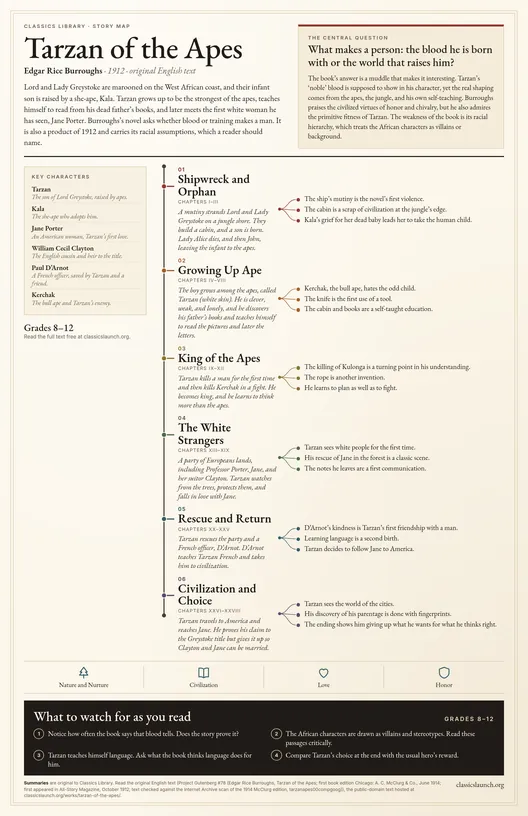 Story mapSee the story mapThe whole book on one page: the story in movements, the characters, and what to watch for. Free to print.
Abstract
The infant and the apes. John and Alice Clayton, Lord and Lady Greystoke, are marooned on the African coast and die there. Their infant son is taken by the ape Kala, named Tarzan, and raised among the tribe of Kerchak, where he learns to survive by strength, by cunning and by a knife, and where the love of a foster mother is his first human-like bond.
Letters and Jane. In his parents’ cabin Tarzan teaches himself to read and write from their books, before he has heard a human voice. When Jane Porter and her party are marooned, he watches, rescues, and loves, still half a beast in manners and already something like a gentleman in courage. The chapters also describe African villagers in language a teacher must stop over and judge.
The costly close. Drawn into the world of men, Tarzan learns the truth of his birth and, in the last chapter, makes a costly choice about his name, his title and Jane, leaving the truth unsaid rather than take a happiness built on another man’s loss. The close is quiet after much blood, and it leaves the hero still half in the jungle.
Main characters
- Tarzan: child of Greystoke, raised by apes
- Kala: foster mother
- Jane Porter: American young woman of the marooned party
Summary
Tarzan of the Apes begins with a young English couple, John and Alice Clayton, Lord and Lady Greystoke, put ashore on the African coast and left to die. Their infant son survives them, is taken by the ape Kala, and is named Tarzan, “white skin.” He grows among the apes, learns to kill, and, finding his parents’ cabin and books, teaches himself to read and write English before he has heard a human voice. When a new party is marooned, including the young American Jane Porter, Tarzan watches, rescues, and loves, still more beast than gentleman in manners and yet already marked by a strange courtesy. The later chapters bring him toward France and England, toward the truth of his birth, and toward a costly choice about Jane and about the cousin who bears his title. The book is swift, inventive and often brutal. It also describes African villagers in language that is of its time and is false to their dignity, and a teacher should say so before a student is far into the jungle chapters. Read with that care, the novel is still a remarkable origin story: a child without a human teacher who yet comes to letters, a loyalty between a foster mother and a son of another kind, and a man who must decide whether strength and honor can enter the world of houses, law and marriage. This library hosts the public-domain book text of 1914, first seen in All-Story Magazine in October 1912, checked against the Internet Archive scan of the McClurg edition. It is the original wording, not a later softening. Parents should treat it as a book for grades 8 and up. A good reading will hold together two tasks: to enjoy a strange origin story, and to refuse what is false in its talk of peoples and of “savage” life.
Virtues in this work
- Fortitude: Tarzan meets danger without panic, and the book, at its best, honors courage in defense of the weak.
- Piety: His love for Kala, a foster mother not of his blood, is one of the true pieties of the story.
- Honor: The last choice, whatever a reader thinks of it, is framed as a refusal to thrive by a silence that would injure another man.
Plot or Argument
- The Claytons and the ape people
John and Alice Clayton are marooned on the African coast and die there. Their infant is taken by the ape Kala, named Tarzan, and raised among the tribe of Kerchak, learning the law of the jungle and the use of the knife.
- The cabin, the books, and Jane
Tarzan finds the cabin and the books of his parents and teaches himself to read and write. A new party is marooned, including Jane Porter and William Cecil Clayton. Tarzan watches them, saves them from danger, and comes to love Jane.
- Among men, and the last choice
Tarzan is drawn into the world of men, learns the truth of his birth, and at the end makes a costly choice about his name, his title and Jane, still carrying the jungle in him.
Characters
- Tarzan (John Clayton), orphaned English child raised by apes
The orphaned English child raised by apes, self-taught in letters, who becomes a hunter, a rescuer and, at last, a man among men.
- Kala, ape
The ape who takes the infant as her own and whose love is the first and deepest bond of Tarzan’s life.
- Jane Porter, young American woman marooned on the coast
The young American woman marooned on the coast, whose courage and kindness draw Tarzan toward human love.
- William Cecil Clayton, Tarzan’s cousin
Tarzan’s cousin, a gentleman of the party, who stands in the place of the Greystoke title.
- Professor Porter, Jane’s father
Jane’s father, a learned and impractical man of the marooned party.
- Kerchak, great ape
The great ape who rules the tribe by force in Tarzan’s youth.
Lessons
A child may be schooled by love and by letters
Kala’s care and the found books together make Tarzan what he is. The book honors a foster mother’s loyalty and the power of written words to reach a mind that has never heard speech.
- What does Kala give Tarzan that the tribe will not?
- How does he learn to read, and why does it matter?
- What kind of education is this, and what is missing from it?
Strength needs a law
Tarzan can kill, and often does. The question the later chapters raise is whether strength will serve a promise, a woman and a name, or only itself.
- When does Tarzan refuse to kill, and why?
- What does he owe Jane, and what does he owe the cousin who bears his title?
- Is the jungle a sufficient law for a man?
Read the jungle chapters with care
The book’s pictures of African people are of their time and are false to human dignity. A Christian reader will not take them as knowledge, but will still weigh the story’s goods: courage, loyalty, self-command and the hunger for a true name.
- Where does the language about African villagers fail the truth?
- Why keep the original wording rather than a silent rewrite?
- What in Tarzan is worth imitating, and what is not?
Context
The story belongs to the magazine adventure of the 1910s, when American readers wanted swift tales of far places, lost heirs and extraordinary bodies. It also draws on older romances of a child raised apart from human society, and on a popular interest in Africa as a stage for such inventions, often with little truth about the people who lived there.
Composition
The story appeared in All-Story Magazine in October 1912 and was published as a book by A. C. McClurg & Co. in June 1914. The hosted text is Project Gutenberg eBook #78, checked against the Internet Archive scan of the 1914 McClurg edition (tarzanapes00compgoog). The year given here is 1912, the first appearance; the book edition is 1914.
Reception
The book founded a long series and a still longer life in film and popular image, much of which is milder or simply different from this first novel. The original remains darker, stranger and more concerned with reading, inheritance and a costly choice than many later pictures of Tarzan suggest.
Comparisons
- The Jungle Book
Kipling’s Mowgli, raised by wolves and taught a Law, is the great predecessor of a human child among beasts; Tarzan is more solitary, more violent, and more entangled in questions of title and inheritance.
- A Princess of Mars
The same author’s John Carter is another civilized man proved in a wild world; the Mars book is a romance of honor among invented nations, while Tarzan needs more care for its pictures of African people.
- Robinson Crusoe
Defoe’s marooned Englishman rebuilds a life by labor and Providence; Tarzan, a child rather than a grown man, is formed first by beasts and only later by books and by Jane.
- The Adventures of Tom Sawyer
Another American tale of a boy’s nerve and invention, far milder, useful as a contrast in how a library presents adventure to younger and older students.
Quotes
Frequently cited
“I was born there,” said Tarzan, quietly. “My mother was an Ape, and of course she couldn’t tell me much about it. I never knew who my father was.”
“I had this story from one who had no business to tell it to me, or to any other.”
“For, though Tarzan of the Apes was a killer of men and of beasts, he killed as the hunter kills, dispassionately”
For Students
A reading companion for classical Christian high school students. See the student guide.
Reading Guide
Watch for
- How Kala treats the child, and what Tarzan owes her later.
- How he teaches himself to read, and what he uses the letters for.
- How African villagers are described, and how a reader should judge that language.
- What he chooses at the end, and what it costs him.
Key terms and names
- Greystoke
- The English title and family name of Tarzan’s father, and later the name at issue in the closing chapters.
- Kala
- The ape who becomes Tarzan’s foster mother.
- Kerchak
- The bull ape who rules the tribe by fear in Tarzan’s youth.
- The cabin
- The Claytons’ shelter, later the place of the books by which Tarzan learns to read.
- The Village of Torture
- A late chapter of jungle war in which a teacher should preview both the violence and the language used of the villagers.
Seminar Questions
- Comprehension What happens to the Claytons, and how does their son come to live among the apes?
- Comprehension How does Tarzan learn to read and write?
- Interpretation What kind of person is Tarzan by the time he meets Jane, and what has formed him?
- Interpretation Why does he make the choice he makes in the last chapter?
- Big Question Can a man be honorable if his strength has been used to kill, and if his picture of other peoples is false?
- Big Question What does a person owe to a foster parent, to a name, and to the truth of his birth?
Faith Connections
- Genesis 1:27 (Scripture)
The truth that every person is made in the image of God is the measure against which the book’s language about African people must be held, and it is not a small measure.
- Proverbs 4:7 (Scripture)
The beginning of wisdom is the getting of wisdom: Tarzan’s hunger for the letters in the cabin is a picture of a mind that wants to know, even when no teacher is there.
- Rudyard Kipling, The Jungle Book (Great Conversation)
Kipling’s Law, in this library, is the great companion on a human child among beasts, and a useful contrast in tone and in moral education.
Logic and Rhetoric
Central argument: A child raised apart from human speech can still come to letters, loyalty and a costly honor, but a book that also treats African people unjustly must be read with a teacher so that strength is not confused with truth.
Rhetorical device: pulp origin romance. Burroughs tells the life in swift chapters, from ship to jungle to the edge of England, so that education, violence and love arrive as a single adventure.
Debate: Resolved: That a man should give up a title rather than take a happiness built on a silence about the truth.
Memory Work
I had this story from one who had no business to tell it to me, or to any other.
I was born there,” said Tarzan, quietly. “My mother was an Ape, and of course she couldn’t tell me much about it. I never knew who my father was.
Writing Prompts
Essay: Explain how Tarzan is formed by Kala, by the books, and by Jane, and then say how a Christian reader should judge the book’s violence and its language about African people.
Comparison with The Jungle Book: Compare Mowgli’s education under the Law of the Jungle with Tarzan’s self-teaching and violence, and say what a teacher should ask a student to keep and to refuse in each book.
Medical Lens
The book is full of combat, wounds and an interest in bodies and inherited nature. It is not a medical study, and its talk of inherited traits should be read as pulp invention, not as science.
- Chapter XXI: The Village of Torture
A chapter of captivity, killing and village war, typical of the book’s violence.
Creative Prompts
- Essay
Explain how Tarzan learns to read, why the books matter, and what they cannot teach him.
- Dialogue
Write a dialogue in which Jane and her father, after a rescue, disagree about whether Tarzan is a man or a danger.
- Classroom
Make a timeline of Tarzan’s life from the marooning of the Claytons to the last chapter, and mark the moments when he chooses not to use his full strength.
Further Reading
- The Jungle Book, Rudyard Kipling
The great predecessor of a child raised by beasts, in this library.
- A Princess of Mars, Edgar Rice Burroughs
The same author’s other famous adventure, also hosted here.
- Robinson Crusoe, Daniel Defoe
The older marooned-Englishman tale, in this library.
Verification notes
The text is Project Gutenberg eBook #78, checked against the 1914 McClurg scan tarzanapes00compgoog. The first appearance was All-Story Magazine, October 1912; the first book edition is June 1914. Burroughs’s dates and the later series history follow standard accounts. The meaning of the name Tarzan as “white skin” is stated in the story.
- The exact magazine issue date (October 1912) and the June 1914 McClurg publication follow standard reference accounts and the McClurg title-page history.
- Burroughs’s dates (1875–1950) follow standard reference accounts and are not stated in the hosted text.