Work record
Captain Blood: His Odyssey
Rafael SabatiniCaptain Blood; Captain Blood: His Odyssey; Peter Blood; Captain Blood (Sabatini); Blood Upon the AltarCaptain Blood: His Odyssey by Rafael Sabatini (1922)Captain Blood: His Odyssey is the story of Peter Blood, a doctor of Bridgewater in Somerset who, in 1685, has put aside soldiering and keeps a quiet practice among his geraniums.Also known as: Captain Blood · Captain Blood: His Odyssey · Peter Blood · Captain Blood (Sabatini) · Blood Upon the Altar
1922 · Early 20th Century · Novel · English
Read this when you want to follow a good man made an outlaw by an unjust law.
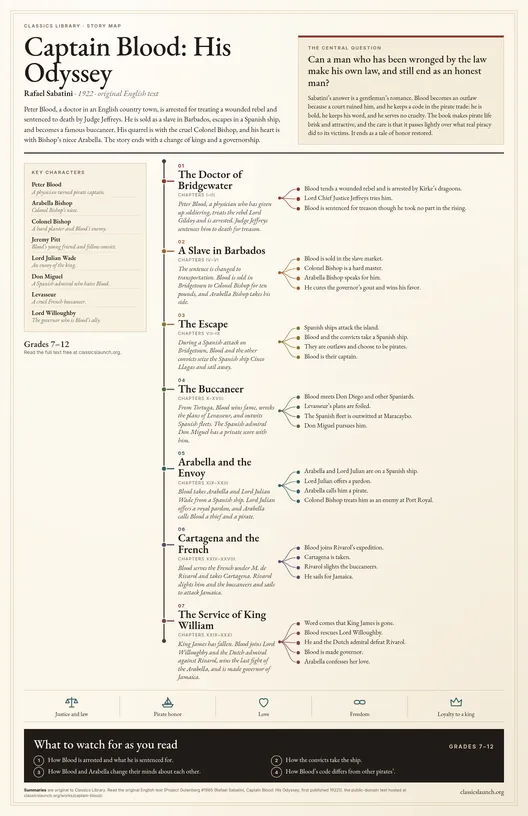 Story mapSee the story mapThe whole book on one page: the story in movements, the characters, and what to watch for. Free to print.
Abstract
The doctor and the slave. Peter Blood, a doctor of Bridgewater, is arrested for tending a wounded rebel after the Monmouth rising. Judge Jeffreys sentences him to death, and the sentence is changed to transportation. He is sold in Barbados to Colonel Bishop for ten pounds, wins the Governor’s favor as a doctor, and is moved by Bishop’s niece, Arabella.
The pirate captain. When a Spanish ship attacks Bridgetown, Blood and his friends seize the Cinco Llagas and become pirates under Captain Blood. From Tortuga they raid Spanish ports, outwit a Spanish fleet at Maracaybo, and meet Arabella and Lord Julian Wade, who offers a pardon from King James. Arabella will not forgive him the pirate’s trade.
The Governor. Blood serves France and takes Cartagena, but his French commander slights him and sails against Jamaica. When King James falls, Blood joins the English and the Dutch, defeats the French fleet at Port Royal, and is made Governor of Jamaica. Colonel Bishop is brought to him a prisoner, and Arabella declares her love. The book thus turns a wronged man into a servant of the crown, and ends where the title said it would, with the wanderer at home.
Main characters
- Peter Blood: physician and buccaneer
- Arabella Bishop: niece of the planter
- Colonel Bishop: planter and Deputy-Governor
- Lord Julian Wade: envoy of King James
Summary
Captain Blood: His Odyssey is the story of Peter Blood, a doctor of Bridgewater in Somerset who, in 1685, has put aside soldiering and keeps a quiet practice among his geraniums. During the rebellion of the Duke of Monmouth against King James the Second, a young messenger summons him to tend the wounded Lord Gildoy, a rebel. Kirke’s dragoons arrest Blood for giving aid to the rebels, though he took no part in the rising, and the Lord Chief Justice, Jeffreys, sentences him to death at the Bloody Assizes. The sentence is changed to transportation, and Blood is shipped to Barbados in the Jamaica Merchant with his friends Jeremy Pitt and Andrew Baynes, and sold in the market at Bridgetown to the brutal Colonel Bishop for ten pounds. Bishop’s niece, Arabella, who has taken a liking to him, stands up to her uncle and is moved by his wit. He cures the Governor’s gout and wins a little freedom. When a Spanish ship attacks Bridgetown, Blood and the other convicts, who are men of the sea, take the Spanish ship, Cinco Llagas, and make a new life as pirates with Blood as their captain. They sail to the island of Tortuga, win a name as the best of the Brethren of the Coast, and meet a series of rogues, among them the Frenchman Levasseur, and the vengeful Spanish admiral Don Miguel de Espinosa. At Maracaybo Blood outwits a Spanish fleet. On a Spanish prize he finds Arabella and Lord Julian Wade, an English envoy sent to offer Blood a pardon in the service of King James. Blood brings them to Jamaica, but Arabella calls him a thief and a pirate, and Bishop, now Deputy-Governor, is his bitter foe. Blood returns to Tortuga, serves the French under M. de Rivarol, and takes Cartagena, only to be slighted by his ally, who then sails against Jamaica. News arrives that King James has been deposed and William of Orange is on the throne. Blood rescues the English Lord Willoughby and the Dutch admiral van der Kuylen, joins them against the French fleet at Port Royal, wins the fight, and is made Governor. Bishop is brought before him as a prisoner, and Arabella confesses her love. The book is a lively romance with an old question: how a man wronged by the law may act, and what a free man owes the country that has wronged him.
Virtues in this work
- Justice: Blood keeps a code among the buccaneers and judges fairly where officials do not.
- Fortitude: He bears the sentence, the slave market and the sea fights without despair.
- Honor: He keeps his word even to his enemies and spares his prisoners.
- Charity: He is a doctor who cares for the sick, even the cruel Governor.
Plot or Argument
- The doctor of Bridgewater
Peter Blood, a physician who has given up soldiering, is called to help the rebel Lord Gildoy. Arrested by Kirke’s dragoons, he is tried by Lord Chief Justice Jeffreys and sentenced to death for treason, though he took no part in the rising.
- A slave in Barbados
The sentence is changed to transportation. Blood is sold in Bridgetown to the cruel Colonel Bishop for ten pounds. Bishop’s niece, Arabella, takes his side, and Blood wins the Governor’s favor by curing his gout.
- The escape
During a Spanish attack on Bridgetown, Blood and the other convicts seize the Spanish ship Cinco Llagas and sail away. They are outlaws, and they choose to be pirates under Captain Blood.
- The buccaneer
From Tortuga, Blood wins fame among the buccaneers, wrecks the plans of Levasseur, and outwits Spanish fleets at Maracaybo. He is pursued by the Spanish admiral Don Miguel, who has a private score to settle.
- Arabella and the envoy
Blood takes Arabella Bishop and Lord Julian Wade from a Spanish ship, and Lord Julian offers him a royal pardon. Arabella calls him a thief and a pirate. At Port Royal, Colonel Bishop treats him as an enemy, and Blood goes back to Tortuga.
- Cartagena and the French
Blood serves the French under M. de Rivarol and takes Cartagena. Rivarol slights him and the buccaneers and sails to attack Jamaica.
- The service of King William
Word comes that King James has fallen. Blood rescues Lord Willoughby and the Dutch admiral van der Kuylen and joins them against Rivarol at Port Royal. He wins the last fight of the Arabella and is made Governor of Jamaica. Arabella confesses her love, and Bishop is brought in as a prisoner.
Characters
- Peter Blood, physician of Bridgewater
A physician of Bridgewater who becomes the buccaneer Captain Blood and later Governor of Jamaica.
- Arabella Bishop, Colonel Bishop’s niece
Colonel Bishop’s niece, who first thinks Blood a pirate and at last loves him.
- Colonel Bishop, cruel owner of Blood in Barbados and later Deputy-Governor of Jamaica
The cruel owner of Blood in Barbados and later Deputy-Governor of Jamaica.
- Jeremy Pitt, young Somerset shipmaster and Blood’s friend
A young Somerset shipmaster and Blood’s friend, who writes the record of his voyages.
- Lord Julian Wade, english envoy of the old school
An English envoy of the old school who offers Blood a pardon and courts Arabella.
- Don Miguel de Espinosa y Valdez, vengeful Spanish admiral
A vengeful Spanish admiral who hunts Blood for years.
- Levasseur, treacherous French buccaneer of Tortuga
A treacherous French buccaneer of Tortuga.
- Lord Willoughby, governor-General of the English islands
The Governor-General of the English islands, who brings Blood into the service of King William.
Lessons
An unjust sentence
Blood is condemned for the kindness of binding up a wounded man. The scene with Judge Jeffreys gives teachers a plain case of a law used as a weapon. Students can ask whether the sentence leaves a good man free to take what is not his, and how Blood answers that question over the course of the book.
- What crime is Blood charged with, and was he guilty?
- How does Judge Jeffreys use the law, and how does Blood answer him?
- Does Blood’s injury excuse what he later does?
A gentleman and a pirate
Blood is a doctor and a gentleman who keeps a code among thieves. He forbids cruelty to women, will not break his word, and spares prisoners. The book is a long argument over whether a pirate can be honorable and whether the code he keeps makes the life he leads right.
- What rules does Blood keep as captain?
- Where does Blood break a rule that he has set himself?
- Is Arabella right to call him a thief and a pirate?
Loyalty to a country that has wronged him
When James is deposed, Blood must choose whether to serve the new king, and he does. The ending asks whether love of country and honest service can heal a wrong, and what a man owes to those who wronged him.
- Why does Blood accept a commission from King William?
- What does he owe to England after the Bloody Assizes?
- What is gained and what is lost when he accepts?
Slavery, white and black
Blood is a slave in Barbados, and the book notices the cruelty that plantation owners show to their servants. Teachers should note that Sabatini pays little attention to the African slaves who work in the same fields, and the use of the words of his time for them is a limit of the book that students can discuss.
- How does Blood’s time as a slave change him?
- What does the book say about the convicts, and what does it leave out?
- Why might the author have passed over the African slaves?
Context
Captain Blood was published in 1922 by Rafael Sabatini, after the success of Scaramouche in 1921. The story is set in 1685 to 1689, in the years of the Duke of Monmouth’s rising against King James the Second, the Bloody Assizes of Judge Jeffreys, and the Glorious Revolution that brought William of Orange to the throne.
Composition
Sabatini built Peter Blood on a number of real figures. Among them was Henry Pitman, a Somerset surgeon who was transported to Barbados after the Monmouth rising, escaped by boat, and wrote an account of his sufferings, and the buccaneer tradition of the Caribbean, in which English privateers fought the Spanish with the quiet approval of the island governors.
Reception
The book was a great success and was made into a film in 1935 with Errol Flynn in the role. It remains Sabatini’s best-known pirate novel, and it set the model of a gallant, educated pirate who is more honorable than the officials who hunt him.
Comparisons
- The Count of Monte Cristo
Both are stories of a man wrongly condemned, sold out of his life, and returned as a power; compare how the two choose between revenge and mercy.
- Treasure Island
The classic pirate novel for younger readers, where Silver is a pirate of a rougher kind than Blood.
- Kidnapped
Stevenson’s novel of a young man sold to a ship and made to fight his way home through a land torn by the aftermath of rebellion.
- The Three Musketeers
Another romance of a gentleman’s code, friendship and swordplay among rogues.
- The Scarlet Pimpernel
A hero who hides his true character behind a disguise and has a wife who misjudges him until the end.
- The Sea-Hawk
Sabatini’s other great sea novel, in which an English gentleman is wronged by his family and becomes a corsair.
- Scaramouche: A Romance of the French Revolution
Sabatini’s romance of a man whose wrongs make him an actor and a fighter in the French Revolution.
Quotes
Frequently cited
“Peter Blood, bachelor of medicine and several other things besides, smoked a pipe and tended the geraniums boxed on the sill of his window above Water Lane in the town of Bridgewater.”
Frequently cited
“I am called Peter Blood, and I am worth precisely ten pounds.”
Frequently cited
“He had reached home at last. His odyssey was ended.”
“only a fool would set himself up as a healer of a species that was best exterminated”
“For a man who can frighten Jeffreys should go far.”
“I judged too harshly where it was a presumption to judge at all.”
“There was never, never anybody but you, Peter.”
For Students
A reading companion for classical Christian high school students. See the student guide.
Reading Guide
Watch for
- How Blood uses his trade as a doctor to change his fortunes.
- What rules Blood sets for his men, and when he must enforce them.
- How Arabella and Blood misjudge one another, and how each changes.
- What the book says about the real history of 1685 to 1689.
Key terms and names
- Transportation
- The sentence of being sent overseas to work, used for felons and rebels.
- Bloody Assizes
- The trials held by Judge Jeffreys after the Monmouth rising, which sent many men to death or exile.
- Buccaneer
- A sea-raider of the Caribbean, especially one who preyed on Spain.
- Brethren of the Coast
- The loose fellowship of buccaneers who met at Tortuga.
- Privateer
- A ship with a government’s leave to attack an enemy’s ships.
- Odyssey
- A long, wandering voyage, after Homer’s poem.
Seminar Questions
- Comprehension Why is Peter Blood arrested, and what is his sentence?
- Comprehension How does Blood escape from Barbados?
- Interpretation How does Sabatini make Blood a pirate whom the reader can admire?
- Interpretation Why does Arabella call Blood a thief and a pirate, and does she have a point?
- Big Question When a law is unjust, how far may a person go to escape it?
- Big Question What should a man owe to the country that has wronged him?
Faith Connections
- Romans 12:19–21 (Scripture)
Do not take revenge, my friends, but leave room for God’s wrath; overcome evil with good. Blood is a man with a grievance and a ship, and the book asks when he gives up revenge for something better.
- Luke 10:25–37 (Scripture)
The Samaritan binds up the wounds of a stranger at a cost to himself. Blood’s trouble begins with his act of mercy to a wounded man, and the parable gives teachers a way to talk about how mercy is repaid.
- Augustine, City of God IV.4 (Great Conversation)
What are kingdoms without justice but great bands of robbers? The remark gives a frame for a book where pirates act more justly than the officials who hunt them.
Logic and Rhetoric
Central argument: A good man may be driven to an outlaw’s life by an unjust law, but he must still answer for what he does as an outlaw.
Rhetorical device: irony. The Governor of Jamaica, Lord Willoughby and Colonel Bishop are shown as the real pirates, while the pirate Blood is the one who shows mercy.
Debate: Resolved: That Peter Blood was justified in becoming a pirate.
Memory Work
I am called Peter Blood, and I am worth precisely ten pounds.
He had reached home at last. His odyssey was ended.
Writing Prompts
Essay: Is Peter Blood more a pirate or a gentleman? Answer with three scenes from the book and one comparison with another character in this reading list.
Comparison with The Count of Monte Cristo: Compare the ways in which Peter Blood and Edmond Dantès answer the wrong that was done to them, and say which man is the better Christian.
Medical Lens
Peter Blood is a physician, and the book shows his skill with wounds, fever and gout, in the care of the convicts on the Jamaica Merchant and the Governor in Barbados. Medicine becomes the means of his rise from slavery. The tone is adventurous and the detail is slight.
- Chapter IV: Human Merchandise
Blood’s care of the sick convicts on the passage to Barbados, and the way a doctor is valued among slaves.
- Chapter VI: Plans of Escape
Blood cures the Governor’s gout and gains favor and freedom of movement.
Creative Prompts
- Essay
Write an essay on whether Peter Blood is a pirate or a gentleman, and support it with three scenes.
- Fiction
Write a scene in which Jeremy Pitt, who kept the log of the voyages, describes Blood’s first night as a slave.
- Dialogue
Write a conversation between Blood and Arabella in which she finally explains why she called him a thief and a pirate.
- Classroom
Plan a mock trial of Peter Blood, with a prosecutor, a defense and a jury, using only what the book says about his deeds.
Further Reading
- The Sea-Hawk, Rafael Sabatini
Sabatini’s earlier sea novel, in this library.
- Scaramouche, Rafael Sabatini
Sabatini’s novel of the French Revolution, in this library.
- A Relation of the Great Sufferings and Strange Adventures of Henry Pitman, Henry Pitman
The real surgeon of the Monmouth rising who was transported to Barbados and escaped.
Verification notes
The text is as given in Project Gutenberg eBook #1965, the 1922 novel, complete in thirty-one chapters. The 1922 publication year, the Monmouth rising and the Bloody Assizes follow standard references; the connection with Henry Pitman is a common critical observation, not a statement made in the novel.
- The text follows Project Gutenberg eBook #1965 and has not been compared with a scan of the 1922 first edition.
- The idea that Henry Pitman’s narrative was one of Sabatini’s sources is a standard critical remark and should be checked in a biography of Sabatini before it is given in class.
- Details of Sabatini’s schooling and intelligence work come from standard reference works and have not been checked in a biography.