Work record
Scaramouche: A Romance of the French Revolution
Rafael SabatiniScaramouche; Scaramouche (Sabatini); Scaramouche: A Romance of the French Revolution; Andre-Louis MoreauScaramouche: A Romance of the French Revolution by Rafael Sabatini (1921)Scaramouche is the story of Andre-Louis Moreau, who is born with a gift of laughter and a sense that the world is mad.Also known as: Scaramouche · Scaramouche (Sabatini) · Scaramouche: A Romance of the French Revolution · Andre-Louis Moreau
1921 · Early 20th Century · Novel · English
Read this when you want to see how a quick wit and a sword meet the French Revolution.
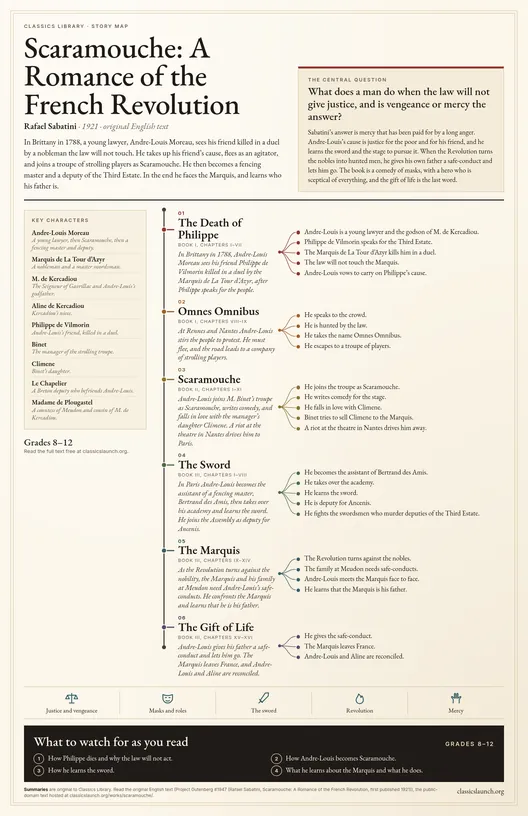 Story mapSee the story mapThe whole book on one page: the story in movements, the characters, and what to watch for. Free to print.
Abstract
The vow. Andre-Louis Moreau, a young Breton lawyer, sees his friend Philippe de Vilmorin killed in a duel by the Marquis de La Tour d’Azyr, and cannot get justice from the law. He speaks for the Third Estate at Rennes and Nantes, is forced to flee, and joins a company of strolling actors, becoming Scaramouche, the clown, who writes the plays and wins the applause of Nantes.
The sword. In Paris he becomes a fencing master, learns of the murders of deputies by duelists, and takes the seat of one of them as deputy for Ancenis. He challenges the nobles who bully the Third Estate, kills the Chevalier de Chabrillane and others, and earns the name of the Paladin of the Third.
The gift of life. As the Revolution turns against the nobles, the Marquis and Andre-Louis’s family are fugitives. At the moment Andre-Louis means to fight his enemy, Madame de Plougastel tells him that the Marquis is his father. He gives the man a safe-conduct and lets him go, and in the end he and Aline are friends again. The tale ends with a gift of mercy, after a long season of revenge, and with the clown at last at peace.
Main characters
- Andre-Louis Moreau: lawyer, actor and fencing master
- Marquis de La Tour d’Azyr: nobleman and swordsman
- Aline de Kercadiou: niece of the Seigneur of Gavrillac
- Philippe de Vilmorin: friend killed in a duel
Summary
Scaramouche is the story of Andre-Louis Moreau, who is born with a gift of laughter and a sense that the world is mad. A young lawyer in the Breton village of Gavrillac in 1788, he is the godson of M. de Kercadiou, the Seigneur of Gavrillac. His dear friend Philippe de Vilmorin, a young nobleman preparing for the priesthood, speaks for the poor and for the Third Estate, and the arrogant Marquis de La Tour d’Azyr, a swordsman and a suitor of Kercadiou’s niece Aline, forces a duel upon him and kills him. Andre-Louis cannot get the law to punish the Marquis, and he swears to carry on his friend’s cause. He speaks at Rennes and Nantes in the name of Omnes Omnibus, rouses the people, and is forced to flee. He joins the commedia dell’arte troupe of M. Binet, and becomes Scaramouche, the clown, a writer and an actor, falls in love with the manager’s daughter Climene, and wins applause in Nantes, until a quarrel over Climene and a riot at the theatre send him fleeing to Paris, where he takes work as the assistant of the fencing master Bertrand des Amis and is brought into contact with Le Chapelier and the leaders of the Revolution. When the master dies, Andre-Louis takes over the academy and learns that the swordsmen of the nobility are murdering their opponents in the National Assembly. He is made deputy for Ancenis in the place of one of those victims, and as the Paladin of the Third he provokes and kills the Marquis’s friends one by one, among them the Chevalier de Chabrillane. In the end he faces the Marquis himself. But the Revolution has turned against the nobility, and the Marquis, Madame de Plougastel and the family at Meudon are in danger and need the safe-conducts that only Andre-Louis can give. In the final scene, when Andre-Louis is about to kill his enemy, Madame de Plougastel declares that the Marquis is his father. Andre-Louis gives him a safe-conduct, the gift of life, and the Marquis goes his way. Andre-Louis and Aline are reconciled. The novel is a lively romance that ends in a gift of mercy, and it asks what a man may do for justice, what revenge does to the one who takes it, and how a man who laughs at the world may still find something to love.
Virtues in this work
- Justice: Andre-Louis wants justice for his friend and for the people against those who abuse their power.
- Fortitude: He bears exile, poverty and danger with good humor.
- Charity: He gives the Marquis his life and a way out of France.
- Friendship: He keeps faith with the dead Philippe and with his friends in Paris.
Plot or Argument
- The death of Philippe
In Brittany in 1788, Andre-Louis Moreau, a young lawyer, sees his friend Philippe de Vilmorin killed in a duel by the Marquis de La Tour d’Azyr after Philippe speaks for the people. The law will not touch the Marquis, and Andre-Louis vows to carry on his friend’s cause.
- Omnes Omnibus
At Rennes and Nantes Andre-Louis stirs the people to protest under the name of Omnes Omnibus. He must flee, and the road leads to a company of strolling players.
- Scaramouche
He joins M. Binet’s troupe as Scaramouche, writes comedy, falls in love with the manager’s daughter Climene and enjoys a brief success. When Binet tries to sell Climene to the Marquis, a riot at the theatre in Nantes drives him from the stage and he flees to Paris.
- The sword
In Paris Andre-Louis becomes the assistant of a fencing master, Bertrand des Amis, then takes over his academy, and learns the sword. He joins the Assembly as deputy for Ancenis and kills the swordsmen who murder deputies of the Third Estate.
- The Marquis
As the Revolution turns against the nobility, the Marquis and the family at Meudon need Andre-Louis’s safe-conducts. He confronts the Marquis and learns that he is his father.
- The gift of life
Andre-Louis gives his father a safe-conduct and lets him go. The Marquis leaves France, and Andre-Louis and Aline are reconciled.
Characters
- Andre-Louis Moreau, young Breton lawyer
A young Breton lawyer who becomes the actor Scaramouche, a fencing master and a deputy.
- Marquis de La Tour d’Azyr, skilled swordsman and nobleman
A skilled swordsman and nobleman who kills Philippe and turns out to be Andre-Louis’s father.
- M. de Kercadiou, seigneur of Gavrillac and Andre-Louis’s godfather
The Seigneur of Gavrillac and Andre-Louis’s godfather.
- Aline de Kercadiou, M. de Kercadiou’s niece
M. de Kercadiou’s niece, who loves Andre-Louis and is courted by the Marquis.
- Philippe de Vilmorin, Andre-Louis’s friend
Andre-Louis’s friend, a young nobleman who is killed.
- Binet, manager of a troupe of players
The manager of a troupe of players.
- Climene, Binet’s daughter
Binet’s daughter, a young actress who loves Andre-Louis.
- Le Chapelier, breton deputy
A Breton deputy, later president of the Assembly, who befriends Andre-Louis.
- Madame de Plougastel, countess and cousin of M. de Kercadiou
A countess and cousin of M. de Kercadiou, the Marquis’s lover and in truth the mother of Andre-Louis.
Lessons
Revenge and justice
Andre-Louis begins as a man who seeks justice and becomes one who seeks revenge. The long chain of duels asks how far a man may go in the name of a dead friend, and the safe-conduct at the end shows a mercy that revenge could not give.
- What does Andre-Louis want in Chapter IV, and how does it change?
- How does Andre-Louis justify the duels of Book III?
- Why does he spare the Marquis at the end?
The mask and the man
Scaramouche is a stock character of the commedia dell’arte, and Andre-Louis wears a mask as an actor, a fencing master and a politician. The book plays on what a mask hides and what it reveals, and on the way a man may discover himself in a role.
- What roles does Andre-Louis play in the book?
- Which of them is nearest to who he really is?
- What does the mask of Scaramouche let him say?
Rank and its abuse
The nobility of the book are of different sorts: some are sworn to justice and some use the sword to murder, and the Revolution is itself capable of violence. The book gives teachers a lively story of a society in which a few are above the law, and of the dangers on both sides.
- Which nobles in the book act with honor?
- What does the Marquis’s killing of Philippe show about the law?
- What does the book say about the Revolution’s own excesses?
A hidden parentage
Andre-Louis grows up as the godson of M. de Kercadiou and does not know that his father is the Marquis and his mother the Countess de Plougastel. The discovery changes his understanding of his enemy and of himself, and raises the question of what a man owes to his parents even when they have failed him.
- What clues does the book give to Andre-Louis’s parentage?
- How does the news change the final duel?
- What does the Marquis say about his own wrong?
Context
Scaramouche was published in 1921, after Sabatini’s success with The Sea-Hawk, and before Captain Blood in 1922. It is set in France in the years 1788 to 1792, in the troubled time of the calling of the States General, the fall of the old order, the National Assembly and the beginnings of the Terror, and it uses real figures such as the Breton deputy Le Chapelier and Danton, who appears among the politicians.
Composition
Scaramouche was a stock character of the Italian commedia dell’arte, a boastful and cowardly clown, and the name gives the book its pun. Sabatini’s hero is much more than the clown: a mask worn by a lawyer, a writer, a swordsman and a deputy, who is as ready with a jest as with a rapier.
Reception
The book was filmed in 1923 and again in 1952, the later version being remembered for its long sword fight. It is Sabatini’s best-known French novel and is often read as a counterpart to Dickens’s A Tale of Two Cities, though it is lighter in tone.
Comparisons
- A Tale of Two Cities
Dickens’s novel of the same Revolution, with a double, a sacrifice and a darker view of its cost.
- The Scarlet Pimpernel
Orczy’s romance of the Terror, in which an English gentleman hides his true self behind a mask.
- Ninety-Three
Hugo’s great novel of the Revolution, in which a hero must choose between law and mercy.
- The Three Musketeers
Dumas’s French romance of friendship, honor and the sword.
- The Count of Monte Cristo
A man wronged by the great is revenged, and learns what revenge costs.
- Captain Blood: His Odyssey
Sabatini’s other romance of a good man wronged by the law and made a fighter.
- The Sea-Hawk
Sabatini’s romance of a gentleman betrayed by a brother and carried off to the sea.
Quotes
Frequently cited
“He was born with a gift of laughter and a sense that the world was mad. And that was all his patrimony.”
Frequently cited
“God after all, reflected Andre-Louis, was not a grand-seigneur.”
Frequently cited
“In life we pay for the evil that in life we do.”
“the gift of life”
For Students
A reading companion for classical Christian high school students. See the student guide.
Reading Guide
Watch for
- How the death of Philippe de Vilmorin sets the course of the book.
- How each of Andre-Louis’s masks, lawyer, actor, fencer and deputy, suits him.
- How the book treats the nobles and the Revolutionaries, and where it is unfair.
- The final scene of the safe-conduct, and what it says about mercy.
Key terms and names
- Third Estate
- The common people of France, as against the clergy and nobles.
- Commedia dell’arte
- Italian stage comedy with stock masked characters, such as Scaramouche.
- National Assembly
- The body formed in 1789 by the Third Estate to give France a constitution.
- Safe-conduct
- A paper that lets a person pass safely through a dangerous area.
- Spadassin
- A hired swordsman or bully who kills in the guise of a duel.
- Suppleant
- A deputy chosen to take the place of one who has died or resigned.
Seminar Questions
- Comprehension How does Philippe de Vilmorin die, and why can the law do nothing?
- Comprehension How does Andre-Louis come to be a deputy for Ancenis?
- Interpretation What does the mask of Scaramouche do for Andre-Louis?
- Interpretation How does the revelation about the Marquis change the last scene?
- Big Question When the law fails, what may a man do for justice?
- Big Question Is mercy to an enemy a weakness or the strongest thing a man can do?
Faith Connections
- Romans 12:19–21 (Scripture)
Do not take revenge, but leave it to the wrath of God; overcome evil with good. Andre-Louis’s first answer to his friend’s death is revenge, and his last is a gift of mercy.
- Matthew 5:43–48 (Scripture)
Love your enemies and pray for those who persecute you. The safe-conduct that Andre-Louis gives to the Marquis may be read against this teaching, with care for the fact that the enemy is also his father.
- Epictetus, Enchiridion 17 (Great Conversation)
Remember that you are an actor in a play of such a kind as the author wishes; play the part well. Andre-Louis quotes Epictetus in his letters, and the book plays on the idea of a part in a drama.
Logic and Rhetoric
Central argument: Revenge and mercy are the two answers to a wrong, and the book follows a man from one to the other.
Rhetorical device: irony. A man who laughs at the world is the one who is most serious about justice, and the actor Scaramouche turns out to be the most honest man in the book.
Debate: Resolved: That Andre-Louis was right to kill the Marquis’s friends.
Memory Work
He was born with a gift of laughter and a sense that the world was mad. And that was all his patrimony.
In life we pay for the evil that in life we do.
Writing Prompts
Essay: How does Sabatini use the idea of a mask or a role to show who Andre-Louis really is? Answer with three scenes.
Comparison with A Tale of Two Cities: Compare the French Revolution as it appears in Scaramouche and in A Tale of Two Cities, and say which gives a fairer view.
Medical Lens
The book has several sword duels with wounds and killings, told in a vivid but not graphic manner, and a mob scene in which one deputy is murdered by duelists. There is no medical content beyond these.
- Book III, Chapter VII: The Spadassinicides
The deaths of deputies in forced duels, and the wound the Marquis takes from Andre-Louis.
Creative Prompts
- Essay
Explain how the mask of Scaramouche lets Andre-Louis say what he could not say as a lawyer.
- Dialogue
Write the conversation in which Andre-Louis tells M. de Kercadiou why he cannot go back to Gavrillac.
- Fiction
Write a scene for Binet’s troupe in the style of the commedia dell’arte, with Scaramouche as the hero.
- Classroom
Make a map of Andre-Louis’s travels from Gavrillac to Paris and mark the roles that he plays in each place.
Further Reading
- A Tale of Two Cities, Charles Dickens
Dickens’s novel of the Revolution, in this library.
- The Scarlet Pimpernel, Baroness Orczy
Orczy’s romance of the Terror, in this library.
- Ninety-Three, Victor Hugo
Hugo’s last novel of the Revolution, in this library.
Verification notes
The text is as given in Project Gutenberg eBook #1947, the 1921 novel, complete in three books and thirty-six chapters. The historical frame, the real figures of Le Chapelier and Danton, and the film dates follow standard reference works.
- The text follows Project Gutenberg eBook #1947 and has not been compared with a scan of the 1921 first edition.
- The film dates, 1923 and 1952, should be checked in a film reference before they are given in class.
- The remark on Le Chapelier’s presidency and on Danton’s appearance follows standard history and the book’s own pages.