Work record
The Sea-Hawk
Rafael SabatiniSea-Hawk; The Sea Hawk; The Sea-Hawk (Sabatini); Sakr-el-Bahr; Sir Oliver TressilianThe Sea-Hawk by Rafael Sabatini (1915)The Sea-Hawk begins in Cornwall in the later reign of Queen Elizabeth, where Sir Oliver Tressilian, a proud and generous gentleman, lives at Penarrow with his younger brother Lionel and is betrothed to Rosamund Godolphin.Also known as: Sea-Hawk · The Sea Hawk · The Sea-Hawk (Sabatini) · Sakr-el-Bahr · Sir Oliver Tressilian
1915 · Early 20th Century · Novel · English
Read this when you want a fast sea tale about betrayal, slavery and the road home.
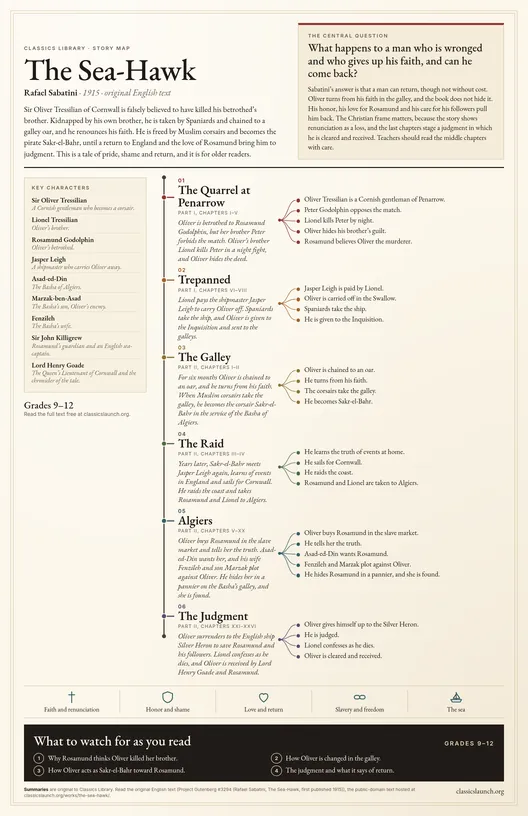 Story mapSee the story mapThe whole book on one page: the story in movements, the characters, and what to watch for. Free to print.
Abstract
Betrayal. Sir Oliver Tressilian, a Cornish gentleman, hides the wounded Lionel, who has killed Peter Godolphin in a quarrel, and takes the blame. Rosamund, his betrothed, believes him guilty. Lionel pays Jasper Leigh to trepan Oliver aboard the Swallow so that he is lost to slavery.
The corsair. Spaniards capture the vessel, and Oliver is given to the Inquisition and the galleys, and in anger turns from the faith. Muslim corsairs free him, and as Sakr-el-Bahr he rises to command in the service of the Basha of Algiers.
The return. He sails to England, takes Rosamund and Lionel to Algiers, buys Rosamund in the slave market and tells her the truth. The Basha wants her, and his wife Fenzileh and son Marzak plot against Oliver. He tries to smuggle Rosamund out in the Basha’s own galley, but she is discovered and his men turn mutinous. He gives himself up to an English ship to save her and his followers. Lionel, wounded in the fight, confesses as he dies, Oliver is cleared, and Rosamund embraces him. The tale ends in the reunion of the pair and the promise of Oliver’s pardon.
Main characters
- Sir Oliver Tressilian: Cornish gentleman and corsair
- Rosamund Godolphin: his betrothed
- Lionel Tressilian: his brother
- Asad-ed-Din: Basha of Algiers
Summary
The Sea-Hawk begins in Cornwall in the later reign of Queen Elizabeth, where Sir Oliver Tressilian, a proud and generous gentleman, lives at Penarrow with his younger brother Lionel and is betrothed to Rosamund Godolphin. Her brother Peter Godolphin, who despises the Tressilians as upstarts enriched by Oliver’s father’s sea-roving, forbids the match, and the quarrel becomes violent. That night Lionel fights and kills Peter Godolphin in the dark. Oliver hides the wounded Lionel and the blame falls on himself, and Rosamund, believing him a murderer, breaks with him. Lionel, who wants Oliver out of the way, pays the rascally shipmaster Jasper Leigh to trepan him aboard the Swallow, so that he may be sold into slavery. A Spanish ship takes the Swallow, and Oliver and Leigh are handed to the Inquisition at Lisbon, where Oliver accepts the Church’s correction to save his life, and then are sentenced to the galleys. For six months Oliver is chained to an oar. In his anger at what he suffers he declares that he will own no religion in whose name such things are done. When Muslim corsairs under the Basha Asad-ed-Din take his galley, he joins them, takes the turban and becomes the famous captain Sakr-el-Bahr, the Hawk of the Sea, scourge of the Mediterranean. In time he captures a Spanish ship with Jasper Leigh aboard, learns what has happened in England, and sails for England, where he raids the coast of Cornwall and carries off Rosamund and Lionel to Algiers. There Rosamund is put up in the slave market and Oliver, by a ruse, buys her himself and takes her to his house. He tells her the truth, and she learns how much she has wronged him. But Asad’s wife Fenzileh and their son Marzak hate Oliver and work against him, and Asad wants Rosamund for his own. Oliver hides her in a pannier aboard the Basha’s galley, where she is found, and his own men turn mutinous. At the last, he gives himself up to the English ship, the Silver Heron, to save her and his men. At his trial Lionel, who has been wounded in the fight, confesses before he dies, and Oliver’s honor is cleared. Lord Henry Goade, the Queen’s Lieutenant, promises him a pardon, and Rosamund embraces him. The book is a rapid and vivid tale of honor and betrayal, with a hero whose loyalty to a brother nearly destroys him.
Virtues in this work
- Honor: Oliver bears the loss of his name to shield his brother, and keeps his word to his enemies.
- Fortitude: He endures the galley without despair and fights on.
- Faith: The book shows the loss of faith through suffering, and leaves open the question of its return.
- Charity: He spares those who betrayed him.
Plot or Argument
- The quarrel at Penarrow
Sir Oliver Tressilian of Cornwall is betrothed to Rosamund Godolphin, but her brother Peter forbids the match. Oliver’s brother Lionel kills Peter in a night fight, and Oliver hides the deed. Rosamund believes Oliver the murderer.
- Trepanned
Lionel pays the shipmaster Jasper Leigh to carry Oliver off in the Swallow. Spaniards take the ship, and Oliver is given to the Inquisition and sent to the galleys.
- The galley
For six months Oliver is chained to an oar, and he turns from his faith. When Muslim corsairs take the galley, he is freed and becomes the corsair Sakr-el-Bahr in the service of the Basha of Algiers.
- The raid
Years after, Sakr-el-Bahr meets Jasper Leigh again, learns of events in England and sails for Cornwall. He raids the coast and takes Rosamund and Lionel to Algiers.
- Algiers
Oliver buys Rosamund in the slave market and tells her the truth. Asad-ed-Din wants her, and his wife Fenzileh and son Marzak plot against Oliver. He hides her in a pannier aboard the Basha’s galley, and she is found.
- The judgment
Oliver surrenders to the English ship Silver Heron to save Rosamund and his followers. Lionel confesses as he dies, clearing his brother, and Oliver is received back by Lord Henry Goade and Rosamund.
Characters
- Sir Oliver Tressilian, cornish gentleman betrayed by his brother
A Cornish gentleman betrayed by his brother who becomes the corsair Sakr-el-Bahr.
- Lionel Tressilian, Oliver’s younger brother
Oliver’s younger brother, whose deed and cowardice send Oliver into slavery.
- Rosamund Godolphin, Oliver’s betrothed
Oliver’s betrothed, who believes the worst of him and later learns the truth.
- Jasper Leigh, rascally shipmaster
A rascally shipmaster who trepans Oliver and later serves him.
- Asad-ed-Din, basha of Algiers
The Basha of Algiers, an old corsair who befriends Oliver and then desires Rosamund.
- Marzak-ben-Asad, basha’s jealous son
The Basha’s jealous son, who works against Oliver.
- Fenzileh, Asad’s Sicilian wife and Marzak’s mother
Asad’s Sicilian wife and Marzak’s mother, a schemer who works against Oliver.
- Sir John Killigrew, Rosamund’s guardian and an English sea-captain
Rosamund’s guardian and an English sea-captain.
- Lord Henry Goade, queen’s Lieutenant of Cornwall and the supposed chronicler of the tale
The Queen’s Lieutenant of Cornwall and the supposed chronicler of the tale.
Lessons
Loyalty to a guilty brother
Oliver hides Lionel’s wound and takes the blame, and his loyalty costs him his name, his betrothed and years of his life. Students can ask whether he was right to shield his brother and whether he had a duty to the truth, and what Lionel owes him in return.
- Why does Oliver conceal Lionel’s wound?
- What does the choice cost Oliver in the first part of the book?
- What does Lionel’s confession at the end give back to him?
Renouncing the faith
A cruel experience and a bitter heart lead Oliver to give up the faith in which he was born. The book calls this a wound laid on him by the cruelty of others and ends in his honor and his home, without taking up the matter of his soul. A classical Christian reader may find in this a story of a loss that the book itself leaves open, and may compare it with Peter’s denial and his return.
- What leads Oliver to renounce Christianity, and what is the book’s attitude to it?
- How would the story of Peter’s denial and restoration deepen the book’s ending?
- What does the book leave unsaid about Oliver’s faith?
Justice and false judgment
Rosamund and the whole county believe the worst of Oliver on little evidence. Her later words, “You always did believe the best of me,” are spoken in bitterness. The book shows how a hasty judgment can ruin a good man, and how long it takes to undo one.
- Why does Rosamund believe Oliver guilty?
- How does Oliver’s response to her change over the book?
- What does the book teach about rash judgment?
Mercy to enemies
Oliver spares Jasper Leigh, who betrayed him, and later gives himself up to save others. The book is generous to enemies and may be put beside the teaching that one should return good for evil.
- Why does Oliver spare Jasper Leigh?
- What does Oliver give up at the end, and for the sake of whom?
- Is Oliver’s mercy a sign of strength or weakness?
Context
The Sea-Hawk was published in 1915. It is set in the later reign of Elizabeth I, in the age of English seamen like Hawkins and Drake, when Spain and England were at war at sea, and when the corsairs of Algiers and the Barbary coast raided the Mediterranean and carried Christian captives into slavery. Spanish galleys were also manned by slaves and convicts.
Composition
Sabatini presents the tale as taken from the chronicle of Lord Henry Goade, a conceit of his own, and Oliver Tressilian is a creature of his imagination. The book draws on the real history of English and other European renegades, who took service with the corsairs of North Africa. It also reflects the Edwardian fondness for adventure at sea.
Reception
The novel was a popular success and was filmed in 1924. A 1940 film with Errol Flynn took the title but not the story, which was about Elizabethan sea-dogs and the Armada. Sabatini’s next books were Scaramouche in 1921 and Captain Blood in 1922.
Comparisons
- Captain Blood: His Odyssey
Sabatini’s later sea novel, in which a Bridgewater doctor wronged by an unjust law becomes a gentleman pirate.
- The Count of Monte Cristo
Both heroes are betrayed and carried away from their love and return changed and powerful to settle accounts.
- Ivanhoe
Another romance of a knight cast out by his family, returning in disguise and cleared of false judgments.
- Kidnapped
A young man is trepanned onto a ship by a treacherous relative and must fight his way home.
- Treasure Island
A sea story of rogues and a reluctant bond between a boy and a pirate.
- The Three Musketeers
Another tale of swordplay and honor with a grand villain and a loyal lady.
- Scaramouche: A Romance of the French Revolution
Sabatini’s romance of a lawyer made a fugitive and an actor in the French Revolution.
Quotes
Frequently cited
“Sir Oliver Tressilian sat at his ease in the lofty dining-room of the handsome house of Penarrow”
Frequently cited
“I will acknowledge no religion in whose name such things are done.”
Frequently cited
“The past is past. The future is in your hands, Oliver. God’s blessing on’t.”
“You always did believe the best of me.”
“Oh, my dear!” she said, and that, after all, summed up a deal.”
For Students
A reading companion for classical Christian high school students. See the student guide.
Reading Guide
Watch for
- How Oliver’s loyalty to Lionel in the first part drives everything that follows.
- What the galley chapters show about cruelty done in the name of religion.
- How Sabatini presents Oliver’s life as Sakr-el-Bahr, and what is missing from it.
- How Rosamund’s opinion of Oliver changes, and what changes it.
Key terms and names
- Corsair
- A sea-raider, especially one working from the coast of North Africa.
- Renegade
- A person who has left his faith or side, as Oliver has.
- Trepan
- To trick someone and carry him off, as Lionel has Oliver kidnapped.
- Galley
- A long warship rowed by slaves and convicts chained to benches.
- Basha
- A Turkish title for a governor, used here for the ruler of Algiers.
- Inquisition
- The Church court that examined the beliefs of Christians in Spain and Portugal.
Seminar Questions
- Comprehension Who really kills Peter Godolphin, and how is Oliver blamed?
- Comprehension How does Oliver come to command a corsair galley?
- Interpretation How does Sabatini show the effect of cruelty on Oliver’s faith?
- Interpretation What is the role of Jasper Leigh in the story?
- Big Question When may a man hide a brother’s crime, and when must he tell the truth?
- Big Question What would it take for a man who has renounced his faith to find his way back?
Faith Connections
- Luke 22:54–62; John 21:15–19 (Scripture)
Peter denied Christ three times and was restored by Christ himself on the shore. Oliver’s rejection of the faith may be read beside Peter’s denial, and the book’s silence about his return gives teachers a point of departure.
- Matthew 10:32–33 (Scripture)
Whoever acknowledges Christ before men will be acknowledged by Christ before the Father. The text sets a serious standard that Oliver does not meet under the lash, and that students may discuss with care and charity.
- Cyprian, On the Lapsed (Church Fathers)
Cyprian’s treatise addresses Christians who denied the faith under persecution and asks how they may be received back. It gives a way of speaking about apostasy with both severity and mercy.
Logic and Rhetoric
Central argument: A man who is betrayed by those he trusts may be carried far from his faith and name, but honor and love may bring him home.
Rhetorical device: dramatic irony. Rosamund and the English believe Oliver a murderer while the reader knows the truth.
Debate: Resolved: That Sir Oliver was right to protect his brother.
Memory Work
I will acknowledge no religion in whose name such things are done.
The past is past. The future is in your hands, Oliver. God’s blessing on’t.
Writing Prompts
Essay: Compare how the book treats Oliver’s betrayal by his brother with his later behavior toward Jasper Leigh, and say what the author wants us to think of mercy.
Comparison with Captain Blood: His Odyssey: Compare The Sea-Hawk and Captain Blood as Sabatini’s two accounts of a gentleman made an outlaw by injustice.
Medical Lens
The galley chapters show sores from the bench, scurvy, filth and deaths at the oar, and the book handles brutal conditions in a stark way. Lionel’s sword wound is dressed by his brother. The detail is for older students.
- Part II, Chapter II: The Renegade
The conditions on a Spanish galley: filth, scurvy and the loss of life among the rowers.
- Part I, Chapter IV: The Intervener
Oliver dresses his brother’s sword wound with threads and linen strips.
Creative Prompts
- Essay
Write an essay on how the author treats Oliver’s renunciation of Christianity, and what the book leaves out.
- Dialogue
Write the conversation between Oliver and Lionel at Penarrow on the night of Peter Godolphin’s death, in which Oliver decides to protect his brother.
- Fiction
Write a scene from the galley in the voice of Yusuf-ben-Moktar, who sees the Englishman beside him.
- Classroom
Hold a mock trial of Lionel Tressilian, with a prosecutor and a defender, using only what the book shows.
Further Reading
- Captain Blood, Rafael Sabatini
Sabatini’s next sea novel, in this library.
- The Count of Monte Cristo, Alexandre Dumas
A great novel of betrayal and return, in this library.
- The Pilgrim’s Progress, John Bunyan
A Christian allegory of fall, trial and restoration, in this library.
Verification notes
The text is as given in Project Gutenberg eBook #3294, the 1915 novel, complete with the Author’s Note and thirty-four chapters in two parts. The plot summary follows the text, and the fine points of the trial scenes were read in the last chapters. The historical context follows standard references and has not been checked against a biography of Sabatini.
- The text follows Project Gutenberg eBook #3294 and has not been compared with a scan of the 1915 first edition.
- The film dates, 1924 and 1940, should be checked against a film reference before they are given in class.
- The remark on English renegades in North Africa is general historical context and has not been tied to Sabatini’s own sources.