Work record
The Murder of Roger Ackroyd
Agatha ChristieRoger Ackroyd; The Murder of Roger Ackroyd (Christie); Hercule Poirot at King's AbbotThe Murder of Roger Ackroyd by Agatha Christie (1926)The Murder of Roger Ackroyd, published in 1926, is the novel that made Agatha Christie's name and one of the most discussed detective stories ever written.Also known as: Roger Ackroyd · The Murder of Roger Ackroyd (Christie) · Hercule Poirot at King's Abbot
1926 · Early 20th Century · Novel · English
Read this when everyone in a quiet village is hiding something, and truth must be sought.
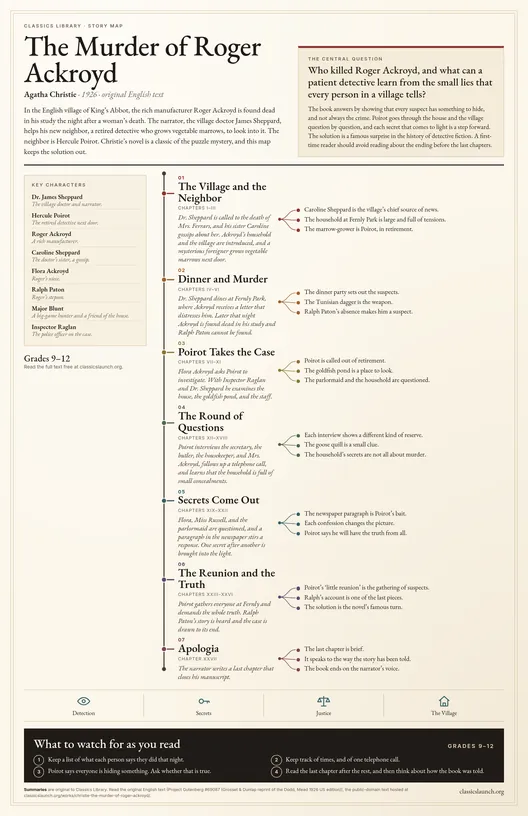 Story mapSee the story mapThe whole book on one page: the story in movements, the characters, and what to watch for. Free to print.
Abstract
Background. A leading writer of the Golden Age of detective fiction published this novel in 1926. It was her sixth and made her famous, and its use of a narrator sparked a long argument among readers about fair play.
Plot. A country doctor tells how a widow died, a wealthy neighbour was killed in his study, and a retired Belgian detective took up the case. The household of Fernly Park is questioned one by one, and each person hides something.
Ideas. The novel is a puzzle with a moral edge: it values patient attention, refuses easy answers and shows how secrecy harms trust. This guide gives no solution and the full text is hosted for readers in the United States.
Text. The text is complete, in twenty-seven chapters, from Project Gutenberg #69087, a transcription of the 1926 US edition. It is in the US public domain but not in the UK or EU, and every quotation was checked against it. Teachers can pair this work with the library's study guide, seminar questions and memory-work selection to prepare a discussion, a short essay or a recitation. The full text is hosted on this site, and each quotation in the guide has been checked against the hosted text.
Main characters
- Dr. James Sheppard: Country doctor and narrator
- Hercule Poirot: Retired Belgian detective
- Roger Ackroyd: Wealthy master of Fernly Park
- Caroline Sheppard: The doctor's inquisitive sister
- Flora Ackroyd: Roger's niece
- Ralph Paton: Roger's missing stepson
Summary
The Murder of Roger Ackroyd, published in 1926, is the novel that made Agatha Christie's name and one of the most discussed detective stories ever written. It is narrated by Dr. James Sheppard, a country doctor in the English village of King's Abbot, who lives with his sharp-eyed and inquisitive sister Caroline. In the first chapter a local widow, Mrs. Ferrars, is found dead of an overdose of a sleeping draught. The next evening Dr. Sheppard dines at Fernly Park with Roger Ackroyd, a wealthy manufacturer who had hoped to marry the widow. During the dinner Ackroyd receives a letter and is clearly distressed by it. Before the night is over he is dead, killed in his study, and his stepson Ralph Paton has vanished. The village has also acquired a new neighbour, a retired Belgian detective who grows vegetable marrows and is called Mr. Porrott, but who is in truth Hercule Poirot. Roger Ackroyd's niece Flora begs him to take the case, and with Dr. Sheppard as his friend and assistant, Poirot sets about examining everyone at Fernly Park: the secretary, the butler, the housekeeper, the major who has hunted in Africa, the stepson, the niece and her mother. Each of them, as he says, has something to hide. The inquiry moves through a locked door, a mysterious telephone call, a goose quill, a Tunisian dagger and a game of mah-jong, until Poirot gathers the household and demands the whole truth. The novel is a puzzle, and it is best read without being told its end. What can be said without spoiling it is that Christie plays fair with her reader while turning the genre's usual conventions upside down, and that the book raised a lively argument about the rules of detective fiction when it first appeared. Beneath the puzzle there is a steady moral interest. A village runs on gossip, secrets and respectable fronts, and Poirot's method is a patient attention to small facts and a refusal to stop at the first plausible answer. He believes that the truth, however ugly in itself, is beautiful to the one who seeks it. For a classical Christian classroom the book is a lively companion to the teaching on truthfulness, conscience and the hiddenness of sin, and a lesson in careful attention. It includes a murder, a poisoning and a suicide, and some period attitudes, so it suits older students.
Virtues in this work
- Prudence: Poirot weighs small facts patiently and refuses to accept the first plausible answer.
- Justice: Poirot refuses to let an innocent person bear the blame and insists that the whole truth be told.
- Honor: Flora Ackroyd stands by her friend and asks that the truth be sought even at a cost to herself.
Plot or Argument
- Chapters I–III: The village and the neighbour
Dr. Sheppard is called to the death of Mrs. Ferrars, and his sister gossips about her. Roger Ackroyd's household and the village are introduced, and a mysterious foreigner grows vegetable marrows next door.
- Chapters IV–VI: Dinner at Fernly and the murder
Dr. Sheppard dines at Fernly Park, where Ackroyd receives a letter that distresses him. Later that night Ackroyd is found dead in his study, and Ralph Paton cannot be found.
- Chapters VII–XI: Poirot takes the case
Flora Ackroyd asks Poirot to investigate. With Inspector Raglan and Dr. Sheppard he examines the house, the goldfish pond and the staff.
- Chapters XII–XVIII: The round of questions
Poirot interviews the secretary, the butler, the housekeeper and Mrs. Ackroyd, follows up the telephone call, and learns that the household is full of small concealments.
- Chapters XIX–XXII: Secrets come out
Flora, Miss Russell and the parlourmaid are questioned, and a paragraph in the newspaper stirs a response. One secret after another is brought into the light.
- Chapters XXIII–XXVI: The reunion and the truth
Poirot gathers everyone at Fernly and demands the whole truth. Ralph Paton's story is heard and the case is drawn to its end.
- Chapter XXVII: Apologia
The narrator writes a last chapter that closes his manuscript.
Characters
- Dr. James Sheppard, narrator and village doctor
The country physician who tells the story, a dry, modest man living with his sister.
- Hercule Poirot, detective
A retired Belgian detective, vain, exact and kind, who believes in order and method.
- Roger Ackroyd, wealthy manufacturer
The master of Fernly Park, a stout, genial man who intends to marry Mrs. Ferrars.
- Caroline Sheppard, the doctor's sister
A shrewd, nosy, good-hearted woman who knows everything that happens in the village.
- Flora Ackroyd, niece
Roger's niece, who begs Poirot to prove Ralph's innocence.
- Ralph Paton, stepson
Roger's charming, careless stepson, who disappears on the night of the murder.
- Major Blunt, big-game hunter
A reserved guest at Fernly Park who proves to feel more than he says.
- Inspector Raglan, police officer
The local police inspector, confident and quick to follow the obvious.
Lessons
Truth is worth patient seeking
Poirot says that the truth, however ugly in itself, is always curious and beautiful to the seeker after it. The novel rewards attention to small facts and refuses to stop at the first likely answer. A Christian may link this with the call to love the truth and speak it plainly.
- How does Poirot's method differ from the inspector's?
- What does it cost the characters to tell the truth?
Hidden things come to light
Poirot's claim that every one concerned in a crime has something to hide runs through the book. Each character's small concealment hides a fear, a debt or a love, and the story shows how secrecy damages trust and delays justice.
- Which characters conceal something, and why?
- Is every concealment a sin, or are some kept for good reasons?
Gossip and the village
Caroline's gossip is both a nuisance and a source of information. The novel presents village talk as ambiguous: it is cruel, curious and sometimes right.
- What does Caroline know that the police do not?
- How does the book judge her?
The reader's trust
Christie challenges the reader's assumptions about who tells the truth and what a narrator may leave out. Students can ask how a story shapes our trust and how we should weigh the testimony we are given.
- Why does the reader trust Dr. Sheppard at first?
- What does the book teach about careful reading and fair judgment?
Context
The story is set in the English countryside in 1926, in a village of retired officers, doctors, spinsters and prosperous manufacturers. The First World War was eight years in the past, servants were still common in large houses, and the detective story was at the height of its popularity in what is now called the Golden Age.
Composition
Christie wrote the novel in 1925 and 1926, and it was published in the United States by Dodd, Mead and Company and in Britain by Collins in 1926. It was her sixth novel and the third in which Poirot appears.
Reception
The book was a great success and an early sign of Christie's wide readership. It was admired and debated for its bold use of a narrator, and critics still discuss whether the plot is fair to the reader. It is regularly listed among the best detective novels of all time.
Comparisons
- The Mysterious Affair at Styles
Christie's first novel, with Hastings as narrator and the introduction of Poirot; Ackroyd uses a different narrator to very different effect.
- The Murder on the Links
Another early Poirot novel, which shares a classic setting and a similar interest in concealed identity.
- The Adventures of Sherlock Holmes
Conan Doyle's detective method of close observation is the model against which Christie's Poirot is both set and contrasted.
- The Innocence of Father Brown
Chesterton's priest-detective solves crimes by understanding sin from within, a strong counterpart to Poirot's reasoning.
- Crime and Punishment
Dostoevsky's novel also builds on a murder, but moves from the question of who did it to the question of what guilt does to a soul.
Quotes
Frequently cited
“Every one concerned in them has something to hide.”
Frequently cited
“The truth, however ugly in itself, is always curious and beautiful to the seeker after it.”
“Mrs. Ferrars died on the night of the 16th–17th September—a Thursday.”
“But Hercule Poirot does not end with a failure.”
“Each one of you has something to hide.”
For Students
A reading companion for classical Christian high school students. See the student guide.
Reading Guide
Watch for
- What Dr. Sheppard says about himself and his sister in the first chapters.
- Each person who has a reason to hide something on the night of the murder.
- How Poirot gathers information and which small facts he treats as important.
- The final chapter, and what the narrator says about his own manuscript.
Key terms and names
- Golden Age
- The period between the two world wars, when the English detective novel had its greatest popularity and set its rules.
- Red herring
- A false clue that leads the reader away from the truth.
- Veronal
- A sleeping drug of the early twentieth century, taken in overdose in the book.
- Fair play
- The convention that a detective story must give the reader the facts needed to find the solution.
Seminar Questions
- Comprehension Who is Roger Ackroyd, and why does he receive a letter at dinner?
- Comprehension Why does Flora Ackroyd ask Poirot to take the case?
- Interpretation How does Christie make the reader trust the narrator?
- Interpretation What is Poirot's method, and how does it differ from Inspector Raglan's?
- Interpretation What does the book show about the harm done by secrets?
- Big Question Is it ever right to conceal the truth to protect someone you love?
- Big Question What does the pursuit of truth demand of a detective, a witness and a reader?
Faith Connections
- Luke 12:2-3 (Scripture)
Nothing is covered that will not be revealed; Poirot's insistence that hidden things must come out echoes this saying.
- Proverbs 28:13 (Scripture)
Whoever conceals his transgressions will not prosper; the characters' small secrets show the principle at work.
- Augustine, On Lying (Church Fathers)
Augustine holds that lying is always wrong because it wounds the speaker's own soul; the novel asks readers to weigh this against the characters' reasons for silence.
Logic and Rhetoric
Central argument: Patient attention to small facts and a refusal to accept the first plausible answer will bring hidden things to light, and the truth, though ugly, is worth the effort of finding.
Rhetorical device: unreliable narration. The story is told by a character who presents himself as honest and modest, so that the reader accepts his account until the final chapters reconsider it.
Debate: Resolved: That a narrator in a detective story has a duty to tell the reader everything he knows.
Memory Work
The truth, however ugly in itself, is always curious and beautiful to the seeker after it.
Every one concerned in them has something to hide.
Writing Prompts
Essay: Argue whether Poirot's method of waiting and asking leads him to the truth better than the police inspector's method of following the obvious clue.
Comparison with The Innocence of Father Brown: Compare how Christie's Poirot and Chesterton's Father Brown find the truth, and say what each detective believes about sin.
Medical Lens
The narrator is a country doctor, and the book turns in part on medical matters: the cause of a widow's death, a sleeping draught, the time of death, and what a doctor knows and says. It shows how a village physician of the 1920s handles an overdose, a death certificate and a request for secrecy. It touches on suicide and poisoning only as plot points.
- Chapter I
The narrator, a doctor, is called to the death of a widow after an overdose of a sleeping draught and reflects on the symptoms and on what he knows.
- Chapters V-VI
Dr. Sheppard examines the body in the study and gives the police his medical judgment on the time and manner of death.
Creative Prompts
- Essay
Explain how Poirot's remark that everyone has something to hide applies to at least three characters, and say what the book suggests about the cost of concealment.
- Classroom
Read the opening chapter aloud and list what the narrator tells us about himself, his sister and the village. Discuss what a reader should and should not trust.
- Dialogue
Write a conversation between Caroline Sheppard and Poirot in which she tries to learn his secrets and he tries to learn hers.
Further Reading
- The Mysterious Affair at Styles, Agatha Christie
Christie's first novel and the first Poirot, in this library.
- Agatha Christie: A Biography, Janet Morgan
The authorised life of Christie.
- The Innocence of Father Brown, G. K. Chesterton
Chesterton's stories of a priest-detective, in this library.
Verification notes
Full text from Project Gutenberg #69087, a transcription of the Grosset & Dunlap reprint of the Dodd, Mead 1926 United States edition. A work published in 1926 entered the public domain in the United States on 1 January 2022; because Christie died in 1976, the novel is NOT in the public domain in the United Kingdom, the European Union and many other countries, and readers outside the United States must check local law. The plot is given without the solution. Quotes were checked against the hosted text. Publication details follow standard bibliographies.
- The date of the British first edition (Collins, 1926).