Work record
A Raw Youth
Fyodor DostoevskyThe Adolescent; A Raw Youth (Dostoevsky); PodrostokA Raw Youth by Fyodor Dostoevsky (1875)A Raw Youth is Dostoevsky's fourth great novel and his least read, a long first-person memoir by a twenty-year-old named Arkady Makarovitch Dolgoruky, who sits down to write ‘the history of the first steps in my career’.Also known as: The Adolescent · A Raw Youth (Dostoevsky) · Podrostok
1875 · 19th Century · Novel · Russian
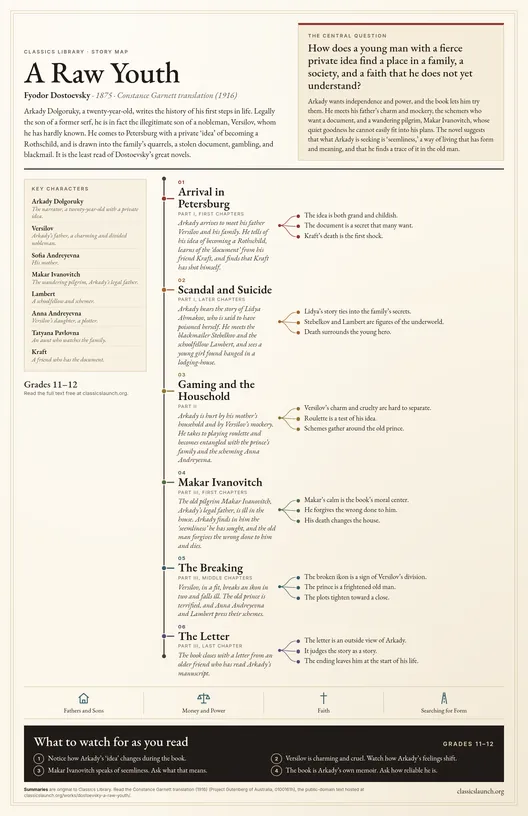 Story mapSee the story mapThe whole book on one page: the story in movements, the characters, and what to watch for. Free to print.
Abstract
Background. Dostoevsky wrote the novel in 1874 and 1875 and it appeared in a Russian journal in 1875. It is the least known of his great novels but contains one of his finest portraits of a good man.
Plot. A twenty-year-old illegitimate son comes to St. Petersburg to meet his father and to carry out a secret plan to become as rich as Rothschild. He is drawn into a scandal over a compromising letter, into gambling and blackmail, and into the death of the old pilgrim who is his legal father.
Ideas. The book is a study of a young man's mind and of the disorder of a time. It asks how a person can find a father and a faith, and sets money and power against the humble order of life shown by Makar Ivanovitch.
Text. The Garnett translation is long, readable and confusing by design. A teacher can select the opening chapters, the chapters on the idea, and the chapters on Makar Ivanovitch. The book contains suicides and mature scenes. Teachers can pair this work with the library's study guide, seminar questions and memory-work selection to prepare a discussion, a short essay or a recitation. The full text is hosted on this site, and each quotation in the guide has been checked against the hosted translation.
Main characters
- Arkady: A proud, secretive young man
- Versilov: His brilliant, divided father
- Makar Ivanovitch: His gentle pilgrim legal father
- Katerina Nikolaevna: A society lady in danger
- Lambert: A blackmailing schoolfellow

Summary
A Raw Youth is Dostoevsky's fourth great novel and his least read, a long first-person memoir by a twenty-year-old named Arkady Makarovitch Dolgoruky, who sits down to write ‘the history of the first steps in my career’. Arkady is a legitimate son in law, because his mother, Sofia, is the wife of a former serf named Makar Dolgoruky, and an illegitimate son in fact, because his real father is the nobleman Versilov, who took Sofia as a mistress in her youth and then left her. Arkady has grown up in other people's houses and in a boarding school, and has nursed a grievance against the father he has barely met. He arrives in St. Petersburg to find him, and also to carry out a secret plan, his ‘idea’, which is to become as rich as Rothschild, not for the money, but for the power and independence that wealth gives to one who is alone. The plot is a tangle of money, family and scandal. The old prince Sokolsky is believed to be losing his mind, and his daughter, Katerina Nikolaevna Ahmakov, has written a compromising letter about him to a lawyer, which, if made public, would ruin her. This ‘document’ sets off a hunt, in which Versilov, Arkady, Arkady's old schoolfellow Lambert, who is now a blackmailer, and Versilov's legitimate daughter Anna Andreyevna all take part. Arkady is drawn to Katerina Nikolaevna and is also in awe of Versilov, a proud, witty, divided man who is by turns tender and cruel. Meanwhile the young man gambles at roulette and spends money he has not earned; Kraft, a friend who helps him, shoots himself; a young girl hangs herself in a lodging-house; and the family secrets of Lidya Ahmakov, who poisoned herself years before, come to the surface. At the center of the book is a quieter figure. Makar Ivanovitch, Arkady's legal father, is an old pilgrim who comes home to die. He is gentle, devout and unshockable, and forgives the wrong done to him by his master and his wife with the simple words that in the sight of God he is more to blame than any of them. Arkady, who has been looking for ‘seemliness’ in life, sees it in him. When the old man dies, Versilov breaks an ikon in a fit of rage and falls ill, and Arkady, who has set out to make himself great, finds that he must make peace with the family he has despised. The novel ends with a letter from an older man who reads Arkady's manuscript and says that such a record of a ‘raw youth’ of a troubled time may be of use to a future artist, because the generations are made of raw youths. The Garnett translation hosted here is the one under the title A Raw Youth; later translators call the novel The Adolescent. The book is long, mature and confused on purpose, and is best read in selections in a classroom with a teacher.
Virtues in this work
- Humility: Makar Ivanovitch's words that he is more to blame than any of them are the book's picture of humility.
- Charity: His gentleness to those who have wronged him is charity.
- Faith: His life as a pilgrim and the ikon scenes carry the religious thread.
- Honor: Arkady's search for an honourable father and Versilov's divided honour are central.
Plot or Argument
- Part I: Arrival in Petersburg
Arkady arrives to meet his father Versilov and his family, tells of his ‘idea’ of becoming a Rothschild, learns of the ‘document’ from his friend Kraft, and finds that Kraft has shot himself.
- Part I: Scandal and suicide
Arkady hears the story of Lidya Ahmakov, who is said to have poisoned herself, meets the blackmailer Stebelkov and the schoolfellow Lambert, and sees a young girl found hanged in a lodging-house.
- Part II: Gaming and the household
Arkady is hurt by his mother's household and by Versilov's mockery, takes to playing roulette, and becomes entangled with the prince's family and the scheming Anna Andreyevna.
- Part III: Makar Ivanovitch
The old pilgrim Makar Ivanovitch, Arkady's legal father, is ill in the house. Arkady finds in him the ‘seemliness’ he has sought, and the old man forgives the wrong done to him and dies.
- Part III: The breaking
Versilov, in a fit, breaks an ikon in two and falls ill. The old prince is terrified, and Anna Andreyevna and Lambert press their schemes.
- Part III: The letter
The book closes with a letter from an older friend who has read Arkady's manuscript.
Characters
- Arkady Makarovitch Dolgoruky, the raw youth
A proud, awkward, secretive young man of twenty who writes the story of his first year in the world.
- Andrey Petrovitch Versilov, the father
A nobleman of ancient family, a brilliant talker, a former wanderer in Europe, who is divided between love and cruelty.
- Sofia Andreyevna, the mother
A gentle, quiet woman who has been faithful to both men in her way.
- Makar Ivanovitch Dolgoruky, the pilgrim
A former serf who has become a wanderer, gentle and wise, and who is Arkady's legal father.
- Katerina Nikolaevna Ahmakov, the lady
A proud, intelligent society woman, daughter of the old Prince Sokolsky, who is in danger from the letter.
- Lambert, the schoolfellow
A cruel old schoolmate of Arkady and a member of a gang of blackmailers.
- Anna Andreyevna, Versilov's daughter
A strong, resourceful young woman who hopes to marry the old prince and to protect herself.
- Tatyana Pavlovna, the aunt
A brisk, shrewd, middle-aged relation who looks after the family.
- Kraft, the friend
A serious, melancholy man, an assistant of the lawyer Andronikov, who shoots himself.
Lessons
A father and a son
Arkady is looking for a father and has two: the brilliant and faithless Versilov and the humble pilgrim Makar. The book's long argument is about which of them has given him what he needs.
- How does Arkady describe his two fathers?
- What does each of them teach him?
The idea of power
Arkady's plan to become as rich as Rothschild is a young man's way of defending himself against a world in which he has no place. The book shows what it costs him, and how it fails to satisfy.
- What does Arkady say he wants from wealth?
- How does the book answer his ‘idea’?
Seemliness
Arkady finds in Makar Ivanovitch a ‘seemliness’ that he has not seen in any of the educated people about him. This quiet order of life, which does not depend on wealth or learning, is the book's positive vision.
- What does Arkady mean by ‘seemliness’?
- Why does Makar Ivanovitch's forgiveness of the wrong done to him matter?
Context
The novel is set in St. Petersburg in the years after the emancipation of the serfs in 1861, when old families were declining, new money was rising, and speculators, blackmailers and gamblers flourished. Dostoevsky saw in the ‘accidental families’ of his day a sign of disorder in Russian society.
Composition
Dostoevsky wrote the novel in 1874 and 1875, and it was serialised in the journal Notes of the Fatherland in 1875. The hosted Garnett translation was published in 1916 under the title A Raw Youth; later versions are called The Adolescent.
Reception
The book was received coolly at the time and is the least read of his great novels. Later critics have noticed its remarkable portrait of a young man's mind and the figure of Makar Ivanovitch, which prepares the way for the Elder Zosima of The Brothers Karamazov.
Comparisons
- The Brothers Karamazov
Dostoevsky's last novel takes the fathers, sons and saintly old men of this book and develops them on a larger scale.
- Crime and Punishment
Raskolnikov's theory and Arkady's ‘idea’ are both ways in which a young man tries to take hold of his life.
- Notes from Underground
The underground man is a more extreme version of the proud, wounded, solitary narrator.
- The Idiot
Another Dostoevsky novel about a family, money, and a figure of simple goodness.
- Fathers and Sons
Turgenev's novel treats the same question of generations with a cooler hand.
Quotes
Frequently cited
“I cannot resist sitting down to write the history of the first steps in my career, though I might very well abstain from doing so.”
Frequently cited
“My "idea" is--to become a Rothschild. I invite the reader to keep calm and not to excite himself. I repeat it. My "idea" is to become a Rothschild, to become as rich as Rothschild, not simply rich, but as rich as Rothschild.”
Frequently cited
“I don't like any of them; there is no 'seemliness' in them...I won't follow them, I don't know where I'm going, I'll go with you.”
Frequently cited
“in the sight of God I am more to blame than any of you, seeing that though you were my master I ought not to have allowed this weakness, and therefore, Sofia, fret not your soul too much, for all your sin is mine”
Frequently cited
“they will preserve at any rate some faithful traits by which one may guess what may have lain hidden in the heart of some raw youth of that troubled time--a knowledge not altogether valueless since from raw youths are made up the generations.”
“Do you know, Sonia, here I've taken up the ikon again" (he had picked it up and was turning it about in his hand), "and do you know, I have a dreadful longing now, this very second, to smash it against the stove, against this corner. I am sure it would break into two halves--neither more nor less.”
For Students
A reading companion for classical Christian high school students. See the student guide.
Reading Guide
Watch for
- How Arkady speaks of his ‘idea’ and how it fails him.
- How the two ‘fathers’ appear in turn.
- What each older character teaches Arkady about forgiveness.
Key terms and names
- Raw youth
- The book's own phrase for a young person not yet formed by life.
- Seemliness
- Arkady's word for a settled, decent order of life, found in Makar Ivanovitch.
- Chantage
- Blackmail, the trade of Lambert's gang.
- Pilgrim
- A man who wanders from monastery to monastery as a religious practice, as Makar Ivanovitch does.
Seminar Questions
- Comprehension Who are Arkady's two fathers?
- Comprehension What is the ‘document’ and who fears it?
- Interpretation Why does Arkady find ‘seemliness’ in Makar Ivanovitch?
- Interpretation How does the break with the ikon reveal Versilov's mind?
- Interpretation Why does Dostoevsky end the novel with a letter?
- Big Question Can a young man build a self out of an idea of power?
- Big Question What does it take to forgive a wrong done to one?
Faith Connections
- Luke 15:11–32 (Scripture)
The prodigal son, the elder brother and the father; Arkady's search for a father and Makar's forgiveness are a rewriting of this story.
- 1 Timothy 6:9–10 (Scripture)
The love of money as a root of evils is the text for Arkady's ‘idea’.
- Psalm 68:5 (Scripture)
'Father of the fatherless... is God in his holy habitation.' Arkady's longing for a father finds an answer beyond men.
- Matthew 18:21–22 (Scripture)
Forgiveness seventy times seven; Makar's forgiveness of his wife and master is a picture of it.
Logic and Rhetoric
Central argument: A person cannot build a self on money and the will to power; he must find a father and a faith that forgive.
Rhetorical device: first-person confession. Arkady announces at the start that he will write ‘the history of the first steps in my career’ and then reveals more than he intends.
Debate: Resolved: That a young person without a family can be made whole by wealth.
Memory Work
My "idea" is--to become a Rothschild. I invite the reader to keep calm and not to excite himself. I repeat it. My "idea" is to become a Rothschild, to become as rich as Rothschild, not simply rich, but as rich as Rothschild.
in the sight of God I am more to blame than any of you, seeing that though you were my master I ought not to have allowed this weakness, and therefore, Sofia, fret not your soul too much, for all your sin is mine
Writing Prompts
Essay: Compare the two fathers of Arkady, Versilov and Makar Ivanovitch, and say what each has given him.
Comparison with The Brothers Karamazov: Compare Makar Ivanovitch with the Elder Zosima: what do they teach, and how do the young men respond?
Medical Lens
The novel is full of suicide and madness. Kraft shoots himself; a young girl hangs herself in a lodging-house; and Lidya Ahmakov is said to have poisoned herself with phosphorus matches. Versilov's rages and the old prince's terror of being sent to a madhouse show how nineteenth-century households treated mental illness. A doctor attends Makar Ivanovitch, who takes quinine for his fever and dies. A teacher should speak plainly with students who may be affected by suicide.
- Part I, Kraft's suicide
Arkady finds that his friend Kraft has shot himself, and sees the revolver he had noticed earlier.
- Part I, the girl who hanged herself
A young girl is found hanged in the next room of a lodging-house.
- Part III, the old prince
The old Prince Sokolsky fears he will be put in a madhouse and trembles at every noise.
- Part III, Makar Ivanovitch's illness
The old pilgrim is given quinine for his fever, is visited by a doctor, and dies.
Creative Prompts
- Essay
Choose one scene and show how Arkady's ‘idea’ shapes his view of other people.
- Fiction
Write a letter from Arkady to Makar Ivanovitch after the old man's death.
- Classroom
Discuss with a teacher the novel's treatment of suicide and what an adult should do when a young person is in despair.
- Essay
What does Arkady mean by ‘seemliness’, and where does he find it?
Further Reading
- The Brothers Karamazov, Fyodor Dostoevsky
The great novel in which fathers, sons and saintly elders recur; hosted in this library.
- Crime and Punishment, Fyodor Dostoevsky
Dostoevsky's novel of an idea that takes hold of a young man; hosted in this library.
- The Idiot, Fyodor Dostoevsky
A novel of a good man among the greedy; hosted in this library.
- Dostoevsky: A Writer in His Time, Joseph Frank
The standard modern life of the author.
Verification notes
Full text from Project Gutenberg of Australia (eBook 0100161h), Constance Garnett's 1916 translation of A Raw Youth, public domain in the United States. Quotes were checked against the hosted text. The summary reports the main strands of a very long and complex novel and does not give all its plots; the serial publication in Notes of the Fatherland (1875) is a standard report and is not verified here. Names follow Garnett's spelling (Ahmakov, Katerina Nikolaevna).
- Serialisation in Notes of the Fatherland in 1875.
- The full course of the document intrigue in Parts II and III, which this record summarises only in outline.