Work record
Demian: The Story of Emil Sinclair's Youth
Hermann HesseDemian; Demian: Die Geschichte von Emil Sinclairs JugendDemian: The Story of Emil Sinclair's Youth by Hermann Hesse (1919)Demian is Hermann Hesse's novel of a boy's growing up and his search for himself, published in 1919 under the pseudonym of its narrator, Emil Sinclair.Also known as: Demian · Demian: Die Geschichte von Emil Sinclairs Jugend
1919 · Early 20th Century · Novel · German
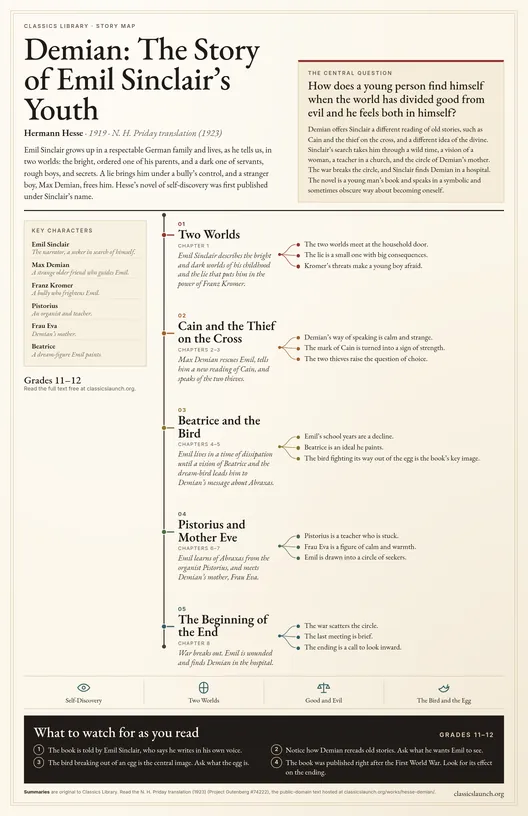 Story mapSee the story mapThe whole book on one page: the story in movements, the characters, and what to watch for. Free to print.
Abstract
Background. Hesse wrote this novel in 1917 after a crisis and analysis with a follower of Jung, and published it in 1919 under the pseudonym Emil Sinclair. It was taken up by the post-war generation.
Plot. A boy from a pious home lies to a bully and is saved by an older friend. He is taught to reread the story of Cain, is led by a dream-bird to the god Abraxas, and learns from an organist and a woman called Mother Eve. War breaks out.
Ideas. The novel is a story of the search for the self. It is built on Gnostic and psychological ideas that Christian readers will want to test against Scripture, and it reinterprets Cain and the thieves on the cross.
Text. The English translation of 1923, named in catalogues as N. H. Priday, is in eight chapters. It follows the German closely and is told in the first person. The hosted text is complete as printed here, with its section headings kept as a guide to the reader, and every quotation on this page is drawn directly from that text. Teachers can pair this work with the library's study guide, seminar questions and memory-work selection to prepare a discussion, a short essay or a recitation. The full text is hosted on this site, and each quotation in the guide has been checked against the hosted translation.
Main characters
- Emil Sinclair: A boy who seeks himself
- Max Demian: A mature older friend
- Franz Kromer: A bully who blackmails him
- Pistorius: An organist and teacher
- Frau Eva: Demian's mother
Summary
Demian is Hermann Hesse's novel of a boy's growing up and his search for himself, published in 1919 under the pseudonym of its narrator, Emil Sinclair. Sinclair is the son of a respectable German family, and he lives, as he tells us in the first chapter, in two worlds: the bright, orderly world of his parents, with prayers and clean aprons, and a dark world of servants, rough boys and rumours. At ten, to impress an older boy, Franz Kromer, he invents a story of stealing apples. Kromer blackmails him, and for months he lives in fear and shame, afraid to tell his parents. He is rescued by a new pupil, Max Demian, a calm, older boy with a strange maturity, who somehow makes Kromer leave him alone. Demian also tells him that the story of Cain and Abel can be read differently, that the mark on Cain's forehead was a sign of strength and not of guilt, and that the pious believers have told the story to make themselves safe. The boy is shaken but excited. He is sent away to a boarding school, where he falls into a time of drink and cynicism, and then is saved by a vision of a girl he names Beatrice, whom he paints from imagination. His painted face turns into Demian's, and then into a bird. A message from Demian, 'The bird fights its way out of the egg. The egg is the world. Whoever will be born must destroy a world. The bird flies to God. The name of the god is Abraxas', sends him on a quest. He learns of Abraxas, a god who unites good and evil, from the organist Pistorius, studies at the university and finds Demian again and his mother, Mother Eve. The First World War begins, a sort of cleansing; Sinclair is wounded, and Demian, who has also been wounded, kisses him and tells him that he will find him within. Demian is among the most influential novels of youth in the twentieth century, but a Christian reader will meet it critically. Hesse, who had been analysed by a follower of Jung, draws on Gnostic and psychological ideas, in which good and evil are halves of a divine whole and the self is the final authority. The book reinterprets Cain's mark, the crucifixion thieves and the person of Christ in ways that contradict the Gospel. It is included because it is a major book and a clear statement of the modern spiritual quest, and teachers should discuss it with attention to those departures.
Virtues in this work
- Friendship: Demian's loyalty to Emil sustains him through the years.
- Fortitude: Emil endures shame and isolation in his search.
- Humility: He learns to listen to teachers and to the voice inside him.
Plot or Argument
- Chapter 1: Two Worlds
Emil Sinclair describes the bright and dark worlds of his childhood and the lie that makes him subject to Franz Kromer.
- Chapters 2–3: Cain and the Thief on the Cross
Max Demian rescues Emil, tells him a new reading of Cain, and speaks of the two thieves.
- Chapters 4–5: Beatrice and the bird
Emil lives in a time of dissipation until a vision of Beatrice and the dream-bird leads him to Demian's message about Abraxas.
- Chapters 6–7: Pistorius and Mother Eve
Emil learns of Abraxas from the organist Pistorius, and meets Demian's mother.
- Chapter 8: The beginning of the end
War breaks out. Emil is wounded, and finds Demian in the hospital.
Characters
- Emil Sinclair, narrator
A boy from a pious home who searches for his true self.
- Max Demian, friend
An older boy with a calm authority who guides Emil.
- Franz Kromer, bully
A rough boy who blackmails Emil.
- Pistorius, organist
A learned former theology student who teaches Emil about Abraxas.
- Frau Eva (Mother Eve), Demian's mother
A woman of great charm who seems to embody the self.
- Beatrice, dream-figure
A girl whom Emil sees at a distance and paints.
Lessons
The danger of a secret lie
Emil's boasting and its consequences show how one lie can enslave a child. Hesse describes his fear accurately and with sympathy.
- Why does Emil lie to Kromer?
- What does the lie cost him?
The self as a path
Hesse's narrator says that the life of everyone is a way to himself. This is a modern, psychological statement of the search for identity, to be measured by Christian readers against the biblical teaching that we find ourselves in God.
- What does Emil mean by 'the way to himself'?
- How does the Christian view of the self differ?
Reading Scripture critically
Demian reinterprets Cain and the thieves on the cross in ways that a Christian must be able to answer. The novel offers an occasion to study the text it reinterprets.
- What does Demian say about Cain?
- What does Genesis 4 actually say?
Context
The novel is set in a small German town and a university city, in the years before and during the First World War.
Composition
Hesse wrote Demian in 1917, in Switzerland, after a personal crisis and a course of analysis with J. B. Lang, a student of Jung. It was published in 1919 under the pseudonym Emil Sinclair.
Reception
The novel was received as a voice of the post-war generation, and Hesse revealed his authorship in 1920. Its English translation by N. H. Priday appeared in 1923.
Comparisons
- Siddhartha: An Indian Tale
Hesse's later novel is another story of a search for the self, set in India.
- Tonio Kröger
Mann's story of a young man between two worlds is a close relative.
- Wilhelm Meister's Apprenticeship
Hesse stands in the tradition of the German novel of formation that Goethe began.
- The Brothers Karamazov
Dostoevsky's novel, which Hesse admired, takes up the theme of good and evil in the human heart, with a very different answer.
Quotes
Frequently cited
“I wanted only to try to live in obedience to the promptings which came from my true self. Why was that so very difficult?”
Frequently cited
“The bird fights its way out of the egg. The egg is the world. Whoever will be born must destroy a world. The bird flies to God. The name of the god is Abraxas.”
“The life of everyone is a way to himself, the search for a road, the indication of a path.”
For Students
A reading companion for classical Christian high school students. See the student guide.
Reading Guide
Watch for
- How Emil describes the two worlds.
- Every place where Demian reinterprets Scripture.
- The role of dreams and pictures in Emil's search.
Key terms and names
- Abraxas
- A name from ancient Gnosticism for a deity who joins good and evil, used by Hesse.
- Gnosticism
- An ancient set of heresies that taught salvation by secret knowledge and set matter against spirit.
- Pseudonym
- A false name used by an author; Hesse published Demian as Emil Sinclair.
- Bildungsroman
- A novel of the formation of its hero.
Seminar Questions
- Comprehension What lie does Emil tell, and who takes advantage of it?
- Comprehension What does Demian say about Cain?
- Interpretation Why does Emil feel that he lives in two worlds?
- Interpretation How does the picture of the bird develop?
- Interpretation What does Pistorius teach Emil?
- Big Question Is the self a sufficient guide?
- Big Question How should a Christian read a book that reinterprets Scripture?
Faith Connections
- Genesis 4:1–16 (Scripture)
The story of Cain and Abel, which Demian reads in a sense opposed to the plain text.
- Luke 23:39–43 (Scripture)
The two thieves on the cross, one of whom repents, are the subject of Demian's other reinterpretation.
- 1 John 4:1 (Scripture)
'Test the spirits to see whether they are from God.' Readers should test the novel's spiritual claims.
- Irenaeus, Against Heresies, Book I (Church Fathers)
Irenaeus describes the second-century Gnostic systems from which Abraxas comes, and answers them.
Logic and Rhetoric
Central argument: A person must find his own way to himself, through the integration of light and dark within; this is the novel's claim, to be examined critically.
Rhetorical device: symbol. The bird, the egg and the god Abraxas recur as images of the self's birth.
Debate: Resolved: That the search for self is the highest task of youth.
Memory Work
I wanted only to try to live in obedience to the promptings which came from my true self. Why was that so very difficult?
The bird fights its way out of the egg. The egg is the world. Whoever will be born must destroy a world. The bird flies to God. The name of the god is Abraxas.
Writing Prompts
Essay: How does Hesse's Demian reinterpret the story of Cain? Compare it carefully with Genesis 4.
Comparison with Siddhartha: An Indian Tale: Compare Emil Sinclair's search with Siddhartha's.
Medical Lens
The novel draws on Jungian ideas of dream and the unconscious, and shows Emil's drinking at boarding school as a period of lost direction.
- Chapter 4
Emil's dissipation at school and the vision of Beatrice.
- Chapter 6
Emil's dreams and the interpretation of them by Pistorius.
Creative Prompts
- Essay
Compare the Cain story in Genesis 4 with Demian's reading of it. What does he add, and what does he omit?
- Dialogue
Write a conversation between Emil's father and Demian about the story of Cain.
- Classroom
Discuss what the novel means by 'two worlds' and how a Christian might respond.
Further Reading
- Siddhartha: An Indian Tale, Hermann Hesse
Hesse's novel of a search, hosted in this library.
- Tonio Kröger, Thomas Mann
Mann's story of a young man between two worlds, hosted in this library.
- The Brothers Karamazov, Fyodor Dostoevsky
A novel that treats good and evil from within the Christian tradition.
- Genesis 4, Scripture
The account of Cain and Abel that Demian reinterprets.
Verification notes
Full text from Project Gutenberg #74222, the 1923 translation (named in standard catalogues as N. H. Priday) published by Boni and Liveright, New York; published before 1931 and in the public domain in the United States. Quotes were checked against the hosted text. The book's religious ideas are Gnostic and psychological, and are flagged for teachers.
- The attribution of the 1923 translation to N. H. Priday.
- The year the pseudonym was revealed (generally given as 1920).