Work record
Tonio Kröger
Thomas MannTonio KroegerTonio Kröger by Thomas Mann (1903)Tonio Kröger is one of Thomas Mann's best-loved stories, a novella of a young artist's divided heart.Also known as: Tonio Kroeger
1903 · Early 20th Century · Novella · German
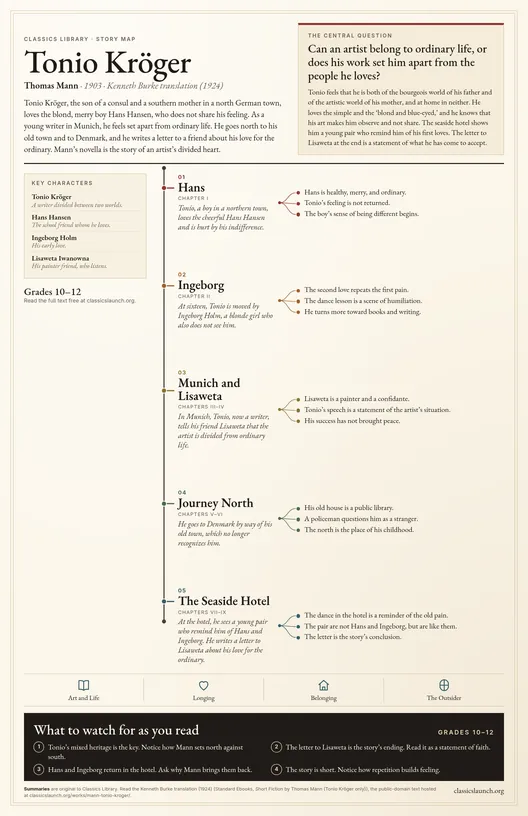 Story mapSee the story mapThe whole book on one page: the story in movements, the characters, and what to watch for. Free to print.
Abstract
Background. Mann wrote this novella early in his career as a kind of coda to Buddenbrooks. Published in 1903, it became one of his best-loved works.
Plot. A boy who loves a cheerful friend grows up to be a famous writer in Munich. He tells a painter friend that the artist is cut off from life, travels north to his old home, and writes a letter in which he accepts his divided place.
Ideas. The story studies the artist's loneliness and his longing for the ordinary. It suggests that love of the plain, happy people is the source of his work.
Text. Kenneth Burke's translation is short, in nine chapters, with a brisk and ironic voice. The text is the Standard Ebooks edition, with section breaks kept as in the print. The hosted text is complete as printed here, with its section headings kept as a guide to the reader, and every quotation on this page is drawn directly from that text. Teachers can pair this work with the library's study guide, seminar questions and memory-work selection to prepare a discussion, a short essay or a recitation. The full text is hosted on this site, and each quotation in the guide has been checked against the hosted translation.
Main characters
- Tonio Kröger: A writer divided between two worlds
- Hans Hansen: His blond school friend
- Ingeborg Holm: A girl he loved at sixteen
- Lisaweta: A Russian painter and friend
Summary
Tonio Kröger is one of Thomas Mann's best-loved stories, a novella of a young artist's divided heart. It begins in a north German town, a thinly disguised Lübeck, where fourteen-year-old Tonio, the son of a consul and a southern mother, stands on a winter afternoon waiting for his friend Hans Hansen, the blond, blue-eyed boy he admires. Hans is healthy, merry and good at riding and at horses, and he cares very little for poetry and for Don Carlos, the book Tonio reads. Tonio loves him, and learns that he who loves more is the inferior, and must suffer. The boy grows up, writes, and leaves his home town after his father's death. He is stirred by another young person, the blonde Ingeborg Holm, at a dance, and again feels humiliated. In the second half, Tonio is a famous writer in Munich, who has lived a dissolute life in the south and returned from it. In the studio of his friend, the Russian painter Lisaweta Iwanowna, he declares that the artist is cut off from ordinary life, that strong emotion is without taste, and that he is tired of representing the human without taking part in the human. Lisaweta calls him, with gentle mockery, a bourgeois on the wrong road. He travels north to Denmark, passing through his old town, where he is almost arrested as a suspicious person, and sees at a hotel by the sea a pair of blond young people who remind him of Hans and Ingeborg. The story ends with a letter to Lisaweta, in which Tonio says that he stands between two worlds, at home in neither, and that he loves the blond, blue-eyed, ordinary people, the happy and the amicable, with a longing and a very shy happiness. He says that this love is good and fruitful, because it makes him a writer. The novella is a classic of the division between the artist and the middle class, and a gentle tragicomedy of the writer who cannot take part in the life he describes. For younger readers, it offers a key to the loneliness of the gifted and to the longing of the outsider for belonging. Teachers should note that the part set in the south alludes briefly to a life of sensual excess, and that the story speaks of being a bourgeois and an artist with some irony.
Virtues in this work
- Humility: Tonio learns that the ordinary people he envied have something he lacks.
- Friendship: His friendship with Lisaweta is the one enduring bond of the story.
- Hope: The letter ends in a hope that his divided life may be fruitful.
Plot or Argument
- Chapters I–II: Boyhood
Tonio, a boy in a northern town, loves the cheerful Hans Hansen and is hurt by his indifference. At sixteen, he is moved by Ingeborg Holm.
- Chapters III–IV: Munich and Lisaweta
In Munich, Tonio, now a writer, tells his friend Lisaweta that the artist is divided from ordinary life.
- Chapters V–VI: Journey north
He goes to Denmark by way of his old town, which no longer recognises him.
- Chapters VII–IX: The seaside hotel
At the hotel, he sees a young pair who remind him of Hans and Ingeborg. He writes a letter to Lisaweta about his love for the ordinary.
Characters
- Tonio Kröger, hero
A writer, the son of a northern merchant and a southern mother, who feels divided between art and ordinary life.
- Hans Hansen, school friend
A handsome, healthy and unreflective boy whom Tonio loves.
- Ingeborg Holm, early love
A fair-haired girl who laughs at Tonio at a dance.
- Lisaweta Iwanowna, painter friend
A Russian painter who is his confidante and gently mocks him.
Lessons
The artist is divided from ordinary life
Tonio says that he is tired to death of representing the human without taking part in the human. Mann turns a personal problem into a question of vocation: can one tell the truth about life without living it?
- What does Tonio mean by the human?
- Does the ending resolve his division?
The one who loves more suffers
Tonio's boyhood friendship teaches him that love is unequal. Mann shows the pain of unrequited affection as a school of feeling.
- What does Tonio learn from his love for Hans?
- How does this shape his writing?
Belonging and exile
Tonio is at home in neither the north nor the south, neither the world of art nor of the middle class. The story ends with an acceptance of both.
- Where does Tonio belong?
- What does he mean by calling himself a bourgeois on the wrong road?
Context
The novella is set in a north German town like Lübeck and in Munich and Denmark, around 1900. Mann's own mixed heritage, north German father and Brazilian mother, is the basis of Tonio's.
Composition
Mann wrote it in 1901–1903 as a sort of coda to Buddenbrooks. It was published in 1903 in the collection Tristan.
Reception
It became one of Mann's most-read stories and a model of the story of the artist. The English translation by Kenneth Burke appeared in The Dial in 1924 and in Death in Venice (Knopf) in 1925.
Comparisons
- Buddenbrooks: The Decline of a Family
Hanno Buddenbrook, the sensitive musician, is a near relation of Tonio.
- Death in Venice
Mann's later novella shows what the artist's divided life can become.
- The Sorrows of Young Werther
Werther is an early model of the sensitive young artist, though Tonio does not die of it.
- Demian: The Story of Emil Sinclair's Youth
Hesse's novel of a youth torn between two worlds is a close relative.
Quotes
Frequently cited
“For the strong and healthy emotion—there is no getting around it—is without taste. It is all over with the artist as soon as he becomes a man and begins to feel.”
Frequently cited
“I have often been tired to death of representing the human without participating in the human.”
Frequently cited
“Do not find fault with this love, Lisaweta; it is good and fruitful. There is longing in it, and brooding envy, and just a little disdain, and a very shy happiness.”
For Students
A reading companion for classical Christian high school students. See the student guide.
Reading Guide
Watch for
- Each time Tonio compares himself to the 'blond and blue-eyed'.
- How the setting changes as he moves north.
- What Lisaweta says about Tonio.
Key terms and names
- Bourgeois
- A member of the middle class; for Tonio, the sphere of the ordinary and the respectable.
- Bohemian
- An artist living outside middle-class conventions.
- Consul
- An honorary title for a merchant; Tonio's father is one.
- Novella
- A prose story of intermediate length.
Seminar Questions
- Comprehension Who is Hans Hansen, and what does Tonio feel for him?
- Comprehension What does Tonio tell Lisaweta in the studio?
- Interpretation Why does Tonio return to the north?
- Interpretation What is the meaning of the letter at the end?
- Interpretation Why does Lisaweta call him a bourgeois?
- Big Question Is it possible to be an artist and a participant in ordinary life?
- Big Question What does the story say about longing?
Faith Connections
- John 17:14–16 (Scripture)
Jesus says his followers are in the world but not of it. Tonio feels something like this tension, though without faith.
- 1 Corinthians 13:1 (Scripture)
'If I speak in the tongues of men and of angels, but have not love, I am a noisy gong.' Tonio fears that art without participation is empty.
- Augustine, Confessions, Book II (Great Conversation)
Augustine's account of his adolescence, with its longing and its restlessness, is an ancient parallel.
Logic and Rhetoric
Central argument: An artist's detachment from ordinary life is both his gift and his loss, and love of the ordinary is the way he returns to the human.
Rhetorical device: epistolary close. The final letter gathers up the story's arguments in a personal voice.
Debate: Resolved: That an artist must stand apart from ordinary life to tell the truth about it.
Memory Work
I have often been tired to death of representing the human without participating in the human.
Do not find fault with this love, Lisaweta; it is good and fruitful. There is longing in it, and brooding envy, and just a little disdain, and a very shy happiness.
Writing Prompts
Essay: What does Tonio's love for the 'ordinary' mean at the end of the story?
Comparison with Demian: The Story of Emil Sinclair's Youth: Compare Tonio's two worlds with Emil Sinclair's.
Creative Prompts
- Essay
Why does Tonio love the blond and blue-eyed? What does he lack that they have?
- Dialogue
Write a conversation between Tonio and Hans Hansen twenty years later.
- Classroom
Discuss whether Lisaweta's judgment that Tonio is a bourgeois on the wrong road is fair.
Further Reading
- Buddenbrooks, Thomas Mann
Mann's first novel, hosted in this library.
- Death in Venice, Thomas Mann
Mann's novella of the artist, hosted in this library.
- Demian, Hermann Hesse
A novel of a youth between two worlds, hosted in this library.
- A Portrait of the Artist as a Young Man, James Joyce
Another story of the artist's formation.
Verification notes
Full text from Standard Ebooks, Kenneth Burke's translation of 1924 (CC0 edition), in public domain in the United States because published before 1931. Quotes were checked against the hosted text.
- Whether the Standard Ebooks text follows Burke's first printing in The Dial or the 1925 Knopf version.
- The first print year of the Burke translation.