Work record
Wilhelm Meister's Apprenticeship
Johann Wolfgang von GoetheWilhelm Meisters Lehrjahre; Wilhelm MeisterWilhelm Meister's Apprenticeship by Johann Wolfgang von Goethe (1795)Wilhelm Meister's Apprenticeship is the novel of formation, the Bildungsroman, from which the whole genre takes its name.Also known as: Wilhelm Meisters Lehrjahre · Wilhelm Meister
1795 · 18th Century · Novel · German
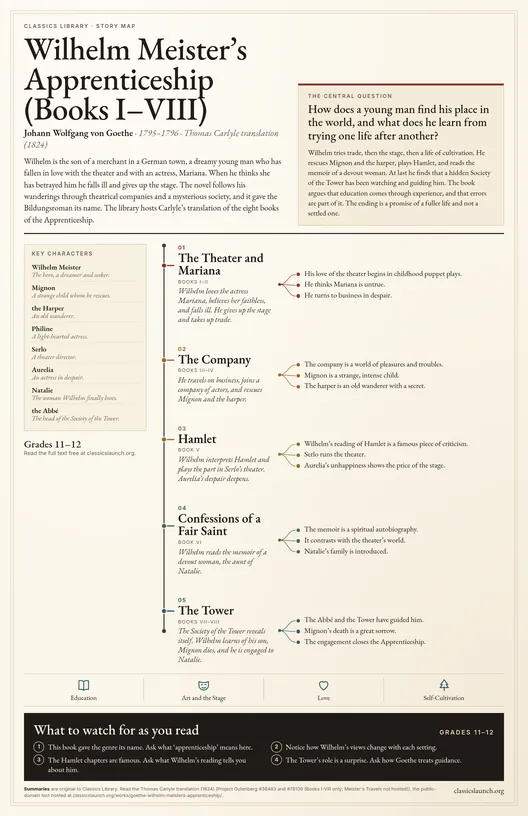 Story mapSee the story mapThe whole book on one page: the story in movements, the characters, and what to watch for. Free to print.
Abstract
Background. Goethe published this novel in four volumes in 1795 and 1796, with Schiller as a close reader. Thomas Carlyle's translation of 1824 introduced it to English readers.
Plot. A merchant's son who dreams of the stage falls in love, fails, and travels with a company of actors. He rescues two strange wanderers, plays Hamlet, and is quietly guided by a secret society to a settled life and an engagement.
Ideas. The book is a study of formation: how experience, error and unseen guidance shape a person. It asks what art can and cannot do for a life.
Text. Carlyle's translation of Books I to VIII, in a late nineteenth-century reprint, includes the songs and the long inset narrative of Book VI. The sequel, Meister's Travels, is not included. The hosted text is complete as printed here, with its section headings kept as a guide to the reader, and every quotation on this page is drawn directly from that text. Teachers can pair this work with the library's study guide, seminar questions and memory-work selection to prepare a discussion, a short essay or a recitation. The full text is hosted on this site, and each quotation in the guide has been checked against the hosted translation.
Main characters
- Wilhelm Meister: A merchant's son turned actor
- Mignon: A strange child rescued by Wilhelm
- The Harper: A grief-stricken old musician
- Philine: A merry actress
- Natalie: Wilhelm's final love
- The Abbé: Head of the Tower society
Summary
Wilhelm Meister's Apprenticeship is the novel of formation, the Bildungsroman, from which the whole genre takes its name. Wilhelm is the son of a merchant in a German town, a dreamy young man who has fallen in love with the theatre and with an actress, Mariana. When he thinks she has betrayed him he falls ill, and when he recovers he gives up the theatre and takes up his father's business. Sent on a journey to collect debts, he is drawn once more to the stage. He falls in with a travelling company, and after the failure of the company's schemes he rescues Mignon, a strange and passionate child with a secret, and a wandering harper who lives apart in grief. The novel's middle books follow Wilhelm's adventures as an actor and then as the manager of a company. He meets the charming and heartless Philine, the clever Serlo and his unhappy sister Aurelia, and leads a performance of Hamlet that includes Wilhelm's own interpretation: that Hamlet is a gentle nature too weak for the deed laid upon him. Mixed with the stage are a love of a married Countess, a bandits' ambush, and the 'Confessions of a Fair Saint' of Book VI, a Pietist woman's account of her inner life, which is among the book's religious high points. In the later books Wilhelm comes into contact with a mysterious society of men, the Society of the Tower, who have been watching and guiding him throughout. He learns that Mariana died after bearing his son Felix, that Mignon and the harper are tied together by a tragic secret, and that his apprenticeship is over. He receives a document, the Indenture, that begins: 'Art is long, life short.' The book ends with his engagement to Natalie and with a comic remark that, like Saul, he went out seeking donkeys and found a kingdom. The novel is a long book on the question of what it takes to be a whole man. Wilhelm believes he is called to the stage, and he finds a calling in social life and in the care of a child. Goethe is gentle with him and ironic. Readers should know that the book is open about sexual freedom in the theatre, that Mignon's story involves incest and her death, and that the harper tries to kill himself. The hosted text is Books I to VIII, and it does not include the sequel, Wilhelm Meister's Travels.
Virtues in this work
Plot or Argument
- Books I–II: The theatre and Mariana
Wilhelm loves the actress Mariana, believes her faithless, and falls ill. He gives up the stage and takes up trade.
- Books III–IV: The company
He travels on business, joins a company of actors, and rescues Mignon and the harper.
- Book V: Hamlet
Wilhelm interprets Hamlet and plays the part in Serlo's theatre. Aurelia's despair deepens.
- Book VI: Confessions of a Fair Saint
Wilhelm reads the memoir of a devout woman, the aunt of Natalie.
- Books VII–VIII: The Tower
The Society of the Tower reveals itself. Wilhelm learns of his son, Mignon dies, and he is engaged to Natalie.
Characters
- Wilhelm Meister, hero
A merchant's son who dreams of the stage and is formed by his experiences.
- Mignon, child
A strange and passionate girl, rescued by Wilhelm, who sings of her lost homeland.
- The Harper, old wanderer
A grief-stricken old man whose secret is bound with Mignon's.
- Philine, actress
A cheerful and heartless young woman.
- Serlo, theatre director
A clever manager who engages Wilhelm.
- Aurelia, actress
Serlo's unhappy sister, disappointed in love.
- Natalie, beloved
A woman of noble character, the book's image of the good life.
- The Abbé, head of the Tower
The master of the secret society that guides Wilhelm.
Lessons
Education comes through mistakes and guidance
Wilhelm learns by error, but he is also watched and quietly guided by the Society of the Tower. Goethe shows a character formed by both freedom and providence.
- What mistakes does Wilhelm make about the theatre?
- How does the Tower's guidance differ from direct control?
Art is long and life short
The Indenture states the lesson that art takes patience, that action is easier than thought, and that a beginning is cheerful. The novel sets this against Wilhelm's early haste.
- What does the Indenture say?
- How does Wilhelm's attitude to art change?
Reading Hamlet as a mirror
Wilhelm's reading of Hamlet as a noble nature too weak for the deed is a statement about himself, and a famous piece of criticism.
- How does Wilhelm describe Hamlet?
- Why is his reading also a self-portrait?
Context
The novel appeared in 1795–96, at the height of the friendship between Goethe and Schiller, who read the book in manuscript and commented on it. It was a model for the German Bildungsroman.
Composition
Goethe began an earlier version, Wilhelm Meister's Theatrical Mission, in 1777, and completed the Apprenticeship in 1795–96. Carlyle translated it in 1824, and it was among the books that introduced German literature to the English-speaking world.
Reception
The Romantics, especially Friedrich Schlegel and Novalis, admired it and then reacted against it. Carlyle's translation made it known to Emerson and others in America.
Comparisons
- Hamlet
Wilhelm's reading of Hamlet is one of the most influential interpretations of Shakespeare's play.
- Faust, Part One
Goethe's drama and his novel both describe the education of a striving man.
- Jane Eyre
Brontë's novel is a later English counterpart in the tradition of the novel of formation.
- Great Expectations
Dickens's novel follows a young man whose hopes are corrected by experience.
- The Life of Friedrich Schiller
Carlyle's life of Schiller discusses Schiller's critical reading of this novel.
Quotes
Frequently cited
“Art is long, life short, judgment difficult, opportunity transient. To act is easy, to think is hard; to act according to our thought is troublesome.”
Frequently cited
“A lovely, pure, noble, and most moral nature, without the strength of nerve which forms a hero, sinks beneath a burden it cannot bear and must not cast away.”
Frequently cited
“I know not the worth of a kingdom,” answered Wilhelm; “but I know I have attained a happiness which I have not deserved, and which I would not change with any thing in life.”
“Who never ate his bread with tears, Through nights of grief who, weeping, never Sat on his bed, midst pangs and fears, Can, heavenly powers, not know you ever. Ye lead us forth into this life, Where comfort soon by guilt is banished, Abandon us to tortures, strife; For on this earth all guilt is punished.”
For Students
A reading companion for classical Christian high school students. See the student guide.
Reading Guide
Watch for
- Each moment where Wilhelm mistakes a longing for a calling.
- What the Tower's members say and what they do.
- The role of music and song in Mignon and the Harper.
Key terms and names
- Bildungsroman
- A novel that follows the moral and intellectual formation of its hero.
- Pietism
- A German Protestant movement emphasising inward devotion, represented in the 'Confessions of a Fair Saint'.
- Apprenticeship
- A period of training under a master, here extended to a whole life.
- Indenture
- A formal contract of apprenticeship, here the Tower's statement of principles.
Seminar Questions
- Comprehension Why does Wilhelm give up the theatre in Book II, and what brings him back?
- Comprehension What is Mignon's song about?
- Interpretation What does Wilhelm's interpretation of Hamlet tell us about Wilhelm?
- Interpretation How does Goethe portray the Society of the Tower?
- Interpretation What does the final line mean?
- Big Question Is a person formed by choice or by providence?
- Big Question What makes a person whole?
Faith Connections
- 1 Samuel 9:3–10:1 (Scripture)
The final line alludes to Saul, who went out looking for his father's donkeys and found a kingdom.
- Proverbs 3:5–6 (Scripture)
Wilhelm's guidance by unseen hands recalls the call to trust the Lord and have the paths made straight.
- Augustine, Confessions (Great Conversation)
Augustine's story of a restless heart formed through wandering is an ancestor of the novel of formation.
Logic and Rhetoric
Central argument: A person is made whole by experience, error and guidance, not by following a single passion.
Rhetorical device: irony. Goethe leaves it unclear whether the Tower is a providence or a manipulator.
Debate: Resolved: That a young person learns more from error than from instruction.
Memory Work
Art is long, life short, judgment difficult, opportunity transient. To act is easy, to think is hard; to act according to our thought is troublesome.
I know not the worth of a kingdom,” answered Wilhelm; “but I know I have attained a happiness which I have not deserved, and which I would not change with any thing in life.
Writing Prompts
Essay: Wilhelm says he found a happiness he had not deserved. How does the novel prepare this ending?
Comparison with Great Expectations: Compare Wilhelm's apprenticeship with Pip's.
Medical Lens
The Harper, in madness and remorse, tries to kill himself; Aurelia is hurt by love and dies; Mignon dies of grief and exhaustion. The scenes are brief but affecting.
- Book VIII
The harper cuts his own throat and is found by Jarno; the doctor treats him.
- Book VIII
Mignon dies of an over-strained heart.
Creative Prompts
- Essay
How does Wilhelm's idea of Hamlet change the way he sees himself? Use the fifth book.
- Dialogue
Write a conversation between Wilhelm and the Abbé on the day after the Indenture is given.
- Classroom
Compare Mignon's song with the Harper's. What does each long for?
Further Reading
- Faust, Part One, Johann Wolfgang von Goethe
Goethe's drama of a striving man, hosted in this library.
- Hamlet, William Shakespeare
The play that Wilhelm interprets in Book IV.
- German Romance, Thomas Carlyle
Carlyle's collection of translated German tales, including Hoffmann's Golden Pot.
- The Life of Friedrich Schiller, Thomas Carlyle
Carlyle's biography, hosted in this library.
Verification notes
Hosted text is Books I to VIII of Thomas Carlyle's 1824 translation, from two Project Gutenberg volumes of a late nineteenth-century reprint, in public domain. The sequel, Meister's Travels, is not hosted. Quotes were checked against the hosted text.
- Whether Carlyle's translation of Book VI, 'Confessions of a Fair Saint', is complete.
- The title of the harper's song as printed in the hosted text.