Work record
Don Carlos, Infante of Spain
Friedrich SchillerDon Carlos; Don KarlosDon Carlos, Infante of Spain by Friedrich Schiller (1787)Don Carlos is Schiller's tragedy of the Spanish court under Philip II, written when the poet was in his twenties and still the author of The Robbers.Also known as: Don Carlos · Don Karlos
1787 · 18th Century · Drama · German
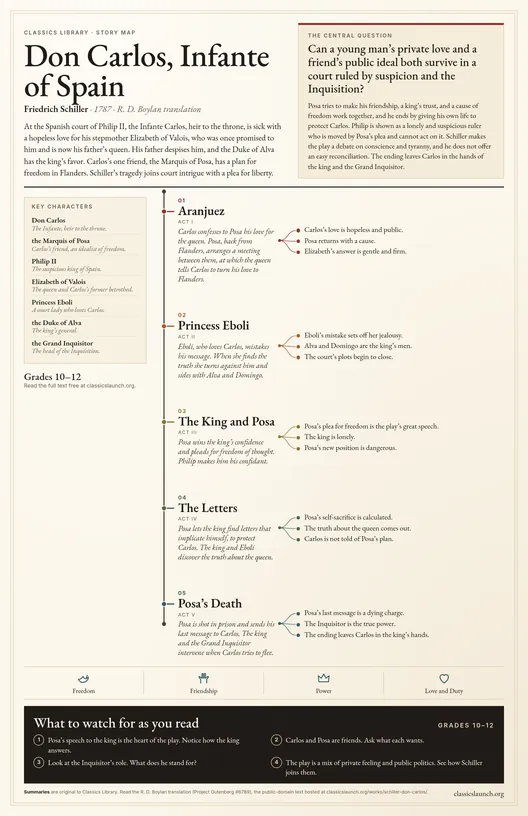 Story mapSee the story mapThe whole book on one page: the story in movements, the characters, and what to watch for. Free to print.
Abstract
Background. Schiller started this play in 1783 as a family drama and finished it four years later as a drama of ideas. It was staged in Hamburg in 1787 and established him as a poet of liberty.
Plot. A prince in love with his stepmother is guided by an idealist friend who wants to use him to free Flanders. The friend wins the king's trust, then sacrifices himself to protect the prince, but the Inquisition takes the young man in the end.
Ideas. The play weighs freedom against authority, and friendship against a cause. It asks whether deceit may serve a good end, and shows that a tyrant becomes his own prisoner.
Text. The translation by R. D. Boylan renders the verse into English blank verse. The text is of a nineteenth-century edition, and the play is long, with many speeches of high rhetoric. The hosted text is complete as printed here, with its section headings kept as a guide to the reader, and every quotation on this page is drawn directly from that text. Teachers can pair this work with the library's study guide, seminar questions and memory-work selection to prepare a discussion, a short essay or a recitation. The full text is hosted on this site, and each quotation in the guide has been checked against the hosted translation.
Main characters
- Don Carlos: The impulsive Spanish prince
- Posa: His idealist friend
- Philip II: The suspicious king
- The Queen: Elizabeth of Valois
- Eboli: A jealous princess
- The Grand Inquisitor: A blind and powerful cardinal
Summary
Don Carlos is Schiller's tragedy of the Spanish court under Philip II, written when the poet was in his twenties and still the author of The Robbers. The Infante Carlos, the king's heir, is sick with a hopeless love for his stepmother, Elizabeth of Valois, who was once promised to him and is now his father's queen. His father despises him and favours the Duke of Alva, and the court is full of spies, among them the confessor Domingo. Carlos is rescued from despair by the return of his boyhood friend, the Marquis of Posa, a Knight of Malta who has just seen the suffering of Flanders under Spanish rule and who is persuaded that a prince like Carlos might free the Netherlands and change the world. Posa arranges a meeting between Carlos and the queen. She tells him to love his country and not herself. Meanwhile Princess Eboli, who loves Carlos and mistakes his signs for her, discovers that his heart belongs to the queen and takes revenge by joining Alva and Domingo against him. Posa, seeing that Carlos will be destroyed, goes to Philip himself. In the most famous scene of the play he tells the king to give his subjects freedom of thought and to become 'a king of men' and not of slaves. Philip, astonished and lonely, treats Posa as the first honest man he has met and makes him his confidant. Posa then does a hard thing. To save Carlos from the king's suspicion and to keep the cause of Flanders alive, he lets the king find letters that make Posa himself appear the queen's secret lover. He is shot in his prison, and as he dies he sends Carlos a message to remember the dreams of his youth. Philip learns too late that Posa was loyal to him in his own way. Carlos, roused to action, tries to escape to Flanders after one last meeting with the queen, but the king and the Grand Inquisitor appear, and the Inquisitor claims the prince. The play asks whether a man may use deceit for a noble end, and what happens to friendship when one friend becomes an instrument of a cause. Schiller is hard on the Inquisition and on the tyranny of Philip, and sympathetic, though not uncritical, towards the idealism of Posa. Teachers should note themes of illicit love, state violence, and a bitter picture of the Inquisition.
Virtues in this work
- Friendship: Posa's loyalty to Carlos is unshaken even when it costs him his life.
- Fortitude: Posa speaks truth to a king who has power to destroy him.
- Justice: He pleads for the free conscience of the subjects.
- Honor: The queen refuses to yield to her stepson's passion and keeps her faith to the king.
Plot or Argument
- Act I: Aranjuez
Carlos confesses to Posa his love for the queen. Posa, back from Flanders, arranges a meeting between them, at which the queen tells Carlos to turn his love to Flanders.
- Act II: Princess Eboli
Eboli, who loves Carlos, mistakes his message. When she finds the truth she turns against him and sides with Alva and Domingo.
- Act III: The king and Posa
Posa wins the king's confidence and pleads for freedom of thought. Philip makes him his confidant.
- Act IV: The letters
Posa lets the king find letters that implicate himself, to protect Carlos. The king and Eboli discover the truth about the queen.
- Act V: Posa's death
Posa is shot in prison and sends his last message to Carlos. The king and the Grand Inquisitor intervene when Carlos tries to flee.
Characters
- Don Carlos, title prince
Heir to the Spanish throne, impulsive and passionate, torn between love and duty.
- Marquis of Posa, friend
An idealist who has seen Flanders and is willing to give his life for freedom.
- Philip II, king of Spain
A lonely and suspicious monarch who rules by fear and cannot trust anyone.
- Elizabeth of Valois, queen
Philip's young wife, once promised to Carlos, loyal to her duty.
- Princess Eboli, court lady
A proud beauty who loves Carlos and is driven by jealousy to betray him.
- Duke of Alva, general
The king's harsh general and a voice of the war party.
- The Grand Inquisitor, churchman
An old blind cardinal who commands even the king.
Lessons
Freedom of conscience is a theme of the play
Posa asks Philip for liberty of thought and refuses to give up his ideal. Schiller lets him argue that a king rules best when the subject is free, and the Grand Inquisitor's scene shows what happens when the Church is made a tool of the state.
- What does Posa ask the king to give?
- How does Philip answer him?
Friendship can take the form of sacrifice
Posa gives up his life for Carlos. Schiller leaves it open whether his method of deceit was right.
- Why does Posa take the blame on himself?
- Did Posa do right to deceive the king?
Tyranny isolates the tyrant
Philip has a throne and a kingdom but no friend, and he admits as much to Posa. The play makes the king a figure of pity as well as of fear.
- What does Philip say about his own loneliness?
- How does the Inquisitor treat him?
Context
Philip II ruled Spain from 1556 to 1598 and was the greatest Catholic monarch of his age. His heir Don Carlos died in prison in 1568, and rumour linked his fall to the king's wife; Schiller took the story from a French historical romance and built on it a drama of ideas.
Composition
Schiller began the play in 1783 as a family drama and, over four years, turned it into a drama of political ideals. The verse version was published in 1787, and first performed at Hamburg that year.
Reception
The play was a success on the German stage and established Schiller as a poet of freedom. Verdi later made it into a grand opera, in 1867.
Comparisons
- The Brothers Karamazov
The Grand Inquisitor of Dostoevsky echoes Schiller's Inquisitor in the question of freedom and authority.
- Hamlet
Both plays show a prince in a court of spies, and a friend who gives his life to help him.
- The Life of Friedrich Schiller
Carlyle's life of Schiller places the play in the poet's development.
- The Prince
Machiavelli's Prince is the textbook of the kind of rule Philip practises.
Quotes
Frequently cited
“One pen-stroke now, One motion of your hand, can new create The earth! but grant us liberty of thought.”
Frequently cited
“Tell him, in manhood, he must still revere The dreams of early youth, nor ope the heart Of heaven's all-tender flower to canker-worms Of boasted reason,--nor be led astray When, by the wisdom of the dust, he hears Enthusiasm, heavenly-born, blasphemed.”
“The world is yet Unripe for my ideal; and I live A citizen of ages yet to come.”
“Lord Cardinal! I've done my part. Go now, and do your own.”
For Students
A reading companion for classical Christian high school students. See the student guide.
Reading Guide
Watch for
- What Posa asks Philip for and what Philip gives him.
- The way every character hides something from every other.
- How the king describes himself.
Key terms and names
- Infante
- The title of a Spanish prince, here the king's son and heir.
- Inquisition
- The Church court set up in Spain to root out heresy, which became an instrument of the state.
- Flanders
- The Spanish Netherlands, then in revolt against Philip's rule.
- Knight of Malta
- A member of a military religious order, as Posa is.
Seminar Questions
- Comprehension Who loves whom in the first act, and why is each love impossible?
- Comprehension What does Posa tell the king in Act III?
- Interpretation Why does Posa choose to deceive Philip?
- Interpretation How does Schiller portray the Grand Inquisitor?
- Interpretation What does the king mean when he says he has done his part?
- Big Question Can a good end justify deceit?
- Big Question What can a ruler do who has no friend?
Faith Connections
- John 15:13 (Scripture)
Jesus says that no one has greater love than to lay down his life for his friends. Posa's death follows that pattern.
- 2 Corinthians 3:17 (Scripture)
Where the Spirit of the Lord is, there is freedom. Posa's plea for liberty of thought has an echo of this verse.
- Augustine, Letters (on coercion) (Great Conversation)
Augustine's later view of the use of force in religion is the background of the Inquisition that Schiller attacks.
Logic and Rhetoric
Central argument: A ruler who forbids freedom of thought makes his own subjects strangers and himself a prisoner.
Rhetorical device: apostrophe. Posa speaks to the king as a representative of future ages, turning a private audience into a public appeal.
Debate: Resolved: That a ruler who restricts freedom of conscience destroys the loyalty he seeks.
Memory Work
Tell him, in manhood, he must still revere The dreams of early youth, nor ope the heart Of heaven's all-tender flower to canker-worms Of boasted reason,--nor be led astray When, by the wisdom of the dust, he hears Enthusiasm, heavenly-born, blasphemed.
Lord Cardinal! I've done my part. Go now, and do your own.
Writing Prompts
Essay: Posa dies for freedom but also deceives his friend. Is he a hero or a manipulator?
Comparison with Hamlet: Compare Posa's friendship with Carlos to Horatio's friendship with Hamlet.
Creative Prompts
- Essay
Is Posa's deception of Philip justified by his goal? Use the third and fourth acts.
- Classroom
Stage the Act III interview between Philip and Posa and discuss how each man reads the other.
- Dialogue
Write the conversation between Carlos and the queen after Posa's death.
Further Reading
- The Life of Friedrich Schiller, Thomas Carlyle
Carlyle's biography, hosted in this library.
- The Revolt of the Netherlands, Friedrich Schiller
Schiller's history of the revolt in Flanders, the cause that Posa serves.
- The Brothers Karamazov, Fyodor Dostoevsky
Contains Ivan's tale of the Grand Inquisitor, a famous descendant of Schiller's scene.
- Philip II, William H. Prescott
A nineteenth-century history of the Spanish king.
Verification notes
Full text from Project Gutenberg, R. D. Boylan's English verse translation (Bohn's Standard Library, nineteenth century), in public domain. Quotes were checked against the hosted text. The play departs freely from the historical Don Carlos.
- Exact publication year of Boylan's translation in the Bohn series.
- Which of Schiller's two versions the translation follows.