Work record
Prometheus Unbound
Percy Bysshe ShelleyPrometheus Unbound (Shelley); A Lyrical Drama in Four ActsPrometheus Unbound by Percy Bysshe Shelley (1820)Prometheus Unbound, which Shelley published in 1820, is a four-act lyrical drama that takes the old Greek myth and gives it a new ending.Also known as: Prometheus Unbound (Shelley) · A Lyrical Drama in Four Acts
1820 · 19th Century · Drama · English
Read this when tyranny seems endless, and hope must be made from its own ruin.
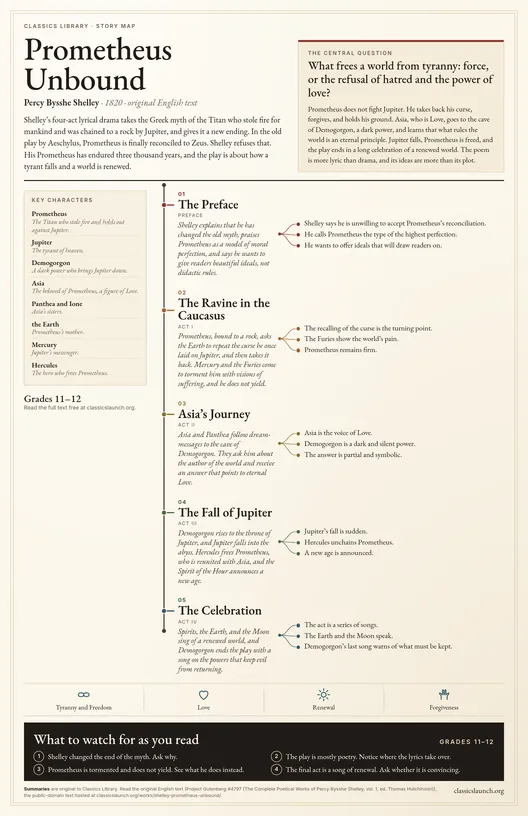 Story mapSee the story mapThe whole book on one page: the story in movements, the characters, and what to watch for. Free to print.
Abstract
Background. A young English poet living in Italy wrote this drama in the years after the fall of Napoleon, and published it with a Preface that praises its hero above Milton's Satan. It gives the Greek myth of the chained Titan a new ending.
Plot. The Titan, bound to a rock for ages, takes back his curse on the god who torments him. Dreams carry his beloved to a dark power, who rises to the throne, throws down the tyrant and frees the world. A last act of songs celebrates the new age.
Ideas. The poem argues that tyranny is sustained by hatred and fear, and that forgiveness, endurance and love are what free the world. It also rejects a sovereign God, which makes it a poem to read critically in a Christian course.
Text. The text is complete, with the Preface and four acts, from Project Gutenberg #4797, and every quotation was checked against it. It is dense verse and suits patient older students. Teachers can pair this work with the library's study guide, seminar questions and memory-work selection to prepare a discussion, a short essay or a recitation. The full text is hosted on this site, and each quotation in the guide has been checked against the hosted text.
Main characters
- Prometheus: Chained Titan and friend of mankind
- Jupiter: Tyrant of heaven
- Demogorgon: Shapeless power of eternity
- Asia: Prometheus's beloved, an Oceanid
- Panthea: Asia's sister, bearer of dreams
Summary
Prometheus Unbound, which Shelley published in 1820, is a four-act lyrical drama that takes the old Greek myth and gives it a new ending. In the ancient story, the Titan Prometheus steals fire for mankind and is chained to a rock by Jupiter; in the play of Aeschylus he is finally reconciled to Zeus. Shelley refuses that reconciliation. His Prometheus, who has endured three thousand years of torment on a ravine in the Indian Caucasus, will never submit to the tyrant. But he does something even more surprising: he recalls the curse he laid on Jupiter in his anger, and he takes it back. 'I wish no living thing to suffer pain.' From that moment, the poem says, the world's order begins to turn. The action is mostly inward and symbolic. In the first act Prometheus is tormented by Furies sent by Jupiter, who show him the sufferings of humankind, including a vision of a youth nailed to a crucifix, to persuade him that his own hope is vain. In the second act Prometheus's beloved Asia and her sister Panthea, helped by dreams, descend to the cave of Demogorgon, a dark power who stands for the necessity that rules both gods and men. In the third act Demogorgon rises to Jupiter's throne and Jupiter falls. Hercules unbinds Prometheus, and the earth is renewed with no kings and no priests. The fourth act is a great celebration of voices, spirits, the Earth and the Moon, closing with Demogorgon's song on the virtues that keep the world free from evil: to forgive, to defy, to love and to hope. Shelley says in his Preface that Prometheus is a nobler figure than Milton's Satan because he is free of ambition, envy and revenge, and that he wishes to teach by beauty and not by doctrine. The play is an act of faith in moral progress, with a very Christian-sounding ethic of forgiveness and endurance and a very un-Christian refusal of a personal, sovereign God. In the poem Jupiter is a projection of fear and a tyrant, not the God of the Bible, and Shelley's hope is that love by itself can make the world new. A Christian reader will recognise the longing for justice and the call to forgive, and will want to ask whether love can overcome evil without the cross and the resurrection. It is a difficult poem and best suited for older, patient readers.
Virtues in this work
- Fortitude: Prometheus endures centuries of torment without yielding to Jupiter.
- Charity: He takes back his curse and wishes no living thing to suffer pain.
- Hope: The closing speech calls on the reader to hope till Hope creates from its own wreck the thing it contemplates.
- Magnanimity: Prometheus rises above vengeance and pride in his own cause.
Plot or Argument
- Preface
Shelley explains that he has changed the old myth, praises Prometheus as a model of moral perfection, and states that he wants to give readers beautiful ideals, not didactic rules.
- Act I: The ravine in the Caucasus
Prometheus, bound to a rock, asks the Earth to repeat the curse he once laid on Jupiter, and then takes it back. Mercury and the Furies come to torment him with visions of suffering, and he does not yield.
- Act II: Asia's journey
Asia and Panthea follow dream-messages to the cave of Demogorgon. They ask him about the author of the world and receive an answer that points to eternal Love.
- Act III: The fall of Jupiter
Demogorgon rises to the throne of Jupiter, and Jupiter falls into the abyss. Hercules frees Prometheus, who is reunited with Asia, and the Spirit of the Hour announces a new age.
- Act IV: The celebration
Spirits, the Earth and the Moon sing of a renewed world, and Demogorgon ends the play with a song on the powers that keep evil from returning.
Characters
- Prometheus, Titan, champion of mankind
Bound to a rock for three thousand years, he is the type of patient endurance and takes back his curse on Jupiter.
- Jupiter, tyrant of heaven
The ruler of the gods, who tortures Prometheus and falls at last through the one he thought his servant.
- Demogorgon, dark power
A shapeless figure of necessity and eternity who rises from the abyss and dethrones Jupiter.
- Asia, beloved of Prometheus
An Oceanid whose journey and transformation bring in the new age; she is love made active.
- Panthea and Ione, Oceanides, sisters of Asia
Attendants who share dreams and visions with Prometheus and Asia and tell what they see.
- The Earth, Prometheus's mother
A voice of the living world that remembers the curse and rejoices in the renewal.
- Mercury, messenger of Jupiter
The god's servant who arrives with the Furies to demand Prometheus's secret.
- Hercules, hero
The son of Zeus who unbinds Prometheus in the third act.
Lessons
Forgiveness frees the one who forgives
Prometheus's first step toward freedom is to unsay his curse and wish no one pain. The drama makes forgiveness a moral act that comes before liberation, an idea a Christian reader will recognise from the Sermon on the Mount.
- Why does Prometheus take back his curse before Jupiter falls?
- How does this agree or disagree with Matthew 5:44?
Tyranny and resistance
Shelley shows tyranny as a power sustained by fear, which falls when the victim refuses to hate and refuses to yield. Students can compare this with Christian teaching on suffering and on the limits of political power.
- What keeps Jupiter in power in the first act?
- What changes when Prometheus refuses to return hatred?
Idealism and its limits
The play trusts that love and imagination can renew the world, and its Preface says it wants to give beautiful ideals to readers. A Christian reader may ask where the poem places the source of love and whether human nature alone can bear this hope.
- What does the poem say is the source of the power of Love?
- What would the Christian answer add to or change in Shelley's account?
Reading a poem critically
Shelley openly criticises the Christian religion of his day, and the poem includes a vision of a crucified youth. A classical Christian course can read the poem as a witness to a moral longing that the Gospel claims to fulfil, while noting where it rejects the Gospel.
- What does the vision of a youth nailed to a crucifix show about Shelley's attitude to Christianity?
- Why might a poet who rejected the Church still admire patient suffering?
Context
Shelley wrote the play in the years after the defeat of Napoleon, when the monarchs of Europe had restored their thrones and many reformers felt that the French Revolution had ended in a worse tyranny. Its hope for a world without kings or priests belongs to that moment, and its fall of Jupiter is a symbolic figure for all unjust power.
Composition
Shelley began the play at Este in the autumn of 1818 and wrote the second and third acts at Rome in the spring of 1819, much of it among the ruins of the Baths of Caracalla. He added the fourth act at Florence at the end of 1819, and it was published by C. and J. Ollier in London in the summer of 1820 along with a number of short poems.
Reception
The play sold poorly and puzzled many reviewers, but later readers have counted it among the great achievements of Romantic poetry. Its lyric beauty, its refusal of vengeance and its closing hymn have been widely admired, and its theology has been criticised by Christian readers from the beginning.
Comparisons
- Prometheus Bound and Other Plays
Aeschylus's Prometheus Bound is the ancient drama that Shelley rewrites; the Greek poet ended with a reconciliation, which Shelley rejects.
- Paradise Lost
Milton's Satan is the figure Shelley says Prometheus exceeds; Milton's poem gives the Christian view of rebellion that Shelley sets aside.
- Frankenstein
Mary Shelley's novel is subtitled The Modern Prometheus; it asks what happens when a human maker takes the place of God, a question the play answers differently.
- Faust, Part One
Goethe's Faust is another Romantic drama of a striving soul, but it ends in a Christian grace that Shelley's play replaces with love.
- Ozymandias
Shelley's sonnet shows the end of a tyrant in a few lines; the play shows it in four acts.
Quotes
Frequently cited
“It doth repent me: words are quick and vain; Grief for awhile is blind, and so was mine. I wish no living thing to suffer pain.”
Frequently cited
“Fate, Time, Occasion, Chance and Change? To these All things are subject but eternal Love.”
Frequently cited
“To suffer woes which Hope thinks infinite; To forgive wrongs darker than death or night; To defy Power, which seems omnipotent; To love, and bear; to hope till Hope creates From its own wreck the thing it contemplates; Neither to change, nor falter, nor repent; This, like thy glory, Titan, is to be Good, great and joyous, beautiful and free; This is alone Life, Joy, Empire, and Victory!”
“But Prometheus is, as it were, the type of the highest perfection of moral and intellectual nature, impelled by the purest and the truest motives to the best and noblest ends.”
“Didactic poetry is my abhorrence; nothing can be equally well expressed in prose that is not tedious and supererogatory in verse.”
“A woful sight: a youth With patient looks nailed to a crucifix.”
“Love, from its awful throne of patient power In the wise heart, from the last giddy hour Of dread endurance, from the slippery, steep, And narrow verge of crag-like agony, springs And folds over the world its healing wings.”
For Students
A reading companion for classical Christian high school students. See the student guide.
Reading Guide
Watch for
- Prometheus's reasons for taking back his curse in the first act.
- Every description of Jupiter and the sources of his power.
- The role of dreams in the journeys of Panthea and Asia.
- The closing speech of Demogorgon and the virtues it names.
Key terms and names
- Titan
- One of the older gods in Greek myth; Prometheus is a Titan who sided with mankind.
- Oceanides
- Nymphs of the sea who are daughters of the Titan Ocean; Asia, Panthea and Ione are sisters.
- Lyrical drama
- A play written in verse whose chief effects are in song and lyric rather than plot.
- Demogorgon
- A mysterious, shapeless power in the poem that stands for eternity and for the necessity that governs the gods.
Seminar Questions
- Comprehension What does Prometheus ask the Earth to repeat in Act I, and what does he say after hearing it?
- Comprehension Who unbinds Prometheus in Act III, and what happens to Jupiter?
- Interpretation Why does Shelley reject the ending in which Prometheus is reconciled with Jupiter?
- Interpretation What does Demogorgon stand for in the poem?
- Interpretation Why does Shelley let a vision of a crucifix appear among the Furies' images?
- Big Question Can love without God make a just world?
- Big Question Is forgiveness a necessary step toward freedom from tyranny?
Faith Connections
- Matthew 5:43-48 (Scripture)
Jesus tells his followers to love their enemies; Prometheus's recantation of his curse echoes this command, though Shelley gives it a different ground.
- Romans 12:19-21 (Scripture)
Do not repay evil for evil; overcome evil with good. The closing hymn of the play states an idea like this without naming God.
- Milton, Paradise Lost (Great Conversation)
Milton's Satan and Shelley's Prometheus are both rebels against a ruler; the two poems offer opposite judgments on the rebellion and on the ruler.
Logic and Rhetoric
Central argument: Tyranny lives on the hatred and fear of its victims, and it falls when a free, patient sufferer wishes no one harm, so that love, not force, remakes the world.
Rhetorical device: lyric chorus and apostrophe. The Spirits' songs and the closing hymn of Demogorgon turn the argument into music, so that the hope for a renewed world is felt before it is reasoned.
Debate: Resolved: That Shelley's Prometheus is a truer model of moral heroism than Milton's Satan.
Memory Work
To suffer woes which Hope thinks infinite; To forgive wrongs darker than death or night; To defy Power, which seems omnipotent; To love, and bear; to hope till Hope creates From its own wreck the thing it contemplates; Neither to change, nor falter, nor repent; This, like thy glory, Titan, is to be Good, great and joyous, beautiful and free; This is alone Life, Joy, Empire, and Victory!
It doth repent me: words are quick and vain; Grief for awhile is blind, and so was mine. I wish no living thing to suffer pain.
Writing Prompts
Essay: Argue whether the play's ethic of forgiveness and endurance can stand without belief in a God who forgives, using Act I and Act IV as evidence.
Comparison with Paradise Lost: Compare Shelley's Prometheus with Milton's Satan as rebels against a ruler, using the Preface, and say which poem gives a more convincing account of evil.
Medical Lens
The poem makes pain and endurance its first subject and treats the torments of Prometheus as a moral test. The dreams shared by Panthea and Asia are the means by which truth is carried across the play, and they allow a discussion of dreams as a source of meaning in Romantic poetry.
Creative Prompts
- Essay
Explain why Prometheus takes back his curse in the first act and what this changes in the poem, and say whether the idea is Christian.
- Classroom
Read the closing speech of Act IV aloud and list the five actions it calls for, then compare the list with the Beatitudes.
- Poetry
Write a short lyric in which a prisoner wishes no one pain, using a refrain like Shelley's.
Further Reading
- Prometheus Bound, Aeschylus
The ancient Greek tragedy that Shelley answers, in this library.
- Shelley: The Pursuit, Richard Holmes
A major biography of the poet, published in 1974.
- Paradise Lost, John Milton
The epic whose Satan Shelley contrasts with Prometheus, in this library.
Verification notes
Full text from Project Gutenberg #4797, the Hutchinson text (1904) of the 1820 poem, public domain; the Preface and Acts I-IV are included, with the editor's textual notes and Mary Shelley's later note omitted. Quotations were checked against the hosted text. Composition and publication facts follow the editor's notes and standard biographies. Readings of Demogorgon, of Jupiter and of the closing hymn are interpretive.
- The exact day on which the play was published, given as the summer of 1820.
- Whether the vision of a crucified youth in Act I is intended as a direct reference to Christ, which is a matter of interpretation.