Work record
The Last Man
Mary ShelleyThe Last Man (Shelley); Lionel Verney; Mary Shelley plague novelThe Last Man by Mary Shelley (1826)The Last Man, published in three volumes in 1826 by the author of Frankenstein, is a long novel about the end of the human race.Also known as: The Last Man (Shelley) · Lionel Verney · Mary Shelley plague novel
1826 · 19th Century · Novel · English
Read this when human plans meet plague and loss, and friendship is all that remains.
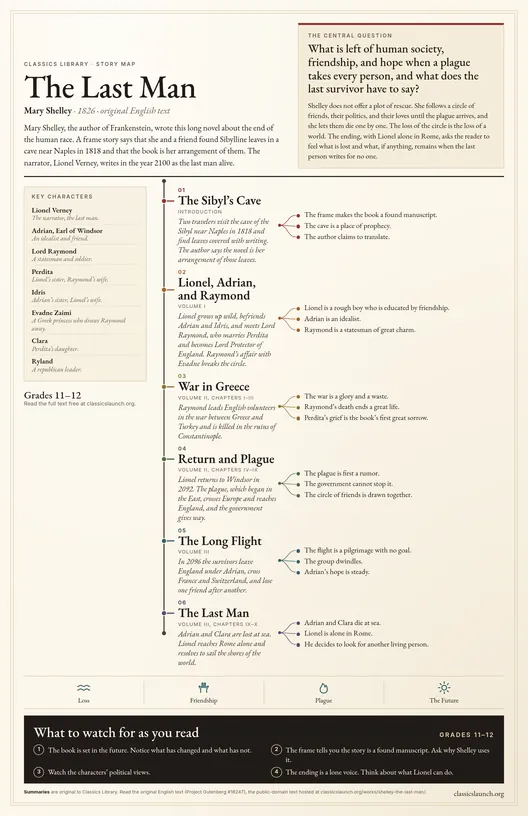 Story mapSee the story mapThe whole book on one page: the story in movements, the characters, and what to watch for. Free to print.
Abstract
Background. A widow of the Romantic circle wrote this book after losing her husband and a close friend. It came out in three volumes under the title page of the author of her first famous novel, was mostly scorned and then forgotten for a hundred years.
Plot. The story is told in the year 2100 by the last man alive. It follows a close group of friends in a republican England, a war in Greece and a plague that spreads from the East. The survivors flee across Europe and are lost one by one.
Ideas. The novel praises friendship, love, nature and the imagination, and shows how powerless any government or science is before disease. It offers almost no hope beyond death, which gives a Christian reader much to think about.
Text. The text is complete, with the Introduction and the three volumes, from Project Gutenberg #18247. Every quotation was checked against it. The book treats plague, death and despair, so it suits older students. Teachers can pair this work with the library's study guide, seminar questions and memory-work selection to prepare a discussion, a short essay or a recitation. The full text is hosted on this site, and each quotation in the guide has been checked against the hosted text.
Main characters
- Lionel Verney: Narrator and last man alive
- Adrian: Gentle idealist and son of the last king
- Lord Raymond: Ambitious Lord Protector
- Perdita: Lionel's sister and Raymond's wife
- Idris: Adrian's sister and Lionel's wife
Summary
The Last Man, published in three volumes in 1826 by the author of Frankenstein, is a long novel about the end of the human race. A frame story tells that its author and a friend found Sibylline leaves in a cave near Naples in 1818, and that the novel is her translation of them. The narrator is Lionel Verney, who writes in the year 2100 as the last man alive, in the ruins of Rome. He sets down the story of his life and of the friends he lost, in the hope that someone may some day read it. The first volume is a story of friendship and politics in the late twenty-first century. In 2073 the last king of England has given up his throne, and Britain is a republic. Lionel, the orphaned son of a favourite of the late king, grows up wild in the mountains of Cumberland. He is taken up by Adrian, the son of the last king, an idealist who has renounced his claims, and he meets Adrian's sister Idris and the brilliant, ambitious Lord Raymond. Raymond marries Lionel's sister Perdita, becomes Lord Protector of England, and then falls into an affair with the Greek woman Evadne that nearly destroys the circle. The second volume follows the war in Greece, in which Raymond is killed at Constantinople, and the return home of Lionel to the happy life of his family at Windsor. Then plague, which had begun in the East, reaches England and grows past all hope of control. The third volume is the long unravelling. The survivors flee from London and then from England, led by the gentle Adrian, and set out across France and Switzerland toward the warm south, losing one companion after another. Lionel's wife Idris and his son Evelyn die; Adrian and the girl Clara are drowned in a storm; and Lionel arrives in Rome alone with a dog, to learn that no other person is alive. The book ends not in hope but in restless resolve: he will sail from the Tiber around the shores of the world. Mary Shelley wrote it after the loss of her husband and of her friend Lord Byron, and readers often see them in Adrian and Raymond. The novel is sombre and Romantic. It praises friendship, love, nature and the imagination, and it shows how powerless a civilisation is before disease. A Christian reader will notice that it offers very little hope beyond the grave, and may ask what a reply from the Gospel would say. It is a book for older students.
Virtues in this work
- Friendship: Lionel and Adrian's loyalty holds through grief, war and plague until the end.
- Charity: Adrian and Idris tend the sick and the poor in London during the plague.
- Fortitude: Lionel continues to live and write after he has lost everyone he loves.
- Hope: Adrian's hymn of thanksgiving shows a hope that is tested but not wholly lost.
Plot or Argument
- Introduction: The Sibyl's cave
Two travellers visit the cave of the Sibyl near Naples in 1818 and find leaves covered with writing. The author says that the novel is her arrangement of those leaves.
- Vol. I: Lionel, Adrian and Raymond
Lionel grows up wild, befriends Adrian and Idris, and meets Lord Raymond, who marries Perdita and becomes Lord Protector of England. Raymond's affair with Evadne breaks the circle.
- Vol. II, Chapters I–III: War in Greece
Raymond leads the English volunteers in the war between Greece and Turkey and is killed in the ruins of Constantinople.
- Vol. II, Chapters IV–IX: Return and plague
Lionel returns to Windsor in 2092. The plague, which began in the East, crosses Europe and reaches England, and the government gives way.
- Vol. III: The long flight
In 2096 the survivors leave England under Adrian, cross France and Switzerland, and lose one friend after another.
- Vol. III, Chapters IX–X: The last man
Adrian and Clara are lost at sea. Lionel reaches Rome alone and resolves to sail the shores of the world.
Characters
- Lionel Verney, narrator
The orphaned son of a favourite of the last king, who grows from a wild boy to a devoted friend and the last man alive.
- Adrian, Earl of Windsor, idealist
The son of the last king of England, gentle, learned and generous, who gives up his claims and leads the survivors.
- Lord Raymond, statesman and soldier
A brilliant, ambitious nobleman who becomes Lord Protector, whose pride and passion divide his friends.
- Perdita Verney, Lionel's sister
A proud, reserved woman who loves Raymond with an all-consuming love.
- Idris, Adrian's sister
Lionel's wife, a gentle and devoted woman whose loss is one of the book's heaviest.
- Evadne Zaimi, Greek princess
A Greek exile who loves Raymond and brings about the crisis of his marriage.
- Clara, Perdita's daughter
Raymond's child, raised by Lionel and Idris, who is Adrian's companion at the end.
- Ryland, republican leader
A politician who succeeds Raymond as Protector and speaks for the plain, practical view of affairs.
Lessons
Friendship and loyalty in a time of loss
The book's strongest note is the love of Lionel, Adrian, Idris and the others for one another. The plague takes the world's order, but the novel keeps asking what remains when only loyalty is left.
- How does Lionel's friendship with Adrian shape his life?
- What does the book suggest remains when everything else is lost?
The limits of human power
Raymond's ambition, England's government and Merrival's science are shown to be helpless before the plague. Students can ask what the novel says about pride in human planning, and how this agrees or disagrees with the Christian doctrine of dependence on God.
- What do Raymond's ambition and his fall show?
- Why do Merrival's calculations and Ryland's politics fail?
Nature, imagination and thanksgiving
Adrian's hymn of praise to a benignant power, and his gratitude for love and the imagination, are set against a story of ruin. The novel leaves unanswered whether such gratitude can survive the plague.
- What does Adrian thank God for in the hymn, and how does the novel treat it later?
- Does the end of the book deny his faith or test it?
Despair and its resistance
Lionel is left alone and chooses to go on. His resolve to sail the world is not hope, but it is a refusal to lie down. Students can compare this with Christian hope, which rests on a promise rather than on restlessness.
- What does Lionel choose to do at the end, and why?
- How is his restlessness different from hope?
Context
The novel looks forward to the end of the twenty-first century, but it is shaped by the 1820s: by the Greek War of Independence, by Romantic hopes for republican government, by a long fear of epidemic disease, and by the deaths that had struck the author's own circle. Cholera and plague outbreaks were not far in Europe's past.
Composition
Mary Shelley wrote the book in 1824 and 1825 in England after the deaths of Percy Bysshe Shelley in 1822 and of Byron in 1824, and her diary calls herself the last relic of a family. It was published by Henry Colburn in London in 1826 in three volumes, with the notice that it was by the author of Frankenstein.
Reception
Reviews in 1826 were mostly hostile and the novel dropped from sight for well over a century. It was reprinted in the 1960s and since then has been read as an early work of science fiction, as a novel of the Romantic circle and as a story of disaster.
Comparisons
- Frankenstein
Shelley's first novel also concerns a lone narrator, a catastrophe of human making and the cost of cut-off friendships, but turns on a single creature instead of a whole world.
- The Plague
Camus's plague novel is a modern, secular study of how people meet an epidemic, set beside Shelley's Romantic one; Camus asks what solidarity is worth.
- Paradise Lost
Milton's epic gives the Christian account of a lost world and of hope beyond it; Shelley's novel imagines the loss without an answer.
- Dracula
Stoker's Victorian novel uses a story of a spreading evil and a band of friends who join to resist it.
- The Decameron
Boccaccio's tales are told by friends who flee a plague-ridden city; Shelley's friends flee too, but there is nowhere left to go.
Quotes
Frequently cited
“And is not love a gift of the divinity? Love, and her child, Hope, which can bestow wealth on poverty, strength on the weak, and happiness on the sorrowing.”
Frequently cited
“I will leave a monument of the existence of Verney, the Last Man.”
“I visited Naples in the year 1818. On the 8th of December of that year, my companion and I crossed the Bay, to visit the antiquities which are scattered on the shores of Baiæ.”
“Look into the mind of man, where wisdom reigns enthroned; where imagination, the painter, sits, with his pencil dipt in hues lovelier than those of sunset, adorning familiar life with glowing tints.”
“I am glad that I have loved, and have experienced sympathetic joy and sorrow with my fellow-creatures.”
“This enemy to the human race had begun early in June to raise its serpent-head on the shores of the Nile; parts of Asia, not usually subject to this evil, were infected.”
“Neither hope nor joy are my pilots—restless despair and fierce desire of change lead me on.”
For Students
A reading companion for classical Christian high school students. See the student guide.
Reading Guide
Watch for
- The frame story in the Introduction and what it says about how the book came to be.
- Each moment when a plan of Raymond, Ryland or Merrival meets a limit.
- The scenes of friendship between Lionel, Adrian and Idris.
- How the plague is first described and how people react to it.
Key terms and names
- Sibyl
- A prophetess of the ancient world; the novel pretends to be her leaves found in a cave near Naples.
- Lord Protector
- An officer who rules a republic or acts for a monarch; Raymond holds the office in the novel.
- Romanticism
- A movement around 1800 that prized imagination, nature and strong feeling, which shapes the book.
- Plague
- An epidemic disease that kills large numbers of people, the central disaster of the novel.
Seminar Questions
- Comprehension Who is Lionel Verney, and what does he say about himself at the start of the story?
- Comprehension What happens to Raymond in Greece?
- Interpretation Why does Mary Shelley set the story in the twenty-first century?
- Interpretation How does Adrian differ from Raymond?
- Interpretation What do the final pages say about hope?
- Big Question Can friendship be enough when the world fails?
- Big Question How does the Christian hope of resurrection answer a book that ends with only one man alive?
Faith Connections
- Psalm 90:3-6 (Scripture)
The psalmist reminds us that human life is as grass that flourishes in the morning and withers by evening; the novel is a long meditation on this.
- 1 Corinthians 15:54-57 (Scripture)
Death is swallowed up in victory; a Christian reader may ask how this answers the last man's loneliness.
- Augustine, City of God (Church Fathers)
Augustine writes of the fall of Rome and says that the city of God endures beyond every earthly ruin, a hope the novel does not share.
Logic and Rhetoric
Central argument: Human plans, politics and learning cannot stop a general ruin, and friendship and love, though precious, are not enough to stand against the end.
Rhetorical device: frame narrative. The Introduction claims that the story is a translation of the Sibyl's leaves, giving the book the force of prophecy.
Debate: Resolved: That The Last Man is a book without hope.
Memory Work
And is not love a gift of the divinity? Love, and her child, Hope, which can bestow wealth on poverty, strength on the weak, and happiness on the sorrowing.
I will leave a monument of the existence of Verney, the Last Man.
Writing Prompts
Essay: Argue whether Adrian's hymn in Volume I is answered or overturned by the events that follow.
Comparison with The Plague: Compare how Shelley and Camus show people facing an epidemic, and say what each concludes about solidarity and hope.
Medical Lens
The plague is the central subject: it spreads from the East, overwhelms government and the habits of daily life, and leaves each survivor to cope with grief. The book is a Romantic account of the social collapse that follows an epidemic and gives much attention to the mental state of survivors, including Adrian's earlier madness. Its descriptions are imaginative, not clinical.
- Vol. II, Chapters VI-IX; Vol. III, Chapters I-III
The plague moves from the East across Europe and into England, and the narrator describes the failure of government, the flight from the cities and the grief of survivors.
- Vol. III, Chapters III-X
Idris dies before the survivors leave England, and on the journey Evelyn, then Adrian and Clara, are lost, until Lionel is left to bear loss after loss alone.
Creative Prompts
- Essay
Explain how the plague changes the way Lionel, Adrian and Raymond understand their ambitions, and say what the novel suggests about human pride.
- Classroom
Read aloud Adrian's hymn of praise in Volume I and discuss what he thanks God for and how the later plague tests it.
- Fiction
Write the last page of a journal kept by a survivor who must choose whether to go on, using Lionel's choice as a model.
Further Reading
- Frankenstein, Mary Shelley
Shelley's first novel, in this library.
- Mary Shelley, Miranda Seymour
A full modern life of the author.
- The Plague, Albert Camus
A modern novel of an epidemic, in this library.
Verification notes
Full text from Project Gutenberg #18247, the 1826 first edition in public domain. The chapter labels follow the Gutenberg file, which prints Chapter IV twice in Volume I as the first edition does; quotations were checked against the hosted text. The dating of the story to 2073 through 2100, the principal characters and the end follow the text. Reading Adrian as Shelley and Raymond as Byron is a widely held interpretive view, and publication facts follow standard biographies.
- The page-level chapter numbering of the first edition and whether the repeated Chapter IV is in the original.
- The exact degree to which Adrian and Raymond were drawn from Percy Shelley and Byron, which is interpretation.