Work record
Idylls of the King
Alfred, Lord TennysonIdylls of the King by Alfred, Lord Tennyson (1859–1885)Idylls of the King is Tennyson's long blank-verse retelling of the Arthurian legend, composed over more than a quarter of a century and gathered in its present form in twelve idylls in 1885.1859-1885 · 19th Century · Poetry · English
Read this when ideals of honor and loyalty must be weighed against human weakness and decay.
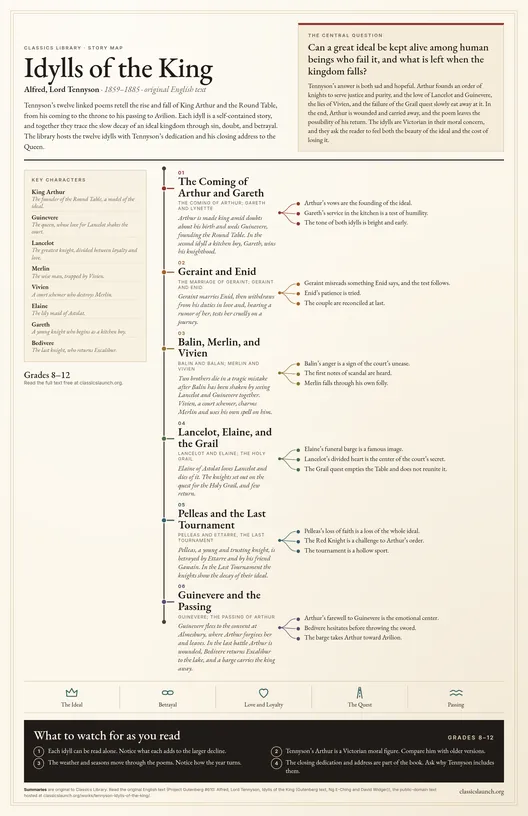 Story mapSee the story mapThe whole book on one page: the story in movements, the characters, and what to watch for. Free to print.
Abstract
Background. Tennyson worked on the Arthurian story for most of his career. Four idylls appeared in 1859, others followed in 1869, 1871, 1872 and 1885, and the final form of twelve idylls was arranged in 1885 after Tennyson had worked on the legend for much of his career.
Content. A young king founds the Round Table and binds his knights to vows. Gareth, Geraint, Balin, Merlin, Lancelot, Elaine, the Grail knights and Pelleas show how those vows are tested and broken. The queen's love for Lancelot undermines the kingdom, Modred rebels and the last battle ends in Arthur's passing.
Form. Twelve connected episodes in blank verse, with a dedication and a closing address to the Queen. Each idyll is a complete short narrative that contributes to the rise and fall of Arthur's kingdom.
Themes. Ideals and vows, loyalty and betrayal, adultery and repentance, rumor, the Grail, leadership and the passing of the old order are developed through the twelve idylls.
Significance. The poem is the major Victorian version of the Arthurian legend and a central text for the study of chivalry and its failure. It invites students to weigh high ideals against human weakness, and to ask what a Christian king, a Christian court and a Christian people owe one another when vows are broken.
Key figures
- King Arthur: The Christian king of Camelot
- Lancelot: The best knight, who loves the queen
- Guinevere: The queen, whose adultery helps bring the kingdom down
- Merlin: The wise counselor undone by Vivien
Summary
Idylls of the King is Tennyson's long blank-verse retelling of the Arthurian legend, composed over more than a quarter of a century and gathered in its present form in twelve idylls in 1885. He drew chiefly on Malory's Le Morte d'Arthur, on Welsh tales in Lady Charlotte Guest's Mabinogion for the story of Geraint and Enid, and on his own moral purpose. The poem is dedicated to the memory of Prince Albert, the Prince Consort, and closes with a verse address To the Queen. The twelve idylls move through the rise and fall of Arthur's kingdom, from its high start at the Round Table to the last battle in the west. The Coming of Arthur tells how a young king is won to the throne and calls his knights to vows of purity and service. Gareth and Lynette shows a young knight learning humility through scorn. Geraint and Enid, with its prelude The Marriage of Geraint, tests trust within a marriage. Balin and Balan shows the first poison of rumor and rage, and Merlin and Vivien the fall of the wise man to a clever tempter. Lancelot and Elaine tells of a lady who dies of an unreturned love, and The Holy Grail of the knights' vision, in which many of them are carried away from their duty. In Pelleas and Ettarre a young knight's trust is mocked, and in The Last Tournament the brotherhood is stained by cruelty and lust. Guinevere shows the queen's repentance after her adultery with Lancelot is discovered, and the king's forgiving yet stern farewell. The Passing of Arthur closes the tale with the last battle and the dying king borne away, with the line that the old order changeth, yielding place to new, and God fulfils himself in many ways, lest one good custom should corrupt the world. Throughout Tennyson treats the king as a figure of Christian virtue, though not as Christ, and the tragedy as the failure of fallen men to keep vows they cannot keep alone. Readers differ about whether the poem criticizes its age or flatters it, but all agree that it is a major work of Victorian moral imagination and an important modern version of the story of Camelot.
Virtues in this work
- Honor: The code of the Round Table asks the knights to live and speak truly and to serve the king, and the poem shows the cost of keeping or breaking it.
- Justice: Arthur's kingship aims at redressing wrongs and upholding the law, though it fails at the end.
- Magnanimity: Arthur's patient forgiveness of Guinevere and his refusal of bitterness show greatness of soul.
- Fortitude: The king faces the ruin of his order without cowardice.
Plot or Argument
- Dedication and The Coming of Arthur
A dedication to the memory of Prince Albert opens the poem. Arthur is raised to be king, wins the Round Table's loyalty and the hand of Guinevere, and begins his kingdom.
- Gareth and Lynette; The Marriage of Geraint; Geraint and Enid
A young knight serves in the kitchen before proving himself, and Geraint's jealous suspicion of his wife Enid is cured by her loyalty.
- Balin and Balan; Merlin and Vivien
Rumor and rage lead two brothers to their deaths, and Merlin yields to Vivien's cunning and is lost.
- Lancelot and Elaine; The Holy Grail
The lily maid of Astolat dies for Lancelot, and the Grail quest draws the knights from their duty to the king.
- Pelleas and Ettarre; The Last Tournament
A true young knight is betrayed by a faithless lady and the order is infected with cruelty and mockery.
- Guinevere; The Passing of Arthur; To the Queen
The queen repents, the king forgives and departs, and the last battle brings the kingdom to its end and Arthur to his passing.
Characters
- King Arthur, The king
The Christian king who founds the Round Table and tries to bind his knights by vows; he is noble yet unable to stop the decay he sees.
- Guinevere, The queen
Arthur's wife, whose love for Lancelot leads to her disgrace and repentance.
- Lancelot, The greatest knight
The king's best knight, torn between his love for the queen and his loyalty to Arthur.
- Merlin, The wizard
The wise counselor of Arthur who falls to the cunning of Vivien.
- Elaine, The lily maid of Astolat
A maiden who loves Lancelot without return and dies of grief.
- Vivien, The tempter
A clever and malicious woman who undermines the court's honor with slander and temptation.
Lessons
Vows are easier to take than to keep
Arthur calls his knights to take vows of purity, truth and service to the king, and the idylls show how each one is tested and many fail. The poem asks what holds a community together after its ideals have been proclaimed.
- Which of the Round Table vows is broken most often, and by whom?
- What does the poem suggest about the need for grace as well as law?
Sin spreads quietly
The decay of Camelot begins with small acts of rumor, pride and secret love, and ends with open war. Tennyson shows how private faults become public ruin.
- How does the story of Lancelot and Guinevere affect the other knights and the king?
- Which small faults lead to the greatest trouble in the poem?
The old order changes but God remains
At the end Arthur passes, but the poem says God fulfils himself in many ways. The tragedy is bounded by a hope that the failure of a kingdom is not the failure of God's purposes.
- How does Arthur's last speech answer the pain of the kingdom's fall?
- What is the difference between losing a kingdom and losing hope?
Context
Tennyson had long wished to treat the Arthurian story. He took up Malory's Le Morte d'Arthur in his youth, and published a poem on the passing of Arthur as early as 1842. The first four idylls, Enid, Vivien, Elaine and Guinevere, appeared together in 1859 as Idylls of the King.
Composition
The poem grew by additions: The Coming of Arthur, The Holy Grail, Pelleas and Ettarre and The Passing of Arthur in 1869; The Last Tournament in 1871; Gareth and Lynette in 1872; and Balin and Balan in 1885, when the twelve idylls were arranged as a single poem. The dedication, written after the death of Prince Albert in 1861, was added in 1862.
Reception
The first volume sold in the tens of thousands, and for decades the poem shaped English ideas of chivalry and the Arthurian legend. Some modern readers find its moral tone heavy and its portrait of women severe, and Victorian critics argued about whether the poem showed how an ideal could be undone by the flaws of its age.
Comparisons
- Le Morte d'Arthur
Malory is the main source; his prose gives the story with its warmth, violence and loyalty, and Tennyson's poem sharpens it into a single moral tragedy.
- The Faerie Queene, Book I
Spenser's allegory also takes chivalric romance as a school of virtue, but spreads it across twelve legendary knights, while Tennyson fixes on one king and one ruin.
- Sir Gawain and the Green Knight
The medieval poem tests a single knight's honor in a game of keeping faith; Tennyson tests a whole court and shows the cost of failure.
- Arthurian Romances
Chrétien de Troyes is an early French source for Lancelot and the Grail legends; Tennyson reshapes the same figures in a Victorian Christian frame.
Quotes
Frequently cited
“The old order changeth, yielding place to new, And God fulfils himself in many ways, Lest one good custom should corrupt the world.”
Frequently cited
“Live pure, speak true, right wrong, follow the King— Else, wherefore born?”
Frequently cited
“His honour rooted in dishonour stood, And faith unfaithful kept him falsely true.”
Frequently cited
“To reverence the King, as if he were Their conscience, and their conscience as their King,”
Frequently cited
“I found Him in the shining of the stars, I marked Him in the flowering of His fields, But in His ways with men I find Him not.”
“Authority forgets a dying king,”
“Man's word is God in man: Let chance what will, I trust thee to the death.”
For Students
A reading companion for classical Christian high school students. See the student guide.
Reading Guide
Watch for
- How each idyll tests one of the knightly vows and shows what happens when it is broken.
- The change of seasons and scene from the spring of The Coming of Arthur to the winter of The Passing of Arthur.
- Arthur's own character: his firmness, his limits and his hope.
Key terms and names
- Idyll
- A short poem or episode, here used for self-contained episodes in the larger story of Camelot.
- Round Table
- King Arthur's order of knights, who swear vows to serve truth, purity and the king.
- Blank verse
- Unrhymed iambic pentameter, the meter of Milton and Shakespeare.
- Excalibur
- Arthur's sword, which Bedivere is told to throw into the lake at the king's passing.
Seminar Questions
- Comprehension What vows does Arthur ask his knights to swear, and which idyll shows the first sign of their failure?
- Comprehension How does Tennyson tell the story of Elaine, the lily maid of Astolat?
- Interpretation Why does Tennyson make Arthur a figure who is good but cannot save his kingdom?
- Interpretation What does Arthur mean when he says that God fulfils himself in many ways?
- Big Question Can a society be held together by ideals alone, or does it need something more?
- Big Question Does the poem show the failure of Christian ideals or the failure of men to live by them?
Faith Connections
- Romans 7:15-19 (Scripture)
Paul writes of the good he wants to do and fails to do. Camelot's story shows a community that wills the good and fails in the doing.
- Hebrews 11:13 (Scripture)
The heroes of faith died without receiving the promise but greeted it from afar; Arthur's passing, with its hope that God is not exhausted, has a similar tone.
- Augustine, City of God, Book XIX (Church Fathers)
Augustine argues that no earthly city can reach true peace, and that the city of man passes while the city of God endures, which gives a context for the fall of Camelot.
Logic and Rhetoric
Central argument: The poem argues that an order built on high ideals will still fail if the people within it are divided in heart, and that the failure of an earthly kingdom is not the end of God's purposes.
Rhetorical device: Epic simile and elegiac tone. Tennyson uses long comparisons and a slow, solemn blank verse to lift Arthur's passing to the height of epic and to give it a tone of loss.
Debate: Resolved: High ideals do more harm than good when a community cannot live up to them.
Memory Work
The old order changeth, yielding place to new, And God fulfils himself in many ways, Lest one good custom should corrupt the world.
Live pure, speak true, right wrong, follow the King— Else, wherefore born?
Writing Prompts
Essay: Write an essay on how the Idylls of the King portrays the decay of an ideal, drawing on at least three of the idylls.
Comparison with Le Morte d'Arthur: Compare Tennyson's treatment of Lancelot and Guinevere with Malory's, and say which makes the sin more grievous.
Medical Lens
The idylls include wounds in battle, the dying king borne to Avalon, and Elaine's death of unrequited love. They offer no clinical material, but the account of Arthur's last wound and the description of Elaine's decline give literary accounts of dying and grief.
Creative Prompts
- Essay
Argue whether Arthur's kingdom fails because of its ideals or because of the people who were asked to live by them.
- Poetry
Write a short passage in blank verse describing a moment of honesty or failure in a leader's life.
- Classroom
Choose one idyll and prepare a short retelling for younger students, making clear what each knight chooses and what it costs.
- Adaptation
Write a scene in which Merlin warns Arthur about the future of the Round Table, using the poem's themes.
Further Reading
- Le Morte d'Arthur, Thomas Malory
The medieval prose version that Tennyson used as his chief source.
- The Mabinogion, Lady Charlotte Guest (trans.)
The Welsh tales, in Guest's translation, that gave Tennyson the story of Geraint and Enid.
- Alfred Lord Tennyson: A Memoir, Hallam Tennyson
The son's life with the poet's remarks on the Idylls.
- The Faerie Queene, Edmund Spenser
Another great English romance poem on the training of a Christian knight.
Verification notes
The text is Project Gutenberg #610 (Ng E-Ching and David Widger), which prints the Dedication, the twelve idylls and the verse address To the Queen. Publication dates for the groups of idylls and the 1862 dedication follow standard accounts of the poem's growth. Tennyson's chief sources are Malory's Le Morte d'Arthur and Lady Charlotte Guest's Mabinogion for Geraint and Enid. Quotes were checked against the hosted text.
No verification flags recorded.