Work record
The Inspector-General
Nikolai GogolThe Government Inspector; The Inspector General; The RevizorThe Inspector-General by Nikolai Gogol (1836)The Inspector-General is the founding comedy of the Russian stage.Also known as: The Government Inspector · The Inspector General · The Revizor
1836 · 19th Century · Drama · Russian
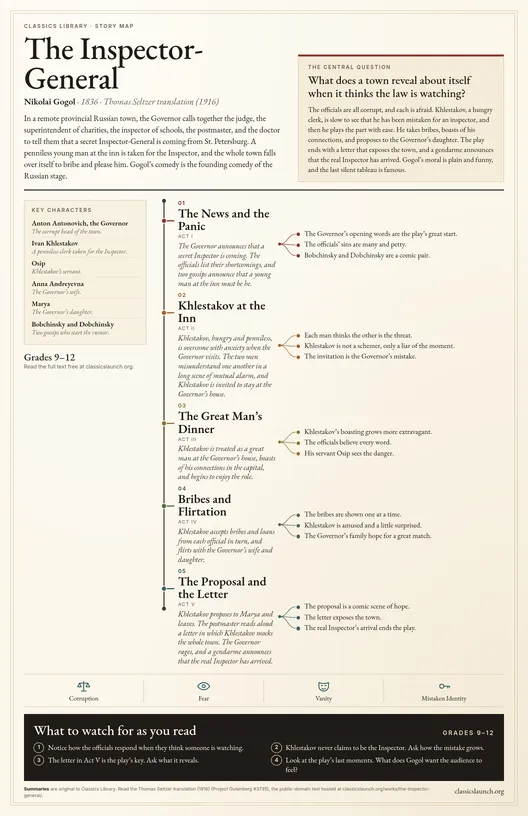 Story mapSee the story mapThe whole book on one page: the story in movements, the characters, and what to watch for. Free to print.
Abstract
Background. Gogol wrote the play in a few weeks in 1835, on a plot he said Pushkin gave him. It was produced in 1836 with the Tsar present, and it caused such a storm that Gogol left Russia for much of the rest of his life.
Plot. A frightened Governor mistakes a poor clerk for a government Inspector and lavishes bribes and hospitality on him. The clerk leaves with the money and a proposal of marriage, and a letter that reveals everything is opened at the post office. Then the real Inspector's arrival is announced, and the play ends in a silent tableau.
Ideas. The play is a comedy of conscience. It shows how guilt and fear make people foolish, how small corruptions grow into a whole way of life, and how a judgment that has not yet come can be felt by everyone as a certainty, which is why the laughter of the audience becomes uneasy.
Text. The Seltzer translation is clear and speakable, with an introduction that places the play in Russian history. The Gutenberg text keeps Gogol's notes on the characters and his stage directions, including those for the final tableau, so a class can stage the play from it. Teachers can pair this work with the library's study guide, seminar questions and memory-work selection to prepare a discussion, a short essay or a recitation.
Main characters
- The Governor: A corrupt official who fears the Inspector
- Khlestakov: A penniless clerk mistaken for the Inspector
- Osip: His shrewd servant
- Anna and Marya: The Governor's wife and daughter

Summary
The Inspector-General is the founding comedy of the Russian stage. It opens with a short, sharp scene in the house of the Governor of a remote provincial town. He has called together the leading officials, the judge, the superintendent of charities, the inspector of schools, the postmaster and the doctor, to tell them that an Inspector-General is coming from St. Petersburg, in secret, to examine the town. Each man knows what he has neglected or stolen. The judge takes bribes in the form of hunting dogs, the hospital is neglected, a schoolmaster makes faces at his pupils, and the doctor cannot even speak the language of his patients. They agree to clean up, bribe and bluff. At this moment two gossips rush in with news that a young man from the capital has been staying at the inn for two weeks without paying. He is Khlestakov, a vain and penniless petty clerk who has lost his money at cards and is stranded with his servant Osip. The Governor, in a panic, decides that this must be the Inspector, and calls on him. Khlestakov, who thinks he is about to be arrested for debt, behaves with a confusion that the officials take for the cunning of a great man. He is given the best rooms, wined and dined, and lent a good deal of money by one official after another. He begins to boast, hands out advice, flirts with the Governor's wife and his daughter, becomes engaged to the daughter, and leaves in a carriage for a visit to an imaginary uncle, with Osip's hurry. The officials are in triumph until the postmaster, who has been opening letters for amusement, reads one that Khlestakov has written to a friend in Petersburg. It describes the officials in terms of cheerful contempt: the Governor is as stupid as an old horse. The town has been taken in by a fool. In the middle of their rage a gendarme arrives and announces that an official from St. Petersburg, sent by imperial order, has come and wants to see them all at the inn. The curtain falls on a silent scene in which all the characters stand fixed like statues. The comedy was a scandal when it was staged in 1836, and the Tsar is said to have remarked that everyone had caught it, himself most of all. Gogol later explained that the real Inspector was the conscience, and that the last judgment awaits every soul. A Christian reader will see how easily bribery, flattery and fear become the habits of a whole community.
Virtues in this work
- Justice: The play is a comedy of injustice and its exposure, and it makes a clear demand for honest official conduct.
- Prudence: The officials' crafty reckoning of their own interests is a false prudence that leads them into folly.
- Humility: The Governor's final fury is the opposite of humility, and the real Inspector's coming is a lesson in it.
- Honor: The play examines the false honor of rank and the true honor of a clear conscience.
Plot or Argument
- Act I: The news and the panic
The Governor announces that a secret Inspector is coming. The officials list their shortcomings, and two gossips announce that a young man at the inn must be he.
- Act II: Khlestakov at the inn
Khlestakov, hungry and penniless, is overcome with anxiety when the Governor visits. The two men misunderstand one another in a long scene of mutual alarm, and Khlestakov is invited to stay at the Governor's house.
- Acts III–IV: Dinner and bribes
Khlestakov is treated as a great man, boasts of his connections, accepts bribes and loans from each official in turn, and flirts with the Governor's wife and daughter.
- Act V: The proposal and the letter
Khlestakov proposes to Marya and leaves. The postmaster reads aloud a letter in which Khlestakov mocks the whole town. The Governor rages, and a gendarme announces that the real Inspector has arrived.
Characters
- Anton Antonovich, the Governor, protagonist
A shrewd old official who has risen through bribes and favours, and who panics at the thought of the Inspector.
- Ivan Alexandrovich Khlestakov, the false Inspector
A thoughtless young clerk who is taken for a great man and cannot stop himself from enjoying it.
- Osip, Khlestakov's servant
A cunning, taciturn valet who sees at once that his master is not the man they take him for.
- Anna Andreyevna and Marya, the Governor's wife and daughter
Two women who see in Khlestakov a ladder to St. Petersburg.
- Bobchinsky and Dobchinsky, the gossips
Two short, inquisitive landowners who start the rumor.
Lessons
Fear is the real inspector
The officials believe, because they fear it, that the man they see is the one who will judge them. Fear makes them see judgement in a clerk and bribes in a ritual. The play shows how guilt prepares a community to be fooled.
- Why do the officials so readily believe that Khlestakov is the Inspector?
- What does each of them have to hide?
Small corruption is still corruption
The judge's puppies and the Governor's presents are described as ordinary customs. Gogol lets the characters excuse themselves with phrases like there are sins and sins, and the audience sees how thin the excuses are.
- What does Ammos Fiodorovich mean by saying there are sins and sins?
- How does the Governor answer him?
The final judgment will come
The gendarme's announcement at the end changes a comedy of errors into a comedy of judgment. Gogol later said that this represents the last, true inspection of the human soul, and the play may be read with that in mind.
- Why does Gogol end on a frozen scene instead of a speech?
- What does the real Inspector represent?
Context
The play is set in a remote provincial town of Nicholas I's Russia, where the provincial bureaucracy was ill-paid and corrupt, and where officials lived in constant fear of a surprise inspection by the capital. The Governor, the judge, the postmaster and the others are ranked on the Table of Ranks that organised the civil service.
Composition
Gogol wrote the play in 1835 at Pushkin's suggestion, according to his own account, and finished it in a few weeks. It was staged in St. Petersburg in April 1836 with the personal permission of Nicholas I. Seltzer's English translation, hosted here, is dated 1916.
Reception
The first audience included the Tsar, who said it was a play in which everybody, and himself above all, had received a lesson. Gogol, upset by the hostile press, left Russia for years. The play has been performed ever since, and is the central comedy of the Russian theatre.
Comparisons
- Dead Souls
Gogol's novel is the same world in a longer form: a stranger arrives in a provincial town and the officials and landowners reveal themselves.
- The Overcoat
Gogol's tale is the tragic side of the same civil service, where a poor clerk is crushed by the machine.
- The Cherry Orchard
Chekhov's last comedy also uses a provincial household to show a society in decline, with a gentler irony.
- Hamlet
Hamlet's play within the play, meant to catch the conscience of the king, has the same moral hope as Gogol's silent last scene.
- The Pickwick Papers
Dickens's comic world of small officials and frauds is an English parallel to Gogol's town.
Quotes
Frequently cited
“I have called you together, gentlemen, to tell you an unpleasant piece of news. An Inspector-General is coming.”
Frequently cited
“There are sins and sins. I tell everyone plainly that I take bribes. I make no bones about it.”
Frequently cited
“What are you laughing at? You are laughing at yourself, oh you!”
Frequently cited
“An official from St. Petersburg sent by imperial order has arrived, and wants to see you all at once. He is stopping at the inn.”
“Bribes are bribes, whether puppies or anything else.”
For Students
A reading companion for classical Christian high school students. See the student guide.
Reading Guide
Watch for
- How each official is introduced by his office and what he fears is found.
- The long scene in Act II in which Khlestakov and the Governor mistake each other.
- The directions for the last scene, in which the cast must freeze.
Key terms and names
- Inspector-General (Revizor)
- An official sent from the capital to examine a provincial town; the title of the play in Russian.
- Bribe
- A gift given to an official to win his favour, which the characters excuse as a custom.
- Incognito
- Travelling under a false name or without making known one's rank, as the Inspector is said to do.
- Silent scene
- The tableau at the end of the play, in which all the characters are frozen in astonishment.
Seminar Questions
- Comprehension What does the Governor tell the officials at the start?
- Comprehension Who is Khlestakov, and why is he mistaken for the Inspector?
- Interpretation Why does Gogol give each official a separate vice?
- Interpretation What does the postmaster's letter do to the plot?
- Interpretation What does the silent scene say that a speech could not?
- Big Question Is the play about Russia or about every human being? Defend your answer.
- Big Question Is there a place for laughter in the judgment of a society?
Faith Connections
- Luke 12:2–3 (Scripture)
'Nothing is covered up that will not be revealed.' The Governor's panic is a comic version of the verse's truth.
- Matthew 25:31–46 (Scripture)
The last judgment, with its separation of sheep from goats, is the background to the real Inspector's arrival.
- Proverbs 29:4 (Scripture)
'By justice a king builds up the land, but he who exacts gifts tears it down.' The text for the Governor and his bribes.
Logic and Rhetoric
Central argument: A community that lives by bribes and fear is ready to be taken in by any impostor, and its real judge is the one it has not looked for. The play argues by dramatic irony, since the audience always knows what the characters do not.
Rhetorical device: dramatic irony. The Governor and Khlestakov each believe the other is dangerous and each acts accordingly, while the audience sees that neither is.
Debate: Resolved: That the real Inspector in the play is the conscience of the audience.
Memory Work
What are you laughing at? You are laughing at yourself, oh you!
There are sins and sins. I tell everyone plainly that I take bribes. I make no bones about it.
Writing Prompts
Essay: Choose two officials and show how Gogol uses a few lines to reveal each man's vice. What does the Governor fear most in each?
Comparison with Dead Souls: Compare the town of the Inspector-General with the town of Dead Souls. What does each stranger reveal about the people who receive him?
Medical Lens
The Governor tells the doctor to be ready for the Inspector, and the German doctor, who knows no Russian, lets patients die and does not much mind. The hospital under the Superintendent of Charities is a comic and cruel picture of neglect. Readers can use the play to talk about the duty of care and the ethics of those in charge of the sick.
- Act I, the hospital
The Superintendent of Charities describes patients who recover like flies, and the doctor who prescribes nothing.
Creative Prompts
- Essay
Explain how the officials' fear creates the Inspector out of Khlestakov. Use two scenes to show how their guilt does the work.
- Classroom
Stage the dinner scene in Act III with the class as the officials. Decide what each is trying to hide and what he gives Khlestakov.
- Dialogue
Write the first conversation between the real Inspector and the Governor in the style of Gogol's comedy.
- Essay
Gogol said the real Inspector is conscience. Argue for or against this reading using the last scene.
Further Reading
- Dead Souls, Nikolai Gogol
Gogol's novel of a stranger in a provincial town; hosted in this library.
- The Overcoat, Nikolai Gogol
The tragic story of a poor clerk; hosted in this library.
- Nikolai Gogol, Vladimir Nabokov
A short study of Gogol by a fellow master of Russian prose.
- The Government Inspector, Nikolai Gogol
The English-language title under which the play is often staged.
Verification notes
Full text from Project Gutenberg, the 1916 translation by Thomas Seltzer, in public domain. Quotes were checked against the hosted text. The historical report of the Tsar's comment follows common accounts and is not verified here.
- The Tsar's reported remark at the first performance.
- Exact date of the St. Petersburg premiere in April 1836.