Work record
Dead Souls
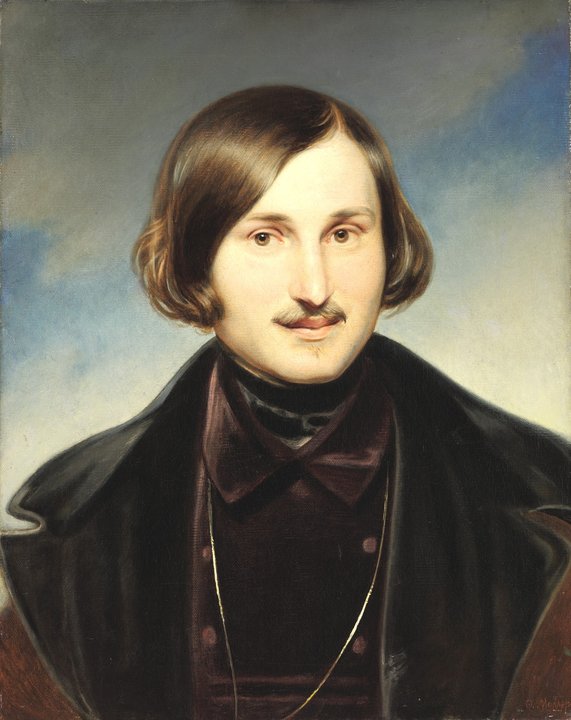
Nikolai GogolDead Souls (Gogol)Dead Souls by Nikolai Gogol (1842)Dead Souls is the first great Russian novel, and it begins with a trick.Also known as: Dead Souls (Gogol)
1842 · 19th Century · Novel · Russian
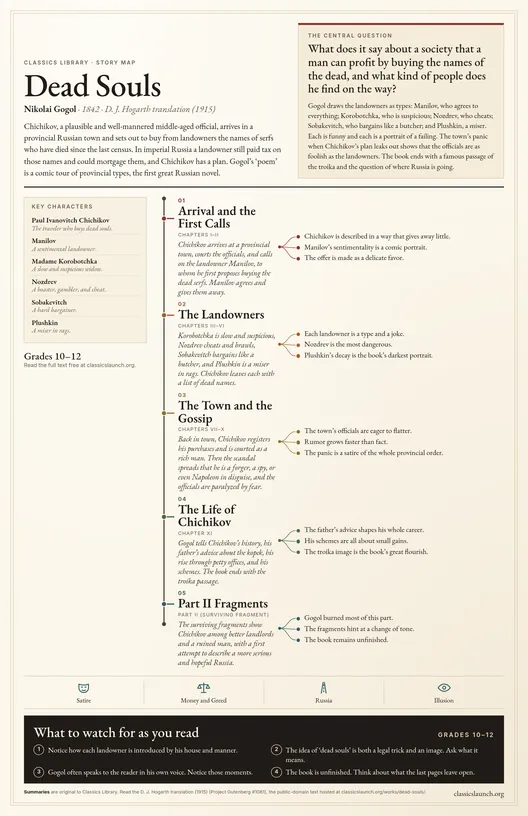 Story mapSee the story mapThe whole book on one page: the story in movements, the characters, and what to watch for. Free to print.
Abstract
Background. Gogol worked on this book for seven years, partly at Rome, and published it in 1842 as the first part of a three-part design. It made him the leader of Russian prose, though he later burned the second part and died soon after.
Plot. A traveler arrives at a provincial town and calls on neighbouring landowners to buy the names of dead serfs, so that he can mortgage them as if they were alive. Each landowner is a comic portrait of a vice. When the town learns of the scheme, rumors of every kind spread, and Chichikov slips away in his carriage.
Ideas. The book asks what a soul is worth, shows how greed, sentiment and laziness kill it, and offers a lyrical vision of Russia's future. It uses laughter as a form of judgment, and it points toward a redemption that Gogol planned in his second and third parts but never completed.
Text. The Hogarth translation is brisk, often witty, and keeps the long sentences and digressions of the original. Some of its phrasing is dated, and the Russian rank titles and place names are retained for flavor, so a short glossary of ranks helps a first-time reader. Teachers can pair this work with the library's study guide, seminar questions and memory-work selection to prepare a discussion, a short essay or a recitation.
Main characters
- Chichikov: A smooth official who buys dead serfs
- Manilov: A sentimental idler
- Korobotchka: A suspicious widow
- Nozdrev: A gambler and liar
- Plushkin: A ragged miser

Summary
Dead Souls is the first great Russian novel, and it begins with a trick. Chichikov, a plausible, well-mannered middle-aged official, arrives in a provincial town and sets out to buy from the landowners the names of serfs who have died since the last census. In imperial Russia a landowner still paid tax on those names and could still mortgage them; Chichikov's plan is to collect enough of these dead peasants on paper to borrow money against them and become a gentleman of property. The book is the story of his round of visits and of the people he cheats. Each of the landowners he calls on is a type, drawn with comic precision. Manilov is a sweet, empty dreamer who gives the dead souls away for nothing. Madame Korobotchka is a close-fisted widow who fears she is selling herself short. Nozdrev, a gambler and liar, tries to cheat Chichikov and nearly gets him beaten. Sobakevitch, a huge bear of a man who sees every living thing as a piece of meat, haggles hard. Plushkin, once a hospitable landowner, is now a ragged miser who lets his estate rot and his serfs run away. Each of these sketches is a short study in the vice that eats the soul. In the town itself, the officials, the governor's ball, and the gossip that follows Chichikov's purchases form a satire of the petty world of provincial Russia. Chichikov himself is the book's greatest creation. He is a nobody who has risen by sycophancy, bribery and a rule from his father, to save a kopek, and Gogol allows us to see that he is not a monster but a very ordinary man in whom a longing for comfort has hollowed out everything else. When the scheme collapses, Chichikov slips out of town in his britchka, and the book ends with the famous lyrical passage in which the carriage becomes a troika and Russia itself seems to fly forward to an unknown goal. Gogol meant the book to be only the first part of a threefold work like Dante's Divine Comedy, in which Chichikov would be punished, reformed and redeemed. The surviving fragments of the second part, hosted here, show a landlord who wants to improve his estate and a ruined man who confesses his own coarseness. Gogol destroyed the rest. Dead Souls is a comic book with a religious intention, and its title points to the death of the soul in men who live for gain.
Virtues in this work
- Temperance: Each landowner is a case of intemperate appetite or sloth, and the book is a study of vices against temperance.
- Justice: The trade in dead souls exposes the injustice of treating men as property.
- Prudence: Chichikov's cleverness is the book's picture of false prudence that serves no good end.
- Humility: The surviving fragments hint at a humbler, repentant Chichikov and at the humility Gogol wished him to find.
Plot or Argument
- Chapters I–II: Arrival and the first calls
Chichikov arrives at a provincial town, courts the officials, and calls on the landowner Manilov, to whom he first proposes buying the dead serfs. Manilov agrees and gives them away.
- Chapters III–VI: The landowners
Korobotchka is slow and suspicious; Nozdrev cheats and brawls; Sobakevitch bargains like a butcher; Plushkin is a miser in rags. Chichikov leaves each of them with a list of dead names.
- Chapters VII–X: The town and the gossip
Back in town, Chichikov registers his purchases and is courted as a rich man. Then the scandal spreads that he is a forger, a spy or even Napoleon in disguise, and the officials are paralysed by fear.
- Chapter XI: The life of Chichikov
Gogol tells Chichikov's history, his father's advice about the kopek, his rise through petty offices, and his schemes. The book ends with the troika passage and the question of where Russia is going.
- Part II fragments
The surviving fragments show Chichikov among better landlords and a ruined man, with a first attempt to describe a more serious and hopeful Russia.
Characters
- Paul Ivanovitch Chichikov, protagonist
A suave, anxious collegiate counsellor who collects dead serfs to raise a mortgage, and whose entire character is smoothness.
- Manilov, landowner
A sentimental, idle man of fine phrases who has never done anything.
- Madame Korobotchka, landowner
A suspicious, frugal widow who is afraid of being cheated.
- Nozdrev, landowner
A gambler, liar and brawler who cannot keep a secret or a promise.
- Sobakevitch, landowner
A huge, hard bargainer, who regards men as cattle.
- Plushkin, landowner
A miser who has ruined his house and his serfs.
Lessons
Avarice empties a soul
The title is a pun: the dead serfs on paper are less dead than the owners who live only to acquire. Gogol's gallery of landowners is a study in different ways the soul can die, from sentimentality to hoarding.
- Which of the five landowners seems to you the most dead, and why?
- What does Chichikov's plan assume about how people are valued?
A comedy can carry a judgment
The book is full of laughter, and the laughter is serious. Gogol's own preface asks the reader's help, and the Russia he draws is one of small vices that add up to a great waste.
- Where does the comedy turn serious?
- How does Gogol keep from making Chichikov a monster?
Sin is ordinary
Chichikov is not a devil. He lies, bribes and cheats out of a plain desire for comfort. The danger lies in how natural it feels, and the book asks how many of us are like him.
- What does Chichikov's father teach him, and what does he do with it?
- Is Chichikov redeemable? What does the second part hint?
Context
Dead Souls is set in the 1830s under Nicholas I, when about half the peasants of Russia were serfs, owned like property and counted in periodic censuses called 'revisions.' Landowners paid a tax for each 'soul' on the last census, even after he died, until the next one; the dead were therefore still property on paper, and could be mortgaged. Gogol took the plot, it is said, from a suggestion by Pushkin.
Composition
Gogol wrote the first part in Rome and Russia between 1835 and 1841, and published it in 1842, with Pushkin's advice and in the shadow of his death. The second part occupied him until his death in 1852, and he burned it; the surviving fragments appear in this translation, the Hogarth of 1915.
Reception
Dead Souls was greeted by some as a savage attack on Russia and by others as a patriotic epic. Belinsky saw in it a great social satire, while Gogol himself grew more religious and thought of it as a spiritual work. Later readers, from Dostoevsky and Nabokov to the present day, have counted it among the central books of Russian literature.
Comparisons
- The Overcoat
Gogol's most famous short story is the small-scale tragedy of a clerk, while Dead Souls is his large-scale comedy of a world of men who count and cheat.
- Don Quixote
A traveller crosses a country, meets a gallery of types, and the whole society is revealed; Gogol's book is in the same picaresque line.
- Oblomov
Goncharov's landowner is the opposite of Chichikov in energy, but his soul is dead in a similar way.
- The Inspector-General
Gogol's comedy of a town thrown into a panic by a false official has the same cast of petty provincial men.
- Great Expectations
Dickens also draws a crowd of comic types and a hero lifted by an unclear fortune, and the two books share a moral concern with money.
Quotes
Frequently cited
“To the door of an inn in the provincial town of N. there drew up a smart britchka--a light spring-carriage of the sort affected by bachelors, retired lieutenant-colonels,”
Frequently cited
“Whither, then, are you speeding, O Russia of mine? Whither? Answer me! But no answer comes--only the weird sound of your collar-bells.”
“Reader, whosoever or wheresoever you be, and whatsoever be your station--whether that of a member of the higher ranks of society or that of a member of the plainer walks of life--I beg of you, if God shall have given you any skill in letters, and my book shall fall into your hands, to extend to me your assistance.”
“But these dead souls of which I speak are quite another matter, for in this case you have put forth no exertions--it was merely God’s will that they should leave the world, and thus decrease the personnel of your establishment.”
“The present moment is particularly propitious, since in various parts of the country there has been an epidemic, and, glory be to God, a large number of souls have died of it.”
“Why do I so persistently paint the poverty, the imperfections of Russian life, and delve into the remotest depths, the most retired holes and corners, of our Empire for my subjects?”
For Students
A reading companion for classical Christian high school students. See the student guide.
Reading Guide
Watch for
- How each landowner is introduced by his house, his dinner and his speech.
- The moments when Gogol turns from comedy to lyrical passages on Russia.
- What Chichikov never says about the people he buys, and how it shows what he is.
Key terms and names
- Dead souls
- Serfs who had died since the last census and were still counted for tax; Chichikov buys the paper names.
- Revision
- The periodic census of the Russian peasants, taken for tax and military service.
- Britchka
- The light carriage in which Chichikov travels and which becomes the troika at the end.
- Tchinovnik
- A Russian official or civil servant, of whom the town has a great many.
Seminar Questions
- Comprehension What does Chichikov want to buy, and why?
- Comprehension Which five landowners does he visit, and what is each like?
- Interpretation Why does Gogol choose a scheme about the dead as his plot?
- Interpretation What is the effect of the lyrical passage on Russia at the end?
- Interpretation Why does the town fall into panic at the rumor about Chichikov?
- Big Question Does the book finally love or hate Russia? Argue from the text.
- Big Question Is Chichikov a villain or a mirror? What does the reader gain by laughing at him?
Faith Connections
- Matthew 16:26 (Scripture)
'What does it profit a man to gain the whole world and forfeit his soul?' Chichikov's whole career is a comic version of the question.
- Matthew 8:22 (Scripture)
'Let the dead bury their own dead.' The title and the plot play on the idea of the spiritually dead and on the way they traffic in the legally dead.
- Luke 12:15 (Scripture)
'Take care, and be on your guard against all covetousness.' The text for Plushkin and Sobakevitch, and for Chichikov himself.
Logic and Rhetoric
Central argument: A society that counts souls as property has lost its own, and the comedy of a rogue who buys dead names exposes the whole living order. The book argues by a series of comic portraits and a closing lyrical question.
Rhetorical device: comic catalogue. Each landowner is introduced through a catalogue of furniture, food and habits that tells the reader his character before he speaks.
Debate: Resolved: That Gogol's laughter in Dead Souls is a kind of mercy.
Memory Work
Whither, then, are you speeding, O Russia of mine? Whither? Answer me! But no answer comes--only the weird sound of your collar-bells.
But these dead souls of which I speak are quite another matter, for in this case you have put forth no exertions--it was merely God’s will that they should leave the world, and thus decrease the personnel of your establishment.
Writing Prompts
Essay: Choose two landowners and compare the kind of spiritual death each represents. What does Chichikov see in each, and what does Gogol want the reader to see?
Comparison with The Overcoat: Compare Akaky in The Overcoat with Chichikov. How does Gogol move from pity to laughter and back in the two works?
Medical Lens
The plot depends on an epidemic that carried off serfs, on the legal fiction that the dead still count, and on the heartlessness of a system that places a price on mortality. Plushkin's decay is a picture of what miserliness does to a mind and a body.
- Part I, Chapter XI, the epidemic
Chichikov notes that the sickness has killed many serfs and that the dead can be bought cheaply.
- Part I, Chapter VI, Plushkin
A rich man lives in rags and filth, hoarding everything, in a ruined house.
Creative Prompts
- Essay
Take one of the landowners and show how Gogol turns a vice into a character through a few small details. Quote the passages.
- Dialogue
Write a conversation between Chichikov and Plushkin on whether a dead man's name is worth buying, in Gogol's comic manner.
- Classroom
Divide the class into landowners and have each sell Chichikov a list of dead souls. Which is the hardest to persuade, and why?
- Essay
Gogol meant Dead Souls to be the first part of a larger work like the Divine Comedy. What would a redeemed Chichikov have to learn? Use the surviving fragments.
Further Reading
- The Overcoat, Nikolai Gogol
Gogol's best-known short story; hosted in this library.
- The Inspector-General, Nikolai Gogol
The comedy of an official mistaken for another; hosted in this library.
- Nikolai Gogol, Vladimir Nabokov
A short, brilliant and opinionated study of Gogol by a great Russian-American writer.
- The Divine Comedy, Dante
The model Gogol had in mind for the three-part structure.
Verification notes
Full text from Project Gutenberg, the D. J. Hogarth translation of 1915 (Everyman's Library) with its introduction by John Cournos, in public domain. Quotes were checked against the hosted text. The historical note on the revision lists and mortgages follows standard accounts.
- Whether the plot was suggested by Pushkin, as Gogol later said.
- Which of the Part II fragments Gogol had finished before the burning.