Work record
The Lost World
Arthur Conan DoyleProfessor Challenger; The Lost World (Doyle); Maple White Land; Challenger and the dinosaursThe Lost World by Arthur Conan Doyle (1912)The Lost World is Arthur Conan Doyle's adventure of a hidden plateau in South America where creatures of the distant past still live.Also known as: Professor Challenger · The Lost World (Doyle) · Maple White Land · Challenger and the dinosaurs
1912 · Early 20th Century · Novel · English
Read this when you want a fast adventure about brave men, stubborn professors and a hidden world.
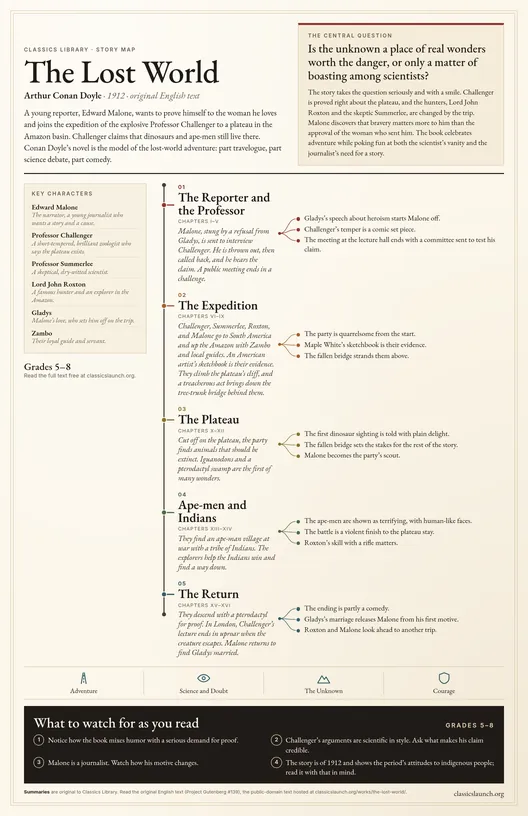 Story mapSee the story mapThe whole book on one page: the story in movements, the characters, and what to watch for. Free to print.
Abstract
Background. Conan Doyle, the creator of Sherlock Holmes, turned to a scientific adventure in 1912. The book appeared in The Strand Magazine and then as a volume, and it introduced Professor Challenger, a character he used again.
Plot. A newspaper man joins three older men on a trip to test a professor's claim that old creatures survive on a high plateau. A treacherous servant strands them there. They are caught between pterodactyls, ape-men and a tribe of Indians until the party finds a way down by rope and returns to London with its proofs.
Ideas. The story looks at courage, the pride of experts and the way a man changes through danger. Roxton's stand for justice and the loyalty of the four friends are set against the vanity of a scientific quarrel and the humour of a young man's first love.
Text. The hosted text is the full book from Project Gutenberg. Use it for reading aloud, for studying a first-person narrator and for comparing the book with other adventure stories. Teachers can pair this work with the library's study guide, seminar questions and memory-work selection to prepare a discussion, a short essay or a recitation. Every quotation in the guide has been checked against the hosted text.
Main characters
- Edward Malone: A young reporter and the narrator
- Professor Challenger: A brilliant and proud zoologist
- Professor Summerlee: A sceptical anatomist
- Lord John Roxton: A sportsman and friend of the Amazon
- Zambo: A loyal servant who waits below the cliffs
Summary
The Lost World is Arthur Conan Doyle's adventure of a hidden plateau in South America where creatures of the distant past still live. It is told by Edward Malone, a young reporter on the Daily Gazette in London. Gladys Hungerton, the girl he hopes to marry, has told him she can love only a man who does some heroic deed, and so he asks for a dangerous assignment. He is sent to interview Professor George Edward Challenger, a gifted but furious zoologist whom the scientific world has laughed at ever since he claimed to have seen living prehistoric animals on a journey up the Amazon. Challenger throws the reporter down his front steps, then thinks better of it and shows him the sketch-book of an American artist, Maple White, who drew a strange beast from the plateau and died soon after. At a crowded meeting Challenger is met with hoots and with the doubts of his old rival, Professor Summerlee. A party is chosen to go out and test his claim. It is made up of Summerlee, the sportsman Lord John Roxton, and Malone, with Challenger as the guide. They sail to Brazil and go up the Amazon with Indian boatmen and servants, among them the faithful Zambo and two half-breeds, Gomez and Manuel. At the foot of a great red cliff they find a pinnacle and a fallen tree that serves as a bridge to the top. Gomez, bent on revenge against Roxton, sends the tree crashing down, and the four men are trapped on the plateau. What follows is the heart of the book. The explorers cut a ring of thorny bushes for a camp and meet a world of dinosaurs, a swamp full of pterodactyls and a tribe of ape-men. They also meet the Accala Indians, who are at war with the ape-men, and the explorers take part in the end of that war. Malone, laid up with fever from a bite, is later sent out as scout and sees the lake the party names Lake Gladys. In the end the four find a way down by rope, carrying their proofs and a store of rough stones that Roxton believes to be diamonds. A rescue party of twenty Indians waits below. In London the evidence is first doubted, and then a live pterodactyl, brought in a packing-case to the Queen's Hall, escapes through a window. Gladys has married a solicitor's clerk named Potts, and Roxton's diamonds are valued at two hundred thousand pounds, to be shared among the four. Malone chooses to go back to the plateau. The book is written with great humour and pace. Beneath it are lasting questions about courage, the honesty of scientists, the pride that spoils a wise man, and the wonder of a created world far wider than any one mind can hold.
Virtues in this work
- Fortitude: Malone goes out alone at night on the plateau, and the four men face the ape-men and the dinosaurs without turning back.
- Justice: Roxton tells how he made war on the slave-drivers of the Putumayo because every man must at times stand for right.
- Friendship: The four men rescue one another and keep their quarrels from breaking the company; the last sentence of the book is Roxton's handclasp.
- Humility: Malone's closing words say that wonders and suffering have made each of them a better and deeper man, in contrast to Challenger's conceit.
Plot or Argument
- Chapters I-V: A reporter and a professor
Malone asks Gladys to marry him, is told he is not heroic enough, and takes an assignment from the Gazette to interview Professor Challenger. After a fight on the steps Challenger shows him Maple White's sketch-book and the wing-bone of a pterodactyl, and at a lecture the doubting Summerlee agrees to go and see for himself.
- Chapters VI-VIII: The expedition
Malone and Lord John Roxton meet at Roxton's rooms in the Albany, where the sportsman tells of his stand against the slave-drivers of the Putumayo. The party sails for Brazil, goes up the Amazon with Zambo, Gomez, Manuel and Indian boatmen, and arrives at the foot of the cliffs.
- Chapter IX: Trapped
The party crosses to the plateau by a fallen tree. Gomez topples the tree into the gulf out of revenge on Roxton, and the explorers are cut off, with Zambo as their one link with the world below.
- Chapters X-XII: The plateau
They build a thorny camp, call it Fort Challenger, and meet pterodactyls and other beasts; Malone and Summerlee suffer fever from the bites. Malone is the hero of the hour for a scouting walk and the party makes the first map of the lost world, with Lake Gladys at its centre.
- Chapters XIII-XV: The Indians, the ape-men and the descent
The explorers learn that the Accala Indians and the ape-men are at war and share in the Indians' victory. Challenger tries a plan for a gas balloon from the geyser's hydrogen. At last the party finds a way down by rope and meets a rescue party of twenty Indians with stakes and ropes.
- Chapter XVI: Home to London
At a great meeting in the Queen's Hall Challenger shows a live pterodactyl, which escapes through a window. Roxton's rough stones prove to be diamonds worth two hundred thousand pounds, and Malone, with Gladys married to another man, asks to go back to the plateau.
Characters
- Edward Malone, narrator
A young reporter on the Daily Gazette who is brave and honest and wants to prove himself to a girl who wants a hero.
- Professor George Edward Challenger, leader of the expedition
A huge-bearded zoologist with a great mind, a violent temper and a vast conceit, who is nonetheless right about the plateau.
- Professor Summerlee, sceptic
A thin, dry professor who doubts Challenger and keeps quarrelling with him, but shows courage when it is tested.
- Lord John Roxton, sportsman
A famous hunter who knows the Amazon and once made a stand against the slave-drivers of the Putumayo; he is the steadiest and most practical of the four.
- Zambo, servant
The big, loyal black servant who stays at the pinnacle as the party's link with the world below.
- Gomez, villain
A half-breed servant who knocks down the tree bridge to take revenge on Roxton.
- Gladys Hungerton, Malone's sweetheart
A pretty girl who wants a hero and who marries a solicitor's clerk, Mr. Potts, while Malone is away.
- Maple White, earlier explorer
An American artist who found the plateau first and died after sketching one of its creatures; his sketch-book is the first proof.
Lessons
Pride and the truth
Challenger is right about the plateau, but his pride makes him impossible to believe. Summerlee refuses to believe what he has not seen. Doyle shows two faults that stand in the way of honest knowledge, the conceit that cannot be questioned and the doubt that cannot be satisfied. A classical Christian student can read Proverbs 18:13 and 26:12 beside the novel.
- Why do the scientists at the Zoological Institute laugh at Challenger?
- What does Summerlee do when he is finally given proof?
- Which is the worse fault in a scholar, Challenger's pride or Summerlee's doubt?
What a hero is
Gladys wants a man who can win glory, and Malone goes out for her sake. By the end of the book he has found something better than her good opinion. Roxton, who stood against slave-drivers when no one asked him to, is a nobler model than the glory-seeker. The book asks what courage is for.
- Why does Malone set out, and what does he want by the end?
- What does Roxton say about making a stand for 'human right and justice'?
- Is Gladys right that heroism is waiting to be done all round us?
Friendship tested in danger
Four very different men are thrown together, and the quarrels of the two professors never break their loyalty. In the long days on the plateau each does a hard thing for the others, and the book shows how a company is held together by courage and by humour.
- How do the four men depend on each other on the plateau?
- What does Malone do for the party when he goes out as scout?
- Why does the book end with Roxton's hand held out to Malone?
A created world full of wonders
The plateau is full of creatures that the world thought gone for ever. The reader is meant to feel wonder, and a Christian student can think of Psalm 104 and of Job 38-41, where God points out the great beasts to man. The book also shows the limits of human knowledge in a world that is older and larger than any one mind.
- What wonders of the plateau does Malone describe best?
- What does the book suggest about the limits of what scientists know?
- Which Psalm or passage in Job would you read with this book?
Context
The Lost World appeared in 1912, when the Amazon and the South American highlands were still partly unmapped for Europeans, and when expeditions to little-known regions were popular newspaper stories. The age was also one of lively argument over the fossils of giant reptiles that had been found in Europe, North America and Africa in the nineteenth century. Doyle sets a tale of the newspapers, the learned societies and London clubs in the same world as the jungle.
Composition
Doyle wrote the book while living in Sussex, and it appeared in The Strand Magazine in monthly parts in 1912, with the book following in the same year. It brought in Professor Challenger, who is said to have been drawn partly from the Edinburgh physiologist William Rutherford, Doyle's old teacher. Doyle wrote further Challenger stories, including The Poison Belt in 1913 and The Land of Mist in 1926.
Reception
The book was an immediate success and has remained in print ever since. It was filmed as a silent picture in 1925, with the stop-motion dinosaurs of Willis O'Brien, who later worked on King Kong, and its lost-world plot has been used again and again in books, films and television.
Comparisons
- The Hound of the Baskervilles
Another Doyle story in which a monster turns out to be real, and a scientific mind meets a wild landscape; Doyle's Holmes explains the beast, while Challenger finds it.
- King Solomon's Mines
Haggard's earlier tale of English gentlemen going to a hidden country in Africa, with a hunter as guide, is the nearest model for Doyle's expedition.
- Journey to the Center of the Earth
Jules Verne's professor, nephew and guide find a prehistoric world below ground; Doyle's professor and reporter find one on top of a mountain.
- The Voyage of the Beagle
Darwin's account of the real exploration of South America, with its fossil beasts and its wonder at living creatures, stands behind the whole of Challenger's science.
- Heart of Darkness
Conrad's river journey into the heart of a continent, written ten years earlier, asks what the wilderness does to the men who enter it; Doyle's answer is much more cheerful.
- The Sign of the Four
Another Doyle adventure in which London men travel by river and meet strange people and animals, and the doctor narrator watches his companions' very different gifts.
Quotes
Frequently cited
“There are heroisms all round us waiting to be done. It's for men to do them, and for women to reserve their love as a reward for such men.”
Frequently cited
“There are times, young fellah, when every one of us must make a stand for human right and justice, or you never feel clean again.”
Frequently cited
“Our eyes have seen great wonders and our souls are chastened by what we have endured. Each is in his own way a better and deeper man.”
“Ape-men--that's what they are--Missin' Links, and I wish they had stayed missin'.”
“I am not aware that they are dependent upon endorsement either from you or anyone else.”
“both Summerlee and Challenger possessed that highest type of bravery, the bravery of the scientific mind.”
“I am Gladys Potts. Let me introduce you to my husband.”
“Lord Roxton said nothing, but a brown hand was stretched out to me across the table.”
For Students
A reading companion for classical Christian high school students. See the student guide.
Reading Guide
Watch for
- How each of the four men reacts to danger, and what each does that the others cannot.
- The humour in the quarrels of Challenger and Summerlee, and what they do when real danger comes.
- Malone's changing reasons for going, from the wish to impress Gladys to the love of the adventure itself.
- The way Doyle uses letters and reports to carry the story and to make it seem true.
Key terms and names
- Plateau
- A high, flat region of land with steep sides, here a mountain top cut off from the country around it.
- Pterodactyl
- A flying reptile of the age of the dinosaurs, with leathery wings and a long beak.
- Missing link
- A name used in 1912 for a supposed creature between apes and men, which Roxton uses for the ape-men.
- Zoological Institute
- The learned society in London where Challenger lectures and where the committee of investigation is chosen.
- Gazette
- The London newspaper on which Malone works; the narrative is presented as his reports for it.
Seminar Questions
- Comprehension How does Malone come to be sent to Professor Challenger, and what does Challenger show him?
- Comprehension How are the four explorers cut off on the plateau, and who is responsible?
- Interpretation Why does Doyle make Challenger both right and ridiculous?
- Interpretation What does Roxton mean when he says a man must sometimes make a stand for human right and justice?
- Interpretation How does the ending, with Gladys married and Malone free to go back, change the meaning of the first chapter?
- Big Question What makes courage worth the cost, and how can a man tell a worthy reason for risk from a vain one?
- Big Question What should a careful person do when someone he dislikes brings a surprising claim?
Faith Connections
- Psalm 104:24-25 (Scripture)
How manifold are thy works, O LORD, in wisdom hast thou made them all, and the sea is full of creatures great and small. The lost world is a picture of this fullness.
- Proverbs 18:13 (Scripture)
He that answereth a matter before he heareth it, it is folly and shame unto him. The verse describes the learned men at the Zoological Institute who laugh before they look.
- Micah 6:8 (Scripture)
To do justly, and to love mercy, and to walk humbly with thy God. Roxton's private stand against the slave-drivers is an example of the first of these.
- Job 38-41 (Great Conversation)
God asks Job about the great creatures of the earth and shows how little man knows of them; the passage is a long and dignified version of the book's wonder.
Logic and Rhetoric
Central argument: A claim that looks absurd may be true, and the proper response is to go and look with an open mind rather than to laugh from a chair; courage and honest testing are rewarded with wonder.
Rhetorical device: framing by letters and eyewitness reports. Malone writes letters to McArdle from the Amazon and the plateau, which gives the strange events the plain voice of a newspaper reporter.
Debate: Resolved: That a scientist should be believed only when he has produced proof that others can examine.
Memory Work
There are times, young fellah, when every one of us must make a stand for human right and justice, or you never feel clean again.
Our eyes have seen great wonders and our souls are chastened by what we have endured. Each is in his own way a better and deeper man.
Writing Prompts
Essay: Explain how Doyle uses the quarrel between Challenger and Summerlee to show a fault in each of them, and say which of the two grows more by the end.
Comparison with King Solomon's Mines: Compare Doyle's party of four with Haggard's three Englishmen in King Solomon's Mines, and say what each author thinks makes a good leader in a dangerous country.
Medical Lens
The book is not medical, but Doyle was a doctor and notes the effects of bites and fever with a doctor's eye. On the morning after their first adventure on the plateau Malone and Summerlee are in great pain and fever from the bites of the pterodactyls, and Roxton had suspected a toxic quality in the bite. The professors talk of bones, wings and the habits of living creatures, and the story's concern with testimony and proof also fits the history of how scientific claims are tested.
- Chapter XI
Malone and Summerlee suffer pain and fever after the bites of the pterodactyls, and Roxton suspects a poisonous quality in the bite.
- Chapter IV
Challenger shows Malone the damaged wing-bone of a pterodactyl and lectures on the structure of the wing, treating physical evidence as the test of a claim.
Creative Prompts
- Essay
Explain why Doyle gives his hero a reporter's eye and a young man's love as his reasons for going. Does Malone's reason change by the end?
- Fiction
Write a letter from Malone to McArdle describing one new creature on the plateau, in the lively first-person style of the book.
- Dialogue
Write a conversation between Professor Challenger and Professor Summerlee on the evidence for one of the creatures, in which each is polite and neither gives in.
- Classroom
Hold a mock meeting of the Zoological Institute. One group presents Challenger's evidence and another argues like Summerlee, with the class as the jury.
Further Reading
- The Poison Belt, Arthur Conan Doyle
The second Professor Challenger adventure, from 1913.
- Memories and Adventures, Arthur Conan Doyle
Doyle's own account of his life and writing.
- Teller of Tales: The Life of Arthur Conan Doyle, Daniel Stashower
- The Lost World (1925 film), directed by Harry O. Hoyt
Silent film with early stop-motion dinosaurs.
Verification notes
The plot, the character names and the quotations are checked against the hosted Project Gutenberg text. The publication dates of the Strand serial and the first book edition, and the report that Challenger was based in part on William Rutherford, follow standard reference accounts and should be checked before they are quoted. The people of the Amazon and the servants are described in the vocabulary of 1912, which the hosted text preserves.
- The exact dates of the Strand serial (April to November 1912) and of the first book edition.
- The report that Professor Challenger was modelled in part on William Rutherford, and the claim that Doyle drew on the 1911 travels of Percy Fawcett.
- Which film studio and year gave the 1925 silent version, and the credit for its effects.