Work record
On the Eve
Ivan TurgenevOn the Eve (Turgenev); NakanuneOn the Eve by Ivan Turgenev (1860)On the Eve opens in the summer of 1853, under a lime-tree on the bank of the Moskva near Kuntsovo, where two young men are lying in the shade.Also known as: On the Eve (Turgenev) · Nakanune
1860 · 19th Century · Novel · Russian
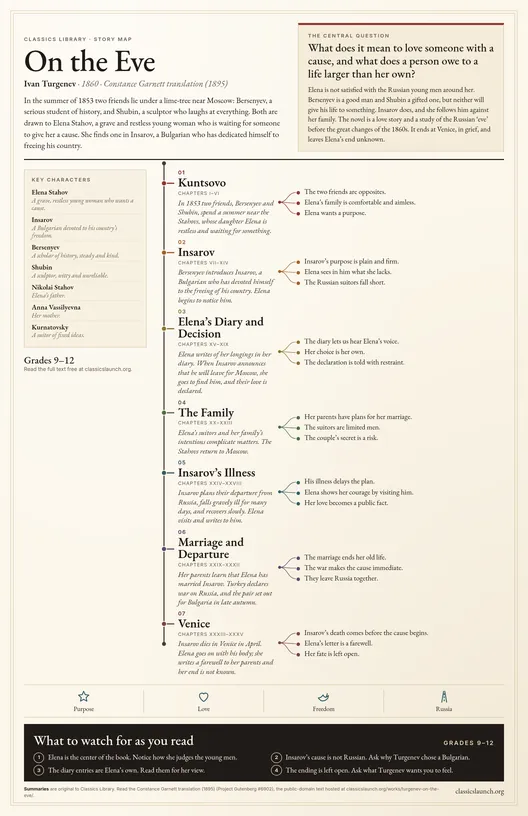 Story mapSee the story mapThe whole book on one page: the story in movements, the characters, and what to watch for. Free to print.
Abstract
Background. Turgenev finished the novel in 1859 and it appeared in 1860, a few years after Russia's defeat in the Crimean War, at a moment of hope for reform.
Plot. A young Russian woman who longs to do good falls in love with a Bulgarian patriot, a man who lost his family to Turkish violence in boyhood and has given himself to the liberation of his country. They marry in secret and set off for Bulgaria through Vienna and Venice, but he dies in Venice, and she goes on alone with his body, meaning to nurse the wounded.
Ideas. The book sets the lack of purpose in Russian life beside a single devoted man, and asks what a cause is worth. Its answer is sombre and noble.
Text. The Garnett translation is smooth and readable. The diary chapter and the Venice chapters are the strongest and can be read apart from the rest. Teachers can pair this work with the library's study guide, seminar questions and memory-work selection to prepare a discussion, a short essay or a recitation. The full text is hosted on this site, and each quotation in the guide has been checked against the hosted translation.
Main characters
- Elena: A serious, restless young woman
- Insarov: A Bulgarian patriot
- Bersenyev: A quiet scholar
- Shubin: A witty sculptor
- Uvar Ivanovitch: A silent cousin

Summary
On the Eve opens in the summer of 1853, under a lime-tree on the bank of the Moskva near Kuntsovo, where two young men are lying in the shade. One is Bersenyev, a serious student of history; the other is Shubin, a sculptor who laughs at everything. Both have for some time been drawn to the daughter of a nearby country house, Elena Nikolaevna Stahov, a grave, restless young woman who is waiting, she does not know for what, for something to love and to do. Her father is a vain retired officer, her mother a soft and plaintive woman, and the life of the house seems to Elena too small. Bersenyev brings to the house a friend, a Bulgarian student named Dmitri Nikanorovitch Insarov, who is not interested in anything except the liberation of his country from the Turks. Insarov is not a talker or a charmer. He is a man who has one aim and has already paid for it: his mother was reported murdered by a Turkish aga when he was a child, his father was shot after trying to avenge her, and he has cut himself off from every ease. Elena watches him, first with curiosity and then with wonder, and writes in her diary that being good is not enough, that the great thing in life is to do good, and she does not know how. She finds in Insarov the first man who has chosen a purpose that costs him something. She falls in love and seeks him out to tell him so. After his serious illness they marry secretly, in the face of her family's displeasure, and set out to go to Bulgaria through Vienna and Venice, at the very moment when the Crimean War is breaking out. The last third of the book is a tragedy. In Venice, in April, Insarov dies, and Elena, who has written a letter to her parents saying that she now has no country but Dmitri's country, goes on with his body to Dalmatia and takes up the nurse's life among the soldiers. The narrator tells us that she was never heard of again. The other characters scatter: Bersenyev becomes a professor, Shubin a sculptor in Rome, and the old cousin Uvar Ivanovitch, to whom Shubin once put the question whether Russia will ever have men, makes a sign with his fingers and stares into the distance. Turgenev wrote a book about the lack of such men in Russia and the power of those who have a cause. It was read in 1860 as a book about the coming of the age of reform. The Garnett translation hosted here has Edward Garnett's introduction of 1895, which treats it as one of Turgenev's most poetic works, and finds Insarov, in its words, a ‘figure of wood’. Christian readers will find in it a picture of the human desire to give oneself to something greater, together with a plain account of what that giving costs.
Virtues in this work
- Fortitude: Insarov's single-minded service and Elena's final choice are the book's picture of fortitude.
- Hope: Uvar Ivanovitch's gesture and Shubin's question leave the book on a note of hope.
- Charity: Elena's wish to do good and to nurse the wounded is charity in action.
- Friendship: Bersenyev's loyalty to his rival Insarov is the book's best example of friendship.
Plot or Argument
- Chapters I–VI: Kuntsovo
In 1853 two friends, Bersenyev and Shubin, spend a summer near the Stahovs, whose daughter Elena is restless and waiting for something.
- Chapters VII–XIV: Insarov
Bersenyev introduces Insarov, a Bulgarian who has devoted himself to the freeing of his country. Elena begins to notice him.
- Chapters XV–XIX: Elena's diary and decision
Elena writes of her longings in her diary. When Insarov announces that he will leave for Moscow, she goes to find him, and their love is declared.
- Chapters XX–XXIII: The family
Elena's suitors and her family's intentions complicate matters. The Stahovs return to Moscow.
- Chapters XXIV–XXVIII: Insarov's illness
Insarov plans their departure from Russia, falls gravely ill for many days, and recovers slowly; Elena visits and writes to him.
- Chapters XXIX–XXXII: Marriage and departure
Her parents learn that Elena has married Insarov. Turkey declares war on Russia, and the pair set out for Bulgaria in late autumn.
- Chapters XXXIII–XXXV: Venice
Insarov dies in Venice in April. Elena goes on with his body; she writes a farewell to her parents and her end is not known.
Characters
- Elena Nikolaevna Stahov, the heroine
A serious, passionate young woman who longs to do good and finds in Insarov a man to give herself to.
- Dmitri Nikanorovitch Insarov, the Bulgarian
A student devoted to the liberation of Bulgaria, plain, strong and serious, who does not talk much.
- Andrei Petrovitch Bersenyev, the scholar
A quiet, loyal young historian, who loves Elena without hope and brings Insarov to her.
- Pavel Yakovlevitch Shubin, the sculptor
A witty, talented, impulsive young artist who also loves Elena and plays the buffoon.
- Nikolai Artemyevitch Stahov, the father
A vain, pompous retired officer who rules the household by cold dignity.
- Anna Vassilyevna, the mother
A soft, complaining, affectionate woman, wholly dependent on those around her.
- Uvar Ivanovitch, the cousin
A fat, silent country gentleman whose enigmatic gestures become, in the novel, a symbol of the sleeping strength of Russia.
- Kurnatovsky, the suitor
A cold, ambitious government official whom the parents prefer.
Lessons
A cause that costs
Insarov is the only person in the book who has given himself to something greater, and the cost is plain to see. Elena's love for him is love for that.
- What does Insarov say about loving one's country?
- How does the book show that his cause costs him?
Doing good
Elena writes that being good is not much, and that doing good is the great thing. This is the book's central question, put by a young woman who does not yet know how to answer.
- What does Elena want to do with her life?
- Does she find an answer by the end?
Loss and loyalty
Elena's last letter, with its promise to be faithful to Dmitri's work, shows that her love did not die with him. The reader must judge whether this is wisdom or a kind of tragic obstinacy.
- What does Elena decide after Insarov's death?
- Is her choice a form of faith or of flight?
Context
The novel is set in 1853, the year before the Crimean War, when Russia was ruled by Nicholas I and the Balkan Slavs were under Ottoman rule. The idea that Russia might help the Bulgarians and other Slavs was in the air, and the book appeared in 1860, when Russia had lost the war and reforms were being discussed.
Composition
Turgenev published the book in 1860 in The Russian Messenger. The hosted Garnett translation is dated 1895 and has Edward Garnett's introduction, which says that the character of Insarov was handed to Turgenev by a friend, Karateev, who had left an unfinished plan for a story.
Reception
The book was read in Russia as a call for men of action to appear. Critics argued over Insarov, whom Edward Garnett calls ‘a figure of wood’ though ‘cleverly constructed’.
Comparisons
- Fathers and Sons
Turgenev's best-known novel, in which a new type of man appears, is a companion to this one.
- Rudin
Rudin is the man who talks and fails; Insarov is the man who acts and dies.
- Anna Karenina
Both novels follow a woman's choice of love against her family's wishes, with very different results.
- The Idiot
Dostoevsky's novel, too, gives a young woman the choice between safety and a costly love.
- Doctor Zhivago
A later Russian novel in which love is overtaken by war and history.
Quotes
Frequently cited
“That remains to be shown,’ he answered. ‘When one of us dies for her, then one can say he loved his country.”
Frequently cited
“Being good--isn’t much; doing good... yes, that’s the great thing in life. But how is one to do good?”
Frequently cited
“now I have no country but Dmitri’s country”
“How live without love? and there’s no one to love!”
“Good-bye, my poor girl! good-bye, my country!”
“Death is like a fisher who catches fish in his net and leaves them for a while in the water; the fish is still swimming but the net is round him, and the fisher will draw him up--when he thinks fit.”
For Students
A reading companion for classical Christian high school students. See the student guide.
Reading Guide
Watch for
- What each of the three young men wants from Elena.
- What Elena says in her diary about love and goodness.
- How the narrator treats the family and household.
Key terms and names
- Bulgaria
- A Balkan land under Ottoman rule in the 1850s, whose liberation is Insarov's aim.
- Sisters of Mercy
- Women who nursed the sick and wounded, the order Elena says she will join.
- Crimean War
- The war of 1853–1856 between Russia and an alliance including the Ottomans, Britain and France.
- Diary
- The form by which Elena speaks directly to the reader in Chapter XVI.
Seminar Questions
- Comprehension Why is Insarov in Russia, and what does he want?
- Comprehension What does Elena write in her diary about doing good?
- Interpretation Why does Elena choose Insarov and not Bersenyev or Shubin?
- Interpretation What does Insarov mean when he says one can only say a man loves his country when he dies for it?
- Interpretation How does the ending change the sense of the title?
- Big Question Is a life given to a cause more valuable than a life given to a person?
- Big Question Is Elena's last decision wise?
Faith Connections
- John 15:13 (Scripture)
'Greater love has no one than this, that someone lay down his life for his friends.' Insarov's idea of loving his country is the same thought.
- James 2:14–17 (Scripture)
Faith without works is dead; Elena's sense that good is not enough without the doing of it is the same concern.
- Ruth 1:16 (Scripture)
'Your people shall be my people.' Elena's last letter says she has no country but her husband's, a deliberate echo of Ruth.
Logic and Rhetoric
Central argument: A nation or a person awakens only when some one is ready to pay for a cause, and love can be a form of that readiness.
Rhetorical device: symbol. Uvar Ivanovitch's gesture, which Shubin takes as an answer to the question whether Russia will have men, ends the book on a note of hope.
Debate: Resolved: That a person who gives everything for a cause has lived a fuller life than one who does not.
Memory Work
That remains to be shown,’ he answered. ‘When one of us dies for her, then one can say he loved his country.
Being good--isn’t much; doing good... yes, that’s the great thing in life. But how is one to do good?
Writing Prompts
Essay: Show how Turgenev prepares the reader for Insarov's death. What do the earlier chapters suggest?
Comparison with Rudin: Compare Rudin and Insarov as men with ideals. Why does one fail and the other succeed, and at what price?
Medical Lens
Insarov is critically ill for eight days (Chapter XXVI) and attended by a young doctor, and later dies in Venice after a sudden decline; the book gives no precise diagnosis. Elena, who had nearly died of a malignant fever as a girl, plans to nurse the wounded in the war. The last chapters are a plain account of grief and of the death of a young man.
- Chapter XXVI, the illness
Insarov lies for eight days between life and death, attended by a doctor and Bersenyev.
- Chapter XXXIV, the death
Insarov dies in Venice with Elena beside him.
- Chapter XXXV, the letter
Elena writes that she will join the Sisters of Mercy and tend the sick and wounded.
Creative Prompts
- Essay
Elena writes that doing good is the great thing. What would doing good have meant for her, and is her end the answer?
- Fiction
Write the scene in which Elena walks to Insarov's room, from the point of view of someone who watches her go.
- Classroom
Debate: Is Insarov a hero or a figure of wood, as Edward Garnett says? Use the text.
- Essay
Compare the three men in love with Elena: Bersenyev, Shubin and Insarov.
Further Reading
- Fathers and Sons, Ivan Turgenev
Turgenev's best-known novel; hosted in this library.
- Rudin, Ivan Turgenev
Turgenev's first novel; hosted in this library.
- A Sportsman's Sketches, Ivan Turgenev
The book that made his name; hosted in this library.
- Turgenev: His Life and Times, Leonard Schapiro
A readable life of the author.
Verification notes
Full text from Project Gutenberg #6902, Constance Garnett's translation (dated 1895 in the hosted source), with Edward Garnett's introduction, public domain. Quotes were checked against the hosted text. The publication venue (The Russian Messenger) is a traditional report not verified here.
- That the novel appeared in The Russian Messenger in 1860.
- Insarov's family history as told by Bersenyev, which is reported as rumour in the text.