Work record
Rudin
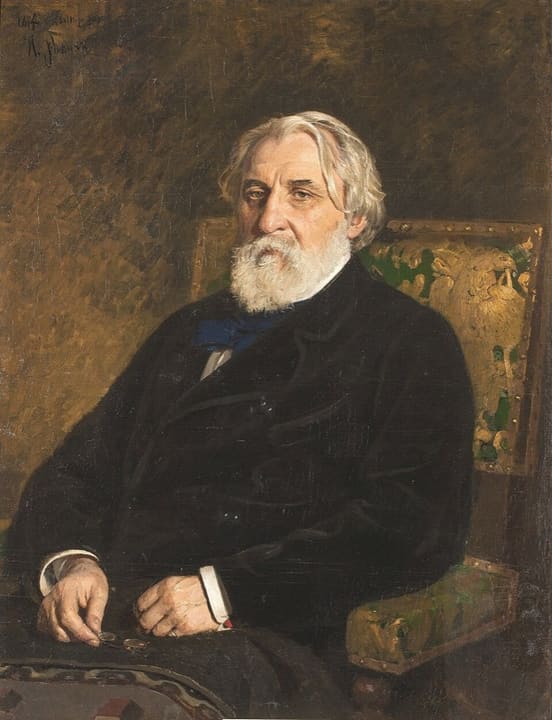
Ivan TurgenevDmitri RudinRudin by Ivan Turgenev (1856)Rudin is Turgenev's first novel, a short and exact study of a man who can inspire others with words and cannot act on them.Also known as: Dmitri Rudin
1856 · 19th Century · Novel · Russian
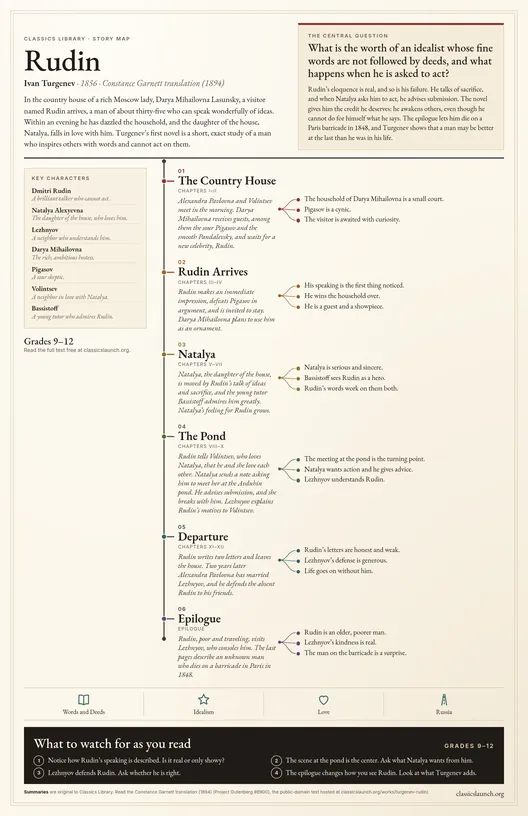 Story mapSee the story mapThe whole book on one page: the story in movements, the characters, and what to watch for. Free to print.
Abstract
Background. Turgenev wrote his first novel in 1855 and published it in 1856. It fixed the type of the Russian idealist who cannot act, and gave a name to a whole generation.
Plot. A gifted talker arrives at a country house, charms its inhabitants, and wins the love of a young woman. When she asks him to act, he counsels submission, and she leaves him. Years later, a plain friend defends him, and a short epilogue shows his end.
Ideas. The novel sets speech against action. It asks whether eloquence about ideals is worth anything if it cannot be lived, and whether it can still do some good in others. Lezhnyov's reply is a model of fair judgement.
Text. The Garnett translation is easy to read. The book is short and the pond scene can be read alone. The speeches are long but the plot is simple. Teachers can pair this work with the library's study guide, seminar questions and memory-work selection to prepare a discussion, a short essay or a recitation. The full text is hosted on this site, and each quotation in the guide has been checked against the hosted translation.
Main characters
- Rudin: An eloquent idealist
- Natalya: A serious young woman
- Lezhnyov: A plain, fair-minded neighbour
- Darya Mihailovna: The hostess
- Pigasov: A sceptic

Summary
Rudin is Turgenev's first novel, a short and exact study of a man who can inspire others with words and cannot act on them. The scene is the country house of Darya Mihailovna Lasunsky, a rich and ambitious lady of Moscow society who keeps clever men around her. One summer morning a man of about thirty-five, Dmitri Nikolaitch Rudin, arrives as a guest. Within an evening he has defeated the sour old sceptic Pigasov in an argument, charmed the drawing-room, and made himself the centre of attention. He speaks of truth, of enthusiasm, of the duty to live for ideas, and the young listeners are moved: the tutor Bassistoff, the lonely Alexandra Pavlovna, and above all Natalya Alexyevna, Darya Mihailovna's seventeen-year-old daughter, who has never before heard anyone speak so. Natalya falls in love with Rudin and tells him so by her seriousness more than her words. Rudin, who has talked all his life about boldness, hesitates when the moment comes. When Natalya meets him by the old pond and asks what he will do now that her mother knows, he answers that her mother will not consent and that they must submit. She sees at once that he is a coward, and leaves him with the unforgettable cry that if he had loved her, she should have felt it at that moment. Rudin goes away, ashamed. The second half of the book supplies what the first has left out. Two years later, the neighbour Lezhnyov, a plain man who knew Rudin as a student in Moscow, defends him to his wife and friends: he has no character, but he has enthusiasm, which is the most precious quality in our times. In the epilogue, years later, a worn Rudin meets Lezhnyov at a provincial inn and says that he has failed and will come to a bad end. The last page is a brief, bright scene on a barricade in Paris in 1848, where a tall grey-haired man waves a red flag and is shot through the heart. Turgenev's Rudin was drawn from the generation of Russian idealists of the 1830s and 1840s, and some of it is based on the revolutionary Mikhail Bakunin. The book is sympathetic to Rudin and honest about his faults, and in this it is one of the best accounts in literature of the gap between speech and deed. The Garnett translation hosted here includes the introduction by S. Stepniak.
Virtues in this work
- Fortitude: Natalya's resolve and Rudin's failure define fortitude by contrast.
- Honor: Rudin is honest in speech and false in deed; Lezhnyov is honest in both.
- Friendship: Lezhnyov's loyalty to Rudin, though he knows his faults, is the book's picture of friendship.
- Charity: Lezhnyov's fair judgement of Rudin is an example of charity.
Plot or Argument
- Chapters I–II: The country house
Alexandra Pavlovna and Volintsev meet in the morning. Darya Mihailovna Lasunsky receives guests, among them the sour Pigasov and the smooth Pandalevsky, and waits for a new celebrity, Rudin.
- Chapters III–IV: Rudin arrives
Rudin makes an immediate impression, defeats Pigasov in argument and is invited to stay. Darya Mihailovna plans to use him as an ornament.
- Chapters V–VII: Natalya
Natalya, the daughter of the house, is moved by Rudin's talk of ideas and sacrifice, and the young tutor Bassistoff admires him greatly. Natalya's feeling for Rudin grows.
- Chapters VIII–X: The pond
Rudin tells Volintsev, who loves Natalya, that he and she love each other. Natalya sends a note asking him to meet her at the Avduhin pond; he advises submission, and she breaks with him. Lezhnyov explains Rudin's motives to Volintsev.
- Chapters XI–XII
Rudin writes two letters and leaves the house. Two years later Alexandra Pavlovna has married Lezhnyov, and he defends the absent Rudin to his friends.
- Epilogue
Rudin, poor and travelling, visits Lezhnyov, who consoles him. The last pages describe an unknown man who dies on a barricade in Paris in 1848.
Characters
- Dmitri Rudin, the idealist
A man of about thirty-five, eloquent and magnetic, who speaks of ideas and ideals but cannot commit himself to action.
- Natalya Alexyevna, Darya Mihailovna's daughter
A grave, serious girl of seventeen who falls in love with Rudin and has a clearer sense of courage than he does.
- Lezhnyov, the neighbour
A plain, humorous, good-hearted man who knew Rudin as a student and who gives the book's fairest judgement.
- Darya Mihailovna Lasunsky, the hostess
A rich and imperious lady of society who likes to gather clever men around her.
- Pigasov, the sceptic
A sour, cynical old man who delights in running down everything, and women in particular.
- Volintsev, the neighbour in love
A kind, honest landowner who loves Natalya and is overshadowed by Rudin.
- Bassistoff, the tutor
A young tutor in the house who looks on Rudin as a prophet.
Lessons
Words and deeds
Rudin's speeches are fine, and his failure is entire. Natalya's judgement of him, that a man who talks of courage and then advises submission has shown that his courage was only a manner of speaking, is the lesson of the book.
- What does Natalya ask of Rudin at the pond, and what does he answer?
- Why does Natalya conclude that Rudin is a coward?
A fair judgement
Lezhnyov's defence of Rudin gives the other side: a man without character can still wake others, and his enthusiasm can do good. The reader must hold both judgements together.
- What does Lezhnyov find worth praising in Rudin?
- Is it just to say Rudin has failed?
Love as choice
Natalya's love is serious and costly, and she is ready to break with her family for it. The book asks what love requires of a man who professes it.
- How does Natalya's love differ from Rudin's?
- What would Rudin have had to do to deserve her?
Context
Rudin is set in the 1840s, in the years when Russian intellectuals, shut out of public life under Nicholas I, formed circles in Moscow to discuss German philosophy, history and the question of Russia's future. The men of these circles, among them Belinsky, Herzen, Stankevich and Bakunin, were gifted talkers, and their gifts were often unemployed.
Composition
Turgenev wrote Rudin in seven weeks in 1855 and published it in The Contemporary in 1856. He revised it more than once; the epilogue was added in a later edition, and the Garnett translation hosted here, published in 1894, includes it, along with an introduction by the Russian exile S. Stepniak.
Reception
Critics at the time were divided on whether Rudin was a satire or a tribute. Later readers have taken it as a tribute to a whole generation of idealists.
Comparisons
- Fathers and Sons
Turgenev's best-known novel puts a hard-headed younger generation against the idealists of Rudin's day.
- Oblomov
Goncharov's Oblomov is another picture of the Russian man who cannot move from dream to deed.
- Notes from Underground
Dostoevsky's underground man is a bitter relative of the superfluous man, as proud and as idle.
- A Hero of Our Time
Pechorin is the cynical version of the Russian man without a purpose.
- Hamlet
Rudin has often been compared to Hamlet, the thinker who cannot act, and Turgenev himself wrote a well-known essay, Hamlet and Don Quixote.
Quotes
Frequently cited
“He has enthusiasm; and believe me, who am a phlegmatic person enough, that is the most precious quality in our times.”
Frequently cited
“Ah! if you had loved me, I should have felt it now, at this moment....”
“Ah! his tongue is his enemy. Though it’s a good servant to him too.”
“Thought, too, has its veterans; they, too, ought to have their home.”
“Every man remains what Nature has made him, and one cannot ask more of him!”
For Students
A reading companion for classical Christian high school students. See the student guide.
Reading Guide
Watch for
- How each character reacts to Rudin's first speeches.
- What Rudin says about love and what he does when it is tested.
- What Lezhnyov says of Rudin in two different places.
Key terms and names
- Superfluous man
- A type in Russian fiction: a gifted man with no place or purpose in his society.
- Circle
- A Moscow group of friends in the 1830s and 1840s who read and argued about philosophy.
- Enthusiasm
- In Lezhnyov's use, a warm, sincere zeal for ideas, thought precious and rare.
- Manor
- A country estate with a landowner's house, the usual setting of Turgenev's novels.
Seminar Questions
- Comprehension What does Rudin do on his first evening in the house?
- Comprehension What does Natalya ask of Rudin at the pond?
- Interpretation Why does Rudin fail when Natalya asks him to act?
- Interpretation How does Lezhnyov's judgement change the reader's sense of Rudin?
- Interpretation Why does Turgenev put Rudin's death in the epilogue?
- Big Question Is a person who inspires others, but fails himself, a failure?
- Big Question What does love require that speech cannot give?
Faith Connections
- James 1:22 (Scripture)
'Be doers of the word, and not hearers only.' Rudin is a clear case of a speaker who is not a doer.
- Matthew 21:28–31 (Scripture)
The parable of the two sons, one who says he will go and does not, is a plain gloss on Rudin.
- 1 John 3:18 (Scripture)
'Let us not love in word or talk but in deed and in truth.' Natalya's judgement of Rudin is this text in action.
Logic and Rhetoric
Central argument: Eloquence about ideals is not the same as courage, and a person can be of real use to others and still fail in his own life.
Rhetorical device: foil. Lezhnyov, who is plain and has no ideas, is set against Rudin, who is all ideas, and the contrast is the book's argument.
Debate: Resolved: That a man who inspires others but fails to act has done more good than harm.
Memory Work
Thought, too, has its veterans; they, too, ought to have their home.
He has enthusiasm; and believe me, who am a phlegmatic person enough, that is the most precious quality in our times.
Writing Prompts
Essay: Compare Natalya and Rudin: which of them shows more courage, and how do their words and actions show it?
Comparison with Oblomov: Compare Rudin and Oblomov as men who fail to act. Which failure is more culpable, and why?
Medical Lens
The book is a psychological and social study with no clinical content. Natalya's collapse in her bedroom after the meeting is a plain account of a faint after strong emotion.
Creative Prompts
- Essay
Natalya says that she ‘should have felt’ Rudin's love. What does she mean? Argue for or against her judgement.
- Fiction
Write a scene in which a gifted speaker, asked to act, fails; tell it from the point of view of the person who asked.
- Classroom
Stage the pond scene with two students, then ask the class what Rudin should have said.
- Essay
Is Lezhnyov right that enthusiasm is the most precious quality of the age? Weigh the case.
Further Reading
- Fathers and Sons, Ivan Turgenev
Turgenev's best-known novel; hosted in this library.
- On the Eve, Ivan Turgenev
Turgenev's third novel; hosted in this library.
- Oblomov, Ivan Goncharov
A comic and sad portrait of Russian inertia; hosted in this library.
- Turgenev: His Life and Times, Leonard Schapiro
A readable life of the author.
Verification notes
Full text from Project Gutenberg #6900, Constance Garnett's translation (1894), with the Stepniak introduction, public domain. Quotes were checked against the hosted text. The statement about Bakunin and the date of composition are traditional reports about the novel and are not verified against the text.
- That the epilogue was added in a later edition (the hosted translation includes it).
- That Turgenev wrote the book in seven weeks.