Work record
Othello
c. 1603-04 (published 1622) · Renaissance Early Modern · Drama · English (Early Modern)
Abstract
Background. Shakespeare reshaped a grim novella from Cinthio's Hecatommithi, in which only the heroine is named, into a play for the King's Men, giving the Moor and the ensign names, motives and voices. Venice's war with the Turks over Cyprus supplies the frame.
Plot. Charged before the senate with bewitching Brabantio's daughter, Othello is acquitted and posted to Cyprus. There Iago disgraces Cassio through a drinking bout, then persuades the general that his bride is Cassio's mistress, using a lost keepsake and an invented dream as proof. Othello collapses, strikes his wife in public, and kills her in their bed; once Emilia reveals the truth, he takes his own life.
Structure. One night in Venice gives way to a tightly compressed action on the island, whose double time scheme makes the alleged adultery impossible to fit into the days shown. Iago's soliloquies draw the audience into his confidence while every character on stage trusts him.
Themes. Jealousy as self-feeding poison, the gap between seeming and being, a stranger's honour in a city that both employs and scorns him, and faithful love meeting deceit.
Significance. Among the most performed of the tragedies, it gave English its green-eyed monster and inspired operas by Rossini and Verdi, as well as celebrated portrayals by Ira Aldridge and Paul Robeson.
Main characters
- Othello: Moorish general of the Venetian republic, newly married
- Desdemona: Senator's daughter who weds him in secret
- Iago: Passed-over ensign who works the catastrophe by insinuation
- Emilia: Iago's wife, who at last unmasks him
- Michael Cassio: Promoted lieutenant made to look like Desdemona's lover
- Roderigo: Gullible suitor bled of money and finally of life
- Brabantio: Desdemona's father, who charges Othello with sorcery
- Bianca: Cassio's companion on Cyprus, asked to copy the fatal handkerchief

Summary
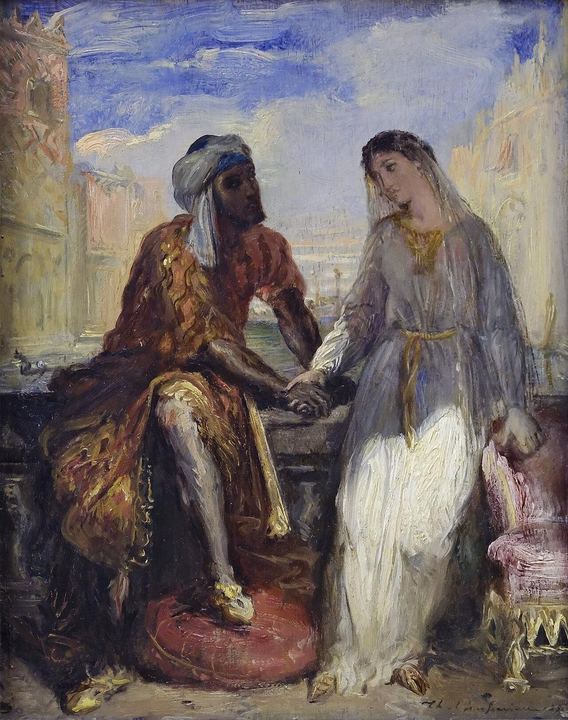
Othello is the tragedy of a Moorish general in the service of Venice who is brought, step by step, to murder the wife who loves him. The play opens at night in a Venetian street, where the ensign Iago, furious that Othello has promoted the Florentine Michael Cassio over him, rouses the senator Brabantio with crude news that his daughter Desdemona has eloped with the Moor. Brabantio accuses Othello before the Duke of winning her with drugs and charms, but Othello answers that he wooed her only by telling the story of his life, his battles, captivity and travels, and Desdemona, called before the council, declares that her duty is now divided and belongs to her husband. A Turkish fleet threatens Cyprus, and Othello is sent to defend it, with Desdemona following. On Cyprus a storm has already wrecked the Turks, and the play becomes a domestic war. Iago, who uses the foolish Roderigo as his purse and tool, gets Cassio drunk on watch, provokes a brawl, and so causes Othello to dismiss him; he then urges Cassio to ask Desdemona to plead for his return. In the long temptation scene of Act 3, Iago turns her generosity into evidence: with hints, hesitations and a warning against jealousy he plants the idea that she and Cassio are lovers. When Desdemona drops the strawberry-spotted handkerchief that was Othello's first gift to her, Emilia, Iago's wife, picks it up and gives it to her husband, who leaves it in Cassio's lodging. Othello demands ocular proof, hears Iago's invented report of Cassio talking in his sleep, and vows revenge. In Act 4 he falls into a fit, eavesdrops on a conversation about Cassio's mistress Bianca that he takes to be about his wife, strikes Desdemona in front of the Venetian envoy Lodovico, and calls her a whore. That night Desdemona sings the old Willow song while Emilia undresses her. In Act 5 Roderigo fails to kill Cassio and is stabbed by Iago, and Othello smothers Desdemona in her bed. She revives long enough to say that nobody but herself did it. Emilia, learning that her husband was the source, exposes the handkerchief plot and is killed by Iago. Othello, seeing what he has done, asks to be remembered as one who loved not wisely but too well, and stabs himself, dying upon a kiss. Iago refuses to explain himself and is led off to torture; Cassio is left to govern Cyprus. Shakespeare took the plot from an Italian novella by Giraldi Cinthio (1565). The play was acted at court in November 1604, printed in quarto in 1622 and in the First Folio of 1623.
Virtues in this work
- Prudence: Othello's ruin comes from accepting Iago's handkerchief and hearsay as proof without questioning Desdemona or Cassio.
- Charity: Desdemona keeps pleading for Cassio after Othello strikes her and with her dying words protects her husband.
- Honor: Emilia defies Iago in the last scene and tells the truth about the handkerchief, though it costs her life.
- Temperance: Cassio loses his lieutenancy after one night of drinking on watch, and laments it in Act 2, Scene 3.
Plot or Argument
- Act 1: A secret marriage in Venice
Iago and Roderigo rouse Brabantio; Othello defends his marriage before the Duke and senators by recounting how he told Desdemona his story; Desdemona chooses her husband; Othello is sent to Cyprus against the Turks, and Iago resolves to ruin him.
- Act 2: Storm and a drunken watch on Cyprus
The Turkish fleet is wrecked; the lovers are reunited; Iago gets Cassio drunk, provokes a fight with Montano, and Othello strips Cassio of his lieutenancy; Iago advises Cassio to seek Desdemona's help.
- Act 3: The temptation and the handkerchief
Desdemona pleads for Cassio; Iago insinuates her guilt, warns against jealousy while feeding it, and obtains the handkerchief from Emilia; Othello demands proof, hears the tale of Cassio's dream, and kneels with Iago to swear vengeance.
- Act 4: The fit and the public blow
Othello falls into a fit; he misreads Cassio's jesting about Bianca, strikes Desdemona before Lodovico, interrogates Emilia, and accuses his wife; Desdemona sings the Willow song and speaks with Emilia about fidelity.
- Act 5: The bedchamber
Roderigo wounds Cassio and is killed by Iago; Othello smothers Desdemona; Emilia reveals the plot and is slain; Othello wounds Iago, speaks his last account of himself, and kills himself; Lodovico assigns judgment on Iago to Cassio.
Characters
- Othello, the Moor, general of Venice
A Christian soldier of royal descent, eloquent and trusting, whose self-command breaks under Iago's suggestion.
- Desdemona, Othello's wife
Brabantio's daughter, who marries Othello against her father's wishes and stays loving and loyal to her death.
- Iago, Othello's ensign
An embittered soldier, called honest by everyone, who engineers the tragedy and gives shifting reasons for his hatred.
- Emilia, Iago's wife, Desdemona's attendant
Worldly and outspoken; she hands over the handkerchief but finally exposes her husband at the cost of her life.
- Michael Cassio, Othello's lieutenant
A courteous Florentine officer whose weakness for drink and closeness to Desdemona are turned against him.
- Roderigo, Venetian gentleman
A rejected suitor of Desdemona whom Iago fleeces and uses as an instrument.
- Brabantio, Venetian senator
Desdemona's father, who accuses Othello of witchcraft and dies of grief at the marriage.
- Bianca, Cassio's mistress
A woman of Cyprus whose quarrel over the handkerchief seems to confirm Othello's suspicion.
- Lodovico, Venetian envoy
Desdemona's kinsman, who witnesses Othello's public cruelty and closes the play.
Lessons
How suggestion becomes certainty
Iago almost never states a lie outright in the temptation scene; he echoes Othello's words, hesitates, and warns him against the very jealousy he is planting. Shakespeare shows how a mind can be led to supply its own false proof once it accepts a frame of suspicion.
- What does Iago actually assert in Act 3, Scene 3, and what does he only imply?
- Why does a handkerchief carry so much weight as evidence?
- At what moment does Othello stop asking for proof?
Reputation and the self
Cassio cries that he has lost the immortal part of himself when he loses his reputation, while Iago tells Othello that a good name is the jewel of the soul. Othello's own final speech is an attempt to set his story straight before he dies. The play asks how far a person is what others say of him.
- How does Iago speak differently about reputation to Cassio and to Othello?
- What does Othello ask the Venetians to report of him, and is his account fair?
Faithfulness to the end
Desdemona, struck and insulted, still pleads for Cassio, refuses to imagine infidelity even for the whole world, and with her last breath shields her husband. Emilia, long compliant, at last tells the truth though it kills her. The play sets their loyalty against Iago's betrayal.
- Why does Desdemona say that nobody killed her but herself?
- What changes in Emilia during the last scene?
- Is Desdemona's patience a strength or a weakness in the play?
The outsider and the city
Venice honours Othello as the general it needs, but Iago, Roderigo and Brabantio speak of him in animal and devilish images. Othello wins Desdemona by telling his history, and he ends by narrating it again, comparing himself to the Turk he once struck down. His dignity and his isolation are both part of the tragedy.
- How do the Duke and Brabantio judge Othello differently in Act 1?
- How does Othello's view of himself change from his speech to the senate to his final speech?
Context
Venice was famous in Shakespeare's England as a rich, law-governed republic that hired foreign soldiers to command its forces, and Cyprus was its frontier against the Ottoman Turks until the island fell in 1571. The word Moor was used loosely of North Africans and of dark-skinned peoples generally. In 1600-01 an embassy from the King of Morocco spent several months in London, and Leo Africanus's description of Africa had appeared in English in 1600.
Composition
Shakespeare adapted the seventh tale of the third decade of Giraldi Cinthio's Gli Hecatommithi (1565), in which an unnamed Moor and his ensign kill Disdemona; Shakespeare named the other characters, compressed the time, and invented Roderigo and the Venetian council. The Revels accounts record a performance by the King's Men at Whitehall on 1 November 1604. The play was printed in quarto in 1622 and in a somewhat different text in the First Folio of 1623.
Reception
Othello was popular from the start and was one of the first plays revived after the Restoration. The African American actor Ira Aldridge played the role across Europe in the nineteenth century, Paul Robeson's Othello ran on Broadway in 1943-44, and Verdi's opera Otello (1887), with a libretto by Arrigo Boito, is among the greatest operatic adaptations of Shakespeare.
Comparisons
- much-ado-about-nothing
Don John stages a false scene at a window to make Claudio believe Hero unfaithful; the same device of manufactured evidence is comic there and fatal in Othello.
- the-merchant-of-venice
Both plays set a foreigner within the commerce and courts of Venice; Shylock and Othello are each needed by the city and spoken of with contempt by some of its citizens.
- macbeth
Iago and the witches both work by suggestion on a brave soldier, but Macbeth acts from his own ambition while Othello acts from a love that has been poisoned.
- paradise-lost
Milton's Satan, envious of a happy pair in their garden, tempts by insinuation as Iago does; both villains look on wedded love and resolve to destroy it.
- romeo-and-juliet
Both plays begin with a secret marriage against a family's will and end with lovers dead in a bedchamber, but Juliet and Romeo are destroyed by outward feud, Othello and Desdemona by a lie inside the marriage.
Quotes
Frequently cited
“I am not what I am.”
Frequently cited
“She lov’d me for the dangers I had pass’d, And I lov’d her that she did pity them.”
Frequently cited
“O God, that men should put an enemy in their mouths to steal away their brains!”
Frequently cited
“O, beware, my lord, of jealousy; It is the green-ey’d monster which doth mock The meat it feeds on.”
Frequently cited
“Not poppy, nor mandragora, Nor all the drowsy syrups of the world, Shall ever medicine thee to that sweet sleep Which thou ow’dst yesterday.”
Frequently cited
“Of one that loved not wisely, but too well;”
“I do perceive here a divided duty”
“Nobody; I myself. Farewell. Commend me to my kind lord. O, farewell!”
For Students
A reading companion for classical Christian high school students. See the student guide.
Reading Guide
Watch for
- Othello's speech to the senate in Act 1, Scene 3, where he describes how he wooed Desdemona with the story of his life.
- Every time a character calls Iago honest, and who is speaking when they do.
- The movement of the handkerchief from Desdemona to Emilia, Iago, Cassio and Bianca in Acts 3 and 4.
- Iago's soliloquies at the ends of Act 1, Scene 3 and Act 2, Scenes 1 and 3, where he gives different reasons for his hatred.
- The Willow song in Act 4, Scene 3 and the conversation between Desdemona and Emilia that follows.
Key terms and names
- Moor
- A term for North Africans and, loosely, for dark-skinned peoples; Othello is a Christian Moor serving Venice as its general.
- Ancient (ensign)
- Iago's rank, the officer who carried the company's flag, below Cassio's rank of lieutenant.
- Ocular proof
- The visible evidence Othello demands of Iago in Act 3, Scene 3, which Iago answers with stories and the handkerchief.
- The handkerchief
- Othello's first gift to Desdemona, spotted with strawberries, which he says an Egyptian charmer gave his mother.
- Cyprus
- The Venetian island fortress against the Turks where Acts 2-5 take place, far from the laws and family of Venice.
- Soliloquy
- A speech alone on stage revealing private thought; Iago's soliloquies make the audience the only ones who know his plot.
Seminar Questions
- Comprehension Why is Iago angry with Othello at the beginning of the play, and what other reasons does he give later?
- Comprehension How does Cassio lose his position, and why does he turn to Desdemona for help?
- Comprehension How does the handkerchief come into Iago's hands, and what does he do with it?
- Interpretation Is Iago's evil explained by his motives, or are the motives excuses for something deeper?
- Interpretation Othello wins Desdemona by telling a story and loses her by believing one. What does the play suggest about the power of stories?
- Interpretation In his last speech, does Othello understand what he has done, or is he still trying to save his reputation?
- Big Question How should we weigh evidence about the people we love, and what do we owe them before we believe the worst?
Faith Connections
- 1 Corinthians 13:4-7 (Scripture)
Paul's charity thinks no evil, believes all things and hopes all things. Desdemona lives this kind of love; Othello, taught by Iago, comes to believe only evil.
- Proverbs 6:16-19 (Scripture)
Among the things the Lord hates are a lying tongue, a heart that devises wicked imaginations, a false witness, and one who sows discord among brethren, a near portrait of Iago.
- Gregory the Great, Moralia in Job XXXI (Church Fathers)
Gregory counts envy among the principal vices and describes it as grief at another's good. Iago's resentment of Cassio's promotion and of Othello's happiness fits this account.
- Milton, Paradise Lost IV (Great Conversation)
Satan looks on Adam and Eve in their bower with envy and sets out to ruin them by insinuation. Milton's tempter and Shakespeare's ensign both attack wedded love by working on trust.
Logic and Rhetoric
Central argument: Othello trusts Iago because Iago has a reputation for honesty and seems reluctant to accuse. Iago supplies hints, a story of Cassio's dream, and a handkerchief instead of proof. Othello, a soldier unused to suspecting friends and uncertain of his place in Venice, takes suggestion for evidence. Therefore the play argues that a noble mind can be destroyed when it trusts the wrong witness and stops testing what it is told.
Rhetorical device: paralipsis (stating by pretending to withhold). In Act 3, Scene 3 Iago repeatedly says he will not speak his thoughts, and in warning Othello to beware of jealousy, the green-eyed monster, he plants the jealousy he names.
Debate: Resolved: that Othello is more a victim of Iago than responsible for his own fall.
Memory Work
O, beware, my lord, of jealousy; It is the green-ey’d monster which doth mock The meat it feeds on.
She lov’d me for the dangers I had pass’d, And I lov’d her that she did pity them.
Writing Prompts
Essay: Compare Desdemona and Emilia as wives. Using Act 4, Scene 3 and Act 5, Scene 2, argue which woman's loyalty is finally the greater and why.
Comparison with Much Ado About Nothing: Claudio and Othello are both deceived into believing the women they love are false. Compare how the deception is staged and why one play ends in weddings and the other in deaths.
Medical Lens
Othello is one of Shakespeare's fullest studies of a passion overthrowing reason, and Renaissance readers would have understood jealousy through humoral and moral psychology as a disease of the imagination: Iago himself says that dangerous conceits are in their natures poisons. The play's drug language is concrete: Brabantio accuses Othello of drugs or minerals and medicines bought of mountebanks, and Iago names poppy and mandragora, the standard soporifics of the period, as powerless against a troubled mind. In Act 4 Othello collapses in what Iago calls an epilepsy, his second fit, and Iago describes the expected course of lethargy, foaming and savage madness; whether the earlier fit happened at all rests only on Iago's word, and modern readings of the collapse as a seizure, a syncope or an emotional crisis are interpretations, not diagnoses the play supplies. Cassio's drunkenness and its consequences give a clear early-modern picture of alcohol and loss of self-command. The final scene adds Brabantio's reported death from grief, the smothering of Desdemona, and Othello's suicide.
- Act 1, Scenes 2 and 3
Brabantio charges that Othello bewitched Desdemona with drugs, minerals and medicines bought of mountebanks; Othello answers that his only witchcraft was his story.
- Act 2, Scene 3
Cassio, who says he has a poor brain for drinking, is pressed to drink on watch, brawls with Montano, and afterwards laments the loss of his reputation.
- Act 3, Scene 3
Othello complains of a pain upon his forehead and Desdemona offers to bind it with the handkerchief; later Iago calls jealous fancies poisons and says no poppy or mandragora will bring Othello sleep again.
- Act 4, Scene 1
Othello falls into a trance or fit after Iago's broken words about Cassio; Iago calls it an epilepsy and tells Cassio the lethargy must have its quiet course.
- Act 5, Scene 2
Desdemona is smothered and briefly revives; Gratiano reports that grief killed Brabantio; Othello stabs himself.
Listen to the book
Public-domain audiobook from LibriVox, read by Various volunteers. Recording: Othello (Version 2) on LibriVox (Internet Archive).
LibriVox recordings are volunteer readings released into the public domain. The reading may follow a different edition from the text in this library.
Creative Prompts
- Classroom
Stage the opening hundred lines of Act 3, Scene 3 twice: once with Iago reluctant and loyal, once with Iago openly sly. Discuss which version makes Othello's trust more believable.
- Essay
Trace the handkerchief from Othello's first gift through Emilia, Iago, Cassio and Bianca. Argue what Shakespeare gains by hanging the tragedy on so small an object.
- Dialogue
Write the conversation between Emilia and Desdemona in Act 4, Scene 3 as it might sound between two friends today, keeping each woman's view of marriage.
- Fiction
Tell the events of the play as Bianca might have seen them from her lodging on Cyprus.
Further Reading
- Gli Hecatommithi, Giovanni Battista Giraldi Cinthio
Decade 3, story 7 is Shakespeare's source.
- Shakespearean Tragedy, A. C. Bradley
Two classic lectures on Othello and on Iago.
- Shakespeare's Tragic Heroes: Slaves of Passion, Lily B. Campbell
Reads Othello's jealousy through Renaissance moral philosophy of the passions.
- Shakespeare: The Invention of the Human, Harold Bloom
Verification notes
Plot, sources and stage history are standard. Act and scene locators follow the attached Project Gutenberg #1531 text, which reads Judean rather than Indian in Othello's final speech. All quotations were checked by exact search against that text. The 1604 Whitehall performance comes from the Revels accounts as usually cited. Readings of Othello's fit and of jealousy as a disorder are interpretive.
No verification flags recorded.