Work record
Cædmon's Hymn
c. 658-680 · Medieval · Poetry · Old English
Abstract
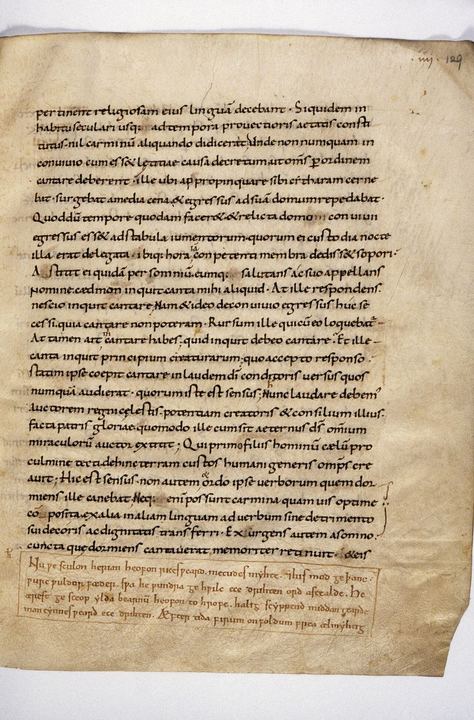
Background. Bede, writing at Jarrow, finished his Ecclesiastical History in 731 and there told how a herdsman at Hild's abbey became a poet. He offered only a Latin rendering, admitting it lost the beauty of the English; the vernacular lines were copied into early manuscripts of his Latin and later taken into the Old English translation of the History.
Content. Four lines summon listeners to glorify the guardian of the heavenly kingdom, his power, his purpose and his works. Five more retell the making of the world in sequence: the sky lifted over humankind like a rafter, then middle-earth spread beneath as their dwelling. The surrounding prose relates the dream command, the scrutiny by Hild's scholars, and Cædmon's later verse paraphrases of Scripture.
Form. Every line pairs two halves linked by alliteration, and God is renamed again and again, as guardian, creator, father, ruler, in the manner of Germanic praise of a lord.
Themes. Creation as the proper first theme of song; skill received as grace rather than won by training; the overlooked man chosen to begin a literature.
Significance. Cædmon is the earliest English poet whose name survives, and his nine lines are among the oldest written records of English. Bede's narrative has served ever since as the origin story of English devotional verse.
Key figures
- Cædmon: Unlettered layman of Whitby who received the gift of sacred song
- Hild: Abbess who examined the gift and made him a monk
- Bede: Monk of Jarrow whose History preserves the story
- The dream visitor: Unnamed figure who orders Cædmon to sing

Summary
Cædmon's Hymn is a nine-line poem in praise of God the Creator and the oldest surviving English poem whose maker is known by name. It survives because Bede told its story in his Ecclesiastical History of the English People, finished in 731. According to Bede, Cædmon was a layman of some years at the double monastery of Whitby, ruled by the abbess Hild. When the harp was passed round at a feast and every guest had to sing, he would slip away in shame. One night, having left such a feast to guard the cattle, he dreamed that a man called him by name and asked for a song. When Cædmon protested that he could not sing, the visitor told him to sing of the beginning of things, and he sang verses he had never heard before. On waking he remembered them and added more. Hild's learned men judged the gift to be from God and tested him with a passage of holy teaching, which he brought back the next morning as verse; the abbess then persuaded him to take monastic vows. For the rest of his life he turned the sweep of sacred history, from Genesis and the Exodus to the Passion, Ascension, Pentecost and Last Judgment, into English song. The hymn moves in two steps. The first four lines call the hearers to praise and name what is to be praised: the might of the Maker, his purpose, and the wondrous works of the Father. The last five lines follow the order of Genesis 1, telling how God first raised heaven as a roof for the race of men and then established the world below as their home. Nearly every half-line gives God a new title, Ward, Maker, Father, Lord, Ruler and Almighty, so that the short poem becomes a litany of names. The stored text gives the hymn twice in Cosette Faust and Stith Thompson's 1918 alliterative translation: once on its own, and once inside their translation of the Old English version of Bede's account.
Virtues in this work
- Humility: Cædmon leaves the feast rather than pretend to a skill he lacks, and his gift is credited to God rather than to himself.
- Piety: His first song and every later one is praise of God, and Bede says he could compose nothing light or idle.
- Industry: After his dream he ponders each passage he is taught and works the whole biblical story, from Genesis to the Judgment, into verse.
- Prudence: Hild does not accept the dream on Cædmon's word but has her learned men test it with a fresh passage of Scripture before receiving him.
Plot or Argument
- Bede's account: the man who could not sing
Cædmon leaves the feast when the harp comes near him, goes to the cattle shed, and in a dream is commanded to sing of the beginning of things.
- Lines 1-4: the call to praise
The hymn summons its hearers to praise the Prince of heaven and names his might, his thought or purpose, and the wonders he wrought when he laid out the worlds.
- Lines 5-9: creation in order
God first raises heaven as a roof for humankind, then establishes the world below as a home for man; each half-line adds a fresh title for the Creator.
- Bede's account: the gift tested and used
Hild and her learned men judge the song a gift from God, test Cædmon with a passage of Scripture, and receive him as a monk, after which he puts the whole biblical story into English verse until a fair death.
Characters
- Cædmon, layman, later monk and poet
A shy older layman who flees the harp at feasts and receives in a dream the gift of sacred song.
- Hild, abbess of Whitby
Gathers her learned men to judge Cædmon's gift and receives him and his household into the monastery.
- The dream visitor, unnamed messenger
Calls Cædmon by name and commands him to sing of the beginning of things.
- The steward, Cædmon's master
Hears of the gift the next morning and brings Cædmon to the abbess.
Lessons
Creation is the first subject of praise
Asked to sing of the beginning of things, Cædmon sings of the Maker before the made: he praises God's might and thought, and only then tells of heaven and earth. The hymn teaches that the world is understood rightly when it is received as a home built by someone for someone.
- Why does the hymn praise God's might and manifold thought before it describes heaven and earth?
- What does it mean that heaven is a roof and the earth a home for man?
- How does the hymn's order compare with the first chapter of Genesis?
A gift given to the least likely
Bede's story turns on Cædmon's shame: the one man who left the feast rather than sing becomes the first English poet. The gift is tested by the abbess and her scholars before it is trusted, and then it is put to use for the whole community.
- Why does Cædmon leave the banquet, and why does that matter to the story?
- Why do Hild's learned men test him with a new passage of Scripture?
- Bede says Cædmon could never compose light or idle poetry. Is that a limitation or a freedom?
Old forms, new matter
The hymn uses the inherited tools of Germanic verse, alliterating half-lines and a heap of varied titles for a lord, and turns them to the praise of the Creator. It shows how a Christian culture can take up the craft of its ancestors rather than discard it.
- List every name the hymn gives to God. What does each one stress?
- Why might a poet who once heard heroic songs at the harp praise God as Ward and Prince?
Context
Christianity reached Northumbria with the mission of Paulinus in the 620s and was renewed from Iona under King Oswald in the 630s. Hild founded or refounded the double monastery at Streonæshalch, later called Whitby, around 657 and ruled it until her death in 680; the Synod of Whitby met there in 664. Monasteries of this kind were centers of learning in Latin, but most laypeople knew Scripture only through preaching and explanation in English, which is the gap Cædmon's songs filled.
Composition
The hymn was composed orally, by Bede's account, during Hild's rule at Whitby, and is traditionally dated between about 658 and 680. Bede, writing at Jarrow and finishing his Ecclesiastical History in 731, gave only a Latin paraphrase in Book IV, chapter 24, remarking that a translation cannot keep the beauty of the original. The Old English verses were copied into early manuscripts of the Latin History, in a Northumbrian form, and a West Saxon form was later carried into the Old English translation of the History. Faust and Thompson's 1918 translation keeps the alliterative pattern of the original.
Reception
Cædmon's Hymn is often printed first in anthologies of English poetry and is studied as one of the earliest recorded texts in the language. Bede's story of the shy layman given the gift of song has become a founding account of English religious verse. Later Old English biblical poems such as Genesis and Exodus were once attributed to Cædmon, but scholars now regard the hymn alone as his.
Comparisons
- the-dream-of-the-rood
Both are early Old English religious poems that come through a dream; Cædmon receives a song about creation, while the Rood's dreamer hears the cross tell of the Passion.
- psalm-23
Both praise God under the image of a lord who provides a dwelling, the Shepherd's house in the Psalm and the earth built as a home for man in the hymn.
- beowulf
In Heorot a court singer performs a song of the Almighty making the earth, a scene close to Cædmon's subject, set within the hall culture of harp and feast that Cædmon fled.
- the-bible
The hymn's second half follows the order of Genesis 1, and Bede says Cædmon went on to versify Genesis, Exodus and the Gospel story.
Quotes
Frequently cited
“Now shall we praise the Prince of heaven, The might of the Maker and his manifold thought”
Frequently cited
“Sing to me of the beginning of things.”
“He first raised up for the race of men The heaven as a roof, the holy Ruler.”
“Then the world below, the Ward of mankind, The Lord everlasting, at last established As a home for man, the Almighty Lord.”
“Cædmon, sing me something.”
“his instruction in poetry was not at all from men, nor through the aid of any man, but it was through divine inspiration and as a gift from God that he received the power of song”
“just as a clean beast chews on a cud, transformed it into the sweetest of poetry”
For Students
A reading companion for classical Christian high school students. See the student guide.
Reading Guide
Watch for
- Cædmon's habit of leaving the banquet when the harp comes near him, and why Bede tells us this first.
- The dream visitor's two commands: first to sing anything, then to sing of the beginning of things.
- The break in the middle of every line of the hymn and the repeated sounds that tie the two halves together.
- The order of creation in lines 5-9: heaven as a roof first, then the world below as a home.
- How many different titles the hymn gives to God, from Prince of heaven to Almighty Lord.
Key terms and names
- Hild
- Abbess of Whitby from about 657 to 680, who tested Cædmon's gift and received him into her monastery.
- Whitby (Streonæshalch)
- A double monastery of monks and nuns on the Northumbrian coast, where Cædmon lived and sang.
- Alliteration
- Repetition of initial sounds; in Old English verse it binds the two halves of each line, as in might, Maker and manifold.
- Caesura
- The pause in the middle of each line, shown by the gap in the printed translation.
- Variation
- The Old English habit of renaming the same subject in successive phrases, here Ward, Maker, Father, Lord and Ruler for God.
- Middle-earth (middangeard)
- The Old English word for the inhabited world, rendered by Faust and Thompson as the world below.
Seminar Questions
- Comprehension Why did Cædmon leave the feast on the night of his dream, and where did he go?
- Comprehension What did Hild and her learned men do to test whether Cædmon's song was a true gift?
- Comprehension In what order does the hymn describe the making of the world?
- Interpretation Why does Bede stress that Cædmon's skill came from no human teacher?
- Interpretation The hymn calls heaven a roof and the earth a home. What picture of creation do these two images make together?
- Interpretation Bede compares Cædmon to a clean beast chewing the cud. What does the comparison say about how he learned?
- Big Question Is the power to make beautiful things earned by training, given as a gift, or both?
Faith Connections
- Genesis 1:1-10 (Scripture)
God makes the firmament and calls it Heaven, then gathers the waters and calls the dry land Earth. Cædmon's lines 5-9 follow this order: heaven raised first, then the world below set in place.
- Psalm 104:1-5 (Scripture)
The psalmist praises the Lord who stretches out the heavens like a curtain and lays the foundations of the earth, the same movement from praise to creation that shapes Cædmon's nine lines.
- Leviticus 11:3 (Scripture)
Beasts that chew the cud are clean under the Mosaic law. Bede's image of Cædmon chewing on what he was taught draws on this verse and on the old reading of it as meditation on Scripture.
- Bede, Ecclesiastical History of the English People IV.24 (Great Conversation)
Bede apologizes that his Latin paraphrase cannot keep the beauty of the English verses, an early statement that poetry is bound to its own language.
Logic and Rhetoric
Central argument: God is Maker of all things; he made heaven as a roof and the earth as a home for mankind; therefore those who live under that roof and on that earth owe him praise, and the first song any of them should sing is a song of the beginning of things.
Rhetorical device: variation (appositive renaming). Lines 7-9 call God the Ward of mankind, the Lord everlasting and the Almighty Lord within a single sentence about the making of the earth.
Debate: Resolved: that Bede's account of Cædmon is chiefly a story about humility rather than about poetry.
Memory Work
Now shall we praise the Prince of heaven, The might of the Maker and his manifold thought
Sing to me of the beginning of things.
Writing Prompts
Essay: Bede's account says Cædmon's gift came from God and not from any man, yet he also shows the gift being tested and taught. Argue how the story holds divine gift and human learning together.
Comparison with The Dream of the Rood: Both Cædmon's Hymn and The Dream of the Rood come to their speakers through a dream. Compare what each dream gives, a song of creation or a vision of the cross, and argue what the two poems together show about early English Christian poetry.
Creative Prompts
- Classroom
Read the hymn aloud in Faust and Thompson's translation, pausing at each mid-line break, and mark the alliterating sounds in every line. Then list the eight names given to God and sort them by what they stress: power, care, or making.
- Poetry
Write a nine-line alliterative hymn of your own on another day of creation from Genesis 1, splitting each line into two halves and giving God a new title in at least four of them.
- Fiction
Retell the night of Cædmon's dream from the point of view of the steward who hears about it the next morning.
Further Reading
- Old English Poems, Cosette Faust and Stith Thompson (trans.)
The 1918 translation used here, with the Old English Bede's account of Cædmon in the appendix.
- The Ecclesiastical History of the English People, Bede
Book IV, chapter 24 tells Cædmon's story.
- A Guide to Old English, Bruce Mitchell and Fred C. Robinson
Standard grammar and reader that includes the Old English text of the hymn.
Verification notes
Everything known of Cædmon comes from Bede, and the dating of c. 658-680 rests on Hild's rule at Whitby. Bede's chapter is numbered IV.24 in most editions and IV.22 in some. The Old English text survives in Northumbrian and West Saxon forms that differ in small ways, including whether the first line has an expressed subject we, so line 1 is construed in more than one way. Quotes are verified against the stored Faust and Thompson text; Bede's account there is their translation of the Old English version, not of Bede's Latin.
No verification flags recorded.