Work record
Barbara Frietchie
John Greenleaf WhittierBarbara Frietchie by John Greenleaf Whittier (1863)Whittier opens Barbara Frietchie with a harvest landscape: Maryland's cornfields, orchards, and clustered church spires stand in clear September light.1863 · 19th Century · Poetry · English
Read this when an old woman's flag and an enemy commander's restraint share the same tribute.
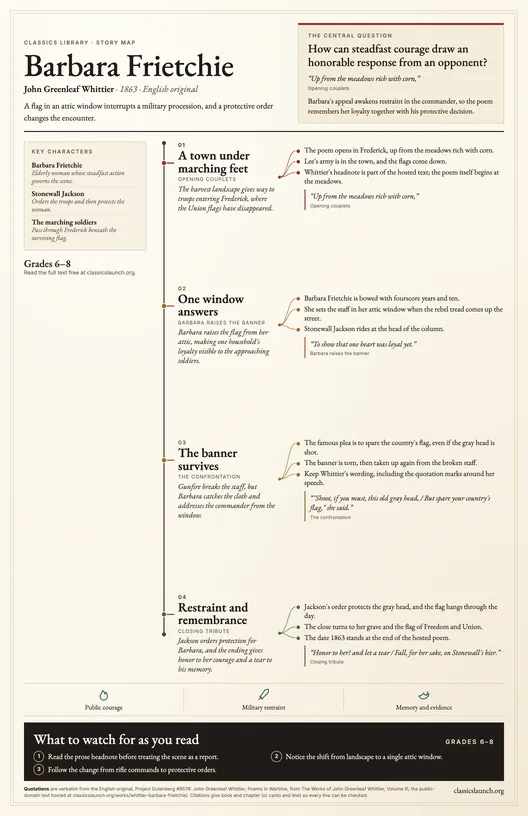 Story mapSee the story mapThe whole book on one page: the story in movements, the characters, and what to watch for. Free to print.
Abstract
Background. First published in the Atlantic Monthly in October 1863, this Civil War poem imagines a celebrated encounter during Confederate movements through Maryland. The attached prose note explicitly recognizes disputed details. That note belongs with the verse, giving readers the poet's distinction between loyalty he considered established and an incident whose particulars were uncertain.
Content. A town lowers its flags as troops enter, but an elderly resident displays hers from an upper window. Gunfire damages it without ending her resistance. Her appeal prompts the commanding officer to protect her, and the marching soldiers pass beneath the surviving banner. The close remembers both figures after death.
Themes. Patriotism appears through a public symbol defended by someone physically vulnerable. Military honor appears through the enemy officer's capacity to answer courage with restraint. Landscape and light frame the confrontation, allowing the final appeal for peace to grow out of a day marked by threatened violence rather than a battlefield triumph.
Significance. Rhyming pairs of lines carry the scene with unusual economy, moving from panoramic description to brief commands and direct exchange. The final remembrance widens the emotional field beyond partisan celebration. Reading headnote and poem together supports a useful discussion of literary commemoration, the power of a memorable scene, and the care required when retelling an event preserved through conflicting reports.
Main characters
- Barbara Frietchie: Elderly woman whose steadfast action governs the scene.
- Stonewall Jackson: Orders the troops and then protects the woman.
- The marching soldiers: Pass through Frederick beneath the surviving flag.
Summary
Whittier opens Barbara Frietchie with a harvest landscape: Maryland's cornfields, orchards, and clustered church spires stand in clear September light. Into that peaceful setting comes an army. Confederate troops enter Frederick, and the Union flags that flew during the morning disappear by noon. The poem narrows from the town and surrounding hills to one elderly woman and an attic window. Barbara, described as ninety years old, raises a flag after others have taken theirs down. Stonewall Jackson approaches at the head of his soldiers. In the poem's compressed encounter, his commands halt the ranks and bring a rifle volley against the banner. The staff breaks, but Barbara catches the cloth and holds it outside the damaged window. She offers her own head as a target while asking that the country's flag be spared. Her courage changes the encounter. Jackson feels shame and sadness, then orders that nobody touch her. The soldiers continue marching beneath the flag for the rest of the day. Evening light settles on its torn folds, and the poem passes beyond the incident to remember both Barbara and the Confederate commander. Whittier calls for honor to her and a tear at his bier, joining patriotic loyalty with respect for an opponent's noble response. The hosted text includes a prose headnote that matters to this reading. Whittier acknowledges conflicting testimony and allows that details of the story were probably incorrect, perhaps blending Barbara's actions with another woman's. The poem is therefore best understood as a shaped account of an admired deed, accompanied by its author's own historical qualification. Its couplets make the confrontation swift and memorable, while the closing tribute gives the victory of courage a generous reach.
Virtues in this work
- Fortitude: Barbara continues displaying her flag after the window and staff are struck.
- Magnanimity: The closing tribute recognizes nobility in the opposing commander as well as loyalty in Barbara.
Plot or Argument
- A town under marching feet
The harvest landscape gives way to troops entering Frederick, where the Union flags have disappeared.
- One window answers
Barbara raises the flag from her attic, making one household's loyalty visible to the approaching soldiers.
- The banner survives
Gunfire breaks the staff, but Barbara catches the cloth and addresses the commander from the window.
- Restraint and remembrance
Jackson orders protection for Barbara, and the ending gives honor to her courage and a tear to his memory.
Characters
- Barbara Frietchie, Flag defender
Elderly woman whose steadfast action governs the scene.
- Stonewall Jackson, Confederate commander
Orders the troops and then protects the woman.
- The marching soldiers, Military company
Pass through Frederick beneath the surviving flag.
Lessons
Courage changes a scene
Barbara has little physical power beside the marching troops. Her refusal to lower the banner nonetheless changes the commander's behavior.
- What can Barbara control?
- Which action gives the encounter a new direction?
Honor can answer an opponent
The close gives respect to both figures. Jackson's restraint becomes part of the poem's tribute to courage.
- Why does the poet ask for a tear for Jackson?
- How does his order differ from the earlier gunfire?
Remember with precision
Whittier's headnote acknowledges uncertainty about the event's details. Keeping that qualification beside the verse helps distinguish commemoration from a settled report.
- What does the headnote qualify?
- How can a poem remain valuable when details are disputed?
Context
The poem concerns Confederate passage through Frederick during the Civil War. Whittier wrote as a supporter of the Union, using a local act of loyalty to create a compact scene of courage and military restraint.
Composition
The Atlantic Monthly published the poem in October 1863. The hosted collected text includes Whittier's later historical qualification before the verse.
Reception
The confrontation became a familiar subject for recitation. Its enduring narrative force should be read alongside the conflicting testimony acknowledged in the author's own note.
Comparisons
- Paul Revere's Ride
Both poems turn a local action into national remembrance, with different relations between historical detail and dramatic concentration.
- The Civil War
Compare Whittier's brief emblematic encounter with a historical narrative's account of military movement and evidence.
Quotes
“Up from the meadows rich with corn,”
“To show that one heart was loyal yet.”
“"Shoot, if you must, this old gray head, But spare your country's flag," she said.”
“Honor to her! and let a tear Fall, for her sake, on Stonewall's bier.”
For Students
A reading companion for classical Christian high school students. See the student guide.
Reading Guide
Watch for
- Read the prose headnote before treating the scene as a report.
- Notice the shift from landscape to a single attic window.
- Follow the change from rifle commands to protective orders.
Key terms and names
- couplet
- Two successive lines joined here by an end rhyme.
- bier
- A stand on which a coffin or body is placed before burial.
- Union
- The United States government and the states supporting it during the Civil War.
- commemoration
- An act of preserving and honoring a person or event in memory.
Seminar Questions
- Comprehension What happens to the town's flags before Barbara acts?
- Comprehension What order protects her after she speaks?
- Interpretation Why does Whittier begin with orchards and corn?
- Interpretation How does the closing tribute change the poem's emotional range?
- Big Question What may poetry preserve that a list of verified events does not?
- Big Question Can loyalty to one's country include respect for an enemy?
Faith Connections
- Proverbs 16:32 (Scripture)
The praise of self-command provides a fitting comparison for the officer's decision to restrain force.
- Matthew 5:9 (Scripture)
The blessing on peacemakers can be discussed beside the poem's final movement toward peace, order, and remembrance.
Logic and Rhetoric
Central argument: A person's steadfast public act can call forth restraint from an armed opponent and deserve remembrance beyond the quarrel itself.
Rhetorical device: symbolism. The damaged banner gathers the woman's loyalty, the soldiers' power, and the closing hope for national peace.
Debate: Resolved: the closing tribute to Jackson strengthens the poem's praise of Barbara.
Memory Work
"Shoot, if you must, this old gray head, But spare your country's flag," she said.
Writing Prompts
Essay: Explain why the poem ends by honoring Barbara and remembering Jackson rather than stopping at his protective order.
Comparison with Paul Revere's Ride: Compare the use of one memorable action in Barbara Frietchie and Paul Revere's Ride, including each poem's handling of history.
Creative Prompts
- Poetry
Write two couplets describing a quiet street before an approaching column changes its sounds.
- Dialogue
Compose a conversation between a poet and a historian about preserving an event in a memorable scene.
- Classroom
Make a two-column chart of what Whittier's headnote affirms and what it leaves uncertain.
Further Reading
- Snow-Bound, John Greenleaf Whittier
- Battle-Pieces and Aspects of the War, Herman Melville
Verification notes
Quotations follow the complete hosted poem in Project Gutenberg #9578. The supplied 1863 publication date is retained. The encounter is described as the poem presents it; Whittier's explicit doubt about its details is preserved in the editorial account.
No verification flags recorded.