Great Churches & Monasteries · Western Europe
Monte Cassino
The mountaintop abbey where Benedict of Nursia founded the monastic order that shaped Western Europe.
Still standing. The abbey stands on its hilltop. It was destroyed by Allied bombing in February 1944 and rebuilt after the war, and it was consecrated again in 1964. The burial place of Benedict was found intact beneath the ruins.
What it is
Benedict of Nursia, who had lived as a hermit and led several small communities, came about 529 to the hilltop above Cassino, where a pagan temple stood, and founded a monastery. Benedict wrote his Rule for monks there, according to tradition, a short book of seventy-three chapters on prayer, work, obedience, and hospitality. He and his sister Scholastica were buried there. The abbey was destroyed by Lombards about 580, restored in 717 under Abbot Petronax, destroyed again by Saracens in 883, and rebuilt in the eleventh century, with a great basilica consecrated in 1071.
In the Middle Ages Monte Cassino was a center of learning and manuscript copying. The young Thomas Aquinas was sent there as an oblate by his family around 1230. In the Second World War the abbey stood at the center of the German Gustav Line, and on 15 February 1944 Allied bombers destroyed it. The ruins became the scene of a long battle. After the war the abbey was rebuilt on the old plan and consecrated by Pope Paul VI in 1964. The tombs of Benedict and Scholastica lie under the high altar.
“Listen, my son, to your master's precepts, and incline the ear of your heart.”
Why it matters for a classical Christian student
Benedict's Rule shaped the monasteries of the West and, through them, schools, farms, hospitals, and libraries. A classical Christian student will see that the quiet virtues of stability, obedience, work, and prayer were the working method of a civilization. The abbey's history of destruction and rebuilding is itself a lesson: in 580, 883, 1349, and 1944 it was ruined, and each time monks came back.
Read alongside
- The Rule of St Benedict: The Rule written for the monks of Monte Cassino.
Great Lives connected here
- Benedict of Nursia, in Great Lives: Benedict founded the monastery about 529 and wrote his Rule for the monks who lived there.
- Gregory the Great, in Great Lives: Gregory the Great wrote the only early life of Benedict, in his Dialogues, with its account of Monte Cassino.
- Thomas Aquinas, in Great Lives: Thomas Aquinas was sent to Monte Cassino as a boy, about 1230, to be educated.
Look closely
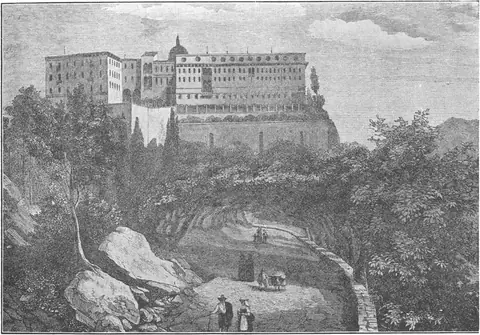
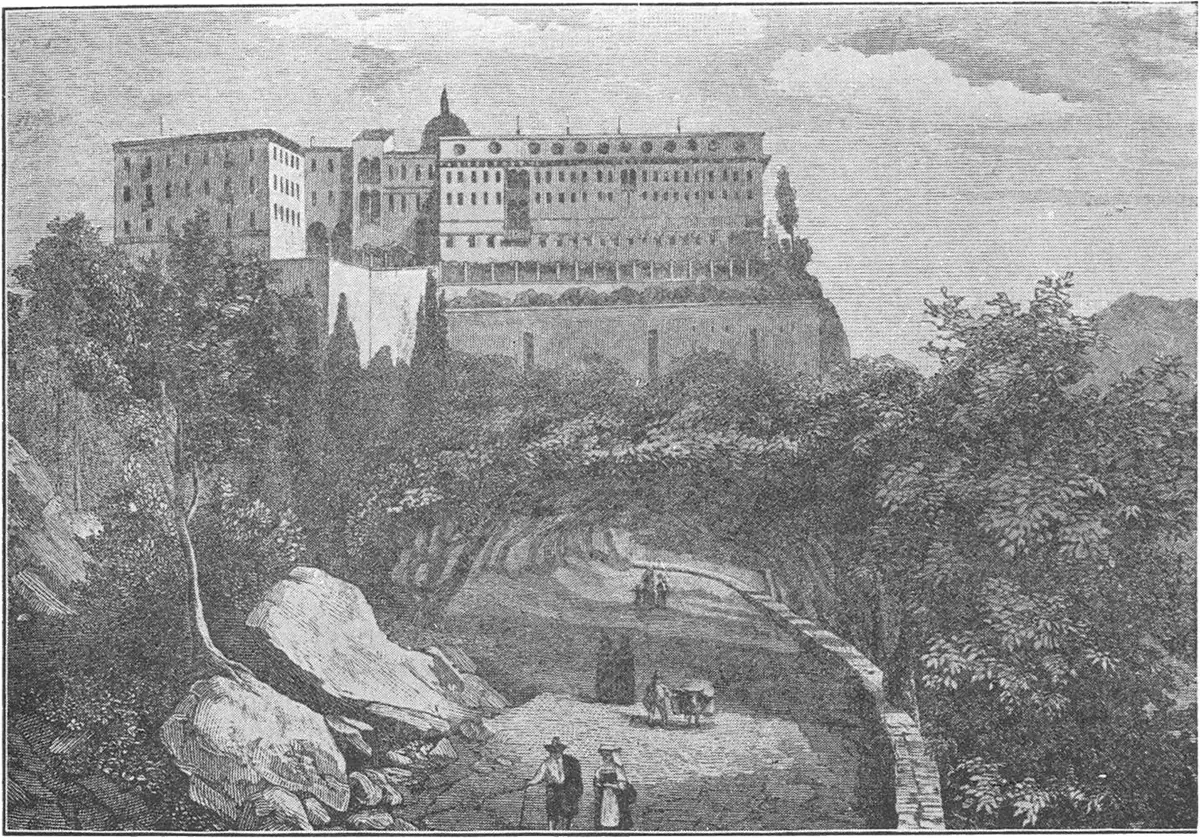
Image: Wikimedia Commons · Public domain (PD-Art) The abbey on its hill
Look closely. A print shows the abbey buildings along the top of a steep hill, over woods and a path. The abbey was the head of Benedict's order.
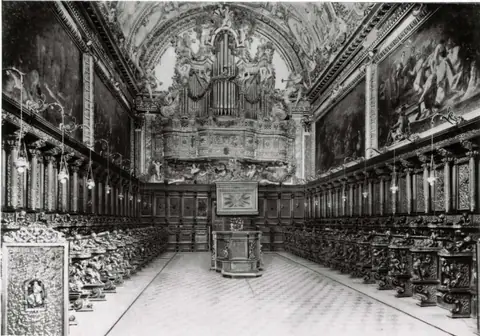
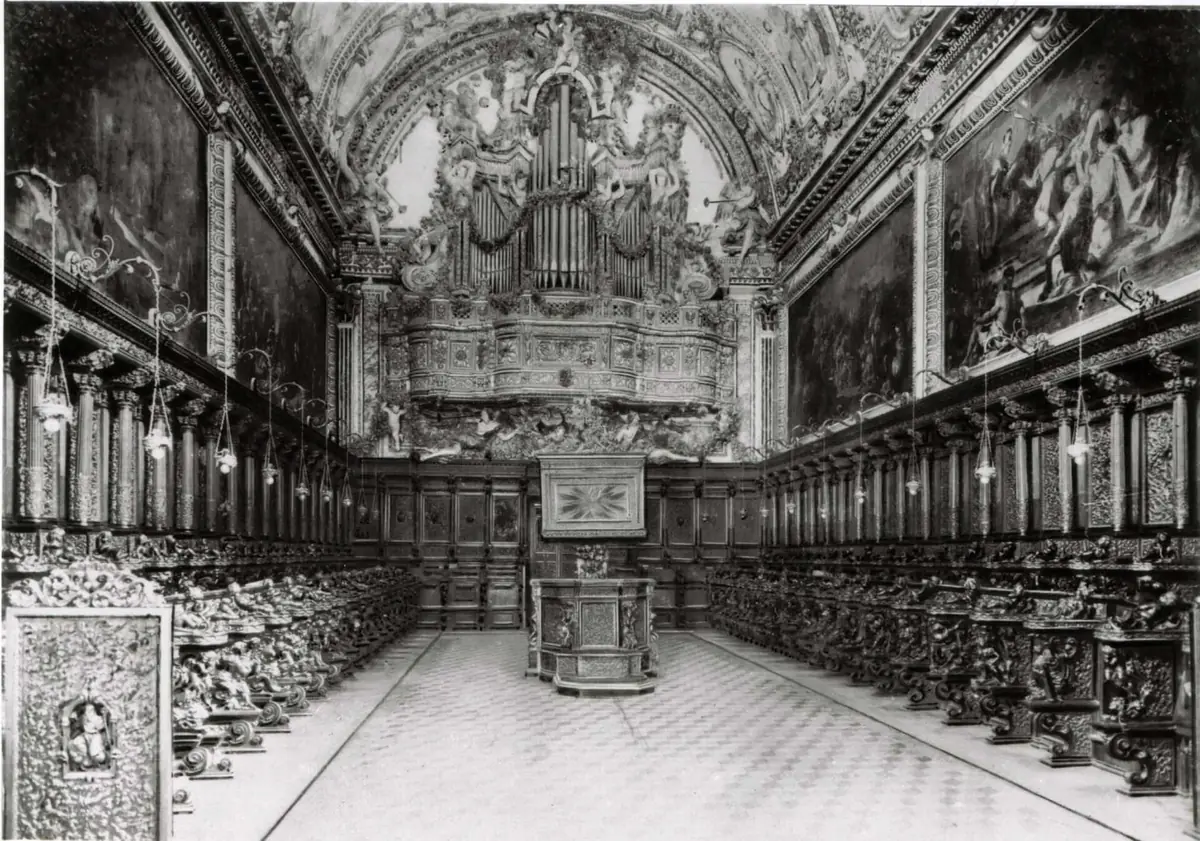
Image: Wikimedia Commons · Public domain (PD-Art) The choir and organ before 1944
Look closely. A photograph from the 1930s shows the choir stalls and organ of the abbey church. This room was destroyed in the bombing of February 1944, and the church was rebuilt afterward.
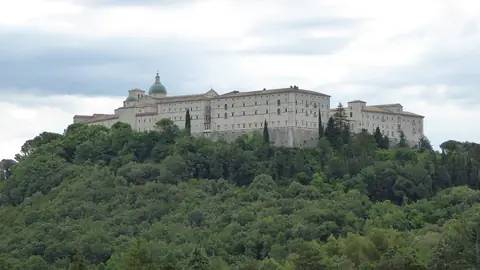
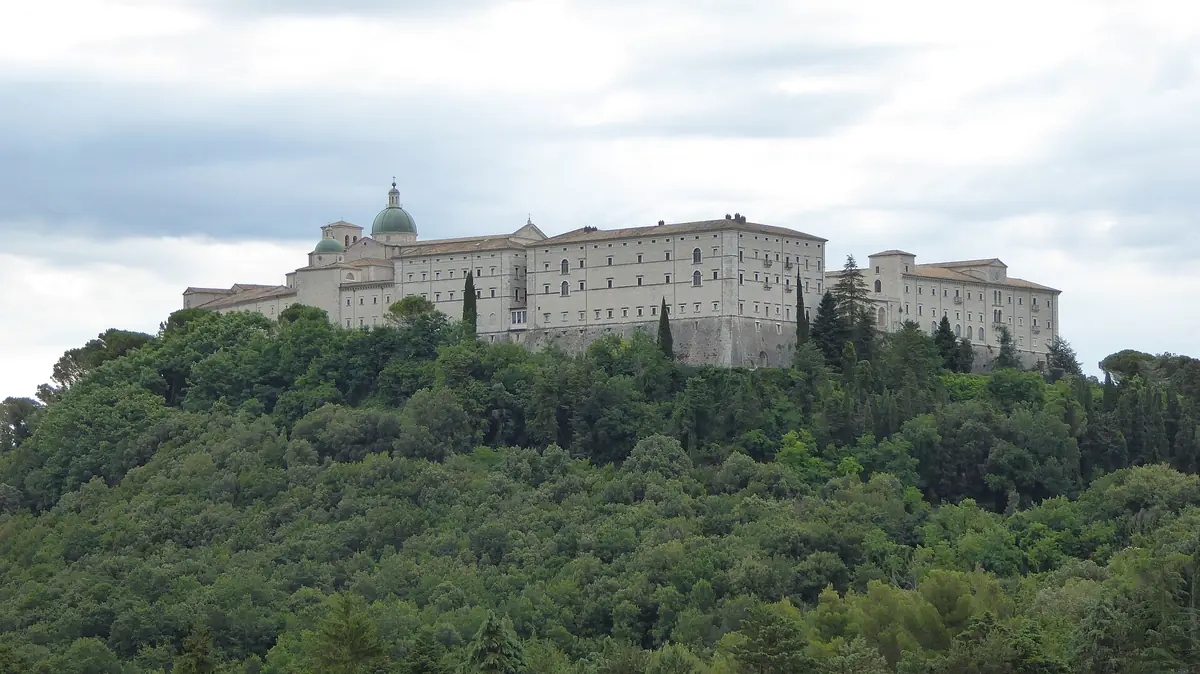
Image: Wikimedia Commons · CC0 (public domain) The abbey today
Look closely. The rebuilt abbey sits on its hilltop above the town. It was rebuilt after 1944 on its old plan.
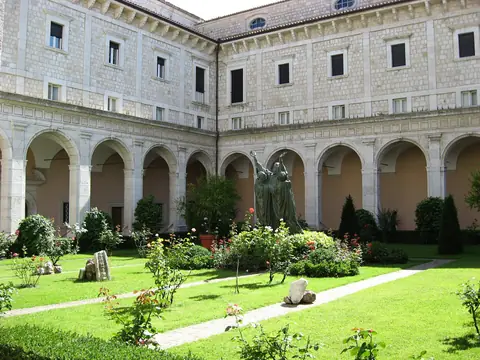
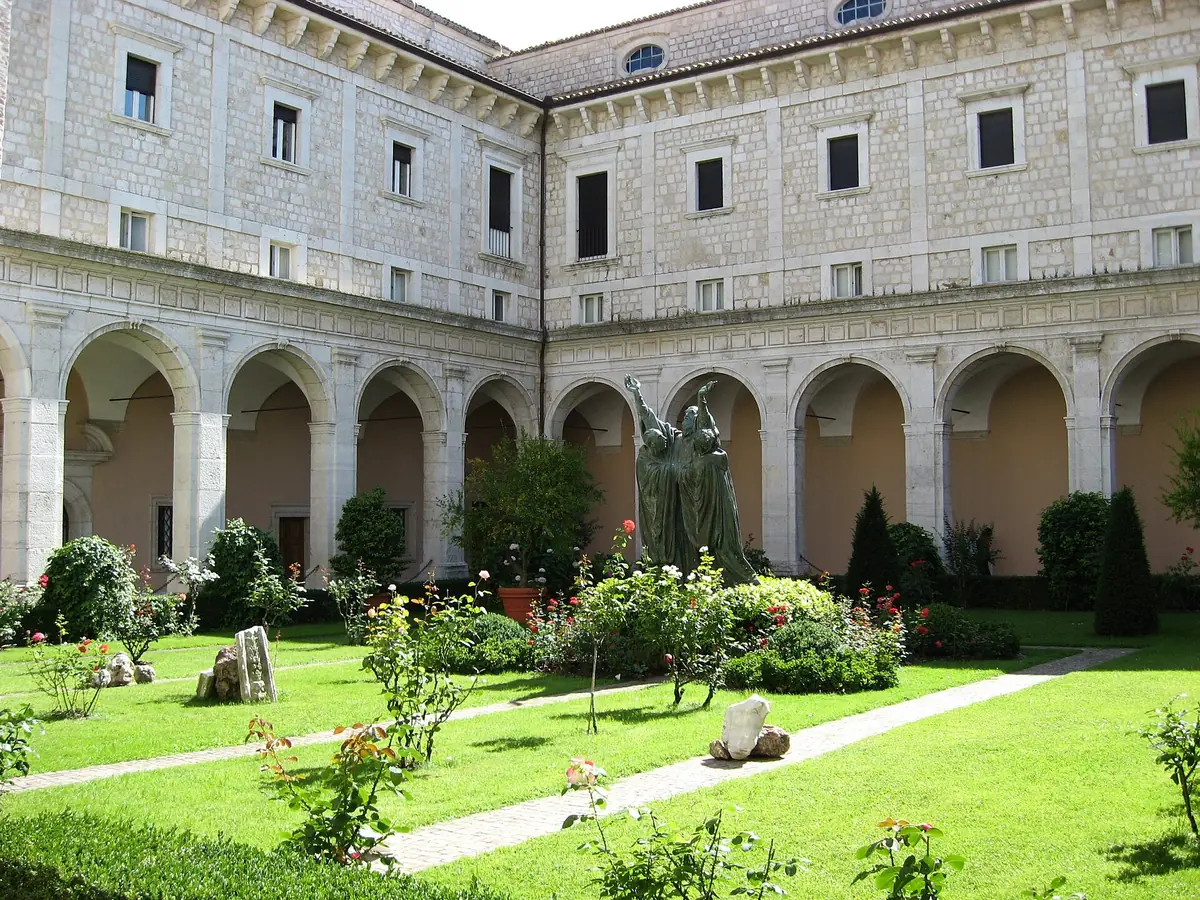
Image: Wikimedia Commons · CC BY 3.0 · Photo: Pilecka The cloister
Look closely. The courtyard of the abbey is ringed by two stories of arches. Notice the order and calm of the plan, the garden and the open sky.


What to watch for
Look slowly- The hill. The abbey sits on a summit, with a view over the valley.
- The rebuilding. The new buildings follow the old plans.
- The tomb of Benedict. It is under the high altar.
- The Rule. Read a chapter of the Rule alongside the building.
Sources
Dates follow standard historical references and, where we quote a book, the wording of the edition hosted in this library. Where a tradition is not certain history, the page says so. Photographs and pictures are used only when the image itself is Public domain, CC0, or CC BY with a named credit. Each picture links to its source page with full licence details. Pictures taken before a site was damaged are labelled with their date.