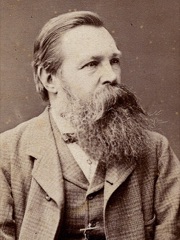
Friedrich Engels
1820–1895 · German social theorist and businessman, coauthor with Karl Marx of The Communist Manifesto.
Friedrich Engels was born in 1820 in Barmen, Prussia (now part of Wuppertal), into a wealthy family of textile manufacturers. His father sent him to work in business, and while doing military service in Berlin he joined the Young Hegelians, a group of radical philosophers. In 1842 he was sent to Manchester, England, to work at a cotton mill partly owned by his father, and his observations there led to The Condition of the Working Class in England (1845). In 1844 he met Karl Marx in Paris, and the two began a lifelong partnership. Together they wrote The Communist Manifesto (1848), published on the eve of revolutions across Europe, which called on workers to unite and overthrow capitalism. Engels took part in the 1849 uprisings in Germany, then returned to the family firm in Manchester, where he worked for about twenty years and supported Marx and his family financially. After Marx's death in 1883, Engels edited and published the second and third volumes of Das Kapital. He died in London in 1895.
Friedrich Engels is also an author in the library: author page and works.
Faith: Raised in a devout Pietist Lutheran family; he became an atheist as a young man. Source: Wikipedia
Further reading
- Engels: A Very Short Introduction by Terrell Carver (Oxford University Press, 2003), ISBN 9780192804662
See also: Karl Marx

Key dates
- 1820 Born in Barmen, Prussia
- 1842 Goes to work in Manchester
- 1844 Meets Karl Marx in Paris
- 1845 The Condition of the Working Class in England
- 1848 The Communist Manifesto published
- 1883 Marx dies; Engels edits his work
- 1895 Dies in London
Fun facts
- He wrote so much about wars that Karl Marx's family nicknamed him 'The General'. (Source: Friedrich Engels (Wikipedia))
Read about them
Grades 9–12
- The Communist Manifesto · In the library
- Capital, Volume I · In the library · Engels edited the English translation of 1887
- Karl Marx and the Close of His System · In the library · A critique of the third volume of Capital, which Engels edited
Historical impact
Marxism as state ideology and the persecution of Christians and other believers
Written for grades 9–12. Every figure is taken from the sources listed below.
Marx died in 1883 and Engels in 1895, before any government ruled in their name. In the twentieth century, Communist parties that took Marx as their founding authority came to power in Russia, Eastern Europe, China, Albania and elsewhere and made Marxism-Leninism the official ideology of the state. Because Marx taught that religion was an illusion that would pass away, these governments set out to hasten its end: they closed churches, banned Christian teaching of the young, and imprisoned or executed pastors, priests and ordinary believers. Many Christians kept the faith at the cost of their freedom or their lives, and churches today honour them as martyrs and confessors. Students reading Marx and Engels should know this history. The facts below are taken from the sources listed at the end.
From Marx's writings to party doctrine
In 1844 Marx wrote that religion "is the opium of the people" and that "the abolition of religion as the illusory happiness of the people is the demand for their real happiness." [1]
In 1909 Lenin, who would lead the Bolshevik seizure of power in Russia in 1917, called this "dictum by Marx" "the corner-stone of the whole Marxist outlook on religion" and wrote that Marxism regards all churches and religious organisations "as instruments of bourgeois reaction." In the same article Lenin recalled that Engels had called an open declaration of war on religion by exiled French radicals in 1874 a piece of stupidity, likely to revive interest in religion rather than end it. [2]
The Soviet Union
The Library of Congress describes the Soviet Union as "the first state to have as an ideological objective the elimination of religion." The regime confiscated church property, ridiculed religion, harassed believers and taught atheism in the schools, although most organized religions were never formally outlawed. [3]
During the famine of 1922 the government ordered the seizure of church valuables. In a secret letter to the Politburo dated March 19, 1922, after believers in the town of Shuia resisted, Lenin wrote: "The greater the number of representatives of the reactionary clergy and the reactionary bourgeoisie that we succeed in shooting on this occasion, the better." [4]
The League of the Godless, founded in 1925 and renamed the League of the Militant Godless in 1929, campaigned for the closure of churches, the silencing of church bells and against religious holidays. It claimed 5.5 million members in the early 1930s, though the historian Daniel Peris notes that many were members only on paper and that church closures were chiefly the work of state power. [5]
The Russian Orthodox Church, the largest, was the main target in the 1920s and 1930s. Nearly all of its clergy, and many believers, were shot or sent to labour camps; theological schools were closed and church publications banned. By 1939 only about 500 of more than 50,000 churches remained open. [3]
According to Russian state records cited by church historians, 136,900 Orthodox clergy were arrested in 1937, of whom 85,300 were shot, and 28,300 were arrested in 1938, of whom 21,500 were shot. [6]
Other churches suffered too. By 1926 the Roman Catholic Church had no bishops left in the Soviet Union, and by 1941 only two of the almost 1,200 Catholic churches that had existed in 1917 were still active. The Ukrainian Catholic Church was forcibly subordinated to the Russian Orthodox Church in 1946. Protestants were persecuted, attacks on Judaism were constant throughout the Soviet period, and Islam was suppressed by force until 1941. [3]
Stalin allowed a revival of the Orthodox Church during the Second World War, and by 1957 about 22,000 churches were active. From 1959 Nikita Khrushchev forced the closure of about 12,000 of them, and by 1985 fewer than 7,000 remained active. [3]
Albania
Albania's Communist leader Enver Hoxha, whom the Library of Congress country study calls "a dogmatic Stalinist," nationalized most church property in 1945 and expelled all foreign Catholic priests, monks and nuns in 1946. Between 1945 and 1953 the number of Catholic churches fell from 253 to 100. Many clergy and believers were tried, tortured and executed. [7]
By May 1967 religious bodies had been forced to give up all 2,169 churches, mosques, cloisters and shrines in the country; the literary monthly Nendori declared that Albania's youth had "created the first atheist nation in the world." More than 200 clergy of various faiths were imprisoned. The 1976 constitution banned religious activity and propaganda, and the 1977 penal code set prison terms of three to ten years for religious propaganda and for producing or keeping religious literature. In 1980 a Jesuit priest was sentenced to life for baptizing his nephew's newborn twins. [7]
China
The Chinese Communist Party is officially atheist, and Pew Research Center notes that its stance "aligns with the Marxist view that religion is a temporary historical phenomenon that will disappear as societies advance." After 1949 the government confiscated many churches, temples and mosques, deported foreign missionaries and set up patriotic associations to manage and monitor each of five recognized religions. [8]
During the Cultural Revolution (1966–1976), "all religious activities were banned, and religious personnel were persecuted"; Red Guards attacked or destroyed many churches, temples and mosques, and believers practised in secret. After Mao's death the party allowed only "normal" religious activity under state control and continued to bar its members from religious belief. [8]
For students and teachers
The Library of Congress notes that Soviet policy toward each religion was shaped by the interests of the state, so that churches linked to foreign authorities, such as Catholics loyal to the Pope, were treated most harshly. Historians still debate how much of this persecution follows from Marx's own view of religion and how much from Lenin's one-party state and the choices of later rulers; students can weigh both as they read the Manifesto and Capital alongside the critics below. [3]
Christians have long read such persecution in the light of Christ's words, "If they have persecuted me, they will also persecute you" (John 15:20), and of the ancient conviction that the blood of the martyrs is the seed of the church. In 2000 the Russian Orthodox Church canonized 1,765 named new martyrs and confessors of the Soviet era, a reminder that the faith outlasted the regimes that tried to abolish it. [6]
Critics and responses
Works in the library that answer Marx's ideas or describe their results:
- Karl Marx and the Close of His System · Eugen von Böhm-Bawerk
Böhm-Bawerk (1896) argues that the third volume of Capital contradicts the labour theory of value of the first. - Principles of Economics · Carl Menger
Menger's subjective theory of value (1871) offers the main alternative to the labour theory of value. - Economic Calculation in the Socialist Commonwealth · Ludwig von Mises
Mises argues (1920) that without market prices for the means of production a socialist economy cannot calculate rationally. - Socialism: An Economic and Sociological Analysis · Ludwig von Mises
Mises's full-length critique (1922) of socialism's economics, ethics and view of history. - The Road to Serfdom · F. A. Hayek
Hayek warns (1944) that central economic planning leads toward the loss of political freedom. - The Open Society and Its Enemies · Karl Popper
Popper's second volume (1945) criticizes Marx's claim to have found laws of history. - The Law · Frédéric Bastiat
Bastiat (1850) attacks the socialist schemes of his day as legal plunder that perverts the purpose of law. - Capitalism and Freedom · Milton Friedman
Friedman (1962) argues that competitive capitalism is a necessary condition of political freedom. - The Origins of Totalitarianism · Hannah Arendt
Arendt (1951) analyses the Nazi and Stalinist regimes as a new form of government built on ideology and terror. - Darkness at Noon · Arthur Koestler
Koestler's novel (1940) portrays an old Bolshevik imprisoned and tried in the era of the Moscow show trials. - Animal Farm · George Orwell
Orwell's fable (1945) allegorizes the betrayal of the Russian Revolution under Stalin. - Nineteen Eighty-Four · George Orwell
Orwell's novel (1949) imagines a totalitarian state that controls truth, language and memory. - The Gulag Archipelago · Aleksandr Solzhenitsyn
Solzhenitsyn's history (1973) of the Soviet labour-camp system, drawn from his own imprisonment and the testimony of other prisoners. - One Day in the Life of Ivan Denisovich · Aleksandr Solzhenitsyn
Solzhenitsyn's novel (1962) of a single day in a Stalinist labour camp. - Rerum Novarum · Pope Leo XIII
Leo XIII (1891) rejects the socialist abolition of private property while defending workers' rights to a just wage and to form associations. - Centesimus Annus · John Paul II
John Paul II (1991), on the centenary of Rerum Novarum, reflects on the collapse of Communist regimes in 1989.
Sources
- Karl Marx, A Contribution to the Critique of Hegel's Philosophy of Right, Introduction (1844). Marxists Internet Archive. Link
- V. I. Lenin, "The Attitude of the Workers' Party to Religion" (1909). Marxists Internet Archive. Link
- Revelations from the Russian Archives: Anti-religious Campaigns. Library of Congress. Link
- Revelations from the Russian Archives: Translation of letter from Lenin to Molotov and the Politburo, March 19, 1922. Library of Congress. Link
- Daniel Peris, "League of the Militant Godless," Encyclopedia of Russian History (2004). Encyclopedia.com. Link
- Mikus Solovejs, "Canonisation of New Martyrs and Confessors of the 20th Century in the Russian Orthodox Church," European Journal of Mental Health 8 (2013): 46–59. Semmelweis University. Link
- Albania: A Country Study, "Hoxha's Antireligious Campaign" (Library of Congress Federal Research Division, 1992). countrystudies.us. Link
- "Government policy toward religion in the People's Republic of China: a brief history" (August 30, 2023). Pew Research Center. Link
More lives
Frédéric Bastiat · Eugen von Böhm-Bawerk · Thomas Carlyle · Carl von Clausewitz · Samuel Taylor Coleridge · John Dewey