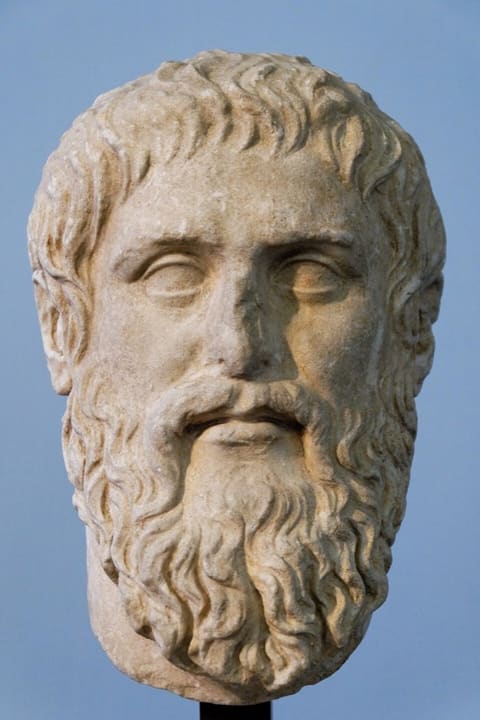
Plato
c. 428–348 BC · Student of Socrates and founder of the Academy, whose dialogues shaped Western philosophy.
Plato was born into a wealthy and politically powerful Athenian family. As a young man he became a follower of Socrates, and the trial and death of his teacher in 399 BC turned him away from a political career. He traveled, including to Sicily, where he tried without success to guide the rulers of Syracuse. Around 387 BC he founded the Academy in a grove outside Athens, a school where students studied mathematics, philosophy and politics; it lasted in some form for centuries, and Aristotle studied there for twenty years. Plato wrote dialogues, conversations usually led by Socrates, on justice, love, knowledge, the soul, beauty and the best kind of city. In the Republic he describes a just city ruled by philosopher-kings and tells the allegory of the cave, in which prisoners mistake shadows for reality. He taught that the changing things we see are copies of unchanging Forms, such as the Good itself. Nearly all his writings survive. He died in Athens around 348 BC.
Plato is also an author in the library: author page and works.
Faith: Faith not well documented beyond the Greek religion of his time; his philosophy later influenced Christian, Jewish and Islamic thought. Source: Wikipedia
Further reading
- Plato: A Very Short Introduction by Julia Annas (Oxford University Press, 2003), ISBN 9780192802163
Key dates
- c. 428 BC Born in Athens
- 399 BC Death of Socrates
- c. 387 BC Founds the Academy
- c. 375 BC Writes the Republic
- c. 348 BC Dies in Athens
Fun facts
- Ancient writers say his favourite pastime as a young man was writing poetry. (Source: Plato (Wikipedia))
- 'Plato' may have been a nickname referring to his broad, sturdy build, though this story is widely doubted. (Source: Plato (Wikipedia))
Record-breaker
Firsts and records, worded as the sources give them ("first known", "at the time").
- His longest work is the Laws, written near the end of his life. (Source: Plato (Wikipedia))
Watch


Videos load from YouTube in privacy-enhanced mode only when you press play.
Read about them
Grades 9–12
- The Last Days of Socrates · In the library
- The Republic · In the library
- Meno · In the library
- The Symposium · In the library
- Phaedrus and Letters VII and VIII · In the library
- Laws · In the library
- Timaeus · In the library
- Statesman · In the library
- Charmides, Lysis and Laches · In the library
- Protagoras · In the library
- Gorgias · In the library
- Euthydemus · In the library
- Cratylus · In the library
- Ion · In the library
- Critias · In the library
- Parmenides · In the library
- Theaetetus · In the library
- Sophist · In the library
- Philebus · In the library
More lives
Aristotle · Cicero · Confucius · Epictetus · Epicurus · Heraclitus