Work record
A Frog He Would A-Wooing Go
Randolph CaldecottA Frog He Would A-Wooing Go by Randolph Caldecott (1883)A frog sets off to court a mouse, apparently determined to go whether his mother approves or not.1883 · 19th Century · Poetry · English
Read this when a jaunty refrain carries an animal party toward an unexpectedly brisk ending.
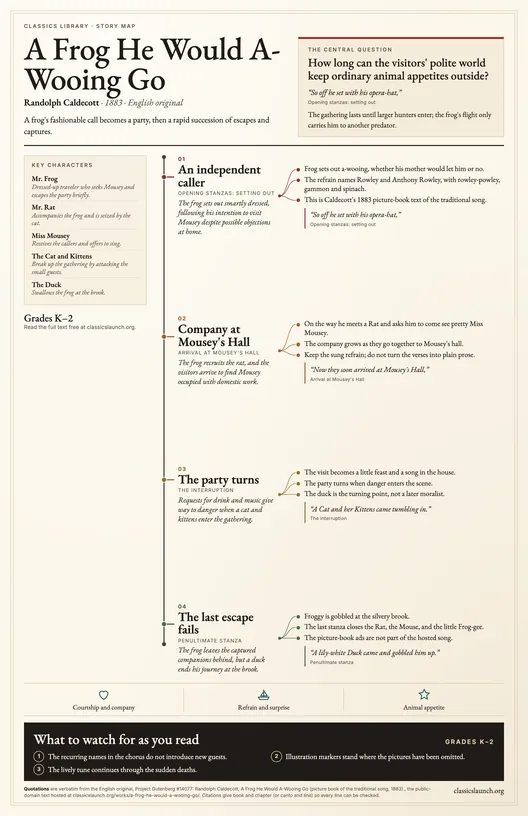 Story mapSee the story mapThe whole book on one page: the story in movements, the characters, and what to watch for. Free to print.
Abstract
Background. Caldecott's 1883 picture book presents an older traditional song through his art and its familiar verbal pattern. This record follows the hosted words, which retain illustration markers while omitting the plates. Caldecott is therefore identified as the maker of this edition, rather than as the inventor of the song.
Content. A dressed-up amphibian recruits a companion for a call on a mouse. Refreshments and a request for music turn the visit into entertainment, until feline intruders seize host and guest. The surviving caller departs quickly, only to be eaten at the water crossing. A final count gathers the three losses into one close.
Themes. Social ceremony and animal appetite occupy the same little world. Polite conversation never stops the creatures from being prey, and the lively chorus continues regardless of what happens. The resulting humor depends on sudden changes of scale: the important visitors become small animals again when larger hunters enter the scene.
Significance. The repeated responses make the song easy for a group to join, even before children can read independently. Changes in spelling, capitals, and printed emphasis belong to this particular textual witness. Reading the words beside a complete illustrated edition would also reveal how much a picture-book artist can add through timing and gesture without supplying a different plot.
Main characters
- Mr. Frog: Dressed-up traveler who seeks Mousey and escapes the party briefly.
- Mr. Rat: Accompanies the frog and is seized by the cat.
- Miss Mousey: Receives the callers and offers to sing.
- The Cat and Kittens: Break up the gathering by attacking the small guests.
- The Duck: Swallows the frog at the brook.
Summary
A frog sets off to court a mouse, apparently determined to go whether his mother approves or not. He wears an opera hat, a detail that immediately turns the animal into a little gentleman making a social call. On the road he meets a rat and invites him to accompany the visit. The two arrive at Mousey's Hall, knock loudly, and discover their hostess at her spinning. The visit becomes a small party. The guests ask for beer, and the mouse asks the frog for a song, provided it is not too long. The frog excuses himself because a cold has made his voice hoarse. Mousey offers to sing something she has made herself. These exchanges give the company the recognizable manners of human visitors: invitations, refreshments, polite requests, and an excuse for avoiding a performance. The recurring chorus gives listeners a place in the gathering without adding another character to the action. The party ends suddenly when a cat and her kittens tumble in. The cat seizes the rat, and the kittens pull down the mouse. Alarmed, the frog takes his hat and leaves with a hurried farewell. His escape lasts only until he crosses a brook, where a duck swallows him. The final stanza counts the three companions together and closes their adventure. In Caldecott's 1883 picture-book text, the refrain continues through courtship, entertainment, fright, and death with the same buoyant rhythm. That steadiness is part of the song's nursery humor: small creatures behave like fashionable company until larger animals restore the ordinary order of appetite. The hosted version retains the words and illustration markers but cannot supply the gestures and movement of Caldecott's pictures.
Virtues in this work
- Prudence: The abrupt interruption invites attention to danger beneath the visitors' confident social routine.
- Friendship: The invitation to travel together and the shared visit make companionship central to the opening.
Plot or Argument
- An independent caller
The frog sets out smartly dressed, following his intention to visit Mousey despite possible objections at home.
- Company at Mousey's Hall
The frog recruits the rat, and the visitors arrive to find Mousey occupied with domestic work.
- The party turns
Requests for drink and music give way to danger when a cat and kittens enter the gathering.
- The last escape fails
The frog leaves the captured companions behind, but a duck ends his journey at the brook.
Characters
- Mr. Frog, Caller
Dressed-up traveler who seeks Mousey and escapes the party briefly.
- Mr. Rat, Companion
Accompanies the frog and is seized by the cat.
- Miss Mousey, Hostess
Receives the callers and offers to sing.
- The Cat and Kittens, Intruders
Break up the gathering by attacking the small guests.
- The Duck, Final hunter
Swallows the frog at the brook.
Lessons
A chorus holds a song together
The same musical responses follow very different events. Children can keep the pattern while hearing the story change.
- Where would a group join in?
- Does the chorus slow down when danger comes?
Pictures belong to the telling
The printed words name actions, costumes, and visitors. Caldecott's pictures would give those details additional movement and expression.
- Which action would be most useful to draw?
- How might a picture prepare for the cat's arrival?
Small manners, large appetites
The visitors act like polite adults at a party. The cat and duck return the tale to the everyday relations of animals.
- What makes the frog seem like a gentleman?
- Why does leaving the house fail to save him?
Context
Traditional songs often existed in several wordings before and after picture-book publication. Caldecott's edition joins an inherited animal courtship song to the expressive visual storytelling of the Victorian nursery.
Composition
This picture-book text dates from 1883. The hosted extraction excludes the illustration plates and the publisher material from the source volume.
Reception
Caldecott's books remain central examples of storytelling through the partnership of pictures and words; this song also survives in other sung versions.
Comparisons
- The Real Mother Goose
Both preserve nursery verse whose repeated sounds can be enjoyed before every word is understood.
- The Wind in the Willows
Compare the frog's human social manners with the fuller domestic lives of Grahame's animal characters.
Quotes
“So off he set with his opera-hat,”
“Now they soon arrived at Mousey's Hall,”
“A Cat and her Kittens came tumbling in.”
“A lily-white Duck came and gobbled him up.”
For Students
A reading companion for classical Christian high school students. See the student guide.
Reading Guide
Watch for
- The recurring names in the chorus do not introduce new guests.
- Illustration markers stand where the pictures have been omitted.
- The lively tune continues through the sudden deaths.
Key terms and names
- wooing
- Seeking someone's affection or proposing a courtship.
- opera-hat
- A formal hat associated with fashionable evening dress.
- spinning
- Twisting fibers into thread with a spindle or wheel.
- refrain
- A repeated response or group of lines in a song.
Seminar Questions
- Comprehension Whom does the frog invite to travel with him?
- Comprehension Why does the frog decline to sing?
- Interpretation How does the hat help create the frog's character?
- Interpretation What makes the cat's arrival a turning point?
- Big Question Can a cheerful tune tell a story with a sad ending?
- Big Question What do pictures contribute when a story's words are very brief?
Faith Connections
- Proverbs 27:1 (Scripture)
The warning against certainty about the next day offers a measured comparison with the callers' confident plans.
- Aesop, The Town Mouse and the Country Mouse (Great Conversation)
Both animal gatherings place food and company beside sudden danger, though their tones and endings differ.
Logic and Rhetoric
Central argument: A fixed cheerful response binds the animal visit together while the narrative shifts abruptly from manners to appetite.
Rhetorical device: refrain. The chorus answers every episode in the same musical pattern, including the intrusion and the last capture.
Debate: Resolved: the unchanged chorus makes the sudden ending more memorable.
Memory Work
A Cat and her Kittens came tumbling in.
Writing Prompts
Essay: Explain how the song turns an ordinary visit into an animal adventure using costume, conversation, and interruption.
Comparison with The Real Mother Goose: Compare the repeated sounds here with a nursery rhyme in The Real Mother Goose, explaining how listeners join in.
Medical Lens
The frog excuses himself from singing because a cold has affected his voice; the detail serves the social comedy.
Creative Prompts
- Classroom
Make a group performance with a narrator and a chorus, changing the narrator's pace at the interruption.
- Adaptation
Draw the frog's hat in three scenes, using its position to show confidence, alarm, and departure.
- Poetry
Write a new animal visiting song with a repeated response and two changes of fortune.
Further Reading
- The Diverting History of John Gilpin, William Cowper, illustrated by Randolph Caldecott
- The House That Jack Built, Randolph Caldecott
Verification notes
Quotations reproduce the hosted Project Gutenberg #14077 text exactly, including underscore emphasis where selected. The traditional song predates Caldecott; 1883 identifies this picture-book edition. No claims are made from omitted illustrations.
No verification flags recorded.