Work record
Cecily Parsley's Nursery Rhymes
Beatrix PotterCecily Parsley's Nursery Rhymes by Beatrix Potter (1922)Cecily Parsley's Nursery Rhymes (1922) is Beatrix Potter's later companion to Appley Dapply: another small book of verses rather than a plotted tale.1922 · Early 20th Century · Poetry · English
Read this when a family wants Potter's later nursery-rhyme picture book.
Abstract
The title rhyme. Cecily Parsley lives in a pen and brews ale for gentlemen, until she runs away. The book then turns from that short song to other brief verses.
Old songs, new pictures. Traditional rhymes — a gander, little pigs, three blind mice, a dog's greeting — sit beside a garden poem and a candle riddle, each short enough to read alone.
A second pocket of verses. There is no long plot to map. Later publisher advertising has been removed from the hosted text, so the reading stays with the 1922 verses. An illustrated copy remains the best way to share the book. Young listeners can retell the events in order and talk about the choices without needing a lecture from the narrator. A text-only reading is well paired with an illustrated copy whenever one is at hand. The complete English text of Cecily Parsley's Nursery Rhymes is hosted here from a verified public-domain transcription of the 1922 book, so families can read the words freely. Families can linger over the pictures and retell the events in their own words. The sequence is short enough to narrate after a single sitting. Nothing essential is left to a later sequel.
Main characters
- Cecily Parsley: A rabbit or hare who brews ale in a pen and then runs away.
- The little pigs: Figures from the traditional market rhyme, given Potter's pictures.
- The gardener in the verse: The voice of 'We have a little garden,' tending seeds and blossoms.
Summary
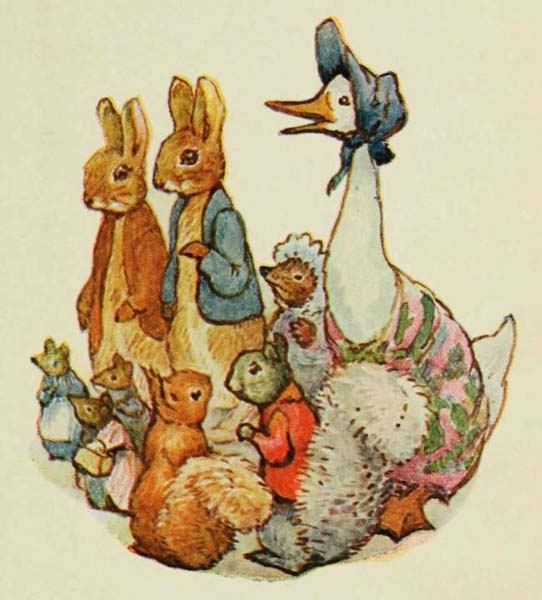
Cecily Parsley's Nursery Rhymes (1922) is Beatrix Potter's later companion to Appley Dapply: another small book of verses rather than a plotted tale. It opens with Cecily Parsley, who lives in a pen and brews good ale for gentlemen, until she runs away. Other rhymes follow in the same short compass, some of them Potter's pictures set to traditional nursery songs. Goosey goosey gander wanders upstairs and downstairs; this little pig goes to market; three blind mice run after the farmer's wife; a dog and a pussy exchange greetings; Tom Tinker's dog answers 'Bow, wow, wow'; and a little garden is watered and tended until there is no faded leaf. A final riddle verse, 'Ninny nanny netticoat,' describes a candle. Because the book is a string of songs, this library does not give it a story map. Some of the traditional rhymes are brisk or grim in the old way — a carving knife, a runaway brewer — and an adult can decide how to speak them, without needing a lecture on the history of each song. The hosted text follows a public-domain transcription of the 1922 Warne book, with later publisher advertising lists removed so that the reading stays with the verses themselves. An illustrated copy is still the right companion, since Potter's pictures of the pen, the pigs, the garden, and the candle do as much as the words. Read one rhyme at a time, let children join the repeats, and pair the book with Appley Dapply if you want a second pocket of songs from the same hand. There is no single moral and no long plot; the design is a handful of pictures and verses for the nursery, late in the Peter Rabbit series and still meant to be heard aloud with a young child nearby.
Virtues in this work
Plot or Argument
- Cecily Parsley
The title verse presents a brewer in a pen who runs away.
- Traditional songs
A gander, little pigs, three blind mice, and a dog's greeting follow.
- Garden and candle
The book closes on a garden poem and a riddle about a candle.
Characters
- Cecily Parsley, title figure
A rabbit or hare who brews ale in a pen and then runs away.
- The little pigs, figures in a rhyme
Figures from the traditional market rhyme, given Potter's pictures.
Lessons
A book of songs
Like Appley Dapply, this is a collection, not a single plotted tale.
- What happens in the title rhyme?
- How should we read a book that has many short pieces?
Old rhymes in new pictures
Some verses are traditional songs Potter has illustrated.
- Which rhyme did you already know?
- What does a picture change about a song you can already say?
A garden carefully kept
The garden verses offer a quiet counterweight to the brisker old songs.
- What do the speakers do in their garden?
- How is that different from the title rhyme?
Context
Potter's later verse book mixes an original title rhyme with traditional nursery songs and a garden poem, issued as a small illustrated collection rather than a plotted tale.
Composition
First published by Frederick Warne in 1922. The local text follows a Project Gutenberg transcription of the English original, with later publisher advertising lists removed.
Reception
It is the natural companion to Appley Dapply's Nursery Rhymes and one of the last of the little Warne picture books.
Comparisons
- Appley Dapply's Nursery Rhymes
The earlier companion volume of short verses; both are to be read as rhymes, not as one long story.
- The Story of Miss Moppet
Another very short Potter book for the youngest; Moppet has a tiny plot, while Cecily is a string of songs.
Quotes
“Cecily Parsley lived in a pen, And brewed good ale for gentlemen;”
“We have a little garden, A garden of our own, And every day we water there The seeds that we have sown.”
For Students
A reading companion for classical Christian high school students. See the student guide.
Reading Guide
Watch for
- That the book is a string of verses, not one story.
- What the title rhyme says about Cecily Parsley.
- Which songs are traditional, and which feel quieter.
Key terms and names
- Nursery rhyme
- A short verse for young children, sometimes traditional, often paired with a picture.
- Traditional
- A song already known in the nursery, such as the little pigs or three blind mice.
- Riddle
- A verse that describes a thing without naming it; the candle poem is one.
- Collection
- A book of several short pieces rather than one long tale.
Seminar Questions
- Comprehension What does Cecily Parsley do in the title rhyme, and how does it end?
- Comprehension Name two other rhymes in the book.
- Interpretation Why might Potter include both brisk old songs and a quiet garden poem?
- Interpretation How should a family read a grim line in an old rhyme with young children?
- Big Question What is gained by keeping an old song's wording rather than smoothing it away?
- Big Question How does Proverbs 22:6 help a talk about what we choose to repeat with children, including songs?
Faith Connections
- Proverbs 22:6 (Scripture)
Train up a child in the way he should go: a frame for choosing which songs to linger on, without treating every rhyme as a lesson.
- Psalm 24:1 (Scripture)
The earth is the Lord's: a way to receive the garden verses as thanks for a small plot carefully kept.
Logic and Rhetoric
Central argument: A late book of songs can mix an original title verse with old nursery tunes, and it does not need a plotted rescue to be complete.
Rhetorical device: Catalog. A string of short, distinct rhymes gives the book its shape, each one a picture and a song rather than a chapter.
Debate: Resolved: Traditional rhymes may be kept and spoken carefully, not discarded because they are brisk.
Writing Prompts
Essay: Describe the title rhyme and one other verse, and explain how this book differs from a plotted Potter tale.
Comparison with Appley Dapply's Nursery Rhymes: Compare these two verse books: which songs feel original, which feel traditional, and how you would read each one aloud.
Creative Prompts
- Classroom
Read the garden verses and draw the plot as the poem describes it, with no faded leaf.
- Essay
Choose two rhymes, one brisk and one quiet, and explain how they belong in the same small book.
- Fiction
Write a four-line rhyme about tending something small, without copying Potter's lines.
Further Reading
Verification notes
Primary text checked against the edition identified in fullText. No unverified quotations or page numbers supplied. Recommended grades concern teaching suitability, not a mechanical reading score.
No verification flags recorded.