Work record
Ben-Hur: A Tale of the Christ
Lew WallaceBen Hur; Ben-Hur: A Tale of the Christ; Ben-Hur, A Tale of the Christ; Judah Ben-HurBen-Hur: A Tale of the Christ by Lew Wallace (1880)Ben-Hur: A Tale of the Christ is a long Christian novel of revenge and mercy set in the Roman world at the time of Jesus.Also known as: Ben Hur · Ben-Hur: A Tale of the Christ · Ben-Hur, A Tale of the Christ · Judah Ben-Hur
1880 · 19th Century · Novel · English
Read this when you want a long classic of revenge, mercy and the coming of Christ.
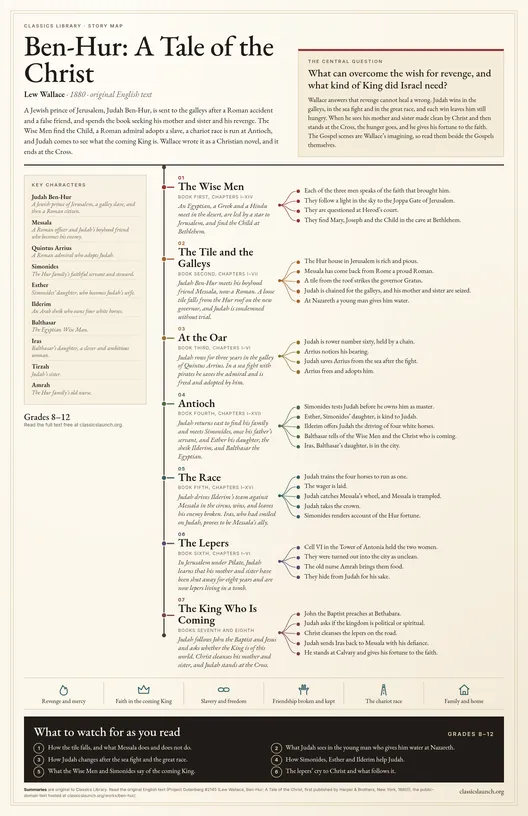 Story mapSee the story mapThe whole book on one page: the story in movements, the characters, and what to watch for. Free to print.
Abstract
The wrong. Judah Ben-Hur, a young Jewish prince of Jerusalem, is condemned to the galleys when a loose tile from his roof falls on the new Roman governor, and his old friend Messala does nothing for him. His mother and sister are shut away. Three years chained to an oar end when pirates attack and he pulls the Roman admiral Quintus Arrius from the sea, and Arrius frees him and makes him his son.
The race. Judah returns to Antioch as a Roman citizen and meets Simonides, once his father’s servant, and his daughter Esther, with the Arab sheik Ilderim and the Egyptian Balthasar, one of the Wise Men. He drives Ilderim’s horses in the chariot race against Messala, wins, and leaves his enemy broken. Iras proves to be Messala’s ally, and Judah sends her back to him. Simonides, who had tested Judah before owning him, gives him the whole of the Hur fortune that he has kept.
The King. In Jerusalem Judah learns that his mother and sister are lepers living in the tombs, and he follows John the Baptist and Jesus. Christ cleanses the two women, and Judah, who hoped for a soldier king, stands at the foot of the Cross and gives his fortune and life to the service of Christ, with Esther as his wife.
Main characters
- Judah Ben-Hur: Jewish prince, galley slave and Roman citizen
- Messala: Roman officer and enemy
- Simonides: faithful steward
- Esther: Judah’s wife
- Balthasar: the Egyptian Wise Man
Summary
Ben-Hur: A Tale of the Christ is a long Christian novel of revenge and mercy set in the Roman world at the time of Jesus. It opens with three Wise Men from the East, an Egyptian, a Greek and a Hindu, who meet in the desert, follow a star to Jerusalem and Bethlehem, and find the Child. Years later, Judah Ben-Hur, a young Jewish prince of Jerusalem, loses his boyhood friend Messala, a Roman who comes back as a haughty officer and turns on him. When a loose tile from the roof of the Hur palace falls on the new procurator, Valerius Gratus, Judah is sent in chains to the galleys, and his mother and sister Tirzah are seized and shut away. On the march, at Nazareth, a stranger gives him water, and he and the carpenter’s son meet for a moment. Judah rows at the oar for three years, and in a sea fight against pirates he saves the life of the admiral Quintus Arrius, who frees and adopts him. As a Roman citizen and athlete he returns east to Antioch to find his family and to avenge them. There he meets the merchant Simonides, once his father’s servant and still his faithful steward, and Simonides’ daughter Esther; the Arab sheik Ilderim, who trains four white horses; and Balthasar the Egyptian, one of the Wise Men, with his daughter Iras, who is Messala’s ally. Judah drives Ilderim’s team against Messala in the great chariot race at the circus, wins, and leaves Messala crippled and ruined. In Jerusalem, now under Pontius Pilate, he learns that his mother and Tirzah have been kept eight years in a cell and are now lepers living among the tombs, hidden from him by their own wish. Judah follows the preaching of John the Baptist and Jesus, and comes to see that the King who is coming is not a soldier king. At the gate of Jerusalem the lepers are made clean by Christ, and Judah is reunited with them. The story ends at the Crucifixion, where Judah and his friends stand before the cross, and he gives up his old thirst for revenge and turns his fortune to the service of the new faith, with Esther as his wife. The book’s last lines point to the catacombs of Rome.
Virtues in this work
- Fortitude: Judah endures the galleys, the loss of his family and the long years of seeking them.
- Charity: Esther, Simonides and Amrah serve others at cost to themselves.
- Faith: The Wise Men and Balthasar keep their faith over many years and find the Christ.
- Piety: Judah’s mother and Tirzah bear their illness and their silence out of love for him.
- Justice: The book shows injustice at the Hur roof and asks what true justice is.
Plot or Argument
- The Wise Men
An Egyptian, a Greek and a Hindu meet in the desert, are led by a star to Jerusalem, and find the Child at Bethlehem, where Mary and Joseph are, and where shepherds have been told of his birth.
- Judah and Messala
Judah Ben-Hur, a young prince of a rich Jewish house, meets again his boyhood friend Messala, now a proud Roman, and the friendship turns to enmity.
- The tile and the galleys
A loose tile from the Hur roof falls on the new procurator Gratus. Judah is condemned without trial to the galleys, and his mother and sister are seized. At Nazareth a young man gives him water.
- At the oar
Judah rows for three years on the galleys of Quintus Arrius, saves the admiral in a sea fight with pirates, and is freed and adopted by him.
- Antioch
Judah returns east and meets Simonides, once his father’s servant, and Esther his daughter; the Arab sheik Ilderim; and Balthasar the Egyptian and his daughter Iras. Simonides tests him before he owns him as his master.
- The chariot race
Judah drives Ilderim’s four white horses in the circus at Antioch against Messala, wins, and leaves Messala broken. Iras, Balthasar’s daughter, had smiled on Judah in the circus though she would have favored Messala.
- The lepers
In Jerusalem under Pilate, Judah learns that his mother and sister have been held in the Tower of Antonia for eight years and are now lepers living in a tomb. They hide from him for his sake.
- The King who is coming
Judah follows John the Baptist and meets Jesus, and struggles to understand whether the King is spiritual or political. At the Mount of Olives, Christ cleanses his mother and sister.
- The Crucifixion
Judah finds that Iras has been working for Messala, and sends her back to him with his defiance. He and his friends come to Calvary, and Judah gives his fortune and life to the service of the Christ.
Characters
- Judah Ben-Hur, young Jewish prince of Jerusalem
A young Jewish prince of Jerusalem, condemned to the galleys and returned a Roman citizen.
- Messala, roman officer and Judah’s boyhood friend
A Roman officer and Judah’s boyhood friend who becomes his enemy.
- Quintus Arrius, roman admiral
A Roman admiral whom Judah saves and who adopts him.
- Simonides, hur family’s faithful servant and steward in Antioch
The Hur family’s faithful servant and steward in Antioch.
- Esther, Simonides’ daughter
Simonides’ daughter, who becomes Judah’s wife.
- Ilderim, arab sheik
An Arab sheik who owns the four white horses.
- Balthasar, egyptian Wise Man
The Egyptian Wise Man, who has waited many years for the Christ.
- Iras, Balthasar’s daughter
Balthasar’s daughter, a clever and ambitious woman.
- Tirzah, Judah’s sister
Judah’s sister, taken with their mother to the Tower.
- Amrah, hur family’s old Egyptian nurse and servant
The Hur family’s old Egyptian nurse and servant, who tends the lepers.
- Pontius Pilate, roman governor of Judea in the later chapters
The Roman governor of Judea in the later chapters.
Lessons
From vengeance to mercy
Judah begins the book with a single purpose, to repay Messala, and ends it in front of the cross. The book is a long argument that vengeance is a poor ruler of the heart, and that mercy answers wrongs in a way that no sword can. Students can trace each turn of Judah’s anger and ask what has changed in him at the end.
- What is Judah’s first wish for Messala?
- What happens to Judah’s desire for revenge across the book?
- Why does Wallace set the Crucifixion at the end?
The two kinds of kingdom
Many in the novel hope for a King who will break the Roman power, and Judah has the same hope. Simonides and Balthasar argue that the kingdom may be a different kind. The book helps students read the Gospel question in its first-century setting, and see why it was hard for a people under Rome to hear.
- What do Simonides and Balthasar say of the coming King?
- Why does Judah want a soldier king at first?
- How does the Crucifixion answer the question?
Friendship broken and kept
Messala and Judah begin as friends and end as enemies, while Judah and Esther, Simonides and Ilderim become bound by loyalty. The contrast gives teachers a way to talk about what holds friendship together and what ends it.
- What causes the break between Messala and Judah?
- What do Simonides and Ilderim give to Judah?
- How is pride a mark of Messala?
Faith in a Roman world
The novel shows the Wise Men, the lepers, the Passover pilgrims and the Romans as seen by a Jewish hero, and gives a picture of the world into which Christ came. Teachers should note that the picture is a nineteenth-century romance, and set it beside the Gospels and the Acts.
- What parts of the Roman world does Wallace show?
- Where does he follow the Gospels, and where does he invent?
- What does the book show of the hope of the faithful in Israel?
Context
Ben-Hur is set in the Roman province of Judea and in Antioch and Rome in the reign of Tiberius, with Valerius Gratus and then Pontius Pilate as procurators. The Wise Men’s story comes from Matthew’s Gospel and the Crucifixion from all four Gospels, and the rest of the book is Wallace’s own invention against a background of real places such as the Tower of Antonia, the Grove of Daphne and the circus at Antioch.
Composition
Wallace was a Union general in the Civil War, and he wrote much of the book in the 1870s, finishing it during his term as governor of New Mexico Territory. Harper and Brothers published it in New York in 1880. Wallace’s own account of the book’s making, in his Autobiography, says that his study of the life of Christ brought him to faith.
Reception
The book was widely read and was long a popular novel, and it was made into a stage play in 1899 and into films in 1907, 1925 and 1959. The 1959 film with Charlton Heston won eleven Academy Awards. Wallace’s work is cited in discussions of the Christian novel of the nineteenth century.
Comparisons
- Quo Vadis
Sienkiewicz’s tale of Christians in Nero’s Rome, which carries the same story forward to the age of the martyrs.
- The Count of Monte Cristo
Dumas’s tale of a man wrongly imprisoned who returns to punish his enemies, with a different ending.
- Ivanhoe
Scott’s tale of a wronged knight and the clash of two peoples in a medieval land.
- Les Misérables
Hugo’s tale of a man condemned to the galleys who is changed by mercy.
- The Pilgrim's Progress
Bunyan’s allegory of a soul on a road to the Celestial City.
- A Tale of Two Cities
Dickens’s tale of wrongs, revenge and sacrifice in revolutionary France.
Quotes
Frequently cited
“To the wife of my youth, who still abides with me.”
Frequently cited
“Fear not: for behold, I bring you good tidings of great joy, which shall be to all people.”
Frequently cited
“The noble Arrius was my father by adoption”
Frequently cited
“Begone! Ye are of the dead; go to the dead!”
Frequently cited
“O Master, Master! Thou seest our need; thou canst make us clean. Have mercy upon us—mercy!”
Frequently cited
“So wilt thou best serve the Christ. O my husband, let me not hinder, but go with thee and help.”
Frequently cited
“Out of that vast tomb Christianity issued to supersede the Cæsars.”
For Students
A reading companion for classical Christian high school students. See the student guide.
Reading Guide
Watch for
- How the Wise Men meet and what each says of his faith.
- The scene on the roof when the tile falls, and how Messala answers it.
- The scene at Nazareth, and what Judah sees in the young man who gives him water.
- What the book says of vengeance at each stage of Judah’s life.
- How Esther, Simonides, Ilderim and Balthasar each help Judah.
Key terms and names
- Procurator
- A Roman governor of a smaller province such as Judea.
- Galley
- A long warship rowed by oarsmen, often slaves or convicts.
- Duumvir
- One of two Roman officers who held a joint office; Arrius holds a naval command.
- Sheik
- The head of an Arab tribe or clan.
- Leper
- A person with leprosy, who under the law of Moses had to live apart as unclean.
- Circus
- In this book, the great arena in which chariots race.
- Messiah
- The anointed king and savior promised by the prophets.
Seminar Questions
- Comprehension How does Judah come to be condemned to the galleys, and what happens to his family?
- Comprehension How does Judah win his freedom and come to be adopted by Quintus Arrius?
- Interpretation What does the chariot race show about Judah and about Messala?
- Interpretation Why do the mother and Tirzah hide from Judah when they are lepers?
- Interpretation How does Wallace answer the question whether the King will be spiritual or political?
- Big Question Is revenge ever just, and what can overcome it?
- Big Question What does a person owe to a friend who has become an enemy?
Faith Connections
- Matthew 2:1–12 (Scripture)
The Wise Men follow the star to Jerusalem and Bethlehem and worship the Child. Book First retells their journey with more detail than the Gospel gives, and the two tellings can be set side by side.
- Romans 12:19–21 (Scripture)
Do not take revenge, but leave room for the wrath of God, and overcome evil with good. Judah’s turn from vengeance to mercy answers this teaching.
- Luke 17:11–19 (Scripture)
Jesus cleanses ten lepers on the road. The cleansing of the mother and Tirzah in the novel is Wallace’s own scene, and may be read next to this Gospel account.
- Augustine, City of God XIX.17 (Church Fathers)
Augustine writes of the two cities, the heavenly and the earthly, and how a pilgrim uses the peace of the earthly one. It gives a way of speaking of Judah’s hope for a kingdom of this world and the one that Christ gives.
Logic and Rhetoric
Central argument: Vengeance cannot heal a wrong, and the true King rules by mercy and not by the sword.
Rhetorical device: irony. Judah, who wants a soldier king, finds the King he is looking for dying on a cross.
Debate: Resolved: That Judah was right to seek revenge on Messala.
Memory Work
Fear not: for behold, I bring you good tidings of great joy, which shall be to all people.
Out of that vast tomb Christianity issued to supersede the Cæsars.
Writing Prompts
Essay: How does Wallace use Judah’s story to retell the Gospel? Answer with three scenes from the book.
Comparison with Quo Vadis: Compare Ben-Hur and Quo Vadis as novels in which a young pagan or Jew is brought to Christ, and say what each says about the Roman world.
Medical Lens
Leprosy is central to the book: Judah’s mother and sister, held in prison, are driven out as unclean and live among the tombs, and the law of the unclean is shown at the gate of Jerusalem. The healing of the two women by Christ is told as a miracle, not a medical event. Messala’s broken back after the chariot race, the rowers’ chains and hunger on the galleys, and the death of Christ by crucifixion are also shown. Teachers can use the book to discuss the old law of the unclean and the care of the sick.
- Book Sixth, Chapter II: The Lepers
The mother and sister of Ben-Hur are found in Cell VI after eight years and go out into the city as unclean.
- Book Eighth, Chapter IV: The Miracle
Christ cleanses the lepers, and the story describes the sense of healing.
- Book Fifth, Chapter XIV: The Race
Messala is thrown and trampled in the chariot race and left with a broken back.
- Book Eighth, Chapter X: The Crucifixion
The death of Christ on the cross is shown as the center of the story.
Creative Prompts
- Essay
Write an essay on how Judah changes from a man who wants revenge to one who serves Christ, using three scenes.
- Dialogue
Write the conversation between Judah and Messala on the day of the break, as each tries to win the other.
- Fiction
Retell the sea fight from the point of view of the rower at oar number sixty.
- Poetry
Write a poem about the star and the three Wise Men crossing the desert.
- Adaptation
Write the scene at Nazareth in which a stranger gives Judah water, as it might be given on the stage or in a film.
- Classroom
Compare the Wise Men’s story in Book First with the account in Matthew 2.
Further Reading
- The Gospel according to Matthew, chapter 2, The Gospels
The account of the Wise Men on which Book First draws.
- Quo Vadis, Henryk Sienkiewicz
A novel of Christians in the Rome of Nero, in this library.
- The Count of Monte Cristo, Alexandre Dumas
A novel of wrongful imprisonment and revenge, in this library.
- Lew Wallace: An Autobiography, Lew Wallace
Wallace’s own account of his life and of the writing of Ben-Hur.
Verification notes
The text is Project Gutenberg eBook #2145, the complete 1880 Harper and Brothers text with the dedication and all eight books and eighty-one chapters. Wallace’s own religious account of the book’s writing is from his Autobiography and should be cited as his testimony. Some details of the film and stage history are given from general knowledge and flagged below.
- Wallace’s statements about how the writing of the book changed his religious views are drawn from his Autobiography, and the passages should be checked before being quoted in class.
- The dates of the 1899 stage play and the 1907, 1925 and 1959 films, and the eleven Academy Awards of the 1959 film, should be confirmed from a film reference.
- The claim that the book was widely read and long popular should be supported by a sales source before it is given a number.