Work record
A Capital Ship
Charles E. CarrylCharles E. Carryl; Charles E Carryl; CharlesECarrylA Capital Ship by Charles E. Carryl (1885)A Capital Ship introduces a vessel with an improbable name and a crew whose confidence seems equal to any ocean weather.1885 · 19th Century · Poetry · English
Read this when a ship's boastful crew sails straight into a feast of impossible words.
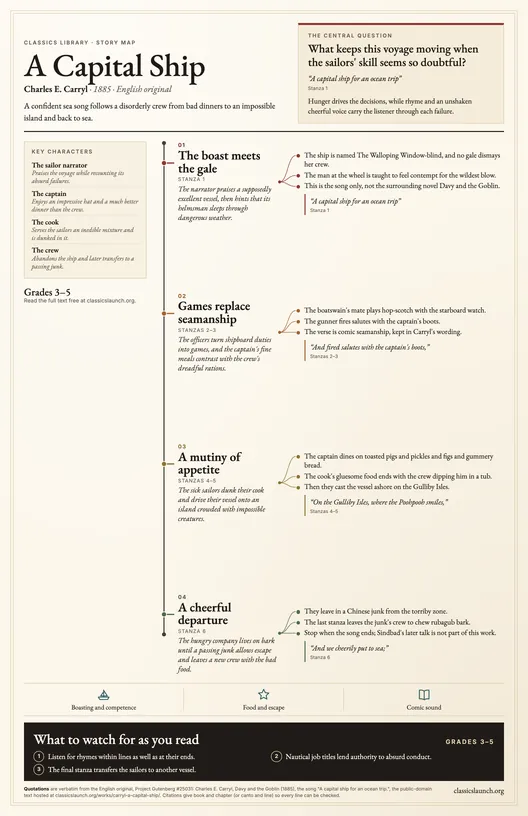 Story mapSee the story mapThe whole book on one page: the story in movements, the characters, and what to watch for. Free to print.
Abstract
Background. This song appears within Carryl's Davy and the Goblin, published in 1885. The hosted selection contains only the verse, so it can be read as a complete miniature voyage. Its setting draws on the vocabulary of seafaring while admitting invented islands, creatures, and provisions without any pause for explanation.
Content. A sailor celebrates his vessel, describes the officers' absurd conduct, and contrasts the captain's rich diet with the crew's dreadful food. Illness leads to punishment of the cook and a landing. Strange wildlife cannot compensate for a diet of bark, and a passing vessel supplies an opportunity to sail away again.
Themes. The humor joins inflated confidence to practical failure. Hats, salutes, and professional titles look impressive, yet they provide neither navigation nor nourishment. Appetite directs the plot more reliably than command. The final escape also passes the bad provisions to another group, giving the cheerful conclusion a further comic sting.
Significance. Internal rhyme propels the account through compact episodes, while long invented names make the tongue perform a second kind of adventure. The stanzas reward careful reading aloud because stress and sound often explain the joke before meaning does. As a brief example of Victorian nonsense, the piece makes an accessible companion to Lear's voyages and the fantastic conversations of Lewis Carroll.
Main characters
- The sailor narrator: Praises the voyage while recounting its absurd failures.
- The captain: Enjoys an impressive hat and a much better dinner than the crew.
- The cook: Serves the sailors an inedible mixture and is dunked in it.
- The crew: Abandons the ship and later transfers to a passing junk.
Summary
A Capital Ship introduces a vessel with an improbable name and a crew whose confidence seems equal to any ocean weather. The speaker praises the ship's ability to face a gale. Almost at once, however, that praise acquires a comic twist: the helmsman may actually be asleep below when the wind blows hardest. Throughout the song, nautical language gives an air of professional authority to thoroughly unlikely behavior. The next stanza displays the crew at recreation. The boatswain's mate plays games with one watch, the captain tickles the sailors, and the gunner fires the captain's boots as salutes. Responsibility dissolves into playground entertainment without interrupting the energetic rhyme. The captain's impressive hat and extravagant meals then provide another picture of ceremony without sound management. His dinner includes roast pigs, while the crew receives buns mixed with sugar and glue. The food finally makes the sailors ill. They dunk the cook in his own mixture and abandon their maritime pride by driving the ship ashore. The Gulliby Isles offer a new set of absurdities: sand decorated with cinnamon, fantastically named creatures, and bats dressed for the water. Yet this curious destination does not provide a good meal. After living on bark and becoming thin, the sailors seize an opportunity to leave aboard a passing Chinese junk. They depart cheerfully, leaving that vessel's crew with the bark. The poem's six stanzas turn a boast into a voyage of comic incompetence, hunger, and escape. Its strongly patterned sounds keep the adventure buoyant even when the sailors face miserable food. Carryl's inventions invite listeners to enjoy the shape and music of unfamiliar words before asking what any of them could possibly mean.
Virtues in this work
- Prudence: The officers' comic failures invite attention to what competent command and sound provisioning require.
- Temperance: The captain's grand meals sharpen the contrast between appetite and responsible care for a crew.
Plot or Argument
- The boast meets the gale
The narrator praises a supposedly excellent vessel, then hints that its helmsman sleeps through dangerous weather.
- Games replace seamanship
The officers turn shipboard duties into games, and the captain's fine meals contrast with the crew's dreadful rations.
- A mutiny of appetite
The sick sailors dunk their cook and drive their vessel onto an island crowded with impossible creatures.
- A cheerful departure
The hungry company lives on bark until a passing junk allows escape and leaves a new crew with the bad food.
Characters
- The sailor narrator, Storyteller
Praises the voyage while recounting its absurd failures.
- The captain, Commander
Enjoys an impressive hat and a much better dinner than the crew.
- The cook, Provider
Serves the sailors an inedible mixture and is dunked in it.
- The crew, Traveling company
Abandons the ship and later transfers to a passing junk.
Lessons
A confident voice can be comic
The speaker praises a voyage full of bad decisions. His tone lets listeners discover the distance between reputation and performance.
- Which details weaken the opening praise?
- Does the narrator seem ashamed of the voyage?
Names have music
Invented creatures and places extend the island's strangeness. Their sounds invite playful speech without requiring a dictionary definition.
- Which invented name is easiest to say?
- How do the names fit the rhythm?
Practical needs steer the journey
The sailors' hunger produces both the landing and the escape. Grand uniforms matter less to their actions than dinner.
- Why do the sailors leave their first ship?
- What makes them leave the island?
Context
Victorian literary nonsense often set elaborate language beside impossible events. Carryl uses the conventions of a sea song to give that play a brisk sequence of scenes and a recognizable traveling company.
Composition
The song was printed in Davy and the Goblin (1885). The hosted text omits the surrounding novel dialogue.
Reception
The piece also circulates under the ship's name, The Walloping Window-Blind; its compact stanzas suit recitation and song.
Comparisons
- Alice's Adventures in Wonderland
Carryl and Carroll both make absurd behavior sound quite assured, inviting readers to follow comic reasoning.
- Treasure Island
Compare the poem's games and pretend authority with the practical shipboard dangers in Stevenson's adventure.
Quotes
“A capital ship for an ocean trip”
“And fired salutes with the captain's boots,”
“On the Gulliby Isles, where the Poohpooh smiles,”
“And we cheerily put to sea;”
For Students
A reading companion for classical Christian high school students. See the student guide.
Reading Guide
Watch for
- Listen for rhymes within lines as well as at their ends.
- Nautical job titles lend authority to absurd conduct.
- The final stanza transfers the sailors to another vessel.
Key terms and names
- boatswain
- A ship's officer responsible for equipment and deck work.
- starboard
- The right side of a vessel when facing toward its bow.
- watch
- A group of sailors assigned a particular period of duty.
- junk
- A sailing vessel associated with Chinese waters and distinctive sails.
Seminar Questions
- Comprehension What does the helmsman do during rough weather?
- Comprehension How do the sailors finally get away from the island?
- Interpretation Why does the captain's hat receive attention?
- Interpretation How do internal rhymes help the voyage move?
- Big Question Can a cheerful storyteller make failure sound like success?
- Big Question What responsibilities should a captain have toward a crew?
Faith Connections
- Proverbs 27:23–27 (Scripture)
The passage joins careful management with providing food; compare its practical attention with the officers' conduct.
- Homer, Odyssey, Book 9 (Great Conversation)
Both voyages connect strange destinations with eating, but Carryl transforms danger into extravagant verbal play.
Logic and Rhetoric
Central argument: The praise of the ship is steadily qualified by details that show how little its officers deserve their confidence.
Rhetorical device: irony. Professional titles and proud descriptions accompany sleeping at the wheel, games on duty, and useless provisions.
Debate: Resolved: the narrator's cheerful tone makes the crew's failures funnier.
Memory Work
A capital ship for an ocean trip
Writing Prompts
Essay: Show how three details turn the narrator's praise of the voyage into a joke.
Comparison with Alice's Adventures in Wonderland: Compare confident but foolish speech in Carryl's shipboard officers and Carroll's Wonderland characters.
Medical Lens
Bad rations make the crew ill, and an inadequate island diet makes them thin; these are comic narrative motives.
- Stanzas 3–6
The crew's glue-filled food and subsequent diet of bark turn hunger into the reason for changing course.
Creative Prompts
- Poetry
Invent an eight-line stanza about the ship's return, using two pairs of internal rhymes.
- Classroom
Draw the invented island animals and explain which sounds suggested each creature's shape.
- Dialogue
Write a dispute between the hungry sailors and the captain about what should count as dinner.
Further Reading
- Davy and the Goblin, Charles E. Carryl
- The Admiral's Caravan, Charles E. Carryl
- Nonsense Songs, Stories, Botany, and Alphabets, Edward Lear
Verification notes
The six stanzas and all quotations match the hosted song from Project Gutenberg #25031. The 1885 date belongs to Davy and the Goblin; no separate first printing of the song is asserted.
No verification flags recorded.