Work record
Three Sisters
Anton ChekhovThree Sisters (Chekhov)Three Sisters by Anton Chekhov (1901)Three Sisters is Chekhov's play about longing.Also known as: Three Sisters (Chekhov)
1901 · Early 20th Century · Drama · Russian
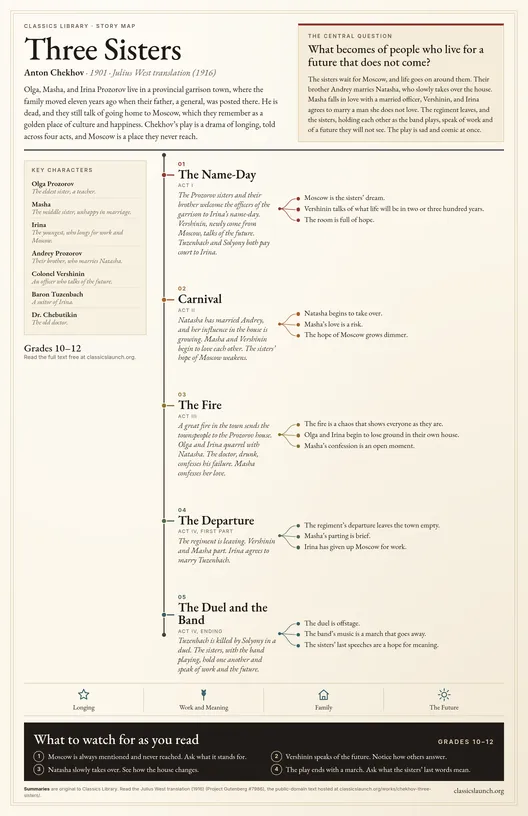 Story mapSee the story mapThe whole book on one page: the story in movements, the characters, and what to watch for. Free to print.
Abstract
Background. Chekhov wrote the play for the Moscow Art Theatre in 1900, and it was produced in January 1901 under Stanislavski. Chekhov, already ill, thought the production too gloomy, but audiences have found in it a moving picture of hope and loss.
Plot. Three sisters and their brother live in a provincial town and dream of Moscow. The brother marries and loses the house, one sister falls in love with an officer who leaves, and the youngest agrees to marry a man who is killed in a duel. The three stand together as the regiment's band plays.
Ideas. The play shows how hope deferred becomes endurance, and how people speak of a happy future while the present slips by. It treats work, love and suffering with gentle irony and refuses to explain why we live.
Text. The West translation is plain and speakable, with brief stage directions. The Gutenberg text is taken from a two-volume set of Chekhov's plays and has a short list of characters at the head. Teachers can pair this work with the library's study guide, seminar questions and memory-work selection to prepare a discussion, a short essay or a recitation. The full text is hosted on this site, and each quotation in the guide has been checked against the hosted translation.
Main characters
- Olga: The eldest sister, a teacher
- Masha: The married sister, in love with Vershinin
- Irina: The youngest, who longs for Moscow
- Andrey: Their brother
- Vershinin: A battery commander
- Tuzenbach: A baron who loves Irina

Summary
Three Sisters is Chekhov's play about longing. Olga, Masha and Irina Prozorov live in a provincial garrison town in the Russian countryside, where the family moved eleven years ago, when their father, a general, was posted to the town. He is now dead, and they still talk of going home to Moscow, which they remember as a golden place of culture and happiness. The first act is Irina's name-day. Her sisters and her brother Andrey are at home with the officers of the garrison: the old drunken army doctor Chebutikin, the awkward, honest Baron Tuzenbach, the sour Captain Solyony, and the newly arrived battery commander Vershinin, who speaks eloquently of the future, of work, and of the happiness that will come to a Russia not yet born. Over the next four acts, four years pass and almost every hope in the house is lost. Andrey, who was to be a professor in Moscow, marries the narrow-minded Natasha, who gradually takes over the house and pushes the sisters aside; he loses money at cards and mortgages the home. Masha, married young to a kind, dull schoolmaster, falls in love with Vershinin. Olga, the eldest, becomes a headmistress against her will. Irina, the youngest, trusts that work will bring happiness, takes a post at the telegraph office and then at the town council, and finds it bitterly dull. A great fire in the town in Act III brings the house together in exhaustion and confession. In the last act, the regiment is ordered away. Vershinin and Masha part. Irina, resigned to a life without Moscow, agrees to marry the Baron, who has resigned his commission to work in a brickworks, and he goes out to a duel with Solyony the day he leaves. A shot is heard in the distance, and Chebutikin announces that the Baron has been killed. The play ends with the sisters standing together while the regiment's band plays a march, as Olga says that the music is so happy, so joyful, that it seems they may soon know why they live and why they suffer, and cries that if only they could know. Chekhov's gentle irony, his refusal of melodrama and his attention to small things have made this one of the great plays of the world theatre. It does not offer a resolution, but a stoical endurance and a faith that the suffering of the present will be redeemed by the labour of those who come later. Christian readers will recognise the longing for another country, the claim that work is a form of dignity, and the faithful, unresolved question of the last line.
Virtues in this work
- Fortitude: The sisters' endurance at the end, and Olga's refusal to despair, are the play's picture of fortitude.
- Hope: Vershinin's faith in the future is a form of hope, though the play leaves it unfulfilled.
- Industry: Irina's and Tuzenbach's faith in work is a form of industry, qualified by the play's ironies.
- Friendship: The sisters' unity in grief is the play's best picture of love in a hard place.
Plot or Argument
- Act I: The name-day
The Prozorov sisters and their brother welcome the officers of the garrison to Irina's name-day. Vershinin, newly come from Moscow, talks of the future; Tuzenbach and Solyony both pay court to Irina.
- Act II: Carnival
Natasha has married Andrey, and her influence in the house is growing. Masha and Vershinin begin to love each other. The sisters' hope of Moscow weakens.
- Act III: The fire
A great fire in the town sends the town's people to the Prozorov house. Olga and Irina quarrel with Natasha. The doctor, drunk, confesses his failure; Masha confesses her love.
- Act IV: The departure
The regiment is leaving. Vershinin and Masha part. Irina agrees to marry Tuzenbach, who is killed by Solyony in a duel. The sisters, with the band playing, hold one another and speak of work and the future.
Characters
- Olga Prozorov, eldest sister
A schoolteacher who becomes headmistress, tired and dutiful, who speaks the last words of the play.
- Masha, middle sister
The married sister, bright and restless, whose love for Vershinin is the play's chief passion.
- Irina, youngest sister
The idealist who believes in work and in Moscow, and who is gradually disillusioned.
- Andrey Prozorov, brother
A gentle, ineffectual man who marries the wrong woman and loses the family's house.
- Colonel Vershinin, the philosopher officer
A battery commander, married unhappily, who looks to the happy future.
- Baron Tuzenbach, the suitor
A honest, plain man who loves Irina and is killed because of her.
- Dr. Chebutikin, the old doctor
An army doctor whose drinking and failures show a man who has lost faith in everything.
Lessons
Longing is not the same as hope
The sisters never go to Moscow, and the play suggests they could have, if they had acted. Their dream is a way of avoiding the present. The lesson is a hard one, that hope must become a deed.
- What stops the sisters from going to Moscow?
- Is Moscow a real place or a symbol?
Work is a dignity, but not a salvation
Irina and Tuzenbach speak of work as the one cure for sadness, yet in Act III Irina finds work as dull as idleness. Chekhov leaves the question open: the labour that does not come from love may be a burden.
- What does Tuzenbach believe about work?
- Does Irina's work make her happy?
Endurance and the unanswered question
The last lines do not give the answer. Olga says that if only they could know why they live and suffer. The play honors the suffering without explaining it, and invites the Christian reader to bring the answer that it does not supply.
- Why does Chekhov end with a question?
- What would a Christian answer to Olga's question say?
Context
The play is set in a remote provincial garrison town of the Russian Empire in the 1890s, where the army and the educated officer class live among a smaller, more conservative population. The family's pull to Moscow reflects the pull of the capital on provincial intelligentsia.
Composition
Chekhov wrote the play for the Moscow Art Theatre in 1900 and it was produced in January 1901 under Stanislavski. Chekhov, already ill with tuberculosis, thought the production too gloomy. The English translation by Julius West is from 1916.
Reception
The play was an immediate success and has been performed all over the world. Its fame lies in its mood, a mix of hope and loss, and its handling of silence and small talk.
Comparisons
- Uncle Vanya
Chekhov's earlier play ends with a similar call to work and to a rest that comes after death, and has the same cast of provincial intellectuals.
- The Cherry Orchard
Chekhov's last play is another study of a family losing its house, but with a lighter touch and an openly comic mood.
- The Seagull
Nina's final speech on endurance is a near relative of the sisters' last scene.
- The Importance of Being Earnest
Wilde's comedy and Chekhov's play are both comedies of manners, one witty and one sad, and each shows a class that cannot find its purpose.
- Oblomov
Goncharov's Oblomov is the novel in which a gentle Russian never gets up to act on his longing, as the sisters never go to Moscow.
Quotes
Frequently cited
“To go away to Moscow. To sell the house, drop everything here, and go to Moscow...”
Frequently cited
“After two or three hundred years, after a thousand--the actual time doesn’t matter--a new and happy age will begin. We, of course, shall not take part in it, but we live and work and even suffer to-day that it should come. We create it--and in that one object is our destiny and, if you like, our happiness.”
Frequently cited
“The music is so gay, so joyful, and, it seems that in a little while we shall know why we are living, why we are suffering.... If we could only know, if we could only know!”
“We must work, work. That is why we are unhappy and look at the world so sadly; we don’t know what work is.”
“life will remain the same, laborious, mysterious, and happy. And in a thousand years’ time, people will still be sighing: “Life is hard!”--and at the same time they’ll be just as afraid of death, and unwilling to meet it, as we are.”
For Students
A reading companion for classical Christian high school students. See the student guide.
Reading Guide
Watch for
- How often the word Moscow is spoken, and by whom.
- The slow takeover of the house by Natasha.
- The stage directions that show silence, music and distant sound.
Key terms and names
- Name-day
- The feast day of a person's patron saint, celebrated like a birthday; Irina's name-day opens the play.
- Garrison
- A military post in a town; the play's officers belong to a battery stationed there.
- Duel
- A formal fight between two men to settle a matter of honor, outlawed but still practised; it ends Tuzenbach's life.
- Provincial
- Of the country and small towns, in contrast to the capital.
Seminar Questions
- Comprehension Where do the Prozorov sisters live, and where do they want to go?
- Comprehension What happens to Andrey, and who takes over his house?
- Interpretation Why does Chekhov never send the sisters to Moscow?
- Interpretation What does Vershinin mean by saying that the present suffering makes the happy future?
- Interpretation What is the tone of the last scene?
- Big Question Is Chekhov's play about despair or about hope? Defend your answer.
- Big Question What does a Christian reader supply that the play leaves out?
Faith Connections
- Hebrews 11:13–16 (Scripture)
The patriarchs, strangers and exiles on the earth, desired a better country. The sisters' longing for a Moscow they cannot reach is a human version of the old longing.
- Ecclesiastes 1:2–9 (Scripture)
The Preacher's weariness with the repetitions of life, and his plain question about what a man gains by his toil, are echoed in the play.
- Romans 8:24–25 (Scripture)
'Hope that is seen is not hope.' The sisters' hope is unseen, and Paul's patience is the right companion.
Logic and Rhetoric
Central argument: Hope for a better life, deferred, may turn to endurance, and the play shows how people live with the unfulfilled. The argument is made through contrast: those who speak of the future are set against those who live the present.
Rhetorical device: repetition. The word Moscow is repeated in every act until it becomes a bell of loss.
Debate: Resolved: That the sisters are to blame for their own unhappiness.
Memory Work
The music is so gay, so joyful, and, it seems that in a little while we shall know why we are living, why we are suffering.... If we could only know, if we could only know!
After two or three hundred years, after a thousand--the actual time doesn’t matter--a new and happy age will begin. We, of course, shall not take part in it, but we live and work and even suffer to-day that it should come. We create it--and in that one object is our destiny and, if you like, our happiness.
Writing Prompts
Essay: Trace the word Moscow through the four acts, and show how its meaning changes. What does the last act say about the dream?
Comparison with The Seagull: Compare Nina's closing speech with Olga's. Which has the more convincing view of endurance?
Medical Lens
Dr. Chebutikin is a physician whose drinking and loss of faith in his own skill is one of Chekhov's most precise portraits of burnout. A patient dies in his care, and he confesses in Act III that he has forgotten all his medicine. The play also shows grief, exhaustion after a fire, and a death by duel.
- Act III, Chebutikin's confession
The old doctor, drunk, says that he has forgotten all he knew and that he is not a doctor at all.
- Act IV, the news of the duel
Chebutikin announces that the Baron has been shot, and the sisters stand together in grief.
Creative Prompts
- Essay
Why do the sisters not go to Moscow? Use two scenes to explain what keeps them in the town.
- Classroom
Read the last scene aloud, with the music, and discuss Olga's final lines. What is the right tone?
- Dialogue
Write a conversation between Irina and Tuzenbach on the morning of the duel, in which neither says what he fears.
- Essay
Compare Vershinin's faith in the future with Tuzenbach's more sceptical view, using Act I.
Further Reading
- Uncle Vanya, Anton Chekhov
Chekhov's earlier play; hosted in this library.
- The Cherry Orchard, Anton Chekhov
Chekhov's last play; hosted in this library.
- Ward No. 6, Anton Chekhov
A story of a doctor and a hospital; hosted in this library.
- Chekhov: A Life, Donald Rayfield
A fine biography of the writer.
Verification notes
Full text from Project Gutenberg #7986 (Plays by Chekhov, Second Series), Julius West's translation of 1916, in public domain. Quotes were checked against the hosted text. The dating of the first production (January 1901) follows standard accounts.
- Exact date of the Moscow Art Theatre premiere.
- Whether the spelling of the names follows West's 1916 edition throughout.