Work record
The Seagull
Anton ChekhovThe Sea-Gull; The Seagull (Chekhov)The Seagull by Anton Chekhov (1896)The Seagull is Chekhov's first great play and the one that began a new age in the theatre.Also known as: The Sea-Gull · The Seagull (Chekhov)
1896 · 19th Century · Drama · Russian
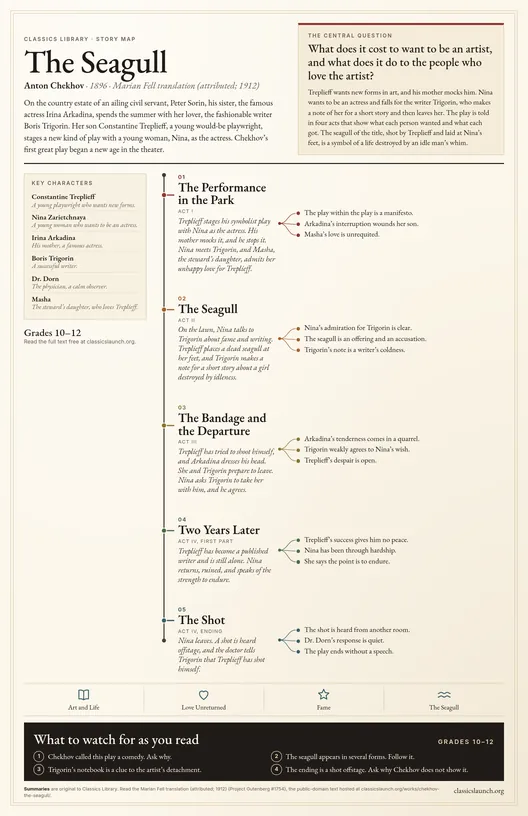 Story mapSee the story mapThe whole book on one page: the story in movements, the characters, and what to watch for. Free to print.
Abstract
Background. Chekhov wrote this play in 1895 and it failed badly at its first performance in St. Petersburg in 1896. When the Moscow Art Theatre revived it two years later, it was a triumph and began Chekhov's career as a playwright.
Plot. A young writer's play is mocked by his famous mother, and the girl who acts in it falls for the writer her mother loves. The girl is ruined, returns two years later, speaks of the strength to endure, and leaves. The young writer shoots himself offstage.
Ideas. The play examines the loves that miss each other, and the claims of art, fame and vanity against the plainer needs of the heart. It sets the idle destroyer against the one who endures, and it leaves its hope in a quiet word, not a triumph.
Text. The English version is clear and speakable, with stage directions in brackets. The Gutenberg text does not name its translator, which the library attributes to Marian Fell. The play is short and can be read in an evening. Teachers can pair this work with the library's study guide, seminar questions and memory-work selection to prepare a discussion, a short essay or a recitation. The full text is hosted on this site, and each quotation in the guide has been checked against the hosted translation.
Main characters
- Treplieff: A young playwright
- Nina: A young actress
- Arkadina: His mother, a famous actress
- Trigorin: Her lover, a novelist
- Dr. Dorn: A calm physician

Summary
The Seagull is Chekhov's first great play and the one that began a new age in the theatre. It is set on the country estate of Peter Sorin, an ailing retired civil servant, where his sister, the famous actress Irina Arkadina, has come for the summer with her lover, the fashionable writer Boris Trigorin. Arkadina's son, Constantine Treplieff, a young would-be playwright, stages a short symbolist play in the park, with the young neighbour Nina Zarietchnaya as its only actress. His mother interrupts and mocks it, and he stops the performance in a rage. Nina falls under the spell of the famous Trigorin, and Treplieff, wounded and jealous, lays a dead seagull he has shot at her feet. The story passes across four acts and some two years. Trigorin, who is dull and kind and cannot stop writing, makes a note for a short story about a young girl who lives by a lake and is destroyed out of idleness by a man who happens to pass by, as the seagull was. Treplieff tries to shoot himself and fails. Arkadina and Trigorin prepare to leave, Nina begs Trigorin to take her to Moscow, and she leaves to become an actress and his lover. In the last act, two years later, Nina comes back, broken. She has had a child who died, Trigorin has left her, and she is a poor travelling actress. She tells Treplieff that she has learned that what matters is not glory but the strength to endure, that one must bear one's cross and have faith. Then she goes. In the next room a shot is heard, which the doctor first explains as a bursting bottle of ether, and then whispers to Trigorin that Treplieff has shot himself. Chekhov called the play a comedy, and a contemporary audience at its disastrous first night in 1896 did not know what to make of it. It is a comedy of unfulfilled desires, in which everyone loves someone who loves someone else, and in which art, fame and love are all pursued by people who cannot give each other what they need. Its quiet endurance, Nina's cross and faith, is the nearest the play comes to a hope. Christian readers will find in it a clear and honest account of vanity, adultery and despair, and a modest, genuine witness to the virtue of patient endurance. Teachers should treat the suicide with care.
Virtues in this work
- Fortitude: Nina's endurance, in the play's closing act, is its picture of fortitude.
- Faith: Her faith is brief and not elaborated, but the play treats it as the thing that makes endurance possible.
- Humility: The play shows the harm of vanity and offers little humility, so its characters mostly lack it.
- Charity: Dr. Dorn's quiet kindness is a modest example of charity in a hard setting.
Plot or Argument
- Act I: The performance in the park
Treplieff stages his symbolist play with Nina as the actress. His mother mocks it, and he stops it. Nina meets Trigorin, and Masha, the steward's daughter, admits her unhappy love for Treplieff.
- Act II: The seagull
On the lawn, Nina talks to Trigorin about fame and writing. Treplieff places a dead seagull at her feet, and Trigorin makes a note for a short story about a girl destroyed by idleness.
- Act III: The bandage and the departure
Treplieff has tried to shoot himself, and Arkadina dresses his head. She and Trigorin prepare to leave. Nina asks Trigorin to take her with him, and he agrees.
- Act IV: Two years later
Treplieff has become a published writer and is still alone. Nina returns, ruined, speaks of the strength to endure, and leaves. A shot is heard offstage, and the doctor tells Trigorin that Treplieff has shot himself.
Characters
- Constantine Treplieff, protagonist
A young, talented, bitter would-be playwright, who is hurt by his mother's coldness and by Nina's choice.
- Nina Zarietchnaya, the actress
A young woman, enchanted by the theatre and by Trigorin, who gives up everything and learns to endure.
- Irina Arkadina, the star
A vain, brilliant, stingy actress who is a poor mother and a good friend.
- Boris Trigorin, the writer
A successful, passive novelist, who sees everything as material for his work and loves no one fully.
- Dr. Dorn, the physician
A calm, observant doctor, whose cool irony hides sympathy.
- Masha, the unhappy girl
A young woman who wears black and takes snuff, in love with Treplieff and married without love to Medvedenko.
Lessons
Art needs endurance, not only talent
Nina's closing speech is the central statement of the play. What matters in the end is not fame or glory but the strength to endure, bear one's cross and have faith. The play does not say what the faith is in, but it grounds the claim in suffering.
- What does Nina mean by 'bear one's cross'?
- How has her view of fame changed since the first act?
Vanity and idleness destroy
Trigorin's note about the girl destroyed out of idleness comes true in Nina's own life. Chekhov shows how a man's idle admiration can ruin a trusting soul, with no villainy except neglect.
- Is Trigorin to blame for what happens to Nina?
- What does Arkadina's vanity cost her son?
The family cannot be replaced by art
Treplieff craves his mother's love and gets only her applause, and he tries to win Nina's admiration by his work. The play makes a plain claim: art does not take the place of love.
- What does Treplieff want from his mother?
- Why does his art not satisfy him?
Context
The play is set in the Russian countryside in the 1890s, at a time when the theatre, the press and the new symbolist and realist movements were competing for a public. The small estate with its lake, its idle visitors and its absent landlord is a typical Chekhovian setting.
Composition
Chekhov wrote the play in 1895 and it was first staged at the Alexandrinsky Theatre in St. Petersburg in October 1896, where it failed badly. Two years later Stanislavski and the Moscow Art Theatre revived it with great success, and the seagull became the emblem of the company. The English version hosted here is attributed to Marian Fell and dated 1912; Gutenberg does not name the translator.
Reception
After the failure of the first night, the revival in Moscow in 1898 made the play a landmark of modern drama. Critics have debated whether it is a comedy or a tragedy, as Chekhov called it a comedy, and whether Nina's closing speech is hopeful.
Comparisons
- Uncle Vanya
Chekhov's next play also turns on an artist and an estate, with a similar mix of disappointed love and the need to endure.
- The Cherry Orchard
Chekhov's last comedy repeats the pattern of a country estate and a society that cannot act on what it knows.
- Three Sisters
Three sisters long for Moscow as Nina longs for the stage, and the play ends with the same call to endurance.
- Hamlet
The Seagull quotes Hamlet in Act III and uses a play within the play, and Treplieff is a Hamlet-like young man in a house with a mother and her lover.
- The Death of Ivan Ilyich
Tolstoy's tale and Chekhov's play are both about lives of habit and vanity, and what the end reveals.
Quotes
Frequently cited
“Do you remember how you shot a seagull once? A man chanced to pass that way and destroyed it out of idleness.”
Frequently cited
“it is not the honour and glory of which I have dreamt that is important, it is the strength to endure. One must know how to bear one’s cross, and one must have faith. I believe, and so do not suffer so much, and when I think of my calling I do not fear life.”
Frequently cited
“I do not believe in anything, and I do not know what my calling is.”
“I have talked a great deal about new forms of art, but I feel myself gradually slipping into the beaten track.”
“what I wanted to say was, that Constantine has shot himself.”
For Students
A reading companion for classical Christian high school students. See the student guide.
Reading Guide
Watch for
- The seagull: when it is shot, when it is mentioned, and when it is stuffed.
- Who loves whom, and who loves in return.
- The way each act ends on a quiet note, not a climax.
Key terms and names
- Symbolism
- An artistic movement that used images and symbols in place of plain description, as in Treplieff's play.
- Subtext
- The meaning beneath the spoken words, which Chekhov uses everywhere.
- Moscow Art Theatre
- The company that revived the play in 1898 and made it famous.
- Estate
- The country property of the landed gentry, here Sorin's, where the action occurs.
Seminar Questions
- Comprehension What does Treplieff do to the seagull, and what does Trigorin make of it?
- Comprehension What happens to Nina between Act III and Act IV?
- Interpretation Why does Chekhov leave the suicide offstage?
- Interpretation What does Nina mean by 'I am a seagull' and then 'no, I am an actress'?
- Interpretation Why does Arkadina fail as a mother?
- Big Question Is Nina's endurance a Christian virtue, or only a human one?
- Big Question Can art save a person? What does the play say?
Faith Connections
- Luke 9:23 (Scripture)
'If anyone would come after me, let him deny himself and take up his cross daily and follow me.' Nina's 'bear one's cross' is her own, plain version of the text.
- Romans 5:3–5 (Scripture)
'Suffering produces endurance, and endurance produces character, and character produces hope.' The sequence matches Nina's path in the play.
- Proverbs 13:12 (Scripture)
'Hope deferred makes the heart sick.' The verse fits the aching waits of the characters.
Logic and Rhetoric
Central argument: What matters in a life, including a life of art, is not fame but the strength to endure. The play shows this through contrasts: Nina against Treplieff, Trigorin against Dorn.
Rhetorical device: symbol. The seagull stands in turn for Nina's innocence, Treplieff's despair and Trigorin's idle story, and its stuffed form in Act IV marks the passing of time.
Debate: Resolved: That Nina is the hero of The Seagull.
Memory Work
it is not the honour and glory of which I have dreamt that is important, it is the strength to endure. One must know how to bear one’s cross, and one must have faith. I believe, and so do not suffer so much, and when I think of my calling I do not fear life.
Do you remember how you shot a seagull once? A man chanced to pass that way and destroyed it out of idleness.
Writing Prompts
Essay: What does Nina learn between the first and last acts? Use her two big speeches to trace the change.
Comparison with Hamlet: Compare Treplieff and Hamlet as sons who stage a play to move a mother. How do they differ in outcome?
Medical Lens
The play contains an attempted suicide (Act III), a completed suicide off stage (Act IV), and several characters who are depressed, lonely or ill. Dr. Dorn, a physician, appears as a calm and useful figure. The suicide is not shown, but a teacher should be ready to speak with students who may be affected and to know the resources of the school.
- Act III, the bandage
Treplieff has tried to shoot himself and wears a bandage on his head; his mother dresses it and quarrels with him.
- Act IV, the shot
A shot is heard offstage and the doctor tells Trigorin the truth after covering it with a lie about a bottle of ether.
Creative Prompts
- Essay
Choose one character and show how Chekhov reveals his or her longing through a few lines. Quote at least two.
- Dialogue
Write a short conversation between Arkadina and Treplieff after the failed performance, in which each says something true.
- Classroom
Stage the last scene between Nina and Treplieff in Act IV, then discuss what Nina's endurance and Treplieff's despair have in common.
- Essay
Chekhov called the play a comedy. Defend or oppose the label, using the final act.
Further Reading
- Uncle Vanya, Anton Chekhov
Chekhov's next play, hosted in this library.
- The Cherry Orchard, Anton Chekhov
Chekhov's last play, hosted in this library.
- Three Sisters, Anton Chekhov
Chekhov's third great play, hosted in this library.
- Chekhov: A Life, Donald Rayfield
A full biography of the playwright and doctor.
Verification notes
Full text from Project Gutenberg, an English version attributed to Marian Fell (1912) though the Gutenberg text does not name its translator, in public domain. Quotes were checked against the hosted text. The attribution should be confirmed from a title page.
- Confirmation of the translator from a printed title page.
- Exact dates of the 1896 premiere and the 1898 revival.