Work record
Ward No. 6
Anton ChekhovWard 6; Ward No. 6 (Chekhov)Ward No. 6 by Anton Chekhov (1892)Ward No. 6 is a long story of a doctor and a madhouse, and one of the strongest things Chekhov wrote.Also known as: Ward 6 · Ward No. 6 (Chekhov)
1892 · 19th Century · Novella · Russian
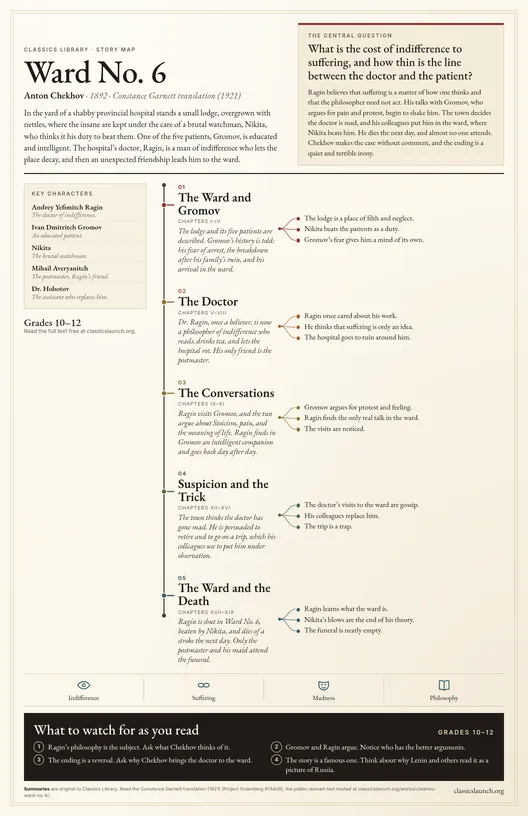 Story mapSee the story mapThe whole book on one page: the story in movements, the characters, and what to watch for. Free to print.
Abstract
Background. Chekhov wrote this story in 1892 after his visit to the penal colony on Sakhalin, and it was published in Russian Thought. It was widely read and discussed, and it is still counted among his greatest long stories.
Plot. A doctor who has persuaded himself that nothing matters befriends a clever patient in the insane ward. The town decides the doctor is mad, and his colleagues shut him in the same ward, where the watchman beats him and he dies of a stroke.
Ideas. The story examines Stoic detachment as a form of moral failure, and shows how an institution that punishes the weak may catch the strong. It is a sober, unsentimental judgment on a society and on one man's philosophy.
Text. The Garnett translation is clear and rather formal. The text keeps Russian names and titles, and the chapters are short enough to read in a single sitting or to divide for discussion. Teachers can pair this work with the library's study guide, seminar questions and memory-work selection to prepare a discussion, a short essay or a recitation. The full text is hosted on this site, and each quotation in the guide has been checked against the hosted translation.
Main characters
- Dr. Ragin: A district doctor who has given up
- Gromov: A patient with a fear of arrest
- Nikita: The brutal watchman
- Mihail Averyanitch: The doctor's only friend

Summary
Ward No. 6 is a long story of a doctor and a madhouse, and one of the strongest things Chekhov wrote. In the yard of a shabby provincial hospital stands a small lodge, overgrown with nettles and burdocks, where the insane are kept under the care of a brutal watchman named Nikita, who believes it his duty to beat them. Five patients live in it, and only one of them is of the educated class: Ivan Dmitritch Gromov, a clever, nervous, kind man who has been haunted by a fear of arrest since he saw convicts marched through the street and who now believes that anyone may be taken to prison. The others are poor artisans and peasants, among them a grieving workman and a harmless Jewish beggar the ward calls Moiseika. The hospital's doctor is Andrey Yefimitch Ragin, a big, gentle, lazy and educated man who has let the place fall to ruin because he has persuaded himself that nothing he can do will change anything. Life is short, pain is only an idea, and a wise man despises suffering. One day he enters the ward out of curiosity and falls into conversation with Gromov, who surprises him by being the only intelligent person in town. The two men argue for weeks on the meaning of life, the stoic ideal of indifference, and the injustice of Russia's institutions. Gromov rejects the doctor's philosophy with rage: he cannot despise pain and prison, and he accuses the doctor of using philosophy to dodge his duty. Ragin enjoys the debates more than he understands them. The town begins to whisper that the doctor himself is mad. His assistant, Dr. Hobotov, and the postmaster Mihail Averyanitch, who is his only friend, arrange a trip to see a specialist, which turns into a trick. Ragin is shut in Ward No. 6 as a patient. For the first time he feels what the cell means: the stench, the iron bars, the blows of Nikita. He sees too late that Gromov was right and that his own indifference had made him an accomplice of the cruelty he disdained. A few days later he has a stroke and dies, and only his friend and his maid follow his coffin. The story is a study of the moral cost of philosophical detachment. Chekhov, himself a physician, was moved to write it after a visit to the prison island of Sakhalin, and the book is as much a judgment on Russian society as on one man. Christian readers will recognise the old warning against passing by on the other side, and the Gospel's call to visit those in prison.
Virtues in this work
- Justice: The story is a judgment on injustice in an institution and on the failure of one who could have changed it.
- Charity: Gromov's cry for the suffering of others and the postmaster's loyalty are small signs of charity.
- Fortitude: The story questions a false fortitude of indifference and shows a truer one in Gromov's refusal to despise pain.
- Prudence: Ragin's learned reasoning is a failure of prudence, which should lead to right action and not to excuse.
Plot or Argument
- Chapters I–IV: The ward and Gromov
The lodge and its five patients are described. Gromov's history is told: his fear of arrest, the breakdown after his family's ruin, and his arrival in the ward.
- Chapters V–VIII: The doctor
Dr. Ragin, once a believer, is now a philosopher of indifference who reads, drinks tea and lets the hospital rot. His only friend is the postmaster.
- Chapters IX–XI: The conversations
Ragin visits Gromov, and the two argue about Stoicism, pain and the meaning of life. Ragin finds in Gromov an intelligent companion and goes back day after day.
- Chapters XII–XVI: Suspicion and the trick
The town thinks the doctor has gone mad. He is persuaded to retire and to go on a trip, which his colleagues use to put him under observation.
- Chapters XVII–XIX: The ward and the death
Ragin is shut in Ward No. 6, beaten by Nikita, and dies of a stroke the next day. Only the postmaster and his maid attend the funeral.
Characters
- Andrey Yefimitch Ragin, protagonist
A learned, idle district doctor who excuses his inaction with philosophy and comes to know the ward from the inside.
- Ivan Dmitritch Gromov, the patient
A former official and university man, intelligent and afraid, who answers the doctor's stoicism with anger.
- Nikita, the watchman
The brutish ward keeper who beats the patients as a matter of principle.
- Mihail Averyanitch, the postmaster
The doctor's only friend, a kind, noisy man who cannot see what is happening.
- Dr. Hobotov, assistant
The ambitious young doctor who has designs on the hospital.
Lessons
Detachment can be a form of cruelty
Ragin's doctrine of indifference is an elegant way to avoid doing anything. Gromov calls him on it: it is easy to say that pain is an idea when someone else is suffering it. The lesson is that a philosophy that frees a man from pity may free him from his duty.
- What does Ragin believe about pain and suffering?
- How does Gromov answer him?
Institutions can imprison the innocent
The ward is a prison, and its keeper is a brute. Ragin allows it to continue because he does not want to be disturbed. Chekhov's story is an indictment of the institutions that harm those in their care.
- What does the ward tell us about the hospital and the town?
- What would a good doctor have done?
Each is judged by the measure he used
When Ragin is shut in the ward, he finds out what he refused to see. The Gospel principle that with the measure you use it will be measured to you is the story's silent law.
- Why does Ragin only understand when he is in the ward?
- Is the story's ending just?
Context
The story is set in a small provincial town in the Russian Empire in the 1880s and early 1890s, where district hospitals were underfunded, doctors were poorly paid, and the care of the insane was largely custodial. The Zemstvo, an elected local council, was responsible for medical services.
Composition
Chekhov wrote the story in 1892, after his trip to Sakhalin and the observations he made there of the penal colony and its medical care. It appeared in the magazine Russian Thought in November 1892. The Garnett translation is from 1921.
Reception
The story was widely read and discussed, and it has been read ever since as an allegory of Russia, with the whole country as a ward, and as a study of stoicism and its limits.
Comparisons
- The Death of Ivan Ilyich
Tolstoy's story of a man brought to a hard truth by illness has the same shape as Chekhov's tale of a doctor brought to the truth by confinement.
- Notes from Underground
Dostoevsky's underground man is another thinker who argues against the comfortable philosophy of his day, in a very different tone.
- The Overcoat
Gogol's tale of a poor clerk is an earlier picture of how Russian institutions crush the weak.
- The House of the Dead
Dostoevsky's memoir of the prison camp treats the same questions of confinement and cruelty from the inside.
- The Trial
Kafka's tale of a man arrested for no reason has the same sense that any person may be taken.
Quotes
Frequently cited
“Life is a vexatious trap; when a thinking man reaches maturity and attains to full consciousness he cannot help feeling that he is in a trap from which there is no escape.”
Frequently cited
“Pain is the idea of pain, and besides 'there is no living in this world without illness; we shall all die, and so, go away, woman, don't hinder me from thinking and drinking vodka.”
“In the hospital yard there stands a small lodge surrounded by a perfect forest of burdocks, nettles, and wild hemp.”
“The Stoics, whom you are parodying, were remarkable people, but their doctrine crystallized two thousand years ago and has not advanced, and will not advance, an inch forward, since it is not practical or living.”
“And what if it really existed? But he did not want immortality--and he thought of it only for one instant.”
“Towards evening Andrey Yefimitch died of an apoplectic stroke.”
For Students
A reading companion for classical Christian high school students. See the student guide.
Reading Guide
Watch for
- How Chekhov describes the lodge and its patients before we meet the doctor.
- Ragin's reasons for letting the hospital decay.
- The moment in which the doctor passes from visitor to patient.
Key terms and names
- Stoicism
- An ancient philosophy that counsels calm indifference to pain and fortune; the doctor's creed.
- Zemstvo
- An elected district council in imperial Russia that ran schools, roads and hospitals.
- Persecution mania
- A delusion in which a person believes he is being hunted or arrested; Gromov's condition.
- Ward
- A room or building of a hospital where patients are kept, here a lodge for the insane.
Seminar Questions
- Comprehension Where is Ward No. 6, and who lives in it?
- Comprehension Why does Dr. Ragin begin to visit Gromov?
- Interpretation Why does Gromov reject Ragin's Stoicism?
- Interpretation How does the doctor come to be in the ward himself?
- Interpretation What does the doctor's last thought about immortality tell us?
- Big Question Is Ragin guilty of a sin, or merely of a failure? Argue from the text.
- Big Question What would a Christian doctor have done differently?
Faith Connections
- Matthew 25:36–40 (Scripture)
'I was in prison and you came to me.' Ragin does not come until he is himself in prison, and then too late.
- Luke 10:30–37 (Scripture)
The priest and the Levite who pass by on the other side are Ragin's spiritual ancestors; the Samaritan is the good doctor he did not become.
- Matthew 7:2 (Scripture)
'With the judgment you pronounce you will be judged, and with the measure you use it will be measured to you.' The text for the story's reversal.
Logic and Rhetoric
Central argument: A philosophy of indifference, however learned, makes a man complicit in the suffering he refuses to see. The story argues through a long debate and a reversal of fortune that tests the doctor's creed.
Rhetorical device: reversal. The doctor who disdained the ward ends as its patient, beaten by the keeper he tolerated.
Debate: Resolved: That Ragin's philosophy is a cause of his fate.
Memory Work
Life is a vexatious trap; when a thinking man reaches maturity and attains to full consciousness he cannot help feeling that he is in a trap from which there is no escape.
Pain is the idea of pain, and besides 'there is no living in this world without illness; we shall all die, and so, go away, woman, don't hinder me from thinking and drinking vodka.
Writing Prompts
Essay: Is Ragin a victim or a participant in the cruelty of the ward? Use Gromov's speeches and the end of the story.
Comparison with The Death of Ivan Ilyich: Compare Ragin's death with Ivan Ilyich's. What does each man learn, and from whom?
Medical Lens
The story is one of literature's best accounts of a physician's moral failure and of the conditions of a nineteenth-century asylum. It is a case study in burnout, in the abuse of patients by untrained staff, and in the way a professional's philosophy can excuse neglect. It is also a study of how a doctor is declared insane and committed by colleagues.
- Chapter I, the lodge
The ward is dirty, cold, and ruled by a watchman who beats patients.
- Chapters IX–X, the conversations
The doctor's philosophy of indifference is tested by a patient with a persecution complex.
- Chapter XVIII–XIX, the confinement and death
The doctor is made a patient, beaten, and dies of a stroke.
Creative Prompts
- Essay
Explain how Gromov and Ragin disagree about pain. Quote their words and say who has the better argument.
- Dialogue
Write a conversation between Ragin and Nikita on the day he is put in the ward, in which each tries to justify himself.
- Classroom
Stage the debate between Gromov and Ragin in Chapter X, then ask which man the class prefers and why.
- Essay
The story suggests that a philosophy of indifference is a sin of omission. Argue for or against this reading.
Further Reading
- The Death of Ivan Ilyich, Leo Tolstoy
A comparable story of an illness and a revelation; hosted in this library.
- Uncle Vanya, Anton Chekhov
Chekhov's play of a provincial doctor and his lost faith; hosted in this library.
- Sakhalin Island, Anton Chekhov
Chekhov's own account of the penal colony that drove him to write this story.
- Chekhov: A Life, Donald Rayfield
A life of the writer and doctor.
Verification notes
Full text from Project Gutenberg, the Constance Garnett translation (dated 1921 in the hosted source), in public domain. Quotes were checked against the hosted text.
- Which Garnett volume first printed the story and the exact year.