Work record
Childhood, Boyhood, Youth
Leo TolstoyChildhood, Boyhood, Youth (Tolstoy)Childhood, Boyhood, Youth by Leo Tolstoy (1852–1857)Childhood, Boyhood and Youth are the three books of Tolstoy's first great work, a fictional autobiography of a Russian nobleman's son, Nicolas Irtenieff, told from the quiet standpoint of later years.Also known as: Childhood, Boyhood, Youth (Tolstoy)
1852–1857 · 19th Century · Novel · Russian
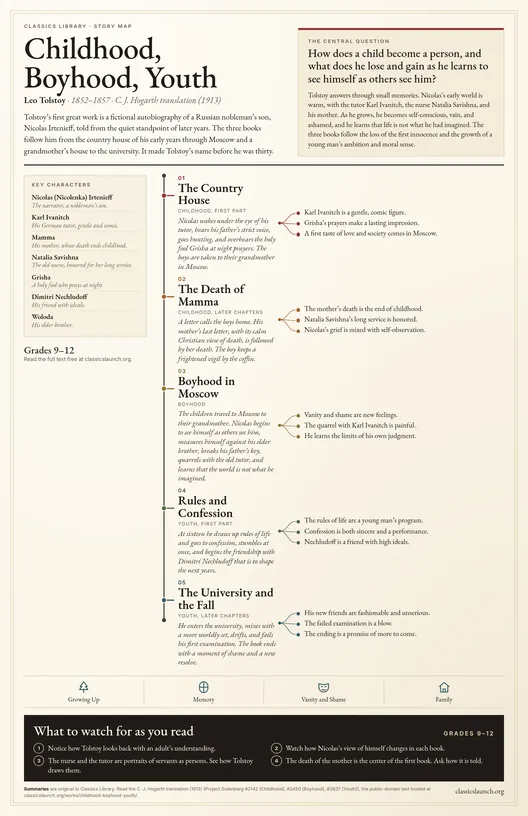 Story mapSee the story mapThe whole book on one page: the story in movements, the characters, and what to watch for. Free to print.
Abstract
Background. Tolstoy began Childhood as a young cadet in 1851 and sent it to the magazine The Contemporary, where it made his name at once. Boyhood followed in 1854 and Youth in 1857, and a fourth part, which was to carry the story into early manhood, was planned but never written.
Plot. A boy on a country estate loses his mother, goes to Moscow, learns shame and vanity from his own faults, makes a stern friend, and goes to the university. He fails his first examination, falls into despair, and writes his first true resolution to begin again.
Ideas. The trilogy shows how character is shaped by memory, grief and self-deception, and how honestly an older man can look at the child and youth he was. Its religious notes are sincere, its irony is gentle, and its love of exact detail is very great.
Text. The Hogarth translation is smooth and attentive, though it softens some of Tolstoy's roughness. The trilogy is long, but each chapter is short and self-contained, which makes it easy to read in parts or by themes, and the three books can be taught separately. Teachers can pair this work with the library's study guide, seminar questions and memory-work selection to prepare a discussion, a short essay or a recitation.
Main characters
- Nicolas Irtenieff: The narrator, from age ten to eighteen
- Karl Ivanitch: His old German tutor
- Natalia Savishna: The serf nurse
- Dimitri Nechludoff: His difficult, upright friend

Summary
Childhood, Boyhood and Youth are the three books of Tolstoy's first great work, a fictional autobiography of a Russian nobleman's son, Nicolas Irtenieff, told from the quiet standpoint of later years. It began as a story of memory, written in his early twenties while he was still a young officer, and it made his name before he turned thirty. The first book, Childhood, follows a boy of ten on his father's country estate. There is the German tutor, Karl Ivanitch, who loves the children and is gently foolish; there is the old nurse, Natalia Savishna, a serf who lives only for others; there is the holy fool Grisha, whom the boy hears praying in the night; and there is his mother, the centre of the whole book, whose death after a short illness ends the first part in grief and an almost fearful awareness of what it is to lose one's world. The second book, Boyhood, takes the family to Moscow and to the grandmother's house. Nicolas begins to see himself as others see him. He measures himself against his elder brother Woloda, fails and cheats at small things, loses a key and tells a lie, quarrels with his tutor, and discovers that he is not the centre of the world. The tutor Karl Ivanitch tells him the sad story of his life, and then goes away. In the third book, Youth, he is sixteen. He makes rules of life, goes to confession and wrestles with his sins, makes a close friendship with the serious and difficult Dimitri Nechludoff, struggles with the sentimentality, snobbery and fear of looking foolish which seem to him to rule his generation, and enters the university. At the end he fails an examination, falls into despair, and for the first time resolves to begin again. The trilogy is the earliest and softest of Tolstoy's lifelong study of how a man comes to know himself. It is not a story of events but a record of impressions, motives and self-deceptions, set down with a precision that astonished readers, and it contains passages on grief, vanity and love that rank among his finest. For Christian readers it is also a rich picture of a child's religious life, from the tutor's kindness to the holy fool's prayer to the mother's last letter, and a candid account of how easily the heart of a young man turns from truth to a flattering image of itself. The Hogarth translation hosted here keeps the three parts under one title.
Virtues in this work
- Humility: The older narrator looks at his own vanity without defense, and Natalia Savishna's quiet service sets an example of humility.
- Friendship: The bond with Dimitri is the book's picture of a hard and valuable friendship.
- Piety: The scenes of prayer, confession and the mother's last letter are the book's religious center.
- Charity: Natalia Savishna and Karl Ivanitch show a plain kindness to children and strangers.
Plot or Argument
- Childhood: the country house
Nicolas wakes under the eye of his tutor, hears his father's strict voice, goes hunting, and overhears the holy fool Grisha at his night prayers. The boys are taken to their grandmother in Moscow, where Nicolas has a first taste of love and of society, until a letter calls them home.
- Childhood: the death of Mamma
The mother's last letter, with its calm Christian view of death, is followed by her death. The boy keeps a frightened vigil by the coffin, and the old nurse Natalia Savishna, whose long service the book honours, follows her mistress a few years later.
- Boyhood: Moscow
The children travel to Moscow to their grandmother. Nicolas begins to see himself as others see him, measures himself against his elder brother, breaks his father's key through meddling, quarrels with the old tutor, and learns that the world is not what he imagined.
- Youth: rules and confession
At sixteen, he draws up rules of life and goes to confession, stumbles at once, and begins the friendship with Dimitri Nechludoff that is to shape the next years.
- Youth: the university and the fall
He enters the university, mixes with a more worldly set, drifts, and fails his first examination. The book ends with a moment of shame and a new resolve, and a promise to tell the story of his next years.
Characters
- Nicolas (Nicolenka) Irtenieff, narrator
The sensitive, self-watching boy, adolescent and young man, whose memories are the book.
- Karl Ivanitch, tutor
The old German tutor, kind, vain and absurd, who loves the children and is dismissed.
- Mamma, mother
A loving and devout woman whose death breaks the household and the boy's first world.
- Natalia Savishna, nurse
A serf woman who lives entirely for the family, whose death Tolstoy treats as a holy one.
- Grisha, holy fool
A wandering pilgrim whose night prayers the boy overhears.
- Dimitri Nechludoff, friend
A serious, stern, difficult young man, the boy's closest friend in Youth, who foreshadows later Tolstoy heroes.
- Woloda, brother
Nicolas's elder brother, easy in society and slightly disdainful of him.
Lessons
Vanity grows early and subtly
The narrator spends much of Boyhood and Youth watching himself, and Tolstoy shows how the wish to look well in other people's eyes can poison friendship, prayer and study. The book is a long examination of conscience.
- Where does Nicolas act in order to be seen?
- How does Tolstoy distinguish vanity from honest self-knowledge?
Grief is holy ground
The death of Mamma and the account of Natalia Savishna's last years are unusually plain and moving. Tolstoy lets a child's grief be as heavy as an adult's, and the Christian hope that is in the mother's letter and the nurse's faith is not argued but shown.
- What does the mother's last letter say about death?
- What does Natalia Savishna's life teach that Karl Ivanitch's does not?
Friendship asks for truth
The friendship with Dimitri begins in a frank conversation and passes through quarrels. Dimitri's sternness and Nicolas's weakness show how a good friend can be hard to love.
- What does Nicolas admire in Dimitri, and what does he resent?
- Is it better to have a friend who judges or a friend who flatters?
Context
The trilogy depicts the country and city life of a Russian landowning family in the 1830s and 1840s, under Nicholas I, in the years of serfdom: the manor house with its serfs, the German tutor, the Moscow grandmother's house, and the university at Kazan or Moscow.
Composition
Tolstoy wrote Childhood in 1851 and 1852 while serving as a cadet in the Caucasus. It was published in 1852 in the magazine The Contemporary, and made him known. Boyhood appeared in 1854 and Youth in 1857, and the plan to add a fourth book was dropped. The Hogarth translation is dated 1913.
Reception
Childhood was praised at once by Nekrasov, Turgenev and others as the work of a new great writer. Tolstoy later thought it too sentimental, and the trilogy has remained a favourite of readers who love his psychological detail and his sense of memory.
Comparisons
- David Copperfield
Dickens's novel is another fictional autobiography of a sensitive boy with a lost mother, written in the same decade.
- The Death of Ivan Ilyich
The later story takes up the questions of death and honest self-knowledge that the mother's letter and Natalia's death introduce.
- A Confession
The older Tolstoy's own account of his youth and its failures, which the trilogy treats more gently.
- Confessions
Augustine's Confessions, with its early chapters on infancy and boyhood, is the great ancestor of every Christian memoir of growing up.
- Great Expectations
Pip's account of his own vanity and shame, in a very different class and country, is a close cousin of Nicolas's.
Quotes
Frequently cited
“Do in after life the freshness and light-heartedness, the craving for love and for strength of faith, ever return which we experience in our childhood’s years?”
Frequently cited
“O truly Christian Grisha, your faith was so strong that you could feel the actual presence of God; your love so great that the words fell of themselves from your lips.”
Frequently cited
“Yes, I am calm, and God knows that I have ever looked, and do look now, upon death as no more than the passage to a better life.”
Frequently cited
“Natalia Savishna had no reason to fear death for the simple reason that she died in a sure and certain faith and in strict obedience to the commands of the Gospel.”
Frequently cited
“got out the copy-book whereon I had once inscribed “Rules of My Life,” opened it, and experienced my first moment of repentance and moral resolution.”
“Everything spoke to me of beauty, happiness, and virtue--as three things which were both easy and possible for me--and said that no one of them could exist without the other two, since beauty, happiness, and virtue were one.”
“taught me the evil that comes of thinking--still worse, of saying--much that seems very fine; taught me that there are certain thoughts which should always be kept to oneself, since brave words seldom go with brave deeds.”
For Students
A reading companion for classical Christian high school students. See the student guide.
Reading Guide
Watch for
- The way each chapter begins with a clear small scene and ends with a general thought.
- How the boy watches himself, and what he finds.
- The religious figures: the tutor's kindness, Grisha's prayer, the mother's letter, the confession in Youth.
Key terms and names
- Holy fool
- A wandering ascetic in the Russian tradition who is thought to see more than others; Grisha is one.
- Confession
- The sacrament in which the penitent names his sins to a priest; Youth describes the boy's first serious confession.
- Comme il faut
- A French phrase for correct manners; the young man's idea of a respectable set of friends.
- Drozhki
- A light Russian carriage used in towns, mentioned often in Youth.
Seminar Questions
- Comprehension Who is Natalia Savishna, and what does she do for the family?
- Comprehension What are Nicolas's rules of life in Youth, and how long do they last?
- Interpretation Why does Tolstoy begin with the tutor Karl Ivanitch? What does the old man teach?
- Interpretation What does Dimitri give Nicolas, and what does he ask of him?
- Interpretation What does the mother's last letter say about death and love?
- Big Question Is it possible to look back on one's own childhood without sentimentality? Does Tolstoy succeed?
- Big Question Does the trilogy end in despair or hope? Defend your answer.
Faith Connections
- Matthew 18:1–4 (Scripture)
Christ's saying that one must become as a child to enter the kingdom is the central text for the first book, which asks what is lost in growing up.
- Psalm 25:7 (Scripture)
'Remember not the sins of my youth.' The prayer is the right companion for Youth, which is a record of such sins and of their remembrance.
- Augustine, Confessions I–II (Church Fathers)
Augustine's accounts of his own infancy, boyhood and theft of the pears ask the same questions about vanity and desire that Tolstoy asks of Nicolas.
Logic and Rhetoric
Central argument: A man's character takes shape in childhood, grief and self-deception, and honest memory shows its formation. The trilogy argues by a long series of scenes, each of which reveals a motive.
Rhetorical device: retrospective address. The older narrator speaks to Grisha, to his mother and to his own childhood in the second person, as in the apostrophe to the holy fool.
Debate: Resolved: That Tolstoy's picture of childhood is more truthful than sentimental.
Memory Work
Yes, I am calm, and God knows that I have ever looked, and do look now, upon death as no more than the passage to a better life.
Natalia Savishna had no reason to fear death for the simple reason that she died in a sure and certain faith and in strict obedience to the commands of the Gospel.
Writing Prompts
Essay: How does Tolstoy show the change from childhood to boyhood to youth? Choose three scenes and say what has changed in the narrator's sight of himself.
Comparison with David Copperfield: Compare Nicolas's loss of his mother with David Copperfield's. How do the two writers treat grief, and what do they let a child understand?
Medical Lens
The mother's illness and death, and the child's grief, are described with great plainness: she is bedridden for days, the household waits, and she dies at home. A reader can use the passages in the study of how children are told of death and of how a household cares for the dying.
- Childhood, Chapters XXV–XXVII, the mother's illness and death
The mother's last letter, her death at the country house and the boy's vigil beside the coffin.
- Childhood, Chapter XXVIII, Natalia Savishna's death
An old servant dies at home, confessed and at peace.
Creative Prompts
- Essay
Choose one scene of childhood from the first book and explain how Tolstoy makes the reader feel what a child feels. Quote the passage and say what detail does the work.
- Fiction
Write a short memory of your own childhood in the manner of Tolstoy, with exact sensory detail and a note of reflection from a later age.
- Classroom
Compare Nicolas's rules of life in Youth with the habits you try to keep. What would you add or leave out? Use the text.
- Essay
Explain what Natalia Savishna teaches the narrator about faith and service, and how Tolstoy draws her without sentimentality.
Further Reading
- A Confession, Leo Tolstoy
The older Tolstoy's own account of his early years and his search for meaning.
- David Copperfield, Charles Dickens
A fictional autobiography of the same decade; hosted in this library.
- Confessions, Augustine
The model of the Christian memoir of boyhood and youth.
- Tolstoy, Henri Troyat
A life that sets the trilogy against Tolstoy's actual childhood.
Verification notes
Full text from Project Gutenberg, the C. J. Hogarth translation of 1913, in public domain. Quotes were checked against the hosted text. Chapter titles in the plot outline follow the Gutenberg text; the grade band is a library judgment.
- The exact publication years of Boyhood and Youth in The Contemporary.
- How closely the family and tutor follow Tolstoy's own household.