Work record
Adam Bede
George EliotAdam Bede (Eliot); Dinah MorrisAdam Bede by George Eliot (1859)Adam Bede, George Eliot's first full-length novel, was published in 1859 and set in the English Midlands at the very end of the eighteenth century.Also known as: Adam Bede (Eliot) · Dinah Morris
1859 · 19th Century · Novel · English
Read this when a quiet wrong grows into ruin, and love must learn to forgive.
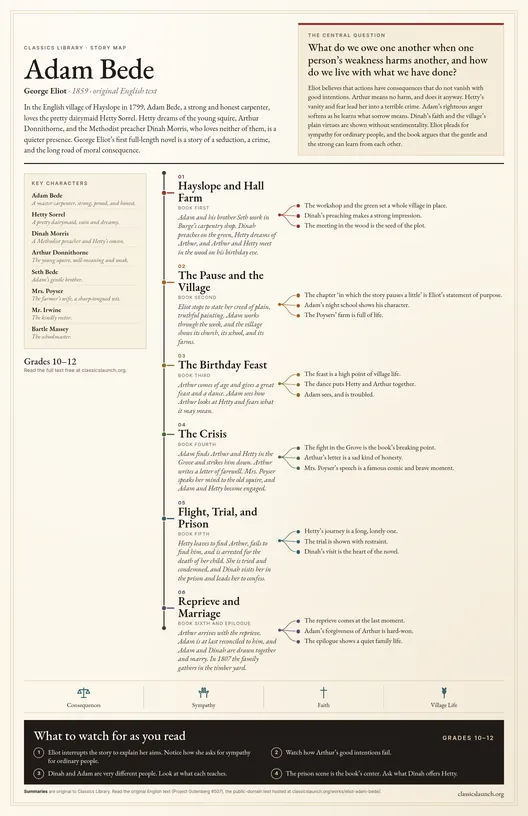 Story mapSee the story mapThe whole book on one page: the story in movements, the characters, and what to watch for. Free to print.
Abstract
Background. The first full-length novel of a writer who had left her Evangelical upbringing but kept her sympathy for plain religious people, it was published in three volumes under a pen name and made her famous. It is set in the farming country she knew as a child.
Plot. A village carpenter loves a pretty dairymaid who is drawn toward the young squire's heir. When the wrong is discovered, the dairymaid's flight, a trial and a prison visit by a Methodist cousin bring the carpenter and the squire to the edge of forgiveness.
Ideas. The book argues for a faithful, sympathetic picture of ordinary people and holds that deeds carry consequences that sorrow can transform into pity. It sets love joined to sorrow against pride and fear of shame.
Text. The text is complete, in six books and an epilogue, from Project Gutenberg #507. Every quotation in this guide has been checked against it. The novel treats seduction and infanticide, so it suits older students. Teachers can pair this work with the library's study guide, seminar questions and memory-work selection to prepare a discussion, a short essay or a recitation. The full text is hosted on this site, and each quotation in the guide has been checked against the hosted text.
Main characters
- Adam Bede: Proud and honest master carpenter
- Hetty Sorrel: Pretty dairymaid ruined by a flirtation
- Dinah Morris: Methodist woman preacher
- Arthur Donnithorne: Kind but weak young squire
- Mrs. Poyser: Plain-spoken farmer's wife
Summary
Adam Bede, George Eliot's first full-length novel, was published in 1859 and set in the English Midlands at the very end of the eighteenth century. In the village of Hayslope, Adam Bede is a master carpenter, strong, proud and honest, who works for the whole village and supports his mother and his wayward brother. He loves Hetty Sorrel, the pretty seventeen-year-old niece of the farmer Martin Poyser, and he does not see how little there is behind her prettiness. Hetty dreams of a different life. She is noticed by Captain Arthur Donnithorne, the young squire-to-be, who is generous and well-meaning but weak, and the two begin a flirtation that neither means to carry far. It carries them further than either intended. The novel sets beside Hetty a very different young woman, her cousin Dinah Morris, a Methodist who preaches on village greens and visits the poor and sick. Dinah's simple faith and her habit of going where she is needed give the book its moral centre. Adam's brother Seth loves her, and Adam himself comes to rely on her. When Adam discovers that Arthur has taken advantage of Hetty, the book turns from idyll to tragedy. Hetty, left pregnant and unmarried, flees the village to find Arthur, fails to find him, and in her despair commits a terrible crime. She is tried and sentenced to hang, and the last act of the story turns on Dinah's visit to her cell, on Arthur's late return, and on what each person owes to the guilty. Eliot is not only telling a story of seduction and a trial. In a famous chapter in the middle of the book she tells her readers that she means to portray men and women as they are, in plain, faithful pictures, like the Dutch painters, and not as a preacher would wish them to be. Her idea that deeds have consequences that cannot be taken back, that suffering teaches pity, and that the weak and the wicked are still our neighbours runs through the whole book. It is balanced by Adam's slow education in forgiveness and by Dinah's conviction that love is not freed from sorrow but joined to it. The comedy of Mrs. Poyser, who has her say out against the old squire, keeps the book humane. For a classical Christian classroom, the novel is an unusually fair portrait of Methodist piety, village life, work, temptation, guilt and the long road toward mercy. It deals frankly with seduction and infanticide, so it is best suited to older students.
Virtues in this work
- Charity: Dinah goes to Hetty in prison when everyone else turns away and stays with her until she confesses.
- Industry: Adam's honest, careful workmanship supports his family and the whole village.
- Faith: Dinah and Seth live by a simple Methodist trust that holds in poverty and in grief.
- Justice: Adam's hardness toward wrongdoing is tested and softened by suffering.
- Humility: Seth and Dinah carry their faith without display, and Adam learns to bear his own failures.
Plot or Argument
- Book First: Hayslope and Hall Farm
Adam and Seth work in Burge's carpentry shop. Dinah preaches on the green, Hetty dreams of Arthur, and Arthur and Hetty meet in the wood on his birthday eve.
- Book Second: The pause and the village
Eliot stops to state her creed of plain truthful painting. Adam works through the week, and the village shows its church, its school and its farms.
- Book Third: The birthday feast
Arthur comes of age and gives a great feast and a dance. Adam sees how Arthur looks at Hetty and fears what it may mean.
- Book Fourth: The crisis
Adam finds Arthur and Hetty in the Grove and strikes him down. Arthur writes a letter of farewell, Mrs. Poyser speaks her mind to the old squire, and Adam and Hetty become engaged.
- Book Fifth: Flight, trial and prison
Hetty leaves to find Arthur, fails to find him, and is arrested for the death of her child. She is tried and condemned, and Dinah visits her in the prison and leads her to confess.
- Book Sixth: Reprieve and marriage
Arthur arrives with the reprieve. Adam is at last reconciled to him, and Adam and Dinah are drawn together and marry.
- Epilogue: 1807
Years later the family is gathered in the timber yard, and Arthur, now a soldier and ill, returns for a visit.
Characters
- Adam Bede, title hero
A master carpenter of Hayslope, strong, proud, honest and hard on others, who learns pity through his sufferings.
- Hetty Sorrel, young dairymaid
The pretty, vain niece of the Poysers, who longs for a grander life and is ruined by it.
- Dinah Morris, Methodist preacher
Hetty's cousin, a gentle woman preacher who lives by faith and goes where she is needed.
- Arthur Donnithorne, young squire
A kind, vain and weak young officer whose wish to be thought well of leads him to wrong Hetty.
- Seth Bede, Adam's brother
A devout Methodist who loves Dinah and carries his faith with humility.
- Mrs. Poyser, farmer's wife
The sharp-tongued mistress of the Hall Farm, famous for her plain speech.
- Mr. Irwine, rector
The kindly, easy-going rector of Broxton and Hayslope, Arthur's friend and counsellor.
- Bartle Massey, schoolmaster
The gruff night-school teacher who is Adam's friend and a loud critic of women.
Lessons
Consequences are unpitying
Mr. Irwine tells Arthur that deeds carry their consequences quite apart from what went before, and that suffering teaches us pity. The novel shows how a small wish to be liked becomes a great harm, and how neither remorse nor good intentions can undo it.
- How does Arthur's desire to be thought well of lead him wrong?
- What does the rector mean when he says that consequences are unpitying?
Truthful portrayal and sympathy
In the pause chapter Eliot says that she wants to give a faithful account of ordinary people, as the Dutch painters do. She believes sympathy for the plain, common and flawed is the beginning of moral understanding.
- What is Eliot asking the reader to do in the chapter on the Dutch paintings?
- Why does she refuse to make Mr. Irwine a model preacher?
Suffering and mercy
Dinah says that love is joined to sorrow and does not seek to throw it off. She goes to Hetty in her cell when Hetty is shunned by all, and the novel shows mercy as presence and companionship before it is forgiveness.
- Why does Dinah go to Hetty, and what does she say to her?
- How does Adam's attitude toward Arthur change by the end?
Work as service
Adam's workmanship, his pride in honest work and his care for his family show a Christian doctrine of vocation without a sermon. His fault is that he is hard on weaker people until sorrow teaches him better.
- How does Adam's work show his character?
- In what way is his hardness a fault?
Context
The story is set in 1799 to 1807, in the Midlands of Eliot's childhood, in a farming parish of squire, rector, farmers, carpenters and labourers. Methodism, founded by John Wesley in the previous century, was spreading among the poor and was sometimes mocked by the established Church, and women preachers such as Dinah were a feature of the movement until the Wesleyan Conference restricted them in 1803.
Composition
Eliot wrote the novel in 1858 after the success of Scenes of Clerical Life, and the first edition was published by William Blackwood in three volumes in February 1859 under the name George Eliot. She said that she drew Dinah from her aunt, a Methodist preacher, and from a story of a visit her aunt had made to a woman condemned for killing her child.
Reception
The book was a great success and the identity of George Eliot soon became known. Critics admired its faithful portrayal of rural life and its moral seriousness, and it made her a leading novelist. Its picture of a woman preacher and of Methodist piety remains one of the fairest in English fiction.
Comparisons
- Silas Marner
Eliot's later short novel also places a rural community, a weak young gentleman and a child at the centre; here a child is lost, and there a child is found.
- The Scarlet Letter
Hawthorne's novel also treats a seduced woman, a hidden father and a child, but sets them in Puritan New England and ends in a different kind of confession.
- Tess of the d'Urbervilles
Hardy's novel also follows a country girl who is wronged by a gentleman and is hanged, but it denies the consolations that Eliot gives.
- Middlemarch
Another of Eliot's great novels, with the same insistence on ordinary lives, small choices and their lasting consequences.
- Jane Eyre
Brontë's novel also joins a plain-speaking heroine, a fervent faith and a moral choice between passion and duty.
- Hard Times
Dickens's novel also treats a young woman led astray in an industrial society, with a similar call for sympathy and mercy.
Quotes
Frequently cited
“Consequences are unpitying. Our deeds carry their terrible consequences, quite apart from any fluctuations that went before”
Frequently cited
“my strongest effort is to avoid any such arbitrary picture, and to give a faithful account of men and things as they have mirrored themselves in my mind.”
Frequently cited
“sorrow is then a part of love, and love does not seek to throw it off.”
“It is for this rare, precious quality of truthfulness that I delight in many Dutch paintings, which lofty-minded people despise.”
“by getting his heart-strings bound round the weak and erring, so that he must share not only the outward consequence of their error, but their inward suffering.”
“Nemesis can seldom forge a sword for herself out of our consciences—out of the suffering we feel in the suffering we may have caused: there is rarely metal enough there to make an effective weapon.”
“I’m not denyin’ the women are foolish: God Almighty made ’em to match the men.”
For Students
A reading companion for classical Christian high school students. See the student guide.
Reading Guide
Watch for
- How Eliot describes Hetty's thoughts and what she does not notice about other people.
- Each moment when Arthur excuses himself and what the narrator says about it.
- What Dinah says and does with the poor and sick, and how people answer her.
- Adam's anger after the discovery in the Grove and how his view of Arthur changes by the end.
Key terms and names
- Methodist
- A follower of John Wesley's evangelical revival, which stressed personal faith, hymns, lay preaching and care for the poor.
- Squire
- The chief landowner of a country parish, whose heir Arthur is.
- Nemesis
- In Greek tradition, the goddess of retribution; Eliot uses the word for the consequences that follow a wrong.
- Realism
- A way of writing that tries to show ordinary people and places as they are, which Eliot defends in Chapter XVII.
Seminar Questions
- Comprehension What does Dinah do for Hetty in the prison, and how does Hetty respond?
- Comprehension How does Adam discover the relation between Arthur and Hetty?
- Interpretation Why does Eliot interrupt the story to explain how she means to portray people?
- Interpretation How are Hetty and Dinah set against each other, and what do they have in common?
- Interpretation Is Arthur wicked, weak or both, and how does the novel judge him?
- Big Question Can deeds with serious consequences ever be fully repaired?
- Big Question What does it mean to forgive someone who has done real harm?
Faith Connections
- Luke 15:4-7 (Scripture)
The shepherd who goes after one lost sheep; Dinah calls Hetty a poor wandering lamb and goes to her in her cell.
- Galatians 6:1-2 (Scripture)
Bear one another's burdens; the narrator says that charity toward the erring is learned only by sharing their suffering.
- Isaiah 53:3 (Scripture)
He was a man of sorrows and acquainted with grief; Dinah names the Man of Sorrows when she says that love is joined to sorrow.
- Aristotle, Poetics (Great Conversation)
Aristotle holds that tragic pity arises when a person not wholly wicked falls through a serious error; Eliot's Arthur and Hetty can be read in that light.
Logic and Rhetoric
Central argument: Wrongs have consequences that cannot be cancelled, yet the weak and guilty remain our neighbours, and love shown in presence and patience is stronger than judgment.
Rhetorical device: narrator's direct address. In Chapter XVII the narrator speaks to the reader directly and defends the choice to paint life truthfully, so that the readers' sympathy is shaped by the argument.
Debate: Resolved: That Arthur Donnithorne is more to blame for Hetty's ruin than Hetty herself.
Memory Work
sorrow is then a part of love, and love does not seek to throw it off.
Consequences are unpitying. Our deeds carry their terrible consequences, quite apart from any fluctuations that went before
Writing Prompts
Essay: Argue whether the novel's ending is a just conclusion or an act of mercy, using Hetty, Arthur and Adam as evidence.
Comparison with The Scarlet Letter: Compare how Eliot and Hawthorne treat a woman's fall, the hidden father and the community's response, and say which novel gives more room for mercy.
Medical Lens
The novel follows a concealed pregnancy, a desperate flight, an unattended birth and the abandonment of a newborn, and it treats Hetty's numb state after her arrest with sympathy rather than with clinical terms. It also shows the grief that follows the sudden death of Adam's father and Adam's long recovery from a broken trust.
Creative Prompts
- Essay
Explain how Eliot makes the reader feel pity for Arthur, Hetty and Adam in turn, and say what the novel teaches about judgment.
- Classroom
Read aloud Dinah's preaching on the green in Chapter II and discuss what she says and how she says it.
- Dialogue
Write a conversation between Adam and Mr. Irwine after the trial in which Adam asks whether he should forgive Arthur.
Further Reading
- Scenes of Clerical Life, George Eliot
Eliot's first fiction, three tales of clergy and people in the Midlands.
- George Eliot: A Life, Rosemary Ashton
A thorough modern biography of Mary Ann Evans.
- Silas Marner, George Eliot
Eliot's short novel of a weaver and a foundling child, in this library.
Verification notes
Full text from Project Gutenberg #507, the 1859 novel in public domain; quotations were checked against the hosted text. Setting, plot, and character names were checked against the same text. Details of publication and of Eliot's aunt as the source for Dinah follow standard biographies and are hedged. The comparisons are interpretive readings.
- Whether the Gutenberg text follows the first edition of 1859 or a later revision.
- The anecdote of Eliot's aunt visiting a condemned girl, which is known from Eliot's own account and from biographies.