Work record
My Past and Thoughts: The Memoirs of Alexander Herzen
Alexander HerzenMy Past and Thoughts; Byloe i dumy; Memoirs of Alexander Herzen; The Memoirs of Alexander HerzenMy Past and Thoughts: The Memoirs of Alexander Herzen by Alexander Herzen (1852–1868)My Past and Thoughts is the great Russian memoir of the nineteenth century, and one of the great autobiographies in any language.Also known as: My Past and Thoughts · Byloe i dumy · Memoirs of Alexander Herzen · The Memoirs of Alexander Herzen
1852–1868 · 19th Century · Memoir · Russian
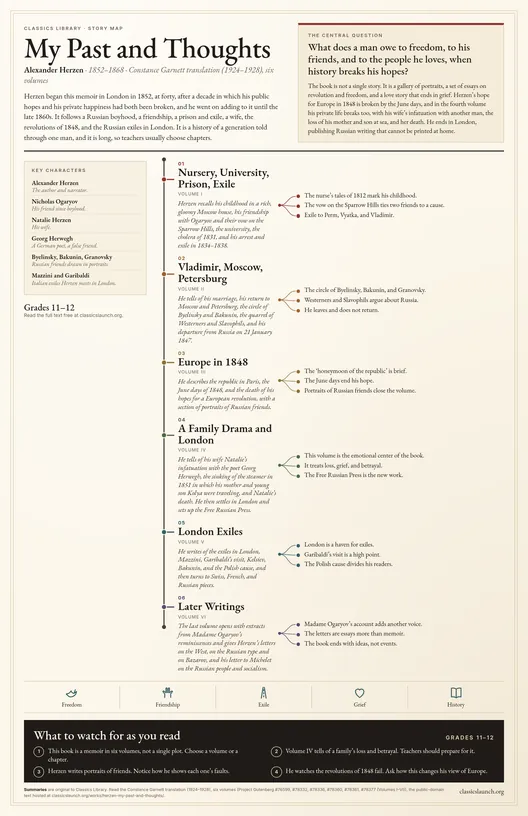 Story mapSee the story mapThe whole book on one page: the story in movements, the characters, and what to watch for. Free to print.
Abstract
Background. Herzen started the memoir in London in 1852 and kept adding to it through the late 1860s. The English text here is Constance Garnett's authorised translation of 1924–1928, in six volumes.
Plot. He tells of his childhood in Moscow, the vow with Ogaryov, the arrest and exile of 1834, the departure from Russia in 1847, the revolutions of 1848, the deaths of his mother, son and wife, and the founding of the Free Russian Press in London.
Ideas. The work is at once the history of a generation, a gallery of portraits, and the tale of a marriage that ends in bereavement. Its concerns are freedom, friendship, exile and the loss of political hope.
Text. The full text of all six volumes is hosted here. It is very long, and teachers will usually choose chapters, such as the first chapters of Volume I, the arrest, and the chapters on 1848 and on the Herwegh affair. Teachers can pair this work with the library's study guide, seminar questions and memory-work selection to prepare a discussion, a short essay or a recitation. The full text is hosted on this site, and each quotation in the guide has been checked against the hosted translation.
Key figures
- Herzen: The narrator and exile
- Ogaryov: His boyhood friend
- Natalie: His wife
- Herwegh: A German poet
- Bakunin: A friend and revolutionary
Summary
My Past and Thoughts is the great Russian memoir of the nineteenth century, and one of the great autobiographies in any language. Alexander Herzen began it in London in 1852, at the age of forty, after a decade in which his public hopes and his private happiness had both been broken, and he went on adding to it until the late 1860s. The hosted text is Constance Garnett's authorised English translation in six volumes (1924–1928), taken from the complete Russian edition printed at Berlin in 1921, and all six volumes are given here in order. The first volume tells of his childhood in a rich, gloomy Moscow house, where his nurse tells him of the French in Moscow in 1812; of his friendship with Nicholas Ogaryov and the vow the two boys made on the Sparrow Hills; of Moscow University; and of the arrest of 1834, the prison, and the exile to Perm, Vyatka and Vladimir. The second volume carries on through Vladimir, Moscow and Petersburg in the 1840s, with long portraits of the circle of Byelinsky, Bakunin, Granovsky and the Westerners and Slavophils, and ends with his departure from Russia on the 21st of January 1847. The third volume is his account of Europe in 1848, from the ‘honeymoon of the republic’ to the June days and the disillusion that followed. The fourth is the book's emotional centre. It tells of his wife Natalie's infatuation with the German poet Georg Herwegh, of the sinking of the steamer in which his mother and his young son Kolya were travelling in November 1851, and of Natalie's death. It then follows him to England, where he sets up the Free Russian Press. The fifth volume is the London of the exiles, with Mazzini, Garibaldi, Kelsiev, Bakunin and the Polish cause, and the last volume gathers later essays and letters, including the open letters on Bazarov and the letter to Michelet on the Russian people and socialism. The book is not a single story. It is a history of a generation told through one man, a gallery of portraits, a set of essays on revolution and freedom, and a love story that ends in grief. It is also a very long book, and a teacher will normally choose chapters rather than the whole.
Virtues in this work
- Friendship: Herzen's lifelong friendship with Ogaryov is the thread of the book.
- Honor: He takes his vow and his public duty seriously, and pays for it in exile.
- Hope: The book follows the loss and the partial recovery of hope.
- Justice: He writes in the cause of freedom and against arbitrary power.
Plot or Argument
- Volume I: Nursery, University, Prison, Exile
Herzen recalls his childhood in Moscow, his friendship with Ogaryov and their vow on the Sparrow Hills, the university, the cholera of 1831, and his arrest and exile in 1834–1838.
- Volume II: Vladimir, Moscow, Petersburg
He tells of his marriage, his return to Moscow and Petersburg, the circle of Byelinsky and Bakunin, the quarrel of Westerners and Slavophils, and his departure from Russia in January 1847.
- Volume III: Europe in 1848
He describes the republic in Paris, the June days of 1848, and the death of his hopes for a European revolution, with a section of portraits of Russian friends.
- Volume IV: A Family Drama and London
He tells of Tata's illness, of the Herwegh affair and the sinking of the steamer in 1851, of Natalie's death, and of his arrival in London in 1852.
- Volume V: London Exiles
He writes of the exiles in London, Garibaldi's visit, Kelsiev, Bakunin and the Polish cause, and then turns to Swiss, French and Russian pieces.
- Volume VI: Later Writings
The last volume opens with extracts from Madame Ogaryov's reminiscences, and then gives Herzen's letters on the West, on the Russian type and on Bazarov, and his letter to Michelet.
Characters
- Alexander Herzen, the narrator
A rich Moscow nobleman's son who becomes an exile, a journalist and a public voice for Russian freedom.
- Nicholas Ogaryov, the friend
Herzen's friend from boyhood, with whom he vows to give his life to the cause of freedom.
- Natalie Herzen, the wife
Herzen's wife, whose love, her infatuation with Herwegh and her death are the centre of the fourth volume.
- Georg Herwegh, the false friend
A German revolutionary poet whose conduct toward the Herzens is the subject of ‘A Family Drama’.
- Vitberg, Byelinsky, Bakunin, friends and portraits
The exiled architect, the critic and the revolutionary, among many portraits of the men of his generation.
- Mazzini and Garibaldi, the Italian exiles
Leaders of Italian freedom whom Herzen meets in London.
Lessons
A life as history
Herzen writes his own life as part of the history of his time, so that the arrest of a student and the revolutions of 1848 stand in one book. The memoir shows how a private person is shaped by public events.
- How does Herzen link his own story to the history of Russia?
- Which chapter shows this best?
Friendship and a shared vow
The vow of two boys on the Sparrow Hills is at the beginning of a friendship that lasts a lifetime. Herzen is aware that the scene may look theatrical, and he defends its sincerity.
- What does Herzen say about the vow in later years?
- How does the friendship with Ogaryov shape the book?
Freedom and disillusion
After 1848 Herzen loses his faith in the European revolution. The book is an education in hope and disappointment, and in the difference between a cause and the people who serve it.
- Why does he turn against the idea of a revolution made by theory?
- What replaces his hope?
Grief and the writing of grief
The deaths in the fourth volume are told with restraint and without self-excuse. Teachers should preview these chapters, which concern bereavement, betrayal and thoughts of suicide.
- How does Herzen describe the news of the steamer?
- What does he do with his grief?
Context
The book covers about sixty years of Russian and European history, from the French invasion of 1812, through the reign of Nicholas I, the Decembrist aftermath, the revolutions of 1848, and the reforms and the Polish rising of the 1860s. Herzen himself, born in 1812, lived through all of it, first as a student in Moscow and then as an exile in Paris, Italy and London.
Composition
Herzen began writing the memoir in London in 1852, and parts appeared in his journal and in separate volumes from the 1850s to the 1860s. The complete Russian edition was printed at Berlin in 1921. The hosted translation is Constance Garnett's authorised version, published in six volumes by Chatto & Windus in London and Alfred A. Knopf in New York between 1924 and 1928.
Reception
The book has long been prized in Russia and abroad as a masterpiece of memoir, and for the portraits of Byelinsky, Bakunin and others. Later readers, including Isaiah Berlin, made Herzen a central figure in the history of liberal thought.
Comparisons
- Fathers and Sons
Herzen's letters on Bazarov in the last volume are an exile's response to Turgenev's novel and its young nihilist.
- Rudin
Turgenev's Rudin is a portrait of the idealist talker of the 1840s, the generation of Herzen's own friends.
- Oblomov
Another picture of the nobility and its inertia, from the novelist's side.
- Dead Souls
Gogol's satire of the provincial Russia from which Herzen was exiled.
Quotes
Frequently cited
“suddenly embracing, vowed in sight of all Moscow to sacrifice our lives to the struggle we had chosen.”
Frequently cited
“we are not the physicians, we are the pain; what will come of our moaning and groaning we do not know; but the pain is recorded.”
“come tell me again how the French came to Moscow,’ I used to say”
“Every one trembled before the terrible plague that was moving up the Volga towards Moscow.”
“The steamer sank, we were pulled out of the water half dead.”
“Letters could not get in, but books would get through of themselves; writing letters was useless—I would print”
“What does matter is that he has recognised himself and his comrades in Bazarov”
For Students
A reading companion for classical Christian high school students. See the student guide.
Reading Guide
Watch for
- How Herzen moves between a personal scene and a general statement.
- The portraits of friends and enemies.
- What changes in his hopes between Volume I and Volume IV.
Key terms and names
- Westerners and Slavophils
- The two parties of Russian thought in the 1840s: one looked to Europe, the other to the old Russia.
- Exile
- Forced residence away from home, by order of the state.
- The Free Russian Press
- Herzen's printing house in London, which published Russian books and a journal for readers at home.
- Memoir
- A writer's account of events that he or she has lived through.
Seminar Questions
- Comprehension What do Herzen and Ogaryov vow on the Sparrow Hills?
- Comprehension Why is Herzen arrested in 1834?
- Interpretation How does the memoir treat the failure of the revolutions of 1848?
- Interpretation Why does Herzen write about the death of his family at such length?
- Interpretation How does he portray his friends?
- Big Question Can a private life be told apart from public history?
- Big Question What does an exile owe to those who stay at home?
Faith Connections
- Psalm 137:1–4 (Scripture)
'How shall we sing the Lord's song in a foreign land?' The exile's question is also Herzen's.
- Ecclesiastes 1:9–11 (Scripture)
'There is no remembrance of former things.' The memoir is an attempt against forgetting.
- Job 2:11–13 (Scripture)
Friends sit with a sufferer in silence; compare the friends who come to Herzen in the fourth volume.
Logic and Rhetoric
Central argument: A free person owes a witness to his time, and the honest memoir is both a record of private loss and an argument for the freedom of others.
Rhetorical device: antithesis. ‘We are not the physicians, we are the pain.’
Debate: Resolved: That a writer in exile serves his country better than one at home.
Memory Work
suddenly embracing, vowed in sight of all Moscow to sacrifice our lives to the struggle we had chosen.
we are not the physicians, we are the pain; what will come of our moaning and groaning we do not know; but the pain is recorded.
Writing Prompts
Essay: How does Herzen use the figure of his nurse and the story of 1812 to open the memoir?
Comparison with Fathers and Sons: Compare Herzen's view of Bazarov with Turgenev's own.
Medical Lens
Herzen writes about illness and death with a witness's exactness. The cholera of 1831 in Moscow is described from the university. The chapter ‘Typhoid’ shows his small daughter Tata's illness, the doctors Rayer and Vogt, and the family's fear. The fourth volume also records thoughts of suicide in the crisis over Herwegh and the deaths of his son, his mother and his wife. The famous sentence ‘we are not the physicians, we are the pain’ uses medical language for the role of the critic.
- Vol. I, Part I: the cholera of 1831
Moscow University is closed, a student dies, and the city is in fear of the plague.
- Vol. IV: Typhoid
Tata falls ill in the winter of 1848 and the doctors are called.
- Vol. IV: Turin. Oceano Nox
In the crisis over Herwegh Herzen writes that there was ‘death in my heart’ and that thoughts of suicide came to him for the first time.
Creative Prompts
- Essay
Herzen says the vow on the Sparrow Hills may look theatrical but was sincere. Do you agree?
- Fiction
Write a scene as told by Vera Artamonovna to a child about a great event.
- Classroom
With a teacher, read the chapter about the arrest in Volume I and discuss what it shows about the police.
- Essay
What does it mean to say ‘we are not the physicians, we are the pain’?
Further Reading
- Fathers and Sons, Ivan Turgenev
Herzen's letters on Bazarov respond to this novel; hosted in this library.
- Rudin, Ivan Turgenev
A portrait of the idealist of the 1840s; hosted in this library.
- Russian Thinkers, Isaiah Berlin
Essays that include the best-known modern account of Herzen.
- Alexander Herzen and the Burden of Modernity, Aileen Kelly
A study of Herzen's thought.
Verification notes
The hosted text joins all six volumes of Constance Garnett's authorised translation, each published between 1924 and 1928 and therefore in the public domain in the United States, from Project Gutenberg #76599, #78332, #78336, #78360, #78361 and #78377. The Gutenberg editions include each volume's title page, the translator's note and footnotes. The Introduction to Volume VI is a set of extracts from Madame Ogaryov's reminiscences, not Herzen's own writing. The library title follows the translation's title page. Quotes were checked against the hosted text.
- Any claim about the date of the Berlin edition of 1921, taken from the translator's note.
- The date of Herzen's death in Paris in January 1870.