Work record
The Eve of St. Agnes
John KeatsThe Eve of St. Agnes by John Keats (1820)The Eve of St. Agnes is a narrative poem of forty-two Spenserian stanzas that Keats wrote in January and February 1819 and published in his 1820 volume.Written January-February 1819; published 1820 · 19th Century · Poetry · English
Read this when old legends of love meet bitter winter, and a lover's stratagem asks for judgment.
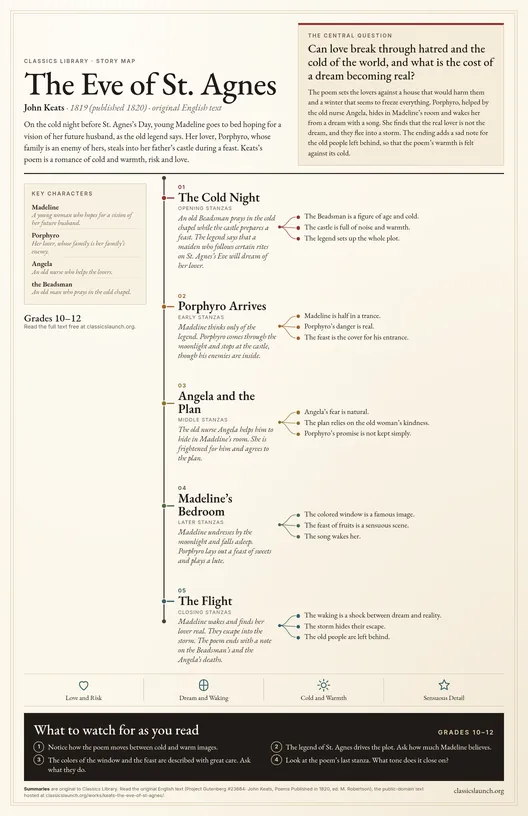 Story mapSee the story mapThe whole book on one page: the story in movements, the characters, and what to watch for. Free to print.
Abstract
Background. Keats wrote the poem in the winter of 1819 after reading Spenser, while staying on the south coast of England. It was published in his 1820 volume, and his publishers worried about the plainness of its love scene, though Keats resisted changing it.
Content. On a bitterly cold night an old Beadsman prays while a feast goes on in the castle. Madeline hopes to dream of her future husband, and Porphyro, whose family is the enemy of hers, comes secretly with the help of the old nurse Angela and hides in her closet. He prepares a feast and wakes her with music, and the lovers flee into the storm. In the closing lines the Baron's household sleeps on in troubled dreams, while Angela and the old Beadsman are said to have died.
Form. Forty-two Spenserian stanzas, each of eight iambic pentameter lines and a longer ninth line, rhymed ababbcbcc. The poem is rich in sensuous detail and moves by contrasts of cold and warmth.
Themes. Love and danger, legend and prayer, beauty and desire, family feud, dream and waking, and the passing of a medieval world.
Significance. It is one of the most admired narrative poems of the Romantic period, a major influence on the Pre-Raphaelites and a study in how a poet can build a whole world out of the senses.
Summary
The Eve of St. Agnes is a narrative poem of forty-two Spenserian stanzas that Keats wrote in January and February 1819 and published in his 1820 volume. It tells a medieval love story set on the night of 20 January, the eve of the feast of St Agnes, a young Roman martyr and patron of maidens. According to the old legend, young virgins who fast and go to bed supperless, looking neither behind nor sideways but upward to heaven, will have visions of their future husbands. The poem opens in bitter cold. The owl is a-cold, the hare limps through the frozen grass, the flock is silent in the fold, and an old Beadsman, numb-fingered, tells his rosary and prays for sinners, among them those revelling in the castle. Inside, the baron's hall is bright with music, and the young Madeline moves through the dance with vague eyes, thinking only of the legend and the bliss to be before morning. Into this house comes Porphyro, her lover, whose family is the sworn enemy of the baron's, and who risks death if found. He is helped by Angela, an old nurse, who is persuaded to lead him secretly to Madeline's chamber and hide him in a closet. He watches Madeline kneel in the moonlight through a stained casement, saying her prayers, undressing and going to sleep, and he lays out a feast of fruits, jellies and spices beside her bed. He wakes her with the music of an old song, and she, half in dream and half awake, finds her vision real. Their love is consummated in the poem's quiet and delicate way, and Madeline, waking to the cold truth, fears she is deserted until Porphyro tells her they must flee. They steal past the sleeping porter and the drunken revellers out into the storm, and the poet says they are gone, ay, ages long ago. That night the baron dreams of woe, and Angela and the Beadsman die. Readers have argued about whether Porphyro is a loving hero or a trespasser who takes advantage of a dream; the poem is rich in the beauty of its images, and its tone is both tender and ironic. Christian readers can ask what the legend of the saint, the old man's prayer and the lovers' flight suggest about purity, love and honest dealing.
Virtues in this work
Plot or Argument
- Stanzas 1-4: the cold and the Beadsman
It is St Agnes' Eve and bitter cold. The Beadsman prays and passes the sculptured dead, while music and revelry sound from the castle hall.
- Stanzas 5-8: Madeline and the legend
Madeline, among the dancers, thinks only of the old legend that maidens may see their lovers in a dream, if they fast and go to bed supperless.
- Stanzas 9-16: Porphyro and Angela
Porphyro comes secretly to the castle, finds the old nurse Angela, and persuades her to hide him in a closet in Madeline's room.
- Stanzas 17-26: the chamber
Angela leads him in; Madeline kneels in the moonlight on the casement, says her prayers and goes to bed.
- Stanzas 27-36: the feast and the waking
Porphyro lays out a feast, wakes her with a song, and she wakes to find him with her. He melts into her dream.
- Stanzas 37-42: the flight
They steal past the sleeping porter and hounds into the storm, and the Baron, Angela and the Beadsman are left to the cold and to death.
Characters
- Madeline, The maiden
A young noblewoman who hopes for a vision of her husband on St Agnes' Eve.
- Porphyro, The lover
A young man of an enemy house who comes secretly to the castle and persuades Angela to help him.
- Angela, The old nurse
An aged serving woman who helps Porphyro and dies in the end.
- The Beadsman, The old man at prayer
A man who prays for the sinners of the castle and dies in the bitter cold.
- The Baron, The head of the house
The lord of the castle, enemy of Porphyro's family, who dreams of woe.
Lessons
Love and danger go together
Porphyro risks his life to come to Madeline, and the poem treats love as a kind of courage. It asks whether risk, secrecy and dream together make love noble or reckless.
- What does Porphyro risk, and for what?
- Does the poem approve of his plan?
Beauty and holiness can pull against each other
The Beadsman's prayers and the legend of St Agnes stand beside Madeline's beauty and Porphyro's desire. The poem keeps the two in tension and invites readers to judge.
- How are the Beadsman and the lovers contrasted?
- What does the poem seem to say about the relation of religion and love?
Poetry can paint a scene in all the senses
Keats gives the cold, the music, the colors of the stained glass and the taste of the feast. The poem is a lesson in using the senses to build a world.
- Which image of cold or warmth is most vivid to you?
- What does the casement scene show about Madeline?
Context
St Agnes was a young Roman girl martyred around AD 304 for her faith; her name was linked to the Latin word for lamb, and her feast on 21 January became a time of folk customs for girls hoping to dream of future husbands.
Composition
Keats wrote the poem in January and February 1819 while staying in Chichester and Bedhampton, after reading Spenser, and in the year of his greatest poems. His publishers, Taylor and Hessey, and their friend Woodhouse were worried about the plainness of the love scene, and Keats resisted changes.
Reception
The poem appeared in 1820 with Lamia and Isabella. It was praised by Leigh Hunt and Charles Lamb, and later became a favorite of the Pre-Raphaelites, Tennyson and many painters. Some modern critics read Porphyro as a lover and some as a voyeur.
Comparisons
- The Faerie Queene, Book I
Keats adopted Spenser's nine-line stanza and some of his romance world, though his poem is shorter and more sensuous.
- The Lady of Shalott
Both poems are medieval romances for a Victorian and Romantic taste, in which a lady is seen through glass and her love ends in a journey.
- Le Morte d'Arthur
Malory's romance treats love and loyalty in a world of feud and honor much like the world of Porphyro and Madeline.
- Sir Gawain and the Green Knight
Both poems set a winter scene with a castle, a lady's chamber and a night of testing.
Quotes
Frequently cited
“St. Agnes' Eve--Ah, bitter chill it was! The owl, for all his feathers, was a-cold;”
Frequently cited
“Full on this casement shone the wintry moon, And threw warm gules on Madeline's fair breast,”
Frequently cited
“And they are gone: ay, ages long ago These lovers fled away into the storm.”
“Numb were the Beadsman's fingers, while he told His rosary,”
“Hoodwink'd with faery fancy; all amort,”
“Never on such a night have lovers met, Since Merlin paid his Demon all the monstrous debt.”
For Students
A reading companion for classical Christian high school students. See the student guide.
Reading Guide
Watch for
- The images of cold in the opening stanzas and how they contrast with the warmth of Madeline's chamber.
- The legend of St Agnes and how it shapes what Madeline and Porphyro do.
- The final stanzas, where the story is pushed into the distant past.
Key terms and names
- Beadsman
- A man paid or bound to pray for others, here for the souls of the castle.
- Spenserian stanza
- A nine-line stanza of eight iambic pentameter lines and a longer final line, rhymed ababbcbcc.
- Casement
- A window that opens on hinges; here a stained-glass window in Madeline's chamber.
- Gules
- A heraldic term for red; the warm gules are patches of red light cast by the stained glass.
Seminar Questions
- Comprehension What is the legend of St Agnes' Eve, and what does Madeline hope to see?
- Comprehension How does Porphyro get into Madeline's chamber?
- Interpretation How does the opening description of the cold set the mood of the poem?
- Interpretation What do the images of the stained glass tell us about Madeline?
- Big Question Is Porphyro's plan a loving act or a betrayal of trust?
- Big Question How does the poem show the relation of faith and desire?
Faith Connections
- Song of Solomon 2:10-12 (Scripture)
The beloved calls his love to rise and come away, for winter is past; the lovers' flight into the storm answers a similar call, though in a darker setting.
- Matthew 5:8 (Scripture)
Jesus blesses the pure in heart, for they shall see God. The legend of St Agnes concerns a maiden's vision granted to purity, and the poem asks what purity means for her and for Porphyro.
- Ambrose, On Virgins (Church Fathers)
Ambrose praised Agnes as a model of consecrated virginity and courage; the poem is a secular tale built round the saint's feast.
Logic and Rhetoric
Central argument: The poem does not argue; it sets a legend of purity beside a story of daring love and invites the reader to judge whether the two are in harmony or in conflict.
Rhetorical device: Contrast and imagery. The poem builds its meaning by setting cold against warmth, age against youth and prayer against desire.
Debate: Resolved: Porphyro acts honorably toward Madeline.
Memory Work
Full on this casement shone the wintry moon, And threw warm gules on Madeline's fair breast,
And they are gone: ay, ages long ago These lovers fled away into the storm.
Writing Prompts
Essay: Write an essay on how Keats uses contrasts of cold and warmth, age and youth, and prayer and love to shape The Eve of St. Agnes.
Comparison with The Lady of Shalott: Compare how the two poems use glass, light and medieval settings to frame a woman's moment of choice.
Medical Lens
The poem is built around a dream-vision, a girl's half-waking sleep and the death of two old people in the cold. It treats dream and waking as a literary theme and not as a clinical matter.
Creative Prompts
- Essay
Argue whether Porphyro is a hero, a trespasser or both, and use the poem's own wording to support your view.
- Poetry
Write a nine-line stanza in iambic pentameter with a longer final line, describing a winter scene as vividly as you can.
- Classroom
Divide the poem into scenes and make a storyboard that shows the change of mood from cold to warmth to storm.
- Adaptation
Retell the poem as a short story from Angela's point of view.
Further Reading
- Lamia, Isabella, The Eve of St. Agnes and Other Poems, John Keats
The 1820 volume that contains the poem.
- The Faerie Queene, Edmund Spenser
The source of the stanza and much of the romance atmosphere.
- The Eve of St. Agnes (painting), Arthur Hughes
A Pre-Raphaelite picture inspired by the poem.
- Keats, Andrew Motion
A modern life of Keats that discusses the poem's writing.
Verification notes
The text follows Poems Published in 1820, ed. M. Robertson, Project Gutenberg #23684, with the editor's introduction and notes omitted; three lines that the source printed wrapped onto a second line are joined. The date of composition, the legend and the publishers' worries about the love scene follow standard accounts of the poem. Stanza and line locations count the forty-two stanzas in the hosted text. Quotes were checked against the hosted text.
No verification flags recorded.