Work record
The Lady of Shalott
Alfred, Lord TennysonThe Lady of Shalott by Alfred, Lord Tennyson (1832)The Lady of Shalott is a four-part ballad by Tennyson about a mysterious woman who lives on an island in a river that flows down to Camelot.1832; revised 1842 · 19th Century · Poetry · English
Read this when a life of shadows and work is tempted by the real world.
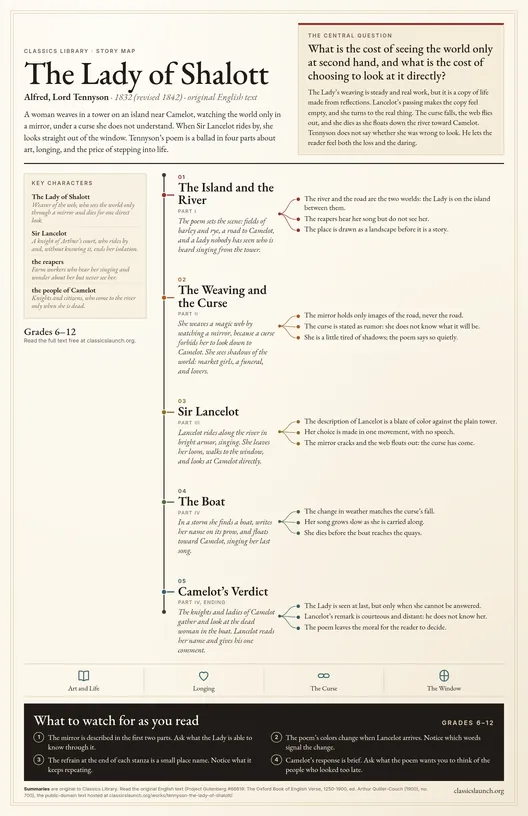 Story mapSee the story mapThe whole book on one page: the story in movements, the characters, and what to watch for. Free to print.
Abstract
Background. Tennyson first published the poem in 1832 and rewrote it for his Poems of 1842. It draws on the Arthurian story of Elaine of Astolat in Malory and on an Italian tale of the Donna di Scalotta.
Content. A lady lives on an island near Camelot and weaves a magic web, watching the world in a mirror because a curse forbids her to look at it directly. When Sir Lancelot rides by singing, she looks down to Camelot. The web flies out, the mirror cracks, and she floats down the river in a boat, singing her last song until she dies. Lancelot says she has a lovely face and prays that God will lend her grace.
Form. Four parts of nine-line stanzas with a fixed rhyme scheme and a refrain on Shalott and Camelot. The poem is a literary ballad with a fairy-tale narrator.
Themes. Art and life, isolation and desire, the cost of looking, the meaning of the curse and the role of the observer are the poem's chief themes, each left open to interpretation.
Significance. One of the best-known narrative poems of the nineteenth century and a favorite subject of painters. It invites students to weigh the claims of withdrawal and engagement.
Summary
The Lady of Shalott is a four-part ballad by Tennyson about a mysterious woman who lives on an island in a river that flows down to Camelot. He first published it in 1832 and thoroughly revised it for his Poems of 1842, the version hosted here. The story draws on the Arthurian legend of Elaine of Astolat and on an Italian tale about the Donna di Scalotta. In Part I the river runs through fields of barley and rye to many-tower'd Camelot, and on the island of Shalott four gray walls and four gray towers overlook a space of flowers. Reapers hear a song from the island but no one has seen the Lady. In Part II we learn that she weaves a magic web by night and day and that a curse is on her if she should look down to Camelot. She sees the world only as shadows in a mirror: the highway, the river eddy, the village-churls, market girls, funerals and lovers. She is half sick of shadows. In Part III the knight Sir Lancelot rides by, his armor flashing and his helmet and plume blazing, and singing Tirra lirra by the river. She leaves her web and her loom, makes three paces through the room, and looks down to Camelot. Out flew the web and floated wide; the mirror crack'd from side to side; the curse is come upon me, she cries. In Part IV she finds a boat beneath a willow, writes her name round the prow, and floats down the river through the night, singing her last song until she dies. At Camelot the knights and ladies come out to see the pale shape drift by, and Lancelot muses a little space and says she has a lovely face, and prays God in his mercy to lend her grace. The poem has been read as a fable of the artist who lives apart from the world and dies when she meets it, as a story of desire and its penalty, and as a picture of withdrawal that cannot last. It is a story of beauty and loss, and a Christian reader can also ask what it means to live in shadows when real life and real love call.
Virtues in this work
Plot or Argument
- Part I: The island and the river
The river runs to Camelot, and on an island in it is the unseen Lady, whose song the reapers hear.
- Part II: The web and the mirror
She weaves a magic web by night and day, forbidden to look at Camelot, and sees the world only as shadows in a mirror.
- Part III: Lancelot
A bright knight rides by singing Tirra lirra, and she leaves the loom to look down at Camelot; the web flies out and the mirror cracks.
- Part IV: The boat and the song
She floats down to Camelot in a boat bearing her name, singing until she dies, and Lancelot sees her face and prays for her.
Characters
- The Lady of Shalott, The weaver
A young woman who weaves day and night in a tower and sees the world only through a mirror, until she looks at Lancelot.
- Sir Lancelot, The knight
A bright, bold knight of Arthur's court who passes by and is the occasion of the Lady's looking.
- The reapers, Observers
Country people who hear her song but have never seen her.
Lessons
Withdrawal has a cost and so does leaving
The Lady lives safely but only in shadows. When she looks at the real world, she loses her art and her life. The poem refuses to say simply that one choice is right.
- What does the Lady gain and lose by weaving in the tower?
- Does the poem judge her for leaving, or pity her?
Art and life pull against each other
The poem has often been read as a story of an artist who must choose between making art and living. The question of what an artist owes the world remains open.
- How is weaving like making a poem?
- What does the mirror suggest about art?
The narrator's silence invites judgment
The poem never explains the curse or its source. Readers must decide what the curse means, and what the knights make of her at the end.
- What do you think the curse is?
- Why does Tennyson let Lancelot speak the poem's last words?
Context
Tennyson published the first version in his Poems of 1832; it was disliked by some critics, and he rewrote it for the Poems of 1842 with new stanzas and a changed ending. It is among his earliest Arthurian poems and belongs with his long concern for the Camelot story.
Composition
His sources include the story of the Maid of Astolat in Malory's Le Morte d'Arthur and an Italian novella, Donna di Scalotta. Tennyson told one friend that the poem concerned the new-born love for something in the wide world, but he did not offer a fixed meaning.
Reception
It became a favorite of the Pre-Raphaelite painters, including Holman Hunt, Rossetti and Waterhouse, and has been set to music and imitated often. It is among the best-known narrative poems in English.
Comparisons
- Le Morte d'Arthur
Malory tells the story of Elaine of Astolat at some length and with plain grief; Tennyson turns it into a symbolic ballad.
- Idylls of the King
Tennyson later retells the Elaine story in Lancelot and Elaine, with the Lady's mystery replaced by a plain tale of love and loss.
- Ode on a Grecian Urn
Keats's urn is a work of art that stands outside time; the Lady's web and mirror are images of art that cannot meet the living world.
- Kubla Khan
Both poems build a magic world that is closed to the ordinary one and touched by a threat from outside.
Quotes
Frequently cited
“On either side the river lie Long fields of barley and of rye, That clothe the wold and meet the sky;”
Frequently cited
“There she weaves by night and day A magic web with colours gay.”
Frequently cited
“Out flew the web and floated wide; The mirror crack'd from side to side; 'The curse is come upon me!' cried The Lady of Shalott.”
Frequently cited
“He said, 'She has a lovely face; God in His mercy lend her grace, The Lady of Shalott.'”
“'Tirra lirra,' by the river Sang Sir Lancelot.”
For Students
A reading companion for classical Christian high school students. See the student guide.
Reading Guide
Watch for
- The use of a repeated rhyme and refrain on Shalott and Camelot in each stanza.
- The difference between the world seen in the mirror and the world seen directly.
- How the mood changes from Part III to Part IV.
Key terms and names
- Ballad
- A story told in verse, usually in short stanzas, often with a refrain.
- Refrain
- A phrase repeated at set points, here the Lady of Shalott or Camelot at the end of each stanza.
- Camelot
- King Arthur's court, to which the river flows.
- Shalott
- The island home of the Lady, a form of Astolat, the place of Elaine in the Arthurian legend.
Seminar Questions
- Comprehension What is the curse, and what does the Lady do to bring it on herself?
- Comprehension What does the Lady see in her mirror, and what does she see when she looks directly?
- Interpretation Why does the poem end with Lancelot's words, and what do they suggest?
- Interpretation What might the web stand for, and why does it fly out when she looks?
- Big Question Is it better to live safely in shadows or to look at the real world, even at a cost?
- Big Question What does an artist owe to the world, and what does the world owe to the artist?
Faith Connections
- 1 Corinthians 13:12 (Scripture)
Paul writes that now we see through a glass darkly, but then face to face. The Lady sees through a mirror, and her fatal glance is a looking face to face that leads to death, which makes the verse an instructive contrast.
- Matthew 5:15 (Scripture)
Jesus says that no one lights a lamp to put it under a basket. The Lady's hidden work, unseen by those who hear her song, raises the question of what gifts are for.
Logic and Rhetoric
Central argument: The poem presents, by story rather than argument, a question about the cost of withdrawal from the world and the cost of entering it.
Rhetorical device: Symbol and refrain. The web, the mirror and the river are symbols whose meaning the poem leaves open, and the refrain of Camelot and Shalott ties each stanza to the central opposition.
Debate: Resolved: The Lady of Shalott is right to leave her loom.
Memory Work
Out flew the web and floated wide; The mirror crack'd from side to side; 'The curse is come upon me!' cried The Lady of Shalott.
On either side the river lie Long fields of barley and of rye, That clothe the wold and meet the sky;
Writing Prompts
Essay: Write an essay on what the web, the mirror and the river symbolize in The Lady of Shalott and how they shape our judgment of the Lady's choice.
Comparison with Ode on a Grecian Urn: Compare how The Lady of Shalott and Ode on a Grecian Urn imagine the relation of art to life.
Medical Lens
The poem does not address medical subjects.
Creative Prompts
- Essay
Argue what the curse means in the poem, and whether the Lady's choice is brave, foolish or both.
- Poetry
Write a ballad in four parts about a person who lives apart from the world until something calls them out.
- Classroom
Prepare a dramatic reading with one voice for the narrator, one for the Lady, and a chorus for the knights, and discuss the change in tone from part to part.
- Fiction
Retell the story from Lancelot's point of view, including what he saw and what he thought afterward.
Further Reading
- Le Morte d'Arthur, Book XVIII, Thomas Malory
The story of Elaine of Astolat, a principal source for the tale.
- Poems (1842), Alfred, Lord Tennyson
The two-volume collection with the revised text of the poem.
- The Lady of Shalott (painting, 1888), John William Waterhouse
A famous Pre-Raphaelite picture of the Lady in her boat.
- Alfred Lord Tennyson: A Memoir, Hallam Tennyson
Includes the poet's remarks on the poem's meaning.
Verification notes
The text follows the revised 1842 version as printed in The Oxford Book of English Verse (1900), no. 700, in Project Gutenberg #66619, and was not compared with a page image of the 1842 Poems. The sources named follow standard accounts. The remark about the new-born love is Tennyson's, as recorded in his memoir. Quotes were checked against the hosted text.
No verification flags recorded.