Work record
Buddenbrooks: The Decline of a Family
Thomas MannBuddenbrooks; Buddenbrooks: Verfall einer FamilieBuddenbrooks: The Decline of a Family by Thomas Mann (1901)Buddenbrooks is Thomas Mann's first novel, written when he was twenty-five and published in 1901, and the book for which he was chiefly honoured with the Nobel Prize in 1929.Also known as: Buddenbrooks · Buddenbrooks: Verfall einer Familie
1901 · Early 20th Century · Novel · German
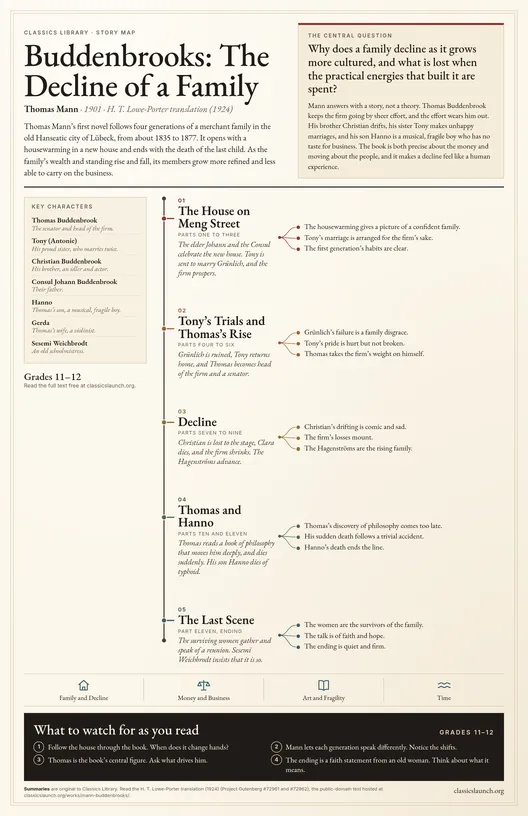 Story mapSee the story mapThe whole book on one page: the story in movements, the characters, and what to watch for. Free to print.
Abstract
Background. Mann wrote this book as a young man, drawing on the history of his own merchant family, and published it in 1901. It won him the Nobel Prize of 1929, the citation being chiefly for this novel.
Plot. Four generations of a Lübeck merchant family move from prosperity to decline. Thomas, the head of the firm, grows weary and dies suddenly. His son Hanno, a musician, dies of typhoid, and the firm is closed.
Ideas. The novel is a study of how appearances and business exhaust a family's vitality. It sets the philosophy of death against simple faith, and ends in an affirmation of reunion.
Text. The Lowe-Porter translation is in eleven parts. It has a translator's note, is very long, and has been criticised for errors and omissions. The hosted text is complete as printed here, with its section headings kept as a guide to the reader, and every quotation on this page is drawn directly from that text. Teachers can pair this work with the library's study guide, seminar questions and memory-work selection to prepare a discussion, a short essay or a recitation. The full text is hosted on this site, and each quotation in the guide has been checked against the hosted translation.
Main characters
- Thomas Buddenbrook: The elegant head of the firm
- Tony: His proud, unlucky sister
- Christian: A clownish, hypochondriac brother
- Hanno: Thomas's frail musical son
- Sesemi Weichbrodt: An old teacher of strong faith
Summary
Buddenbrooks is Thomas Mann's first novel, written when he was twenty-five and published in 1901, and the book for which he was chiefly honoured with the Nobel Prize in 1929. Its subtitle is 'The Decline of a Family'. It follows four generations of a merchant family in Lübeck, the old Hanseatic city, from about 1835 to 1877. The book opens at a housewarming in the new family house on Meng Street, where the elder Johann Buddenbrook, a man of the Enlightenment, jests with his son, the pious and earnest Consul Johann, and where the little girl Tony recites the catechism. It is a world of solid wealth, grain warehouses, Protestant piety and civic office. The novel's centre is the Consul's children. Thomas, the eldest, takes over the firm and becomes a senator, and his career is a long struggle to keep up the family's name. His brother Christian is a clown and hypochondriac who drifts away from business into the theatre and the club. Their sister Tony, vain, warm-hearted and proud, is married by the family to a fraud, Grünlich, who goes bankrupt, and later to a Bavarian, Permaneder, who leaves her, and each failure is a blow to her pride. The youngest sister, Clara, marries a pastor and dies. As the firm's fortunes dwindle and a rival family, the Hagenströms, rises, each Buddenbrook is poorer in vitality, as if the family had spent itself on the effort to keep up the surface. Thomas, whose elegance conceals exhaustion, reads a philosophical book by chance and experiences a brief revelation about death. He dies suddenly after a visit to the dentist, and his son Hanno, a gifted, frail musician who hates the business, dies of typhoid fever at fifteen. The firm is liquidated, and the book ends with the surviving women of the family, Tony, Clothilde and the old schoolmistress Sesemi Weichbrodt, speaking of a reunion in heaven. The novel is a patient study of how a family's energies are bent from business toward art and sensibility, and exhausted by the effort. It is also a book about faith and unbelief. Sesemi's last cry, 'It is so!', is Mann's answer to a long account of worldly success and its limits. Teachers should note that the work is extremely long, that it contains frank, if not graphic, treatment of illness, marital failure and death, and that the Lowe-Porter translation has been criticised for errors and omissions.
Virtues in this work
Plot or Argument
- Parts One to Three: The house on Meng Street
The elder Johann and the Consul celebrate the new house. Tony is sent to marry Grünlich, and the firm prospers.
- Parts Four to Six: Tony's trials and the rise of Thomas
Grünlich is ruined, Tony returns home, and Thomas becomes head of the firm and a senator.
- Parts Seven to Nine: Decline
Christian is lost to the stage, Clara dies, and the firm shrinks. The Hagenströms advance.
- Parts Ten and Eleven: Death of Thomas and Hanno
Thomas reads Schopenhauer-like philosophy and dies suddenly. Hanno dies of typhoid.
- The last scene
The surviving women speak of a reunion, and Sesemi insists that it is so.
Characters
- Thomas Buddenbrook, senator, head of the firm
An elegant, tired man who carries the family's reputation.
- Tony (Antonie), Thomas's sister
A proud, warm and naive woman who is twice married and twice disappointed.
- Christian Buddenbrook, brother
An actor and hypochondriac who is finally confined to an asylum.
- Consul Johann Buddenbrook, father
A devout merchant who clings to old ways.
- Hanno (Johann), Thomas's son
A sensitive, musical boy who has no taste for business.
- Gerda, Thomas's wife
A Dutch violinist who is distant and artistic.
- Sesemi Weichbrodt, schoolmistress
A tiny, hump-backed old teacher who has unshakeable faith.
Lessons
Worldly success can hollow out the soul
The Buddenbrooks keep their name and lose their vitality. Mann shows how a family can spend itself on appearances and inherit weariness.
- How does Thomas's life change between his youth and his death?
- What does Thomas's collapse suggest about the cost of keeping up appearances?
A motto of prudence
The old family motto, 'Attend with zeal to thy business by day, but do none that hinders thee from thy sleep by night', is a rule of prudent trade. The novel shows what happens when a family forgets the second half.
- What is the meaning of the motto?
- Which family member breaks it first?
Faith answers the problem of death
Thomas finds a momentary consolation in a philosophy of the death of the self; the old teacher has a simple Christian faith that answers it. Mann gives her the last word.
- What does Thomas believe he has learned about death?
- How does Sesemi answer the question of a reunion?
Context
Lübeck was a free city in the Hanseatic League and a major north German port. The novel covers the years from the 1830s to the 1870s, including the revolutions of 1848 and the German unification of 1871.
Composition
Mann wrote the book in 1897–1900, drawing on the history of his own family, who were merchants of Lübeck. It was published in two volumes in 1901 and became a popular success in the 1920s.
Reception
Buddenbrooks was admired as a masterpiece of realism and was the work named in the Nobel citation of 1929. The Lowe-Porter translation of 1924 introduced Mann to English readers.
Comparisons
- The Magic Mountain
Mann's later novel explores the same questions of death and the values of the bourgeois world.
- Tonio Kröger
Mann's story of the artist's relation to bourgeois society is a companion to the novel.
- Death in Venice
Another work by Mann in this library on the artist and the discipline of the middle class.
- The Brothers Karamazov
Dostoevsky's family novel is also a study of a family and the question of faith.
- Great Expectations
Dickens's novel also follows the fortunes of a family and the effects of money on character.
Quotes
Frequently cited
“My son, attend with zeal to thy business by day; but do none that hinders thee from thy sleep by night.”
Frequently cited
“But now Sesemi Weichbrodt stood up, as tall as ever she could. She stood on tip-toe, rapped on the table; the cap shook on her old head. “It _is so_!” she said, with her whole strength; and looked at them all with a challenge in her eyes. She stood there, a victor in the good fight which all her life she had waged against the assaults of Reason: hump-backed, tiny, quivering with the strength of her convictions, a little prophetess, admonishing and inspired.”
“This is the revelation: that I shall live! For _it_ will live--and that this _it_ is not I is only an illusion, an error which death will make plain.”
For Students
A reading companion for classical Christian high school students. See the student guide.
Reading Guide
Watch for
- How each generation relates to money, religion and art.
- The role of illness and the body.
- Each scene of a family meal or celebration.
Key terms and names
- Consul
- An honorary title given to a merchant who serves as consul for a foreign state; here it marks Johann Buddenbrook's status.
- Hanseatic League
- The medieval league of north German trading cities, of which Lübeck was a leader.
- Senator
- A member of the city's governing council.
- Bildungsbürgertum
- The educated middle class of Germany; the Buddenbrooks belong to its commercial branch.
Seminar Questions
- Comprehension What is the Buddenbrook motto, and who wrote it?
- Comprehension What happens to Tony's two marriages?
- Interpretation Why does Mann call the book 'the decline of a family'?
- Interpretation What does Thomas experience in Part Ten?
- Interpretation Why does Mann give Sesemi the last word?
- Big Question Can worldly success be a form of loss?
- Big Question What kinds of inheritance are passed on in a family?
Faith Connections
- Matthew 16:26 (Scripture)
'What does it profit a man to gain the whole world and forfeit his soul?' The question lies under the whole novel.
- Ecclesiastes 1:2 (Scripture)
'Vanity of vanities.' The Buddenbrooks' striving ends in loss.
- Augustine, City of God, Book XIX (Great Conversation)
Augustine's account of the restless search for earthly peace parallels the family's search.
Logic and Rhetoric
Central argument: A family that pours its energies into appearances and business exhausts the very qualities that made it strong, and is left with only faith for consolation.
Rhetorical device: leitmotif. Mann repeats details, such as Thomas's teeth and the family book, to link the fates of different generations.
Debate: Resolved: That the decline of the Buddenbrooks is caused by their own choices and not by fate.
Memory Work
My son, attend with zeal to thy business by day; but do none that hinders thee from thy sleep by night.
But now Sesemi Weichbrodt stood up, as tall as ever she could. She stood on tip-toe, rapped on the table; the cap shook on her old head. “It _is so_!” she said, with her whole strength; and looked at them all with a challenge in her eyes. She stood there, a victor in the good fight which all her life she had waged against the assaults of Reason: hump-backed, tiny, quivering with the strength of her convictions, a little prophetess, admonishing and inspired.
Writing Prompts
Essay: How does Mann use the contrast between Thomas and Hanno to criticise the middle-class ideal?
Comparison with Tonio Kröger: Compare Hanno's relation to art and the family with Tonio Kröger's.
Medical Lens
The decline of the family is shown as a physical as well as a social process: bad teeth, nervous exhaustion, and early death. Hanno's typhoid and Christian's confinement are described with period medical detail.
- Part Ten
Thomas's sudden death after a dental extraction.
- Part Eleven
Hanno's fatal illness, a typhoid fever described step by step.
- Part Eleven
Christian is confined to an asylum.
Creative Prompts
- Essay
How does Mann trace the decline of the Buddenbrooks through their bodies as well as their business?
- Dialogue
Write a conversation between Tony and Thomas on the question of what they owe the family name.
- Classroom
Discuss the final scene: whose view of death does Mann endorse, and how can you tell?
Further Reading
- The Magic Mountain, Thomas Mann
Mann's later novel, hosted in this library.
- Tonio Kröger, Thomas Mann
Mann's story of the artist and bourgeois society, hosted in this library.
- Death in Venice, Thomas Mann
Mann's novella, hosted in this library.
- Thomas Mann: A Biography, Ronald Hayman
A biography of the author.
Verification notes
Full text from Project Gutenberg #72961 and #72962, H. T. Lowe-Porter's translation (Knopf, 1924; the hosted text is the 1927 printing), in public domain in the United States because published before 1931. Quotes were checked against the hosted text. The translation has been criticised for omissions.
- Whether the hosted 1927 printing is textually identical to the first printing of February 1924.
- Which of the Buddenbrook ancestors wrote the motto.