Work record
The Magic Mountain
Thomas MannDer ZauberbergThe Magic Mountain by Thomas Mann (1924)The Magic Mountain is Thomas Mann's great novel of ideas, a book that takes up the large questions of Europe before the First World War through the story of one ordinary young man.Also known as: Der Zauberberg
1924 · Early 20th Century · Novel · German
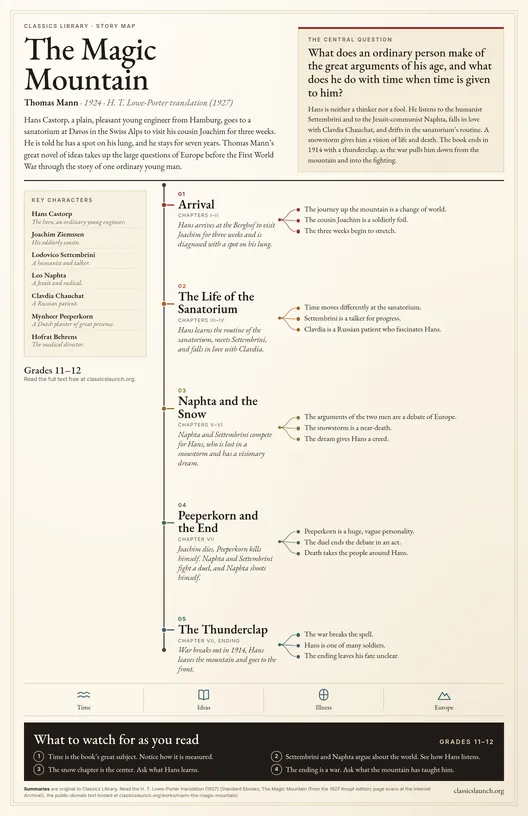 Story mapSee the story mapThe whole book on one page: the story in movements, the characters, and what to watch for. Free to print.
Abstract
Background. Mann began this novel in 1912 as a companion to Death in Venice and finished it after the war in 1924. It was a landmark of the century's fiction.
Plot. A young engineer goes to a sanatorium for three weeks and stays seven years. He is taught by an Italian humanist and a Jesuit radical, falls in love, has a dream in a snowstorm, and at last leaves for the First World War.
Ideas. The novel is a study of time, illness and death, and of the conflict of ideas in Europe. Its central idea is that death must not rule thought, for the sake of goodness and love.
Text. H. T. Lowe-Porter's English version of 1927 is in seven chapters with a foreword. The text is very long and often ironic. The hosted text is complete as printed here, with its section headings kept as a guide to the reader, and every quotation on this page is drawn directly from that text. Teachers can pair this work with the library's study guide, seminar questions and memory-work selection to prepare a discussion, a short essay or a recitation. The full text is hosted on this site, and each quotation in the guide has been checked against the hosted translation.
Main characters
- Hans Castorp: A young engineer from Hamburg
- Joachim Ziemssen: His soldier cousin
- Settembrini: An Italian humanist
- Naphta: A Jesuit radical
- Clavdia Chauchat: A Russian patient
- Peeperkorn: A Dutch planter
Summary
The Magic Mountain is Thomas Mann's great novel of ideas, a book that takes up the large questions of Europe before the First World War through the story of one ordinary young man. Hans Castorp, a Hamburg engineer, goes to the sanatorium at Davos in the Swiss Alps to visit his cousin Joachim Ziemssen for three weeks. He is a plain, pleasant and unremarkable person, and he finds himself caught by the hothouse life of the Berghof, with its rest-cures, five meals a day, thermometers and talk of illness. A doctor finds a 'moist spot' on his lung, and he stays. A visit of three weeks becomes seven years. During that time Hans is educated by the people around him. Lodovico Settembrini, an Italian man of letters and a champion of reason, progress and humanism, takes him as a pupil. Leo Naphta, a Jewish-born Jesuit with a taste for terror and for a communism of the spirit, argues against him with a brilliant, cruel logic. Hans is drawn to a Russian patient, Clavdia Chauchat, who reminds him of a boyhood schoolmate, and in the carnival night he speaks to her in French; later he meets her again with a Dutch planter, Mynheer Peeperkorn, a big, vague, magnetic man who is a force of life. Hans also learns the facts of the body from Dr. Krokowski's lectures on psychoanalysis and Hofrat Behrens's X-rays, and witnesses a séance in which the dead cousin appears. The chapter called 'Snow' is the summit: lost in a blizzard, Hans has a dream of a sunlit southern people who are gracious to one another and, behind a temple, of two old women tearing a child to pieces. He decides that he will not let death rule his thoughts. But the spell is not broken until the outbreak of war in 1914, which Mann calls the thunderclap. Hans comes down from the mountain and is last seen as a soldier in a muddy field of battle, singing a song of Schubert's. The novel is a study of time, sickness and death; of the conflict of reason and unreason in the soul of Europe; and of the wisdom Hans reaches in the 'Snow' chapter. It is long, slow, ironic and often comic. Teachers should note that it includes sexual feeling and a frank account of the body, a séance, two suicides, and prolonged argument about religion that is not always on the side of orthodoxy.
Virtues in this work
- Prudence: Hans learns to weigh competing ideas and not give himself to any one.
- Temperance: The novel is a long study of the body and its excesses.
- Friendship: Hans's loyalty to Joachim is a constant.
- Hope: The final question offers a hope that love will come from the war.
Plot or Argument
- Chapters I–II: Arrival
Hans Castorp arrives at the Berghof to visit Joachim for three weeks and is diagnosed with a spot on his lung.
- Chapters III–IV: The life of the sanatorium
Hans learns the routine of the sanatorium, meets Settembrini, and falls in love with Clavdia.
- Chapters V–VI: Naphta and the Snow
Naphta and Settembrini compete for Hans, who is lost in a snowstorm and has a visionary dream.
- Chapter VII: Peeperkorn and the end
Joachim dies. Peeperkorn kills himself. Naphta and Settembrini fight a duel and Naphta shoots himself.
- The thunderclap
War breaks out in 1914, Hans leaves the mountain and goes to the front.
Characters
- Hans Castorp, hero
A young Hamburg engineer who comes for three weeks and stays seven years.
- Joachim Ziemssen, cousin
A young soldier who longs to return to duty and dies on the mountain.
- Lodovico Settembrini, humanist
An Italian man of letters who believes in reason and progress.
- Leo Naphta, Jesuit
A brilliant, ascetic and cruel logician who argues for a radical spirit.
- Clavdia Chauchat, Russian patient
A woman with slanted eyes who fascinates Hans.
- Mynheer Peeperkorn, planter
A large, magnetic Dutchman who overpowers others by his presence.
- Hofrat Behrens, medical director
The sanatorium's cheerful, ironic chief physician.
Lessons
Time is a theme and a problem
Mann makes the reader feel time as Hans does, by compressing and expanding it. The novel is a long meditation on what time is and how it is lived in sickness and in health.
- How does the narration change the reader's sense of time?
- What does Hans learn about time at the sanatorium?
A man must choose between the voices that claim him
Settembrini and Naphta each speak for a view of man. Hans learns from both but is claimed by neither, until the war drags him out.
- What does Settembrini believe, and what is wrong with it?
- What does Naphta believe, and why does Hans reject it?
Death must have no sovereignty
In 'Snow', Hans decides that, for the sake of goodness and love, man shall let death have no sovereignty over his thoughts. It is the book's central idea.
- How does the dream in 'Snow' lead to the resolution?
- Does Hans keep the resolution?
Context
The novel is set in a tuberculosis sanatorium in Davos, Switzerland, from 1907 to 1914. Before antibiotics, rest and mountain air were the standard treatment for tuberculosis, and sanatoria were also social worlds.
Composition
Mann began it in 1912 as a short companion to Death in Venice and the outbreak of war turned it into a long novel. He finished it in 1924 and Lowe-Porter's English translation appeared in 1927.
Reception
The book was a landmark of the twentieth-century novel and helped Mann win the Nobel Prize of 1929. It has been much read as a diagnosis of pre-war Europe.
Comparisons
- Buddenbrooks: The Decline of a Family
Mann's first novel treats the decline of a family; this one the sickness of a civilisation.
- Death in Venice
Mann's short novella shares the novel's theme of death and the attraction to it.
- Wilhelm Meister's Apprenticeship
The Magic Mountain is a modern Bildungsroman, and Mann often acknowledges Goethe's model.
- The Death of Ivan Ilyich
Tolstoy's story is a shorter study of illness and the meaning of death.
- Thus Spoke Zarathustra
Nietzsche's ideas are a background to the arguments of Settembrini and Naphta.
Quotes
Frequently cited
“For the sake of goodness and love, man shall let death have no sovereignty over his thoughts.”
Frequently cited
“Out of this universal feast of death, out of this extremity of fever, kindling the rain-washed evening sky to a fiery glow, may it be that Love one day shall mount?”
“An unassuming young man was travelling, in midsummer, from his native city of Hamburg to Davos-Platz in the Canton of the Grisons, on a three weeks’ visit.”
For Students
A reading companion for classical Christian high school students. See the student guide.
Reading Guide
Watch for
- How Mann plays with the time of the narrative.
- The arguments of Settembrini and Naphta, and Hans's reactions.
- Every mention of death, and the contrast with the life of the body.
Key terms and names
- Bildungsroman
- A novel of formation; Mann writes a modern, ironic one.
- Humanism
- A view that makes man and reason the measure of things, as Settembrini holds.
- Sanatorium
- A hospital for long-term care, here for the rest-cure of tuberculosis.
- Pneumothorax
- A treatment in which a lung is collapsed to rest it, mentioned in the novel.
Seminar Questions
- Comprehension Why does Hans go to Davos, and how long does he intend to stay?
- Comprehension What does Hans decide in the Snow chapter?
- Interpretation What is the point of the arguments between Settembrini and Naphta?
- Interpretation How does the war change the novel's tone?
- Interpretation Why does Mann end with a question?
- Big Question Is illness a school for the soul?
- Big Question What is the right relation of a person to death?
Faith Connections
- Psalm 90:12 (Scripture)
'Teach us to number our days that we may get a heart of wisdom.' The novel is a long meditation on days and wisdom.
- 1 Corinthians 15:55 (Scripture)
'O death, where is your sting?' Hans's resolution about death is a secular echo.
- Augustine, Confessions, Book XI (Great Conversation)
Augustine's meditation on time is a model for Mann's treatment of it.
Logic and Rhetoric
Central argument: A person must keep faith with the dead without letting death rule thought and action; the answer is love and goodness in life.
Rhetorical device: dialectic. Settembrini and Naphta argue opposed positions, each strong, and the reader, like Hans, must find the truth between them.
Debate: Resolved: That reason alone is sufficient guide for human life.
Memory Work
For the sake of goodness and love, man shall let death have no sovereignty over his thoughts.
Out of this universal feast of death, out of this extremity of fever, kindling the rain-washed evening sky to a fiery glow, may it be that Love one day shall mount?
Writing Prompts
Essay: How does the 'Snow' chapter resolve the conflict between Settembrini and Naphta?
Comparison with The Death of Ivan Ilyich: Compare Hans's relation to death with that of Ivan Ilyich.
Medical Lens
The sanatorium is a detailed picture of early twentieth-century treatment of tuberculosis, with temperature charts, X-rays, rest-cures and pneumothorax. Two characters die by suicide. The book is for older students and calls for teacher guidance.
- Chapters I–II
Hans learns the routine of the rest-cure, the measuring of temperature and the spot on the lung.
- Chapter V
Dr. Krokowski's lectures on psychoanalysis and love as a disease.
- Chapter VII
Joachim's death, the suicide of Peeperkorn and the suicide of Naphta.
Creative Prompts
- Essay
What does Hans learn from Settembrini and from Naphta? Who is nearer the truth?
- Dialogue
Write a conversation between Hans and Joachim about whether to stay or go.
- Classroom
Discuss how Mann uses the sanatorium to represent European society before the war.
Further Reading
- Buddenbrooks, Thomas Mann
Mann's first novel, hosted in this library.
- Death in Venice, Thomas Mann
Mann's novella, hosted in this library.
- The Death of Ivan Ilyich, Leo Tolstoy
A short story of illness and death, hosted in this library.
- Faust, Part One, Johann Wolfgang von Goethe
Goethe's drama of striving, a great model for Mann.
Verification notes
Full text from Standard Ebooks, set from the 1927 Knopf edition of H. T. Lowe-Porter's translation (CC0), in public domain in the United States because published before 1931. Quotes were checked against the hosted text.
- Whether the Standard Ebooks text restores any passages omitted in the 1927 printing.
- The exact division of the book into chapters in the hosted text.