Work record
The Queen of Spades
Alexander PushkinQueen of Spades; Pikovaya damaThe Queen of Spades by Alexander Pushkin (1834)The Queen of Spades is Pushkin's best-known prose tale, a short story of gambling, greed and a ghost.Also known as: Queen of Spades · Pikovaya dama
1834 · 19th Century · Novella · Russian
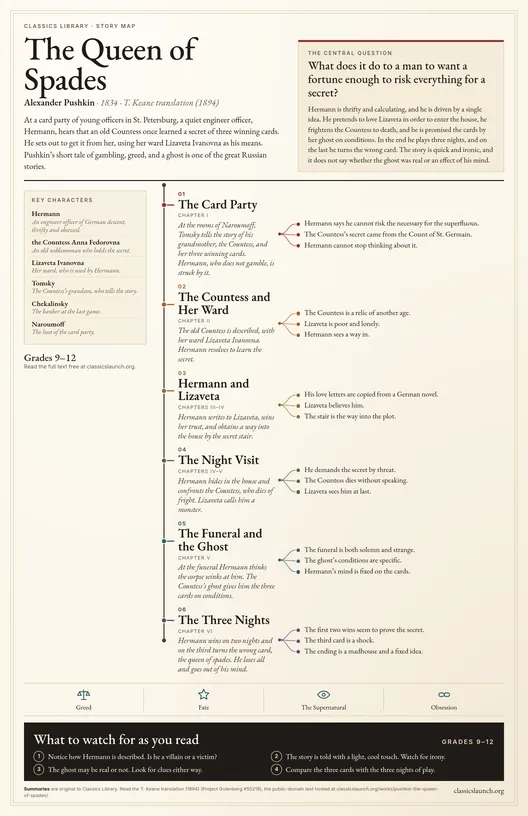 Story mapSee the story mapThe whole book on one page: the story in movements, the characters, and what to watch for. Free to print.
Abstract
Background. Pushkin wrote the tale in 1833 and published it in 1834. It became one of the best-known Russian stories, and gave a model for later tales of obsession.
Plot. A young officer hears of an old Countess who knows the secret of three winning cards. He seduces her ward to get into her house, frightens the old woman to death, and is visited by her ghost, who gives him the cards on conditions he breaks.
Ideas. The story is a short study in greed. It shows how one idea, when it rules a man entirely, drives out charity, prudence and memory. It also shows how the powerless are used.
Text. The Keane translation is plain and readable. The tale is short enough to read in one sitting and is a good first Russian story for older students. Teachers can pair this work with the library's study guide, seminar questions and memory-work selection to prepare a discussion, a short essay or a recitation. The full text is hosted on this site, and each quotation in the guide has been checked against the hosted translation.
Main characters
- Hermann: A cold, ambitious officer
- The Countess: An old woman who holds a secret
- Lizaveta: Her poor ward
- Tomsky: The grandson
- Chekalinsky: The banker
Summary
The Queen of Spades is Pushkin's best-known prose tale, a short story of gambling, greed and a ghost. It begins at a card party at the rooms of Naroumoff of the Horse Guards, where the young officers play all night. One guest, Hermann, an officer of German descent, watches the play and does not take part: he is not in a position, he says, to sacrifice the necessary in the hope of winning the superfluous. His friend Tomsky tells the company of his grandmother, the old Countess Anna Fedorovna, who once lost a fortune at cards in Paris and was given a secret by the Count of St. Germain, by which she played three cards in a row and won back all she had lost. Hermann is struck by the story, and it becomes his one idea. He learns that the old Countess keeps a young ward, Lizaveta Ivanovna, a poor and unhappy girl who is treated as a servant. Hermann pretends to love her, writes to her, and persuades her to let him into the house by the secret staircase. He hides in the Countess's room, and when the old woman returns from a ball he comes out, begs her to give him the secret, and finally draws his pistol. The Countess dies of fright, without a word. Lizaveta, who realises what has happened, tells Hermann that he is a monster, and he answers, coolly, that he did not wish for the old woman's death and that his pistol was not loaded. At the Countess's funeral Hermann thinks that the corpse winks at him. That night the old woman's ghost visits him and says that three, seven and ace will win for him, one card in twenty-four hours, and only on condition that he never plays again and that he marry Lizaveta. Hermann plays the first night with a three and wins, the second with a seven and wins. On the third night he sees that he has staked the queen of spades, not the ace, and the queen seems to smile at him. He loses everything and goes out of his mind. In the last lines he is confined in the Obukhov Hospital, in room 17, muttering ‘Three, seven, ace’ and ‘Three, seven, queen’, while Lizaveta has married a good man and Tomsky has risen in the army. Pushkin wrote the story in 1833 and published it in 1834. It is a work of great economy, and it has become the model of the Russian story of obsession. For students, it is a study of how a single idea, when it rules a man completely, drives out affection, decency and prudence, and of how the poor and the powerless are used. The hosted Keane translation of 1894 is a plain and faithful rendering.
Virtues in this work
- Temperance: Hermann's economy is a counterfeit of temperance; his greed turns it to its opposite.
- Prudence: Hermann's cleverness is not prudence; he destroys himself by it.
- Charity: Lizaveta is the one person who shows charity, and she is the one who is least rewarded in the story.
- Justice: The story shows that gains from violence do not endure.
Plot or Argument
- Chapter I: The card party
At the rooms of Naroumoff, Tomsky tells the story of his grandmother, the Countess, and her three winning cards. Hermann, who does not gamble, is struck by it.
- Chapter II: The Countess and her ward
Tomsky's grandmother, the old Countess, is described, together with her ward Lizaveta Ivanovna. Hermann resolves to learn the secret.
- Chapters III–IV: Hermann and Lizaveta
Hermann writes to Lizaveta, wins her trust, and obtains a way into the house by the secret stair.
- Chapter IV–V: The night visit
Hermann hides in the house and confronts the Countess, who dies of fright. Lizaveta calls him a monster.
- Chapter V: The funeral and the ghost
At the funeral Hermann thinks the corpse winks at him. The Countess's ghost gives him the three cards on conditions.
- Chapter VI: The three nights
Hermann wins on two nights, and on the third turns the wrong card, the queen of spades. He loses all and goes out of his mind.
Characters
- Hermann, the gambler
An officer of German descent, cold, economical and ambitious, who is suddenly ruled by a single idea.
- The Countess Anna Fedorovna, the old Countess
A proud, peevish old woman of eighty-seven who was a beauty in Paris and still keeps the fashions of her youth.
- Lizaveta Ivanovna, the ward
A poor, shy young woman, who is treated as a dependent and who loves Hermann in the hope of escape.
- Tomsky, the grandson
A young officer who tells the story of his grandmother and sees nothing of the harm it will do.
- Chekalinsky, the banker
The dealer at the great gaming table, polite and courteous, who deals the last card.
- Naroumoff, the host
The officer at whose house the story begins.
Lessons
The ruling idea
Pushkin's phrase that two fixed ideas cannot exist together in the moral world shows how a single obsession pushes out everything else, even the memory of the woman Hermann has killed. This is a short study of how a vice grows into a tyranny.
- How does Hermann change after the Countess tells him the three cards?
- What does the narrator say about two fixed ideas?
The poor are used
Lizaveta is the one person in the story who is cheated out of everything and who is not responsible for any of it. Hermann uses her as a key. The reader should notice how her feeling, her loneliness and her hopes are made instruments of his plan.
- How does Hermann treat Lizaveta?
- What does Lizaveta understand after the Countess dies?
Mercy and judgement
The Countess's ghost forgives Hermann and sets a condition, and he disobeys it. The story does not tell us whether the cards are a gift or a snare, but it makes clear that the way he uses the gift is his own.
- What does the ghost require of Hermann?
- Why does Hermann mistake the queen for the ace?
Context
The story is set in St. Petersburg in the 1830s, among young officers of the Guards who played cards for large sums. Gambling was common in the Russian aristocracy, and Pushkin himself played and lost. The Count of St. Germain, who appears in Tomsky's tale, was a real adventurer of the eighteenth century who claimed to have occult powers.
Composition
Pushkin wrote the story in the autumn of 1833 at his family estate of Boldino and it was published in 1834. The hosted translation, by T. Keane, was published in Bohn's Standard Library in 1894 under the title The Prose Tales of Alexander Poushkin.
Reception
The story was an immediate success in Russia and has been one of the most admired of all Russian tales. Tchaikovsky's opera of 1890 is based on it.
Comparisons
- The Gambler
Dostoevsky's novella is another Russian study of the passion for play and of how it breaks a man.
- Crime and Punishment
Raskolnikov, like Hermann, kills an old woman for money and goes mad; Dostoevsky was a keen reader of this tale.
- The Overcoat
Another Petersburg tale, with a ghost and a victim of the system.
- The Captain's Daughter
Pushkin's longer prose work, a historical romance of honour and mercy.
- Eugene Onegin
Pushkin's novel in verse, in which a man of the same city and world makes a cold choice.
Quotes
Frequently cited
“Play interests me very much,” said Hermann: “but I am not in the position to sacrifice the necessary in the hope of winning the superfluous.”
Frequently cited
“I have come to you against my wish,” she said in a firm voice: “but I have been ordered to grant your request. Three, seven, ace, will win for you if played in succession, but only on these conditions: that you do not play more than one card in twenty-four hours, and that you never play again during the rest of your life. I forgive you my death, on condition that you marry my companion, Lizaveta Ivanovna.”
Frequently cited
“Two fixed ideas can no more exist together in the moral world than two bodies can occupy one and the same place in the physical world.”
“Economy, temperance and industry: those are my three winning cards”
“You are a monster!” said Lizaveta at last. “I did not wish for her death,” replied Hermann: “my pistol was not loaded.”
“Hermann started; instead of an ace, there lay before him the queen of spades!”
“He never answers any questions, but he constantly mutters with unusual rapidity: “Three, seven, ace! Three, seven, queen!”
For Students
A reading companion for classical Christian high school students. See the student guide.
Reading Guide
Watch for
- How Hermann speaks of money and of the cards before he hears the story.
- How Lizaveta is treated by the Countess and by Hermann.
- What the ghost says of the conditions, and what Hermann does.
Key terms and names
- Faro
- A card game in which punters stake on cards against a banker; the game at the end.
- Ward
- A young person who lives in a household under the care of an older guardian, as Lizaveta does.
- Obukhov Hospital
- The St. Petersburg hospital where Hermann ends; named in the story as 'Oboukhoff'.
- Countess
- A noblewoman of high rank; here the old Anna Fedorovna.
Seminar Questions
- Comprehension What is the secret of the three cards?
- Comprehension What are the ghost's conditions?
- Interpretation Why does Hermann not simply win honestly? What does the story say about his character?
- Interpretation How does Pushkin use the supernatural in the story?
- Interpretation Why does Hermann turn the queen in place of the ace?
- Big Question Is Hermann punished by the cards or by his own mind?
- Big Question What does the story say about money and the desire for it?
Faith Connections
- 1 Timothy 6:9–10 (Scripture)
'Those who desire to be rich fall into temptation... For the love of money is a root of all kinds of evils.' Hermann is a clear example.
- Luke 12:15–21 (Scripture)
The parable of the rich fool is a gloss on a man who wants to secure his future by a single stroke.
- Exodus 20:13 (Scripture)
Hermann's cold answer, 'I did not wish for her death', is a case of the commandment not to kill read in the heart.
Logic and Rhetoric
Central argument: A single dominating desire, followed without regard to others, destroys the person who follows it, even when the means seem to be supernatural.
Rhetorical device: repetition. The refrain 'Three, seven, ace' repeats until it rules Hermann's mind, as the narrator says it drove out everything else.
Debate: Resolved: That greed is a kind of madness.
Memory Work
Two fixed ideas can no more exist together in the moral world than two bodies can occupy one and the same place in the physical world.
I have come to you against my wish,” she said in a firm voice: “but I have been ordered to grant your request. Three, seven, ace, will win for you if played in succession, but only on these conditions: that you do not play more than one card in twenty-four hours, and that you never play again during the rest of your life. I forgive you my death, on condition that you marry my companion, Lizaveta Ivanovna.
Writing Prompts
Essay: Show how the repeated phrase 'Three, seven, ace' tells the story of Hermann's mind.
Comparison with The Gambler: Compare the treatment of gambling as a passion in Pushkin and Dostoevsky.
Medical Lens
The story ends with Hermann in room 17 of the Obukhov Hospital, answering no questions and muttering the cards: a plain nineteenth-century picture of an obsession that becomes a delusion. The Countess dies, apparently of fright, when a pistol is drawn on her.
- Chapter IV, the Countess's death
The old Countess dies of shock when Hermann threatens her.
- Chapter VI, the fixed idea
Hermann's mind is taken over by the three cards; he sees them in every figure and speaks of them in all conversation.
- Conclusion, room 17
Hermann is confined in the Obukhov Hospital and mutters the cards.
Creative Prompts
- Essay
How does the story show that Hermann is ruled by an idea? Give three details from Chapter VI.
- Fiction
Write the scene of Lizaveta after Hermann leaves her room, at dawn, from her point of view.
- Classroom
Debate: Is Hermann responsible for the Countess's death? Argue from the text.
- Essay
Does the ghost's offer help or harm Hermann? Consider the conditions she sets.
Further Reading
- Eugene Onegin, Alexander Pushkin
Pushkin's novel in verse; hosted in this library.
- The Captain's Daughter, Alexander Pushkin
Pushkin's historical novel; hosted in this library.
- The Gambler, Fyodor Dostoevsky
A later study of the same passion; hosted in this library.
- Pushkin: A Biography, T. J. Binyon
A thorough modern life of the poet.
Verification notes
Full text from Project Gutenberg #55219, T. Keane's translation (1894, the 1916 Bell printing), public domain. One obvious typographic corruption in the hosted source ('out 01 ms mind') was corrected to 'out of his mind'. Quotes were checked against the hosted text. The Boldino composition date, the opera, and the background on St. Germain are standard reports and are not verified here.
- Date and place of composition (Boldino, autumn 1833).
- Tchaikovsky's opera of 1890.