Work record
Mary Stuart
Friedrich SchillerMaria Stuart; Mary Queen of Scots (Schiller)Mary Stuart by Friedrich Schiller (1800)Mary Stuart is Schiller's tragedy of the last three days of Mary, Queen of Scots, and of the Queen of England who sent her to the block.Also known as: Maria Stuart · Mary Queen of Scots (Schiller)
1800 · 19th Century · Drama · German
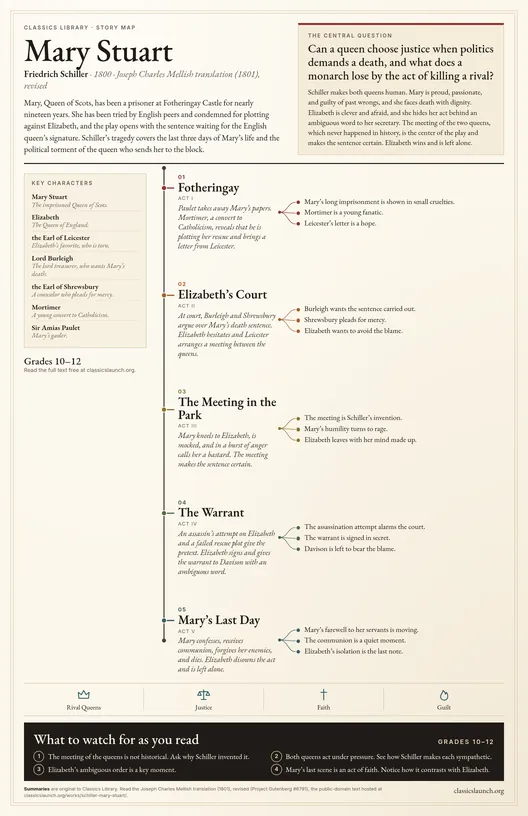 Story mapSee the story mapThe whole book on one page: the story in movements, the characters, and what to watch for. Free to print.
Abstract
Background. Schiller wrote this tragedy in Weimar in 1799 and 1800, soon after Wallenstein. It was first staged there in June 1800 and is still a repertory piece in Germany and abroad.
Plot. A queen long imprisoned at Fotheringay is condemned. In an invented meeting she angers her rival, who signs the warrant in a way that allows her to deny it. The prisoner dies at peace, having confessed and forgiven.
Ideas. The play contrasts the freedom that comes from repentance with the bondage of policy. It asks whether pride, expedience and fear can ever be reconciled with justice, and what a ruler owes to conscience.
Text. Mellish's translation of 1801, revised in a nineteenth-century edition, is in blank verse, with some bracketed passages that were in his source but not in the printed play. The acts are of unequal length. The hosted text is complete as printed here, with its section headings kept as a guide to the reader, and every quotation on this page is drawn directly from that text. Teachers can pair this work with the library's study guide, seminar questions and memory-work selection to prepare a discussion, a short essay or a recitation. The full text is hosted on this site, and each quotation in the guide has been checked against the hosted translation.
Main characters
- Mary Stuart: Queen of Scots, condemned prisoner
- Elizabeth: Queen of England
- Leicester: A double-dealing favourite
- Burleigh: Elizabeth's stern treasurer
- Shrewsbury: An honest counsellor
- Mortimer: A young convert and would-be rescuer
Summary
Mary Stuart is Schiller's tragedy of the last three days of Mary, Queen of Scots, and of the Queen of England who sent her to the block. Mary has been a prisoner at Fotheringay Castle for nearly nineteen years. She has been tried by a commission of English peers and condemned for plotting against Elizabeth, and the play opens with the sentence awaiting only the queen's signature. Her gaoler, Sir Amias Paulet, is a stern Puritan; her nurse Hannah Kennedy and her steward Melvil are loyal; and a young convert to Catholicism, Mortimer, has come in secret to tell her that he will free her by force. The drama then pivots on a scene that Schiller invented and that never happened: the two queens meet in a park. Leicester, who is Elizabeth's favourite but secretly Mary's friend, has arranged it. Mary begins by kneeling and pleading, but Elizabeth's cold contempt breaks her, and she turns on her rival, calling her a bastard and a usurper. The meeting makes her death certain. An attempt on Elizabeth's life by a fanatic, and a plot of Mortimer's to storm the castle, supply the pretext. Mortimer, found out, kills himself. Leicester betrays Mortimer and Mary alike to save his own place. Elizabeth, who has spent the play weighing law, public opinion and her own safety, signs the warrant and hands it to her secretary Davison with an order so vague that it can be disowned. Burleigh takes it and carries out the sentence at once; Elizabeth then blames Davison and sends him to the Tower. Mary, meanwhile, has used her final hours to make a confession, to receive communion from Melvil, who has secretly become a priest, and to forgive her enemies. She goes to the scaffold calm, while Elizabeth, victorious, is left alone with the loss of her best counsellor Shrewsbury and of Leicester, who has fled to France. The play invites comparison of two kinds of power: the queen who is free by the law but a prisoner of opinion and fear, and the prisoner who is bound by the law but made free by repentance. Teachers should note a scene of Catholic confession and Eucharist and an offstage execution; the play is sympathetic to Mary but does not hide her faults.
Virtues in this work
- Humility: Mary is brought low by prison and by her own faults and learns to ask forgiveness.
- Magnanimity: She pardons the sovereign who kills her.
- Justice: Shrewsbury urges that Mary be judged by law and not by expedience.
- Fortitude: Mary goes to the scaffold calm and prepared.
- Honor: Shrewsbury refuses to continue serving a queen who shifts the blame to a subordinate.
Plot or Argument
- Act I: Fotheringay
Paulet takes away Mary's papers. Mortimer, a convert to Catholicism, reveals that he is plotting her rescue and brings a letter from Leicester.
- Act II: Elizabeth's court
At court, Burleigh and Shrewsbury argue over Mary's death sentence. Elizabeth hesitates and Leicester arranges a meeting between the queens.
- Act III: The meeting in the park
Mary kneels to Elizabeth, is mocked, and in a burst of anger calls her a bastard. The meeting makes the sentence certain.
- Act IV: The warrant
An assassin's attempt on Elizabeth and a failed rescue plot give the pretext. Elizabeth signs and gives the warrant to Davison with an ambiguous word.
- Act V: Mary's last day
Mary confesses, receives communion, forgives her enemies and dies. Elizabeth disowns the act and is left alone.
Characters
- Mary Stuart, title heroine
Queen of Scots, a prisoner in England for nineteen years, whose pride at first masks her guilt, and whose faith ripens as death nears.
- Elizabeth, queen of England
Ruler of England, shrewd and vain, whose fear of public opinion makes her an instrument of her own policy.
- Earl of Leicester, favourite
A courtier who wears two faces and loses both loyalty and honour.
- Lord Burleigh, lord treasurer
Elizabeth's stern minister, who believes that state security justifies Mary's death.
- Earl of Shrewsbury, counsellor
The one honest counsellor, who resigns when Elizabeth lets the execution proceed.
- Mortimer, young convert
A passionate young man, nephew of Mary's gaoler, who joins a plot to free her.
- Sir Amias Paulet, gaoler
A rigid Puritan whose sense of duty keeps him from mercy.
Lessons
Repentance can free a prisoner from within
Mary begins as a proud queen who will not admit any fault. Schiller lets her recognise her old sins, accept a punishment she does not strictly deserve for the crime charged, and forgive her enemy before she dies.
- What sins does Mary confess to Melvil?
- In what sense is she freer than Elizabeth at the end?
Policy without conscience leaves a ruler alone
Elizabeth is the winner of the contest, and Schiller leaves her with no friend and no clean conscience. She disowns her order, blames Davison and loses Shrewsbury and Leicester.
- Why does Elizabeth give the warrant to Davison in the way she does?
- What does Shrewsbury mean when he says he could not save her nobler part?
Anger can destroy a good cause
Mary's insult in the park costs her whatever hope she had. Schiller shows the cost of pride even where the grievance is real.
- What provokes Mary to call Elizabeth a bastard?
- Is her outburst a fault or an act of integrity?
Context
Mary, Queen of Scots, fled to England in 1568 and was held by Elizabeth I for nearly nineteen years. She was tried for complicity in the Babington plot and beheaded at Fotheringay Castle on 8 February 1587.
Composition
Schiller wrote the play in 1799–1800, soon after finishing Wallenstein, and the first performance took place at Weimar on 14 June 1800. The meeting of the two queens is his invention, since the two never met.
Reception
The play was admired for its stage craft and for Schiller's balance between the two queens. It has remained a repertory work and inspired Donizetti's opera Maria Stuarda.
Comparisons
- The Life of Friedrich Schiller
Carlyle's life of Schiller discusses the play within the story of the poet's last years.
- Macbeth
Both plays follow a ruler to a crime and the loneliness it brings, though Elizabeth's guilt is of policy and not of ambition.
- Julius Caesar
Both plays turn on the question of when state security can justify the death of a rival.
- Saint Joan
Shaw's play also stages a woman condemned by a court whose motives are partly political.
Quotes
Frequently cited
“My heart was filled with thoughts of envious hate, And vengeance took possession of my bosom. I hope forgiveness of my sins from God, Yet could I not forgive my enemy.”
Frequently cited
“I pardon her my death; most humbly, too, I crave her to forgive me for the passion With which I spoke to her.”
“I am a queen, like you: yet you have held me Confined in prison.”
“God suffers me in mercy to atone, By undeserved death, my youth's transgressions.”
“'Tis little I have done: I could not save Your nobler part. Live--govern happily! Your rival's dead! Henceforth you've nothing more To fear--henceforth to nothing pay regard.”
For Students
A reading companion for classical Christian high school students. See the student guide.
Reading Guide
Watch for
- How each of the two queens speaks about law and about her own conscience.
- What each character wants Elizabeth to do with the warrant.
- The moments when a character in power is forced to look at what he has done.
Key terms and names
- Fotheringay
- The castle in Northamptonshire where Mary was held and executed.
- Warrant
- The document, here signed by Elizabeth, authorising Mary's execution.
- Confession
- The Catholic sacrament in which a penitent tells his sins to a priest; Mary makes it before her death.
- Usurper
- One who seizes a throne that is not rightly his; each queen accuses the other of this.
Seminar Questions
- Comprehension What does Elizabeth say to Davison when she hands him the warrant?
- Comprehension What does Mary confess, and what does she refuse to confess?
- Interpretation Why does Schiller invent a meeting that never took place?
- Interpretation How does Mary change between Act III and Act V?
- Interpretation Why does Shrewsbury resign?
- Big Question Is a ruler responsible for what her ministers do in her name?
- Big Question Can a person be guilty in one way and innocent in another?
Faith Connections
- Matthew 6:14–15 (Scripture)
Jesus teaches that those who forgive others will be forgiven. Mary's last message to Elizabeth is an example.
- Psalm 51 (Scripture)
David's prayer of repentance gives the pattern of Mary's confession.
- Augustine, City of God (Great Conversation)
Augustine contrasts the glory of earthly rulers with the peace of those who fear God, as Schiller does with his queens.
Logic and Rhetoric
Central argument: A ruler who keeps power by expedience pays with inner loneliness, while a prisoner who repents is freed.
Rhetorical device: dramatic irony. The audience knows that Elizabeth's vague order to Davison is meant to be denied, while Davison does not.
Debate: Resolved: That Elizabeth was justified in executing Mary Stuart.
Memory Work
God suffers me in mercy to atone, By undeserved death, my youth's transgressions.
I pardon her my death; most humbly, too, I crave her to forgive me for the passion With which I spoke to her.
Writing Prompts
Essay: How does Schiller make Mary's last day an answer to the question of what freedom is?
Comparison with Macbeth: Compare Elizabeth's isolation after the execution with Macbeth's after Duncan's murder.
Creative Prompts
- Essay
Compare Mary's last speeches with Elizabeth's last scene. Which queen has more freedom, and why?
- Dialogue
Write a conversation between Shrewsbury and Elizabeth the morning after the execution, in which he explains his resignation.
- Classroom
Divide the class to argue for Burleigh and Shrewsbury before Elizabeth on whether Mary should die.
Further Reading
- The Life of Friedrich Schiller, Thomas Carlyle
Carlyle's biography, hosted in this library.
- William Tell, Friedrich Schiller
Schiller's later play on resistance and its limits, hosted in this library.
- Wallenstein, Friedrich Schiller
Schiller's historical trilogy on loyalty and ambition.
- Mary Queen of Scots, Antonia Fraser
A modern biography of the Scottish queen.
Verification notes
Full text from Project Gutenberg, Joseph Mellish's English translation (1801) as revised in a nineteenth-century edition, in public domain. Quotes were checked against the hosted text. Historical details are standard; Mary's meeting with Elizabeth is Schiller's invention.
- Exact identity and date of the revising editor of the nineteenth-century text.
- Whether the bracketed passages are Mellish's own.